
Earlier this week two activists made something of a splash when they removed controversial carved images from a church in Rome and tossed them into the Tiber River. Subsequently, Catholic social media has been flooded with commentary about the controversy. Who or what were these images depicting? Was it the Blessed Virgin (an early theory later rejected by a Vatican spokesperson); was it a “simple representation of life” in Amazonian art, or was it a “pagan idol,” specifically Pachamama? And the men who did this tossing—were they thieves, stuntmen, or heroes? An anonymous video showing the Tiber toss was uploaded to You-tube and has since been watched by thousands; some with concern and dismay, some with wild cheering.
The action comes during the Synod on the Amazon being held in Rome, which itself is stirring significant controversy, particularly from many who fear that it will be used as an occasion to change church teaching. Cries of racism have also arisen from both right and left. The left is accusing the right of rejecting Amazonian symbols and culture because they “aren’t white enough”; the right is claiming that the left is patronizing the Amazonian people by “watering down” church practices.
It is not the first controversy for our church. The centuries have been filled with contention and crises and wars against the church from within and without.
In times of discord, of scandal, of challenged faith, what is a faithful Catholic to do?
In today’s Gospel Jesus tells His disciples “Do you think I have come to spread peace? No, I tell you, but rather division.” One might think His word is being fulfilled!
But looking closer at today’s Gospel, we see both the real desire of Jesus, and the response He desires from us in the wake of scandal. “I have come to set the earth on fire, and how I wish it were already blazing!”
In these times, more than ever, we must pray.
It is not enough to be a chorus of curses against the darkness. We must BE light. A lightbulb on its own is useless—it gives light only when it is plugged into a source greater than itself. We too must receive from a genuine and literal Higher Power.
Prayer is not merely petition, not merely giving voice to our anger or anxieties. Rather it is to sit in the presence of God, to become one with Him, to learn His mind and His heart and receive His Spirit so that we might bring Him to others.
Our mission is to be conduits of grace to the world. If a stone statue of an idol can bring harm, how much more can a living vessel of the Holy Spirit bring good?
To offer anything less than Jesus is a tragedy. Certainly if apparent idols are presented in the church as alternatives to God, that is a grave scandal. But who do people encounter when they meet us? What are we offering through our lives? In my experience both “outsiders” and we ourselves are much more scandalized by the selfishness, hypocrisy, apathy of any individual professed Christians. We must ask ourselves, when people meet us, who or what do they encounter?
The first work of the Christian is to pray, to become and do the good that God asks of us as individuals.
I do not say this as an excuse to avoid the struggle against evil, to avoid taking sides. Rather, I say that we must not limit that fight to the evil in others.
As Aleksandr Solzhenitsyn writes: “If only there were evil people somewhere insidiously committing evil deeds, and it were necessary only to separate them from the rest of us and destroy them. But the line dividing good and evil cuts through the heart of every human being. And who is willing to destroy a piece of his own heart?”
That something other than Jesus might be worshipped, that something other than His Mother be honored as ours, is indeed disturbing. But what idols need to be exorcised from our own hearts?
Who do people encounter when they meet us?
Every conversion I have ever heard or read about has been born of encounter and attraction. Sometimes a direct encounter with God, often, first, an encounter and attraction through the life of a Christian. Always it is a movement toward some good, toward joy, toward peace, toward love.
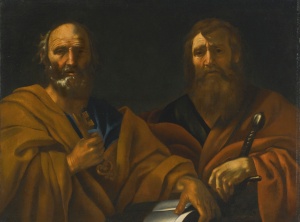 Paul has perhaps the most famous conversion story of all time,
  Paul poured himself out until he was empty, an open vessel in which Christ could dwell. It was then that God’s grace worked in him most fully, supplying him with a transcendent strength to persevere in his mission. The words Jesus once spoke to Peter apply to Paul, too: “For flesh and blood has not revealed this to you, but my heavenly Father.” Peter and Paul both found their strength in weakness, by being receptive to divine revelation, allowing God to take control. Peter was particularly changed after receiving the Holy Spirit at Pentecost—before that moment, he was cowering in the upper room, but upon receiving those graces, he immediately stepped out in courage.
 A few weeks earlier, Peter had stood outside the courtyard of the high priest, weeping bitterly. He had disowned Jesus not once, not twice, but three times, just as Jesus had predicted. Peter was filled with grief when he realized what he had done: despite the fact that he had vowed to stand by Jesus in every possible trial, despite his complete devotion, he had buckled at the first bit of pressure and cast aside the One who meant everything to him.
 Yes, there will be consequences for defending Christ. But there are worse consequences for denying Him. We can’t allow the possible reactions of others to distance us from the Source of all joy and love, as though their approval were the real key to our happiness. And in fact, we might be surprised at others’ openness to our faith—it might end up being a point of connection between us.
 Our God is a God of second chances. How tender Jesus was to Peter, to grant him this moment: He set the scene over again, with a charcoal fire burning just as there was in the courtyard of the high priest, and asked Peter three times, “Do you love me?” And three times, Peter was able to reply, “Yes, Lord, you know that I love you.” He was given a second chance, a do-over of the worst mistake he’d ever made. Jesus saw Peter’s sorrow and contrition, and in His mercy He stepped in to restore the relationship. Not only that, but He entrusted the Church to Peter as the first pope. He cast Peter’s sins as far as the east is from the west, giving him a fresh start. He does this for us, too. No matter how badly we’ve messed up, he will give us another chance if we’re willing to try again—and, this time, to call upon His help to guide us.
 Frassati Reflections