Do You Still Not Understand?

Tomorrow another Lenten season begins. Last year, the season seemed markedly different from previous Lents. The world was in the grip of a pandemic and people everywhere were forced to give up more than what they ever considered as a Lenten sacrifice. Despite what appeared to be insurmountable odds, followers of Christ endured 40 days, hoping the time of trial caused by the pandemic would end quickly. Unfortunately, a whole year later, we are still under its control and face another Lent that will require greater than usual sacrifice.

The question this year is what will this Lent bring and how should we approach it? After an entire year of suffering, can we persevere through another 40 days?

Many people have lost loved ones in this pandemic. Many are in despair, wondering when or if it will ever end. Hope is harder to hold onto when there seems to be no end in sight. However, this is not the first time the world has been asked to wait on the Lord. Noah, for example, had to wait much longer than we have for his period of trial to end. Years passed with no sign of progress outside the ark, yet Noah continued to stay true to the Lord and kept his faith.

Times of suffering are not meant to break us but to strengthen us. This is why Lent is such an integral part of our Catholic liturgical year. When we participate in this period of going without, we are entering into Christ’s own passion. Christ came into the world to die, making the greatest sacrifice possible. Although we may never be able to experience exactly what Jesus went through before Calvary, we can try to imitate Him in this penitential season, asking Him to enter our hearts and provide us with the strength not to give up.

In today’s Gospel, Jesus questions His disciples, “ Do you still not understand?” Perhaps He is now asking us the same question. We have undergone a year of incredible pain and the conditions that caused it remain. Most people are hoping for an end to these trials, but that might not be what we should be seeking. God may want us to look deeper into the current situation of our world. Suffering is a key part of being human and what brings us closer to God. Do we still not understand?

A Distorted World Will Be Made Right

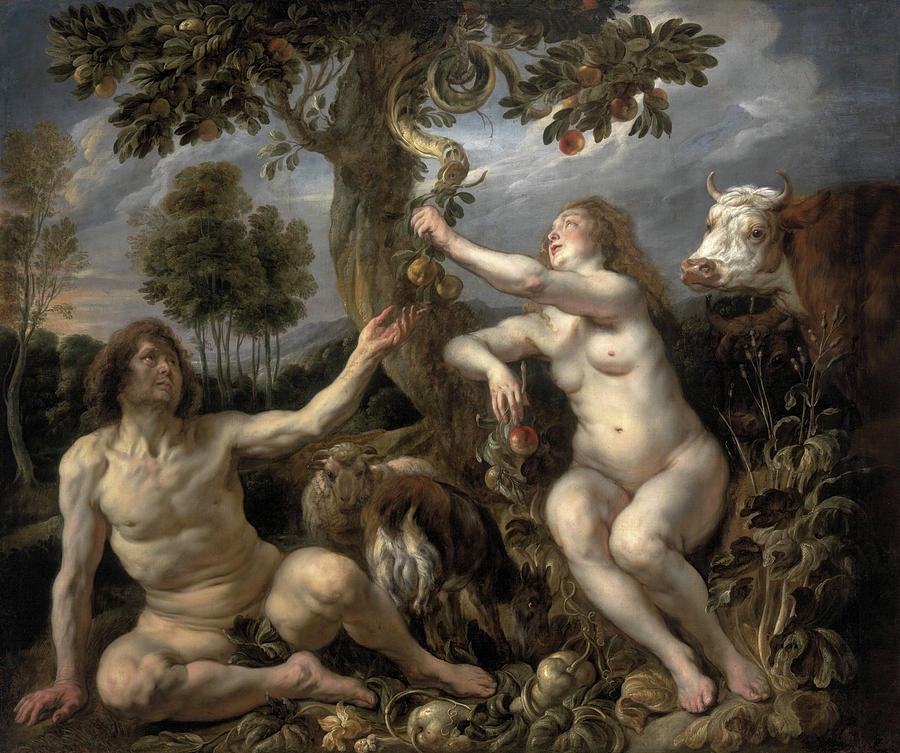
During the last few days the liturgy has taken us to the very beginning of creation, through the garden, and meeting Adam and Eve. So much happens in those first three chapters of the Bible. The maker of heaven and earth forms mankind in his image out of love and shows loving mercy after mankind’s disobedience, promising that things will be alright. Chapters 1-3 from the book of Genesis are short, but go back and read them slowly and prayerfully.

In today’s first reading Adam and Eve ate of the forbidden fruit, disobeying God and falling from grace. The serpent had asked the woman, “Did God really tell you not to eat from any of the trees in the garden?” The woman answered that they could eat of any fruit in the garden except the fruit from the tree of knowledge of good and evil because if they did eat of that fruit, or touch it, they would die. Now, I read Genesis many times and each time I read it I kept overlooking what Eve had said, that they could not eat the fruit or even touch the fruit, lest they die. Who told Eve this?! That wasn’t the original instruction that God gave to Adam in Gen 2:17! No where did God say that touching the fruit would kill them. Clearly there was some miscommunication going on between Adam and Eve. The serpent took advantage of this miscommunication by enticing Eve telling her that certainly she wouldn’t die by touching the fruit. The serpent deceived her into thinking that God didn’t love her. And having the fruit in her hand, touching it and not having died, doubt began to grow.

How could this happen after all the good things that God had given them? How could Eve doubt God’s love after He had created a beautiful paradise for them and given them literally everything in the world? How could Adam stand by and not say anything? All God created was good. The serpent came along and distorted everything that was good, casting doubt in the true love of God. That’s what the evil one does, he takes things that are good that the Father has given us and bends, twists, and deforms it. Suddenly this thing that was originally created to be good is now bad.

Finding pleasure in the taste of food may be distorted to having an eating disorder. Having a causal beer with friends may be distorted to build up into a drinking problem. Enjoying the company of another person may be distorted towards the path of promiscuity. Now I want to make clear that food, drink, and sex are not bad things. God created things that are good and only good. But, the serpent stands nearby and cunningly asks us, is that thing that you’re holding really bad? Then we start looking at those things that were once good as a means to an end in themselves. We start to doubt that God ever loved us and now we focus and try to find happiness in food, drink, and sex. Not realizing that our happiness is by God’s side.

In the Gospel reading, Jesus healed a deaf and mute man by looking up into the heavens and saying Ephphatha! Be opened! Let us ask Jesus to heal our ears and open up our hearts so that we may better listen and follow the Lord, our God. Pray for strength in fighting against the tactics of the evil one. God created all things good and by remembering in God’s merciful love we will be free from doubt and not be silent in times of need (as Adam was when he needed to speak up). Guided by the Holy Spirit may we listen to God, speak His good name, and show His love to others.

We live in a distorted world, but God promises that a distorted world will be made right because He made it to be good.

Image Credit: Adam and Eve by Jacob Jordaens [Public Domain]

Humility

Jesus went to the district of Tyre.
He entered a house and wanted no one to know about it,
but he could not escape notice.
Soon a woman whose daughter had an unclean spirit heard about him.
She came and fell at his feet.
The woman was a Greek, a Syrophoenician by birth,
and she begged him to drive the demon out of her daughter.
He said to her, “Let the children be fed first.
For it is not right to take the food of the children
and throw it to the dogs.”
She replied and said to him,
“Lord, even the dogs under the table eat the children’s scraps.”
Then he said to her, “For saying this, you may go.
The demon has gone out of your daughter.”
When the woman went home, she found the child lying in bed
and the demon gone.

Mk 7:24-30

I’ve been Catholic for a while now. But today’s Gospel reading—from my experience at least—has been among the most misunderstood of all Gospel passages. At least to me it is simply based on “anecdotal evidence.” This event in the Gospels is termed as the exorcism of the Syrophoenician woman’s daughter.

The Gospel passage is pretty simple. Jesus is running His ministry, goes to Tyre, enters a house, sees a woman whose daughter is possessed by demons; the woman pleads for relief for her daughter, Jesus appears to rebukes her first, the woman pleads again, the woman’s daughter is healed. In the midst of the miracles Jesus performs throughout His time on Earth, it’s a pretty run of the mill event: Jesus goes to a town, frees a woman’s daughter of demonic possession. A miracle, right? I’m often told by my non-Catholic friends this is an example of Jesus’ “unsympathetic” nature. “Why doesn’t Jesus just heal the woman’s daughter immediately!? Why make an allusion to a woman being a dog!?” It’s more complex than that.

I’m currently being trained as a Lay Dominican. (Then again, learning as a Lay Dominican and as a Catholic never ends. The journey of faith and towards sainthood is always present until death!)  I’ll be fully professed in August. We’ve recently had a discussion on the Bible and what are called “historical-critical” methods and how to read the Bible proper, especially as the Vatican doesn’t have a wholesale guide on how to read every *single* passage of the Bible. Believe it or not, the Vatican doesn’t! We of course have doctrines and traditions of the faith that mandate a certain reading of the Bible. And this is where one has to be careful of reading certain passages and letting our emotions get the best of us. I’ve heard plenty of individuals ask me, “Well, did this woman teach Jesus to be tolerant?” Well, no. Because to suggest otherwise would be to suggest Jesus lacks what is often called the “divine intellect.” This isn’t exactly new. We may have heard of “rogue” priests who say things that distort Church teaching, but this is a larger historical problem. And the Truth always prevails! Arius of Alexandria caused a scandal in the 4th century when he suggested Jesus was *not* the Son of the Father, but a “first” creature who became divinized and got a promotion. This scandal is often called “Arianism,” and historical figures as far as Isaac Newton believed it. Saint Nicholas, according to legend, once punched Arius for promoting this heresy. (Now, don’t go around doing this!)

That being said, how do we answer to some folks who claim Jesus in this Gospel is unsympathetic? 

Let’s break it down.  

First, it’s important to note that the woman called Jesus “Lord.” Not “sir.” “Lord.” Like many other individuals who come across Jesus, this woman knew and believed Jesus was the Son of David, God’s Son, the Lord, and the Messiah. This woman never met Jesus but knew and believed. Her faith was truly great, and so great, despite her despair at her daughter suffering for so long. She didn’t need signs to believe, and this woman was not a “doubting Thomas”; she truly believed through the thick and thin. No doubt she also heard of many stories of Jesus’ miracles—healing a leper. Healing a paralytic.

The woman’s faith will soon be tested. This is made all the more apparent if you read Matthew 15’s retelling of this event: “But He did not say a word in answer to her. His disciples came and asked Him, ‘Send her away, for she keeps calling out after us’” (Matthew 15:23). Imagine that! Asking Jesus, and Jesus simply does not respond. I am sure we have all felt this in prayer—not getting a response, and simply not getting the response we expect. Even Jesus’ disciples tell her to go away! Throughout history, and through the lives of the saints, we are given plenty of stories where their faith is tested, and they are rewarded. But can you imagine being at home and not getting a response during countless days of prayer? Sure. We all can. But this woman was in front of Jesus and His disciples! I’m often reminded of the story of Saint Bernadette of Lourdes who was mocked by the townspeople and insisted the grotto was where it was. Of course, she was proven right. This woman’s faith will also soon be rewarded.

Then Jesus says, “Let the children be fed first. For it is not right to take the food of the children and throw it to the dogs.” It’s this passage, my non-Catholic friends tell me, that makes Christ “unsympathetic.” This is where analyzing the language and context of the books of the Bible is important. This is especially the case as the Bible was, of course, not written in English. As some of you know, the Gospels were written in Greek. In Greek, there are two words for dogs: kunaria and kyon. Kyon refers to wild dogs, kunaria refers to dogs that are pets. Obviously, one term is more affectionate and endearing than the other. At that time, many people referred to the Canaanites as “wild dogs” (i.e.: kyon). (Tyre is a Canaanite region.) But Jesus refers to kunaria, or pets. The woman herself is not insulted and, in the original Greek of the Gospel passage, says, “Lord, even the [kunaria] under the table eat the children’s scraps.” In many ways, the woman used the word “pet” in a larger analogy: she already saw herself as a follower of Christ, in the same way a dog follows their master, or owner. And isn’t Jesus the Master? In many ways, this already rings true to me. All Dominicans are referred to as “hounds of the Lord.” (St. Dominic is often portrayed with a dog. St. Dominic legit is a saint whose intercession you should ask for if you’re a dog owner!)

This woman was not insulted; she was happy to think of herself as a member of Jesus’ household, one of His favorite pets! Jesus then immediately grants her prayer. These analogies aren’t terribly new throughout the Gospels, either: even at the Last Supper, Jesus refers to the twelve apostles as “children.” In this woman’s great humility, she was not insulted; she merely asked for anything. Of course, it is at this moment, the woman’s faith is rewarded and her daughter is free of demonic possession. What can we learn from this woman? She inspires us to persevere and place a childlike trust in Him. Jesus Himself says, “Great is your faith!” Do we place the same faith in Jesus when the times are rough? Do we give in to others who tell us to go away and not persevere in prayer? Ash Wednesday (and the start of Lent) is next week, and I often wonder if we’re all placing a childlike faith in Jesus. And is our faith as great as the Canaanite woman’s?

From the Heart

Jesus summoned the crowd again and said to them,
“Hear me, all of you, and understand.
Nothing that enters one from outside can defile that person;
but the things that come out from within are what defile.”

“But what comes out of the man, that is what defiles him.
From within the man, from his heart,
come evil thoughts, unchastity, theft, murder,
adultery, greed, malice, deceit,
licentiousness, envy, blasphemy, arrogance, folly.
All these evils come from within and they defile.”

—Mark 7:14–15, 20–23

In today’s Gospel reading, Jesus continues His rebuke against the Pharisees after they had criticized Him for eating with unwashed hands, thus breaking with the tradition of the elders. He calls our attention to the fact that while the Pharisees are concerned with the outward appearances of keeping tradition down to the smallest detail, their inner souls are utterly neglected, and they allow evil thoughts to fester within themselves. Jesus calls us to look at the state of our hearts, for everything else we do flows forth from there. If our hearts are corrupted, then it doesn’t matter how well we attempt to follow the letter of the law; the spirit of the law will be absent.

As we approach Lent, this is a good reminder for us that whatever we give up or take on during this penitential season, the most important thing is the intentions of our hearts. Wherever we create spaces in our lives by giving something up, we are called to make room for God in our lives instead of immediately filling them up with other distractions. And when we take on new habits of prayer and service, we must always orient them within our relationship with God, so that we don’t get caught up in a mindset of constant busyness and self-improvement but rather rely on God to form our hearts into the people He created us to be. We must understand that holiness is not something we can achieve on our own by following a list of instructions; rather, it can only occur through relationship with God, by His grace and in His timing.

Whatever we do, let it be rooted in a sincere love for God from the heart. This Lent, instead of simply making our own plans, let us pause to ask God what He wants us to do for Lent. Maybe He will surprise us; maybe He will confirm and bless the plans we are already making; but most importantly, He will delight to see us coming to Him first and foremost, looking for His guidance instead of relying on our own capacities.


1. Engraving by A. Wierix, Christ shooting arrows into the believer’s heart / CC BY 4.0
2. Engraving by A. Wierix, Christ clearing demons out of the believer’s heart with a broom / CC BY 4.0
3. Engraving by A. Wierix, Christ enthroned in the believer’s heart, venerated by angels / CC BY 4.0
These files come from Wellcome Images, a website operated by Wellcome Trust, a global charitable foundation based in the United Kingdom. Refer to Wellcome blog post (archive).

It Is Good

How easy it is to get lost in the details. How easy it is to become consumed by the day-to-day routine. How easy it is to lose sight of what is really important. It might be fair to say that many people do not even know how to discern what is really important. The Pharisees and the Jewish people living at the time Jesus was on earth were unable to understand the words they heard Him speak. They were comfortable with the traditions they had established for their faith. They focused on what they had been practicing for hundreds of years and this prevented them from remembering who God was and that He was love.

All humans and the traditions they cling to have the ability to overcomplicate new ideas and new truths. God is love–that is the simple truth and we can trust that completely. We can read the story of creation, which should show anyone the love of the Lord. God created the heavens and the earth and every last detail of our lives, and He saw that it was good.

Whenever we lose our ability to see God or become caught up in the unimportant matters that fill our lives, we should return to the story of God’s creation. It can be easy to forget that we are still living on the same earth God proclaimed “good”. We can be part of His creation just as we are, without worrying about maintaining the proper traditions or rules. We are like the disciples with unclean hands coming as they were to the table of Christ. God wants to be with us as we are because He made us that way. If we ever fall into despair wondering where God is, look at the water filled with the creatures of the sea or the sky filled with birds in flight. Look at the earth and see the plants growing and multiplying. God made all this and it is good. He made us in His image and likeness and saw that “it was good.” We can reflect on our world today, including ourselves and our brothers and sisters who share it, and see that it is still good.

He Is Coming

Today is the feast of the Presentation of the Lord in the temple. On this feast day, we remember the fulfillment of the Lord’s promise to His people in the Old Testament. He promised to send a savior to redeem them. The prophet Simeon, much advanced in years, served as an example for these people as well as for all of us living today. He was able to gaze on His Savior and with great faith, he proclaimed, “Now, Master, you may let your servant go in peace, according to your word, for my eyes have seen your salvation, which you prepared in the sight of all peoples: a light for revelation to the Gentiles, and glory for your people Israel.” Luke 2:28-32

While growing up, I read these stories in the Old Testament, telling of the long periods of waiting the Lord’s people were asked to endure. In Sunday school, I learned that we are the fortunate ones. We know that Jesus Christ has come and saved us from our sins. I thought I could never imagine what it was like to wait upon the Lord the way the Israelites had to. The tales of the Old Testament seemed as though they took place in a different world.

The reality is that we Christians today are also waiting. The Lord promised a second coming, and we currently have no idea when it will happen. In this present day, when the circumstances of our world appear more dire with each passing hour, we are called to read these passages from the Bible differently–not as stories of promises already fulfilled, but as messages of hope for the promise we believe will be fulfilled.

We can all be Simeons of our time. The Lord has given us hope of being able to have eyes that will behold our salvation, which He has promised us. Simeon recognized his Savior as a baby, but we will see Him coming in all His glory when He comes again.

Let the Light In Again

Jesus said to his disciples,
“Is a lamp brought in to be placed under a bushel basket
or under a bed, and not to be placed on a lampstand?
For there is nothing hidden except to be made visible; 
nothing is secret except to come to light. – Mk 4:21-25

I do not remember how I learned to “hide things” but I am sure, like many things, I first saw my parents do it. If something broke, went missing, didn’t go well “don’t tell so and so … they’ll get really mad.” The classic picking up the phone and an adult in the house urging you to say, “sorry they’re not home right now…” These events shaped me for school, where despite every teacher’s encouragement to say the truth and although the worst thing that could happen was a time out, the law of the playground stated “Snitches get stitches.” There is a profound fear in lies. White lies, small lies, and lies of omission …they all stem from fear.

My lies always came from the fear rejection. I struggle to be vulnerable to get close by not telling the whole story. I was afraid what others might say or think about me, sometimes I still am. Even when I went back to church in college, I would simply leave, wherever I was and say “bye guys I’m going to bed,” and I would go to mass (it was at 9pm on Sunday, hello college), without any details or invitations, for fear that people would know I was Catholic. People cannot know, they will make fun of me or think I am a crazy fanatic. At least that is what I told myself.  

Beyond that surface level fear, was the fear that I needed to end the double life. That if someone knew how much God wanted me, that I wanted God too, that I would be held to a certain standard. That I would be encouraged in my faith, be set apart and I would have to leave the darkness and live out my faith.  Vulnerability shouldn’t be a fear but it is. The people that I assumed would be making fun of me didn’t really know me. The end of the double life meant I would have to let myself be known.

It was and still is a long journey to not hide anymore. To live out my freedom. To let my yes be my yes, to say no. To set boundaries. To know there is nowhere to hide from God’s loving gaze, from his will for my life.  “Where shall I go from your spirit? Or where shall I flee from your presence… If I say “Let only darkness cover me, and the light about me be night,” Even the darkness is not dark to you, the night is bright as the day; for darkness is as light with you.”-Psalm 139 7, 11-12

Light of the world or a lamp, on a lampstand; imagine the work of His hands, hiding in fear. That is not the life that Jesus came to give us abundantly. So when I fail, when I lie, I go back into myself and find my Father in my dark room, and in the silence he meets me there, and I confess. And I confess again on some Saturdays and I try again to live out his will for my life.

Lord, thank you for the gift of confession. May we always seek to be reconciled to you and to our brothers and sisters. Teach us to live without fear and to lovingly encourage one another to let the light in again. Saint Thomas Aquinas, pray for us.

“I want to walk as a child of the light.
I want to follow Jesus.
God set the stars to give light to the world.
The star of my life is Jesus.
In him there is no darkness at all.
The night and the day are both alike.
The Lamb is the light of the city of God.
Shine in my heart, Lord Jesus.

William Holman Hunt, The Light of the World, 1851-52

God Wants a Family

My dad is a songwriter, and when I was in high school, he wrote one called “Jesus Wants a Family.” The chorus was simple…

“God wants a family,

He made you and me,

Jesus opens up the door,

And He brings us in,

This is what we’re aching for.”

Ever since I learned this song of my dad’s, I continue to find myself in situations that remind me of these lyrics. One of the main reasons its message continues to ring true is that God is always calling out, asking us to join in the communal family banquet. In the first reading, Paul echoes this invitation to bring everyone to the table. Everyone is welcome there and has a seat at this family table.

The beautiful miracle Jesus performed was to create one Church where all people, no matter what their skin color might be, circumcised or uncircumcised, or whatever their past faith might have been, share one common important truth. We are sons and daughters of God. In the Gospel, Jesus confirms this while He is sitting at a table; “Here are my mother and my brothers. For whoever does the will of God is my brother and sister and mother.” Mark 3:35

Jesus does make a single request–that we keep His word and go out to spread it to others. If we do not share the good news with others, there is no way God’s family can grow. Our Father longs for this large united family. In order to make it possible, we must play our part, especially today when so many in this world are in despair. God will reach out and open the door, ready to welcome everyone in.

Apostle of Life

The Gospel reading today tells of Jesus’ calling of his twelve apostles. He appoints these ordinary people to do extraordinary things in His name.  As Christians He calls us to do the same.  It may seem daunting to be called to do extraordinary things, though if we break it down we realize that the extraordinary often happens in the simple everyday moments and it is all centered in a heart that desires to know and be with God. 

Mark’s Gospel emphasizes three aspects of what it means to be Jesus’ Apostle – the Gospel writer says He appoints them “that they might be with Him,” be “sent forth to preach,” and “have authority to drive out demons” (Mk 3:14-15).

Reading this passage this week, it jumped out at me that the first description of Christian apostleship is to simply be with Him.  A relationship with Jesus Christ is the center of it all.  A friendship with Him.  Talking to Him about the things on our heart and asking Him to speak in turn to us.  Listening to His voice.  Receiving His love. This is what it means to be with Him.  The second call on the apostles is being sent forth to preach.  This may sound more daunting to some of us at first and we may think, well this was for the first apostles and certain Christians now… but not necessarily me, right?  But the truth is this call is on us and all followers of Christ, even if it looks different for different people. To preach is to witness and teach, and you probably do this much more than you realize in everyday interactions.  Mentioning to a co-worker that you went to Mass on Sunday, listening intently to a friend who needed someone, or waving and saying hello to a passing stranger even from behind your mask… all of these gestures done in Christ’s love can be a simple moment of preaching.  God will likely call each of us deeper into witnessing and teaching as relationship with Him deepens.  We may be asked outright about our faith, and even if we look back and see how we could have answered differently, our earnest attempts to share our experience of Christ’s love are valuable moments of preaching and witnessing.  God wants to give us wisdom to witness lovingly, humbly, and confidently to our faith.  The more we deepen our relationship with Him in prayer, Scripture, community and fellowship, the sacraments, the more confidence we will gain in witnessing to the love of God we have encountered.  His love will embolden us.

The third aspect of Christian apostleship is the “authority to drive out demons” in Christ’s name.  Okay, talk about daunting again! In the literal sense of Scripture, Christians are indeed called to drive out demons and bring the incredible gift of freedom and healing to those enslaved. When Christ and His apostles drive out demons they are freeing a soul from evil, bringing a soul from darkness to light. While there is a definite time and place for those who are called to specifically drive out demons, we are all called to act in the authority of Christ’s name and encourage people out of the darkness of evil and sin into the light of faith. The third call of apostleship is a call to faith in action. If we are faithful to the first two calls of apostleship (and when we aren’t faithful, we confess our unfaithfulness, receive God’s grace that is new with each day, and get ourselves turned back to Him!)… anyway, as we sink into the first two calls of being with Him and being a living witness of our faith, the third call to act in faith will flow from the first two. Great miraculous healing can happen in many ways.  Hearts can be opened and lives can be changed by an encounter with God’s love in a moment.  And we can be instruments of these miracles without even knowing. Serving in any form is an act of faith, and of course we have a special call to serve the poor and those in need.    Being a living witness of Christ’s love, bringing His light to others opens hearts and changes lives.  If we are rooted in prayer, He will show us what this looks like for each of our lives.

Today in our Catholic Church calendar is a Day of Prayer for the Legal Protection of Unborn Children.  Today, I want us to reflect on this call of apostleship and ask the Lord how we can be an apostle for Life.  Being a witness to the dignity of human life from conception to natural death is an integral call of our time and it is a mission that can again seem daunting.  But I want us to remember the call of apostleship that Mark gives us today and apply these same steps to our Mission for Life.  First step – prayer, by which we can understand God’s heart for every unborn child, every pregnant mother, every expecting father.  I am writing this with my second child in my womb, 23 weeks pregnant.  His or her squirms and kicks remind me of the whole human life going on independently of my will right within my body – it’s a miracle!  I can also understand the very real and urgent fear of a mother who doesn’t have the support she deserves.  Motherhood is a sacrifice.  A physical, emotional, financial, and personal sacrifice – but a pouring out of yourself that brings the deepest joy and fulfillment. We must strive to understand God’s heart on this because we will not get far in speaking to others about it otherwise.  We can never speak on this without putting ourselves in the shoes of a pregnant mother who thinks she doesn’t have another choice.  We must strive to understand and listen.  And when we are called to the second step of apostleship in this, being sent forth to preach, we must speak the truth with the Lord’s compassion. Our third apostleship call is to drive out demons in Christ’s name. There are faithful priests doing incredible work to bring light to the darkness and demons of abortion.  How are we called to bring light to this place of great darkness? This is what I hope we can each pray about today.  How am I called to act in Christ’s name for the mission of protecting unborn life?  We can pray, we can financially support organizations for women in crisis pregnancies, we can educate ourselves on the facts of pregnancy and the history of the legalization of abortion, and we can volunteer at local life centers, educating ourselves by getting to know women who are actually living the experience of a crisis pregnancy.  (At the end of this post I included a list of ways that people can support life that I found inspiring and helpful this week.) 

I have been tempted many times to feel hopeless in our current culture for unborn life.  It can be tempting to think we can’t do anything to help.  But those are lies that distract us from the fact that we are not powerless, God does change hearts, and there are many ways we can act in faith and in love for the women, men, and unborn children at risk of the devastating harm of abortion.  This is not an easy call, but it does not need to be as daunting as we think.  With God all things are possible (Mt 19:26).

God has called you, my dear sister or brother.  He has called me.  And he has appointed us to be His apostles now. At this exact moment in history and in the place he has us. How is He calling each of us to be an apostle of life? 

Lord, show us the way.   

Kindness and truth shall meet;
justice and peace shall kiss.
Truth shall spring out of the earth,
and justice shall look down from heaven.

Psalm 85:11-12

Icon of the Visitation

Some practical ways to support unborn life:

His Covenant Forever

The Lord is incapable of lying; throughout the Old Testament we hear of how He kept His covenants with His people. The Lord continues to make unbreakable covenants with us today. “When God made the promise to Abraham, since he had no one greater by whom to swear, he swore by himself, and said, ‘I will indeed bless you and multiply you.’ And so, after patient waiting, Abraham obtained the promise.” Hebrews 6:13

The Lord swore by Himself to ensure and emphasize that He would never break the bonds He has created between Himself and His creatures. These covenants that were first established in the Old Testament continued in the New Testament with Jesus, the ultimate fulfillment of these covenants. However, the road to salvation has not been easy, and even after the coming of Jesus Christ, we current pilgrims still have a difficult road to follow if we want to enter His kingdom. We are still in a fallen world, and still waiting on the Lord.

Noah was asked to be patient in undertaking the task God set for him, and so were Abraham, Moses, David and so many others throughout the Old Testament. God makes grand and wonderful promises but they involve long waiting periods. Today, we are waiting, but in a sense, we are more fortunate than our ancestors because we already have the promise of salvation fulfilled by Jesus, although we remain in this fallen world for as long as the Lord wills. While we wait, it is easy to become distracted and disregard the divine promises. When life becomes more trying than ever with pandemics, riots, and elections consuming our waking moments, the reassurance of our Lord can be swept away as we crave swift relief from these tribulations. The true and best relief remains with the Lord in His covenant.

“The sabbath was made for man, not man for the sabbath. That is why the Son of Man is lord even of the sabbath.” Mark 2:28

The Lord understands that patience is hard, and the waiting He requires seems endless. But He has promised that it will end, and when it does, the result will be unimaginably wonderful. During our time of waiting, we can find hope and comfort in the Son of Man (and God) who is also our Lord and our Savior.