It is often difficult to remember what we are truly meant to do on earth. We were not created for this earth; we were created for the kingdom of Heaven. From that perspective, our earthly lives are spent in a waiting “room” until we are called to return to the home of our heavenly Father. However, we were not made to simply sit idly by until our time to go to Heaven arrives. God is always calling us to a higher purpose, and if we seek the kingdom of Heaven on earth, the riches of Heaven will appear far greater than we can ever imagine. What we do in this life prepares us for the next, but more importantly, it is who we are that can transform us into the people we are meant to be as we enter into the kingdom of Heaven.
“I consider that the sufferings of this present time are as nothing
compared with the glory to be revealed for us.
For creation awaits with eager expectation
the revelation of the children of God.”
—Romans8:18–19
As we wait upon the Lord, we are filled with great hope. Living the life of a child of God means to live life in anticipation, always living in the hope of the grace to come, knowing that by living this life devoted to Christ, we will inherit His kingdom.
Saint Teresa of Calcutta was a perfect example of living in constant hope. Mother Teresa adopted a spirit of gratitude. She endured all the deprivations of grave poverty, yet she never lost her smile and always radiated joy. She could do this because she recognized every good thing, no matter how small, that the Lord placed in her life and she gave thanks for it. Through this act of thanksgiving, she lived each day in anticipation of the kingdom of Heaven.
For the kingdom of Heaven is like a mustard seed “that a man took and planted in the garden. When it was fully grown, it became a large bush and the birds of the sky dwelt in its branches” (Luke13: 18–19).
Through each action of kindness and love, we can contribute to the kingdom of Heaven. With every expression of gratitude, we strengthen our hope in the promises the Lord has given to us of what is to come.
In the beginning, God created the heavens and the earth. The earth was without shape and God formed it and gave it life. He created light, land, vegetation, animals. He separated the waters and created the moon and the stars. God created mankind and gave us dominion over all the earth: to fend for it, take care of it, and use it according to our needs. Over the many years of mankind’s existence we have learned many things about the earth: how to cultivate food, that it’s warm when the sun is out and cool at night, that different animals migrate throughout seasons, that clouds bring rain. All this and more we have learned, and we’ve used it to grow and prosper in our societies. All thanks to God.
In today’s Gospel Jesus is saddened by the crowds because they do not know what time they are in; they don’t know who He is or why He is amongst them. Jesus reminds the crowds that they can easily tell when the earth is changing, when a cloud rises in the west and it brings rain or when the wind blows from the south and it’s hot. God created the earth; the signs that they interpret are God’s signs which He created so long ago. How come it’s so difficult to see God standing before them now and acknowledge Jesus’ miracles which are happening among them in the present time?
It is easy to only see what we want to see.
It is easy to only hear what we want to hear.
I read and think about the crowd in today’s Gospel and I think, how could they not realize the Son of God is among them?! But then I look at myself—how many times did I ignore the signs God gave me? Too many. I have walked down busy streets, I’ve gotten on the subway, and I have sat at my own dining table ignorant of all the signs God gives me of His presence. Signs to remember His commandments, signs to be kind and loving to my neighbors, signs that He loves me. I’ve chosen to be blind and deaf.
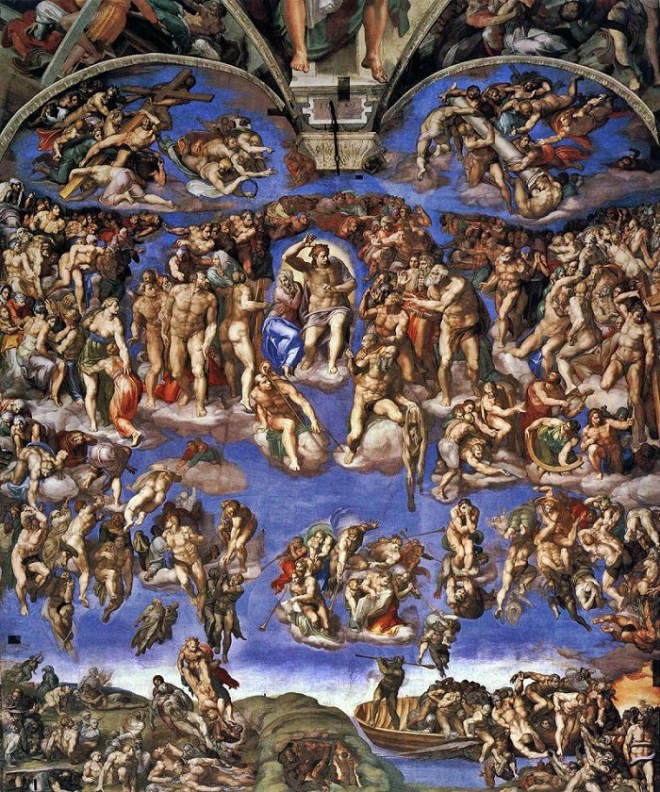
The crowds from the Gospel had missed the sign that God was giving them: it’s time to ask for forgiveness. Jesus is urging the crowds to choose what is right—following God—and asks them to repent. It’s important to ask for forgiveness not only from God but also from anyone to whom we might have done wrong. Jesus tells us that if we are in opposition with someone, we should work to resolve the matter on our own in good faith. If we still bicker and cannot soften our hearts to resolve the matter, a court (a higher power) would rule a decision over us, and the judge may throw us in prison. How much worse is this than if we were to settle things on our own? Friends, this is a clear depiction of Judgment Day. If we die in a state of unrepented sin, we risk our souls going to hell. What a terrible outcome this is! My heart breaks at the possibility that anyone’s soul would forever be separated from God the Father, who loves us so much.
Jesus will come again at the second coming, Judgment Day. But as we wait for Him, there are many signs we should be aware of in the 21st century. We live in a broken world where we will be tempted. People will try to deceive us. Our love for God will be tested. In the first reading, Saint Paul is telling the Romans that the law of man is not equal to the Law of God. By following the law of man alone, we are hurting our relationship with God and giving in to sin. Only God’s grace through Jesus Christ can help us repair that relationship.
As you go about your day and encounter different procedures, policies, regulations, rules—think for a moment: are these things of the world bringing me closer to God, or are they keeping me away from His saving grace? We must be able to see and hear the Word of God in order to do what is righteous now, in the present time.
Image credit: The Last Judgment in the Sistine Chapel by Michaelangelo. [Public Domain]
“If you want me to go another round I will; but, if I’m being honest I don’t want to.” As I silently prayed, the stubborn resistance softened as tired tears rolled silently down my cheeks. I saw the bloodwork. I knew before she called. It would be another protocol, another experiment that hopefully is not mere trial and error. Obviously, there is enough reason to hope. But when you’ve ridden the roller coaster of almost and maybes, it’s natural for there to be a hesitation. The cloud of disappointment can shadows one’s willingness to try again.
What areas of your life are darkened by previous disappointments? Where are you challenged to see the reality that the Lord works all things out for the good of those who love Him? How can we bravely begin again? On the feast of JPII, may we imitate the Holy Father who persevered in trial emphatically reminding us “we are not the sum of our weaknesses but rather of the Father’s love for us”.
Rejection is part of life; everyone has experienced it to some extent. It is easy to take rejection and give in to depression, allowing the rejection to influence our lives in an intensified depressed state. What we must remember is that rejection is just as significant in the Lord’s plan for our lives as the successes we encounter in our lives. The path Jesus Christ followed here on earth was determined by rejection. In the passage from the Gospel of Luke for today, He is rejected by the Samaritans, one of the few times in the gospels that Samaritans were actually portrayed in a negative light. Although the disciples want to rebuke the Samaritans, Jesus moved on towards Jerusalem. Jesus knew His fate and that a greater rejection awaited Him on the cross. The rejection of the Samaritans was a sign to Him of what was to come.
As Christians, we are not promised an easy journey through life. If we truly want to follow the path of Jesus, we have to expect rejection, but we should not take on negativity–quite the opposite. With every rejection, we should challenge ourselves to look for the will of God. What is God trying to tell me? What can I learn from this? Rejection can sometimes be seen as a “roadblock” keeping us from what we want to do and where we want to go. It may be a roadblock, but it might be blocking us from what we believe is the right direction but in reality is not the best way for us to follow. Embrace these rejections and move forward, confident that the Lord kept you from taking the wrong path.
“Let us go with you, for we have heard that God is with you.” —Zechariah 8:23
As long as we seek the Lord in everything we do, we can be certain in faith that we are going in the right direction towards our own Jerusalem. Yes, Jesus knew the road to Jerusalem was the road to His death on the cross, but that death, however, would bring salvation to the entire world.
Then [Jesus] said to them, “But who do you say that I am?” Peter said in reply, “The Messiah of God.” – Luke 9:20
In today’s Gospel Peter confesses his faith by saying that Jesus is the Messiah, the anointed one by God. This is the first time in the Gospel which a human on his own has the insight to KNOW that Jesus is Christ. In first-century Palestine, this declaration was a very big deal. For years and years and years, Israel has been waiting for the Messiah, the one anointed by God to come and save them. Earlier in his ministry (look at yesterday’s reflection) people were confused by Jesus’ identity, thinking he was John the Baptist, Elijah, or some other prophet. But Peter, in an intimate moment, clearly and definitively states that Jesus is the Messiah of God. The Christ. The new David that Israel has so earnestly been waiting for.
We declare our own confession of faith when we recite in the creed, “I believe in one Lord Jesus Christ, the Only Begotten Son of God, born of the Father before all ages.”
A few weeks ago I had the pleasure of attending the Frassati retreat. The theme of the retreat was “Called by Name.” A name is important. We fill out forms with our names. We wear name tags with our names. We write cards and letters and sign them with our names. Our names are special. Just as the name Jesus is special. There is power in a name. Just as the name of Jesus is powerful.
Throughout the retreat I was attentive to hear God call me by name, Mariela. And in hearing him say my name I was reminded of my identity. I am a child of God. Sometimes the world may confuse our identity, as the crowds had earlier been confused by Jesus’ true identity. The world may perceive us in such a way that they may neglect our feelings, deny our dignity, or make us feel less than welcomed. They do not know us. Our true identity is being a child of God.
After Peter speaks Jesus’ true identity, Jesus tells the disciples that he has to suffer, be rejected, be killed and then he will rise on the third day. This is the first time that Jesus mentions his death, telling of the extreme and necessary means by which he would fulfill God’s will. Explaining how he is a different type of Messiah.
In the creed, we confess truth to his Passion when we say, “For our sake he was crucified under Pontius Pilate, he suffered death and was buried, and rose again on the third day.”
Jesus’ death and resurrection is part of his mission. The mission of the Messiah was much more than to be a military figure that would bring Israel out of Roman authority; Jesus’ mission is to save souls. The Catholic Church, the Church Jesus built—its mission is to save souls. You and I are a part of that mission.
Believing in Jesus’ name, in his identity, in his mission, is at the same time believing and trusting in God’s plan. If we were to ask God the same question Jesus had asked his disciples, “Who do you say that I am?”—and let’s be real, we have asked that question every time we have lost our way, every time we wanted to feel loved and desired, every time we wanted to feel like we mattered—God would easily answer us by saying, “You are my beloved, in whom I am well pleased” (Luke 3:22). God the Father would not leave his children out of his plan!
When we know with confidence who Jesus is, as Peter knew that Jesus is our Lord and Savior, we must also be confident in who we are. Our names are delicately engraved in the palms of God’s hands, and upon hearing him say our names, we should be reminded and reaffirmed of our own identity in Christ.
In today’s Gospel, Jesus is doing so much good, so many miracles and teachings that people take notice and Jesus becomes, if you may say, a popular guy. Because of his popularity Herod wanted to know who he was. Who was this person everyone was talking about? The crowds didn’t quite know exactly who Jesus was. Some thought he was John the Baptist. Others thought he was Elijah or another ancient prophet risen. They may not have gotten his name correct but, one thing sticks out, they associated Jesus with good things. In the parallel passage in Matthew, Herod says that “mighty powers are at work in him” because he resembled John the Baptist. But, it’s not Jesus who is like John.
It was John who was like Jesus.
It was Elijah who was like Jesus.
It was Moses who was like Jesus.
People knew these great prophets and knew of the good they did. The people associated the mighty works that Jesus was doing with the good works of the prophets before him because John the Baptist, Elijah and Moses all did good works that reflected God. Jesus as second person of the trinity is God.
As a young child I remember going on field trips and being told that we needed to be on our best behavior because we represented the school. As an adult I’m being told that my demeanor at meetings and conferences reflects back on my company. Recently at a Frassati meeting for our next mission trip (Jamaica 2020!) we had a conversation on how the laity set the example for the religious which we invite to mission with us. This made me stop and ponder. We are the ones to set the example. Have you thought about how your actions constitute how someone views the Church? We represent something so much greater than schools or businesses, we represent God. Jesus told us to behave in such a way that when people saw us and witnessed our good deeds they would glorify our Heavenly Father.
Look in the mirror. Do you see Jesus?
Live your life in such a righteous way that those who do not know God may come to know Him through you.
Image Credit: Stained glass window, at St.Andrew’s R.C. Church, of John the Baptist, Moses and, Elijah. [Public Domain]
When he anxiously asked, I had been seeking the solution for over a year. Well before he even knew his need, the plan was put into motion. He doesn’t see the moving pieces – the way things are slowly coming together nor has he seen the many options that have been rejected and thrown out. He didn’t need to.
Sitting on the other side of the desk, it was easy to see there is a loving God who works “behind the scenes” so that all things work together for our good. When we want answers to the questions we each hold, can we trust the Lord moves mountains for the plans He has for our lives – plans for a future and a hope? As I sit and wait for my own questions to be answered, I too will live my way into the answers, directed by the One who makes crooked paths straight.
[The readings for this reflection are taken from the option for the Memorial of Saint Andrew Kim Taegon, priest and martyr, and Saint Paul Chong Hasang, catechist and martyr, and their companions, martyrs]
I was once told the following story by a religious sister:
In the 50s, there was a young Jewish boy growing up in NY. He had a bunch of Catholic friends in his neighborhood. Every Saturday, they would have to stop playing for them to go along with their parents to confession. This young boy was sad whenever they would quit their games and would tease his friends about confession, saying it was a waste of time and didn’t mean anything. One day, he decided to prove to them that he was right in his conviction. He biked over to the nearby Catholic church and got in line for confession. When it was his turn, he began to tell the priest elaborate lies of the sins he had committed. The priest, being very wise, knew the kid was fibbing and told him that since he had wanted to experience confession, that he would give the boy a penance. For his penance the boy had to go kneel before the tabernacle, above which hung Jesus on a large, beautiful crucifix. The priest told the boy to kneel there and say ten times to Jesus on the crucifix, “You did this for me…and I don’t care.” The young boy was bewildered but did as he was told. He knelt down in the silent church, looked up, and began to say his penance. He couldn’t say the words more than three times before tears started flowing down his cheeks. Looking up at the Crucified Christ, he was granted the grace of conversion. He eventually began his journey to become a baptized Catholic.
This story illustrates that it is only after a deep, personal encounter with the infinite love of our Lord that we ourselves are moved to love. When we grasp what it means that God “did not spare his own Son but handed him over for us all” (Rom 8:32) and that He greatly desires to “give us everything else along with Him” (Rom 8:33), that truth has the power to transform our hearts and lives. Jesus Crucified shows us that there is nothing God will not do for us. Only in response to such a love from which nothing can separate us (Rom 8:35–39) can we ourselves dare to love so selflessly.
This is the very love that filled the lives and deaths of the saints honored today.
Saints Andrew Kim Taegon, the first native Korean priest, Paul Chong Hasang, a layman, and the other Korean martyrs (98 lay people—47 women and 45 men), along with 3 French missionary priests, were canonized by Pope St. John Paul II in 1984. Before he was killed, St. Andrew wrote his fellow Christians: “We have received baptism, entrance into the Church, and the honor of being called Christians. Yet what good will this do us if we are Christians in name only and not in fact?”
Suffering persecutions for their faith was not unfamiliar to these men and women martyrs. The Korean monarchy feared Christianity as a colonizing force and repressed it with several violent persecutions between 1791 and 1866. St. Andrew’s family had converted to Christianity, and his own father, grandfather and uncles were executed when he was a boy. It was around 1777 that a lay Church began, and it wasn’t until a dozen years later that a priest was able to enter Korea secretly, finding there 4,000 Catholics who had never seen a priest.
Picking up their crosses daily was not a figure of speech but a reality (Lk 9: 23–26). But even more real than the sufferings they were undergoing was their love for Christ and their belief in His promise of eternal life. It’s astonishing that even though they had lived all this time without the Sacraments, their faith was tested and found true. I can only imagine the great wonder and joy at their encountering Jesus in the Eucharist for the first time.
While we may not be called in our lifetime to shed our blood for our faith, we can shed our own will to seek God’s, dying to ourselves. We can shed our pride and care for human respect to stand firmly in our identity as beloved of Christ, as His friends and disciples. We can kneel at the feet of the tabernacle before Jesus Crucified, coming to know ever more His deep love for us, and say along with the great cloud of witnesses, “You did this for me…and I love You.”
Through the intercession of these saints of God may we have the courage and strength to always proclaim the victory of Christ Crucified and Resurrected in our lives. May we ask for the grace to love boldly with a martyr’s heart.
Sts. Andrew Kim Taegon, Paul Chong Hasang, and all you holy men and women martyrs of Korea, pray for us!
Spend some extra time before Jesus in Adoration this week, praying to grow deeper in the knowledge of His love for you and asking that He may increase your love for Him. You can also pray for our brothers and sisters who are persecuted for their faith today. Or you can spend some time meditating on the Passion using the Ignatian method to vividly imagine yourself in the scene, asking the Holy Spirit to lead you. To learn more about our saints of the day, read here and here.
“We have the Triumph of the Cross next weekend. It’s always a hard day to preach – to remind people that suffering and the cross are real,” he said.
“It’s hard to live,” I replied.
Looking through His glory wounds, it’s easy to see the passion of Christ illuminated. The soft glow transforms the brutality into the reality it is – a victory march. Yet, the crown of glory is the crown of thorns – which pierces, and at times obscures, the joy of the Resurrection.
In the midst of suffering, what anchors us in the victory of the cross? It is HOPE, which is not just a foreshadow of better days; rather, it is a life giving surrender that trusts even when we can’t change the circumstances, we can still help others personally excel where they are, as they are. Like the first responders who rushed into the World Trade Center, hope shows us how to resist evil by being and becoming a Force for Good. The Lord is the light in the darkness who allows us to endure tragedy by waiting with faithfulness to see transformation of the crown as it is – a beloved gift that pierces our hearts and allows us to whisper “I still believe.”
Implementing change in the workplace can take a long time. I work in the construction industry, and contractors are tough people. They all seem to know everything, and their way is the best way, the right way, because it’s always been done that way. However, things change. Industry standards, safety measures, construction codes—these things change.
In today’s Gospel, Simon is at the shoreline cleaning off his nets; it had been a long night and he hadn’t caught any fish. Along comes Jesus, who gets into Simon’s boat and teaches from the water to the people on the shore. After he is done teaching, Jesus instructs Simon to lower his nets into the water, and behold, the nets are full of fishes.
Simon is a fisherman—he owns his fishing boat, owns his nets, he fishes for a living, it’s his profession. Simon is a professional fisherman. When Simon goes out to fish he isn’t doing a lazy, recreational activity. He is doing hard labor: lifting heavy nets, moving bait around, dealing with waves, being dirty and smelly. A fisherman by trade knows that there is a right way to fish and a wrong way to fish. A fisherman by trade knows that certain fish bait at certain times of the day—given the climate in Israel, hot and dry, the higher temperature of the water would force the fishes to dive deep below to be at a cooler temperature. At night, the water temperature would cool off and fishes would swim upwards, closer to the surface. Simon, a professional fisherman, knew all of this and thus went fishing at night. But even with all his knowledge and tactics, he didn’t catch any fish. Imagine Simon’s first reaction when he hears Jesus tell him to cast his nets into the water. I imagine his initial reaction to be a little bit of annoyance that a carpenter is telling a fisherman how to fish and to cast nets in the middle of the day. You hear a little bit of Simon’s hesitation when he says, “Master, we have worked hard all night and have caught nothing…”
How many times have you doubted that God would provide for you? How many times did you not listen to what Jesus had to say to you? Too often I’ve been like Simon at the beginning of the Gospel, doubting. I have even questioned God: “Really? Is this really how it’s supposed to be? Are you sure this is what you want me to do?”
Notice that the beginning of the Gospel begins with the people listening to the word of God. When we listen and are obedient to God’s word, we change. This change allows us to fully accept God’s grace. Simon changed when, in his obedience, he casted his nets into the deep waters: “but at your command I will lower the nets.” In that instance Simon became Simon Peter. This internal change in Simon Peter allowed him to see that Jesus was not only Master but Lord.
We need to let go of any hesitations. Let go of all doubt. Or at times we need to let go of the pride. Sitting at meetings with the subcontractors on my job always leaves me baffled. How can we finish a building without the plumber or without the electrician? We simply cannot; we need all the skilled workers. Likewise we cannot build our own homes without the foundation of Jesus Christ.
No matter what we do in our lives, what we are skilled at, how many times we have done something and succeeded or done something and failed—let’s give that up to Jesus. Let us always remain humble and listen to each other and listen to what God has to tell us. In our society we take our jobs and our volunteer positions as finite. Let us remember that we’re good at what we do because God deemed it that we’d be good at it. And our work needs to be fruitful in such a way that it glorifies God. Sometimes, we aren’t so good and we fail. That is all right. In this failure we are reminded to trust in God. When Simon couldn’t catch any fish, Jesus entered his boat and Simon Peter caught an overwhelming abundance of fish.
Allow Jesus to enter your own boat—make yourself open so he can walk into your life, and cast nets wherever he tells you to cast them.
Image Credit: The Miraculous Draught of Fishes by James Tissot [Public Domain]



 Frassati Reflections