The Miracle of God’s Food

Two pots were on the stove, both were empty. My grandmother had just finished portioning out dinner for everyone; a little bit of white rice and one piece of meat. Simple. There was no fancy side dish. No stewed beans. No green salad. The rice that was boiled and the meat that was cooked was measured out exactly to feed the nine people that lived under one roof. Simple. Small. Sufficient.

One night I came home with an unexpected guest. I hadn’t told my family that I was bringing my friend, and so dinner—already scarce and proportioned out—was not made to include her. Already knowing the answer would be no, I asked my grandmother if there was any extra food that she may eat. I remember seeing a quick flash of emotions in my grandmother’s eyes: shock and anger, sadness and concern.

“There isn’t any more food left,” she told me, “but we can take a little from our plates and make her a portion.”

Today’s Gospel is about the miraculous feeding of the five thousand. This miracle is so grand at showing the mighty hand of God that it’s the only one of Jesus’ miracles mentioned in each of the four Gospels. Friends, this should immediately tell you something: in our faith, community and communion are important. We attend Mass, we pray and worship as one body. We receive the consecrated Body and Blood of Jesus Christ together.

After much work, Jesus and the twelve disciples had gone into the desert to be alone and rest. The crowds of people saw them leave and followed. They went by foot, which was a longer and harder journey, and followed Jesus into the desert. They wanted to be near Jesus, to be healed by Jesus and through him know God. They wanted this so badly that they traveled to a place that was far away, isolated and alone. The disciples told Jesus to dismiss the people so that the people could find their own food. Jesus did not agree to this. For some unknown reason the disciples were not speaking with reason—God never walks away from His people. He is with them through everything. Just as God was with the chosen people of Israel providing for them in the desert for 40 years, so too God will provide for His people here and now. After wrongly suggesting that the people be dismissed, Jesus tells the disciples to feed the people themselves. Naturally the disciples question this, just as we question all the obstacles in our own lives in disbelief that we cannot overcome them. How can we possibly feed so many people? How am I supposed to do this? But something beautiful happens. The disciples give Jesus the very little food they had, five loaves of bread and two fish (now being without any food themselves) and Jesus performs a miracle.

“Then, taking the five loaves and the two fish and looking up to heaven, he said the blessing, broke the loaves, and gave them to his disciples to set before the people; he also divided the two fish among them all. They all ate and were satisfied. And they picked up twelve wicker baskets full of fragments and what was left of the fish.”
—Mark 6:41–43

How similar is this to the blessing Jesus said at the Last Supper? How similar are these words to the liturgy of the Eucharist? They are one and the same. It is the same God speaking then and now. It is the same grace and the same love. The Gospel tells us that Jesus fed 5,000 men with 5 loaves of bread and 2 fish. Now given that approximately half the population is women, let’s double that number and add a few thousand more for the underage children. That number in your head, multiply it by two and double it again and multiply it by itself (yes, a little bit of math here). The new large number in your head, it’s still itty-bitty small compared to the love our God has for you.

I remember my grandmother taking from the very little we had and sharing it with someone she did not know. I learned a valuable lesson that day. We didn’t have much in material possessions and at times we didn’t even have enough food, but grandma’s heart was gentle when it came to feeding people. Every time I cook I am reminded of my family. Every time I cook I do so with love—because God is love—hoping that by inviting those to my home I not only feed the physical body but also help in feeding the spiritual body.

God is good. He fed the people in the desert before they entered Canaan. He fed the people throughout Jesus’ ministry. He continues to feed His people as we await for the Second Coming. God feeds us with everything we need. Give yourself completely to Jesus. Give him the little that you have and watch how he multiplies it: an overabundance of grace. God always provides. Share it with others.
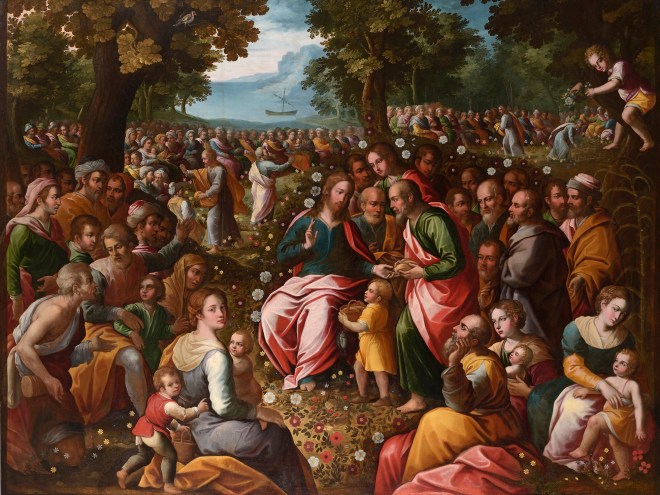
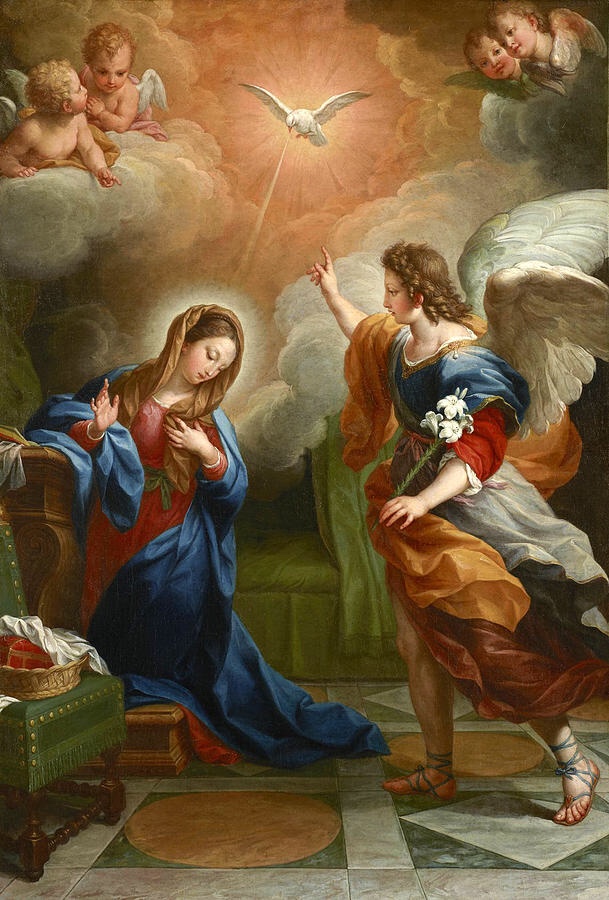
Image Credit: The Multiplication of the Loaves by Musée de Valence [Public Domain]

Christmas is Worth Waiting For

O come, all ye faithful, joyful and triumphant!
O come ye, O come to Bethlehem;
Come and behold him
Born the King of Angels:
O come let us adore Him,
Christ the Lord

Merry Christmas!

Today’s Christmas. Today is probably one of my favorite days of the whole year aside from my birthday. And it’s perhaps providential that it’s my very first Frassati reflection, coming right off the very end of Advent and into this wonderful Christmas season. It is also perhaps providential (no, it most certainly is no coincidence!) that today’s publication of my very first Frassati reflection comes right off what has been a very difficult three months for me. Without divulging much here, the past 90 or so days have been among the most difficult in my entire life. Three months ago, I made the decision to leave my PhD program, completely unaware and uncertain as to what the next step of my life would be come the end of this semester. I had prayerfully discerned, during this past fall Frassati retreat, that it was God’s will that I do indeed leave my PhD program, circumstances notwithstanding. Suffice to say, the past three months have been very trying, emotionally and physically. Academia, and completing a PhD, had represented my hopes and dreams for the past 10 years. I knew little else, career-wise. (I had been in and out of grad school for the past five years and had never held a “normal” 9 to 5 job.) 

Often, we all hit a roadblock in the lives we so try to meticulously plan. I know I certainly thought I had my life planned. I then pondered, and asked God, “Ok, God, now what? I’m waiting.” I often thought to how Our Lady must have thought, “How can this be?” when she was told by the angel Gabriel that she would bear the Christ, the Word Incarnate (Luke 1:34). “How can this be?” rang often in my prayers, late at night. I didn’t understand a lot of what was going on for a while, especially after I felt and knew it was God’s will I be admitted into my PhD program 2.5 years ago. April 15th, 2017, was one of the most joyous days of my life: it was the day I learned I was being admitted into my PhD program, and at my dream program. I now look back on that day with mixed feelings, but I am grateful to the Lord for the knowledge and experience I have gained. But like Our Lady trusted, so should I. True, bearing the Light of The World isn’t quite the same as allowing God to lead you on a different career path, but the sentiment is all the same. Trust. And I felt over and over in prayer, Go to Him.

December 13th was the very last day of my PhD program. I have now resigned myself to never becoming a college professor, never obtaining a PhD, and I am allowing Christ to radically lead me elsewhere. As the saying goes, I am allowing “Jesus to take the wheel.” It ain’t a Carrie Underwood song, it’s life. And I wouldn’t have it any other way.

In the midst of all this, my faith was the rock of my entire being and my eyes were ever so planted onto Our Lord. I was waiting. I’m still waiting. I’m still trusting. Today’s Christmas. Most people around us have been hurrying around looking for the perfect gift until the very last minute, waiting in line shopping at Macy’s well past 11pm, putting up decorations, frantically writing Christmas cards, getting stuck in traffic, and planning parties and dinners. We may have been one of those people, too. I know that sometimes I get lost it in all too. (I’m told I overgift and that I go overboard with party planning. I am also told that I can be more wordy than necessary.) It is easy to lose sight of the true significance of this season. 

This entire season, leading up to today, is meant to have been one of joy and hope, of preparation, and of waiting patiently for the coming of the Lord. It is not only about the past, but also very much about the present and the future. I know I won’t be defined by the past, and that I won’t be defined by any lack of ranks, degrees, or titles. I am a follower of Christ and Lay Dominican first, and everything else is secondary.

When I think back to my most recent disappointment with my PhD, I’m reminded that Christmas should be seen as a time for us to step back and take in the deep and rich meaning of this sacred event. We must see, first, that God became the Word Incarnate, that He entered our own human condition, and, in doing so, is able to identify with all that we experience in life. All our joys. All our disappointments. God understands human life! He lived it. God humbled himself in the most profound way so that we would come to know Him and His perfect love for us. The angel Gabriel told Our Lady, “Do not be afraid” (Luke 1:30). Do we step back and look to Our Lord? And when we do so, are we afraid?

Despite what may come, despite anything that has happened this past season, do not be afraid to come and behold the Christ who came as your savior. This past Advent season we have been reminded over and over that Advent is a time of waiting. But it’s now Christmas. We are often waiting for God to literally come to us. (God also speaks in His silence, but that’s another reflection.) We celebrate His birth just like that of any one of us—offering prayers, eating, drinking and making merry. We celebrate his coming into the world, but we often do not welcome Him into our hearts and lives. And we so often get away from Him in such times of trial and tribulation. I know the more and more I struggled these past few months, the more and more I deeply held onto Our Lord.

Amidst our celebrations this Christmas, let us pause a while to look around us to recognize that Jesus was born into the world two thousand years ago. The Incarnation is the very incarnation of hope itself. The Son of God comes Incarnate to fulfill the hope of the People of Israel. He is among us in every person and in every trial and tribulation we encounter in our lives. Whatever has happened to you this past season, Go to Him, have hope, and rejoice in His birth.

Silent Night

Today is Christmas Eve—in my opinion, the most peaceful day of the year.  To quote the classic song:  “Silent night, holy night, all is calm, all is bright.”  This is the conclusion of the Advent season, the season of hope.  Even though it is the shortest season in the liturgical year, it does not lack in excitement or anticipation.  Advent is focused on building up hope within ourselves and looking toward the future, the coming of our Savior.  Tomorrow is the birth of Jesus, the answer to all the Lord’s promises to HIs people.  No wonder this night is so peaceful because at this moment in time all is right with the world.

It is important to acknowledge these moments of peace and give honor to them.  They do not happen all that often.  Life’s chaos and conflict along with the enemy’s constant waged wars can easily enter into our souls and disrupt our sense of harmony and essentially draw us away from the Lord.  The Lord will never let these times of trouble overcome His true love for us.  He graces us with instances of silence to call us back to Him.  In the first reading, King David experienced one of these crucial moments.

King David was settled in his palace, and the Lord had given him rest from his enemies on every side…The Lord also reveals to you that he will establish a house for you.  And when your time comes, and you rest with your ancestors, I will raise up your heir after you, sprung from your loins, and I will make his Kingdom firm.
—2 Samuel 7

It is during these times that we can be confident that we are the closest to God, and He uses these times to reveal His will for us; promises are made and covenants are created.  On this night, the most silent of nights, all of the Lord’s promises are fulfilled.

In the tender compassion of our God, the dawn from on high shall break upon us, to shine on those who dwell in darkness and the shadow of death, and to guide our feet into the way of peace.
—Luke 1:79

On this most holy of nights, let us pray for those who are struggling, all who are in a state of darkness, all who cannot hear the voice of their loving Father.  Pray that we can all find peace on this silent night and allow our hearts to be opened by the Holy Spirit and to be made ready for everything that is to come in this new year.

Say Yes to God

Could Mary have said no?

This was the question one of my confirmation students asked me. Could Mary have said no?

Well, yes, she could have said no. She could have said to the angel Gabriel that this was just too much, that she wasn’t ready to be a mother, she wasn’t ready to be talked about behind her back or be disgraced because it wasn’t Joseph’s child. She could have said that she didn’t want the responsibility. She could have freely said no. Lucky for us, that’s not the way the Annunciation goes.

Mary said yes to God.

Through Mary’s “yes” the word became flesh and God was amongst us. Through Mary’s “yes” a child was conceived by the Holy Spirit and born of a virgin, fulfilling the prophecy of Isaiah in our first reading.

“Behold, I am the handmaid of the Lord. May it be done to me according to your word.”

Mary freely and willingly accepted her mission as the mother of God. She knew that the fruit of her womb, her son, Jesus Christ, was our redeemer, the perfect lamb by which the world would find its salvation. And she pondered on all of this in her heart because God chose her to love and take care of a small, innocent, and special baby. Mary’s “yes” aligned the will of God with her own will, obediently allowing herself to be an instrument of the Lord.

Mary’s “yes” was powerful.

In the Gospel reading for today, the angel Gabriel tells Mary that “nothing will be impossible for God.” That message is for us as well. The Most High, almighty and omnipotent God can do everything and anything—He made every inch of the universe. And nothing is impossible for God. Let us remember that in our hearts when we pray and when we walk up to the altar. Let us remember that the impossible does not exist to God. Whatever fear or doubt we might have in accepting God’s good word, let us renounce it. Whatever uncertainty we may experience that is stopping us from going forth with God’s plans, let us be aware to walk away from it.

In today’s society we are always busy. Our calendars are full of meetings, appointments, dinner parties, sports tournaments, work, and classes. The list goes on and on. We plan our schedules thinking that we are in control. The hardest thing for us to realize is that our lives are not our own; our lives belong to God and therefore should be centered around God. He is the one in control, and He is the one in charge of our final schedules.

God made us in His image to love us and for us to love Him. That love has to be given freely. So, yes, Mary could have said no. But it was her love for God that willed her to say yes and be open to receive baby Jesus in her womb. It is that same love for the Lord that will shape our individual lives. Through our own “yes” to God, we will be open to receive His many gifts of grace.

During this Advent season, as we are waiting and preparing our hearts for Jesus, let us prepare in a special way to do God’s will. Pray that when God changes our schedules we’d be open and willing to accept this change, always aligning our will with the will of God. Let us prepare to always want to say YES! to our God. That the uniqueness of our individual “yes” may be as powerful as Mary’s fiat.

Image Credit: The Annunciation, 1742, by Agostino Masucci [Public Domain]

A Great Light

The Christmas season is marked by light.  Lights strung around the tree, candles burning in windows, fireplaces warming homes, storefronts decorated with lights…  Many families will take a drive to go see the lights or see a tree in their city adorned with lights.  The beauty of light clearly draws us in. 

I’ve been rediscovering the glory of light as I watch my 2.5-month-old stare at lights — not just Christmas lights, but any kind of light.  I am realizing that we are born with an innate draw to the gift and mystery of light.  And while my sweet little baby stares with wonder at light, she is often being stared at by the people around her.  When we introduce her to friends and family, people find themselves circled around her, staring in wonder in the same way she herself stares at a light.  I’ve had two friends say in the past week that babies are like campfires — you feel like you can just stare at them forever.  There is a beauty, a wonder, and a joy in the presence of a baby and in the light of a campfire that draws our hearts.  This mystery of light is at the beginning of creation, as God himself created light before anything else (Genesis 1:3).  And this mystery of light is revealed to us further at the beginning of the Gospel, the beginning of our re-creation in Christ, as the Light of the world comes to us as a newborn baby.  How everyone present at Christ’s Nativity must have stared at this baby with an unmatched wonder and awe, as they stared at the One True Light Himself.  

Those who follow you, Lord, will have the light of life.

The refrain of today’s Psalm taken from the Gospel of John (Jn 8:12) reminds us that as Christians, we possess the gift of light, for Christ is the fullness of light.  It is through Christ that we are called into union with the Creator of light, the Father, and made partakers in this light by the fire of the Holy Spirit. We may already be well aware that as Christians we possess the light of Christ, but this Advent, perhaps the Lord is calling us deeper, asking us to receive His light more fully. What area or aspect of your heart or life remains in darkness? These areas may take some prayerful digging to find. Anxiety, fear, hopelessness… Ask the Lord to reveal this place to you, in His gentleness and love. This is where the Lord yearns to be invited. To bring an end to any remaining darkness with the light of life.   

I hope that every light we see this Advent and Christmas points us to the One True Light Himself. The Savior of the world, God Himself, was born to us a beautiful, sweet baby. Come let us adore Him, and stare in wonder at the baby Jesus, the Light who changed everything.  

Adoration of the Shepherds by Matthias Stomer, 1632

A Highway for Our God

There are some moments in our lives where we just feel lost and out of place. For me, the moment of complete and utter confusion happened my senior year of college. In preparation for my future, this should have been the year in which I checked off all the boxes on my master plan. But that was not the case; I checked off none. I didn’t even have a plan. I was lost. Although I knew my physical location—on the University campus—I couldn’t find myself anywhere on the map. Someone could have arranged fluorescent direction markers and flagged me down with bright orange batons and I still would not have known in which way to turn. I would have blindly walked past them, lost and uncertain with myself.

I have known about the parable of the lost sheep since I was a child—seeing this Biblical passage through the eyes of a child, I always saw a perfect, fluffy sheep in a picture book. I didn’t realize the impact in my heart this parable would make until my adulthood, when I found myself, no longer lost, in the Catholic Church.

In today’s Gospel reading, Jesus tells us that a shepherd has one hundred sheep and one of them goes astray and is lost. Just one. Jesus asks for our opinion, will you go in search of the lost sheep? I’m sure the disciples listening to Jesus were thinking: “Well, the man has ninety-nine other sheep left. He should be fine. He has more than what he lost. He should just let that one sheep go.” Jesus, however, continuing with the parable tells them the answer to his question: the man will leave the ninety-nine on the hill and go off in search of the one lost sheep. In the children’s picture book the shepherd and even the perfect, fluffy sheep look happy surrounded by beautiful green pastures and mountains, both underneath a beautiful blue sky. The reality, in first-century Palestine, is that a shepherd must have been crazy to leave ninety-nine sheep behind and travel the dangerous, unknown, and hard terrains of the mountains for one lonely sheep.

Who would realistically do this? God would. God would do this for you. Because out of one hundred, one thousand, one million, one billion sheep in his flock, God loves you and He will go after you.

Notice that in the parable it’s not the shepherd who loses the sheep. It’s the sheep that went astray. We are that one sheep. We expect God to love only those who listen to Him and follow His commandments. We forget that God does not love by the boundaries of this world. His love is immeasurable and powerful because God is love. Where we limit our love to those who are undeserving, where we neglect those who disobey or do not follow orders—God gives them His love. He follows these lost sheep, and when they are ready, He guides them home.

In the first reading the Israelites have been called back home after being in exile. They have been in the wilderness, and the Biblical passage describes the way they need to travel from Babylon to Jerusalem. Normally it’s a dangerous and rough journey, but God is with them in preparing the way for them to come home. Every mountain and hill is made low and the rugged lands will be made plain and easy to travel. Here is God gathering his lost sheep and leading them home.

“A voice proclaims: In the wilderness prepare the way of the LORD! Make straight in the wasteland a highway for our God! Every valley shall be lifted up, every mountain and hill made low; The rugged land shall be a plain, the rough country, a broad valley.”

Back in my senior year of college, my lost years, I found myself on my knees lovingly admiring the altar. The place of sacrificial love. I kept thinking about the lost sheep and painfully acknowledged that it was me. I kept thinking that I wasn’t the sheep from my childhood picture book. I wasn’t “fluffy and perfect.” I was a mess. Dirty. Broken. Defeated. I realized that I was looking at myself through the world’s eyes and wrongly thought I didn’t deserve love. But God’s love knows no boundaries. The sheep in the picture book is “perfect” because God always sees you as his perfect child. In the Catholic Church looking at Jesus on the cross, truly knowing that the good shepherd had walked through the wilderness to find me and bring me home—I believed him when he told me he loves me. God’s love is unconditional and no matter how long ago you’ve gone astray, what mountain or valley you’re lost in, no matter how deep of a mess you’ve made of things, if you haven’t gone to Mass in years, or you carry anger or guilt, nothing that you do will take away from God’s love for you. The good shepherd is in search for his lost sheep to come back home. And He will help you to “make straight in the wasteland a highway for our God!

Image Credit: The Lost Sheep [Public Domain]

The End Of Time

The God of heaven will set up a kingdom
that shall never be destroyed or delivered up to another people;
rather, it shall break in pieces all these kingdoms
and put an end to them, and it shall stand forever. –Daniel 2:44

The kingdoms Daniel referred to were made out of iron, bronze, silver and gold. These metals were considered precious, and some virtually indestructible, but not to the almighty God. God’s kingdom is greater and stronger than any created on earth. This passage is a powerful reminder to place all our investments in Jesus Christ for He is more precious than iron, bronze, silver, and even gold.

The Gospel takes this idea further, and Jesus Christ directly addresses the end of the world and how we will know when it is coming:

Nation will rise against nation, and kingdom against kingdom.
There will be powerful earthquakes, famines and plagues
from place to place;
and awesome sights and mighty signs will come from the sky. –Luke 21:11

All goods and possessions we hold onto on this earth will be destroyed, and then what will be left? Only God, with His glorious kingdom far grander and more superior to anything we have ever known. It is so easy to fall into the trap of living for this day, the one that marks the end of time. We convince ourselves we need to be prepared for it, but instead of preparing our souls, we prepare for the earthquakes, famines, and plagues. Jesus Christ rebukes us, telling us not to fear these acts of nature, for He will be there and give us what we need to survive. We must be concerned about the condition of our souls. When these “mighty signs” arrive, we will have no control over them, but we will have control over how we respond. Will we seek comfort in the strength of iron, bronze, silver, or gold, or will we seek refuge in Jesus Christ? Jesus also said we will be asked to testify, even be handed over by our own family, but we need not fear because the Holy Spirit will give us the words to speak when our time comes.

Turn to Jesus Christ in everything and throughout all time, both now in the present day and in the turbulent time to come. Glory, tragedy, and the basic day-to-day events of life will happen, but as long as we keep our gaze fixed on Him, we can have faith that we will be prepared, not just for the end of the world, but more importantly, for the afterlife as well.

Base of Belief

Trepidatiously, I had added the 5 miles to the calendar.  Though I had run 4 miles the week before, I wasn’t certain I could nail the mileage with the same splits. On the morning of, doubt crept in. Within the first mile, I considered backing the distance down.  I had committed. It was gonna be 5. 

The sun glared across a street sign making it impossible to read. After running another mile and looking at the time, I thought I had made a mistake and had cut the run short. So, I decided I would run to the next intersection  to add the distance back to get where I was “supposed” to be. As the distance increased, I sensed my eyes looking up. I realized I hadn’t made a mistake after all. I knew without a doubt the 5 mile run became a 7 mile loop—7.06 to be exact—and each mile split was 6 seconds faster than expected.

Building is a quintessential activity for both endurance and belief. Therefore, it’s necessary to know the ways we stop gap the process, where we simply put one foot in front of the other.  How do you limit possibilities? How do you tap out because of a fear of failure before facing the breaking point? Instead, how will you build your base of belief?

Verso l’alto, 

Kathryn Grace 

“Our deepest fear is not that we are inadequate. Our deepest fear is that we are powerful beyond measure. It is our light, not our darkness that most frightens us. We ask ourselves, ‘Who am I to be brilliant, gorgeous, talented, fabulous?’ Actually, who are you not to be? You are a child of God. Your playing small does not serve the world. There is nothing enlightened about shrinking so that other people won’t feel insecure around you. We are all meant to shine, as children do. We were born to make manifest the glory of God that is within us. It’s not just in some of us; it’s in everyone. And as we let our own light shine, we unconsciously give other people permission to do the same. As we are liberated from our own fear, our presence automatically liberates others.”
― Marianne Williamson, A Return to Love

Moment by Moment with the Lord

On September 21st, mine and my husband’s lives changed forever as we welcomed the baby who had been growing in my womb for nine months into the world! In her first eight weeks outside the womb, our sweet little girl has already encouraged and challenged me to grow. One immediate change I’ve experienced in my day to day is how little my ideas of a plan or schedule really matter. Of course, the words ‘plan’ and ‘schedule’ mean nothing to an eight-week-old, and that is the beauty (and challenge) of it. By nature, I tend to be pretty go-with-the-flow and not much of a planner, but even a plan as simple as making breakfast and coffee when I get up in the morning may or may not come to fruition in the way I imagine now that I have a little one depending on me. Breastfeeding, a diaper change, and/or a snuggle may all need to happen before I have a chance to take a sip of that coffee. In short, any number of little things can re-route my simple daily plans. Equally as often, I am anticipating my little girl getting hungry only to find that she is perfectly content and smiley, giving me an unexpected opportunity to get something done that I wasn’t expecting to do or enter into that smiley moment with her. As I’ve begun to adjust to caring for my sweet little infant, I’ve realized how it encourages me to be present to the moment. I can choose to cling to my ideal plan and be disappointed or upset when it goes differently, or I can choose to be open to what is most important moment by moment.

Holiness is a calling that asks for our whole present selves first and foremost. God asks us to come into His presence and everything else flows from there. Plans and schedules are not bad at all – they are in fact very good. A plan for our day or our entire life plan can be a beautiful source of Hope. What’s important is that this Hope is rooted in the Lord and not the plan itself. He is the source of all Hope and our plans only matter insofar as we don’t lose the source Himself in the midst of them. We must learn detachment from the plans themselves. And while our plans can be good, meaningful, and holy, God often has surprises up His sleeve anyway. As a good friend of mine always says, “If you want to make God laugh, tell Him your plans.”  In today’s Gospel, Jesus speaks of His second coming, when the “Son of Man is revealed” (Lk 17:30). These Scriptures make me ask myself, “What can I be doing to be ready when the Lord comes?” But I think that question can be misleading. At the center of anything I am “doing” to prepare for the Lord, is the simple act of being in Him. Through the grace of God, made concrete through our baptism and the other sacraments, we are in Him and called to remain in Him (Jn 15:4) moment by moment. The Holy Spirit speaks to us and calls us outside of our own plans into His own. At the core, we yearn to be so attune with Him that we don’t miss His voice because it didn’t fit into our own schedule. 

How do we become more attune with Him? Talk to Him, spend time with Him, welcome Him in to every moment. And as often as we forget to do this, ask Him to forgive us and start again, asking for His help because we can’t do this in our own power. And He will. He will teach us, just like He is teaching me through the presence of my daughter. In a time where my prayer time is sporadic, He is teaching me through the very vocation He has given me. He is speaking a specific lesson to me through my daughter in these first weeks of her life. I ask Him to help me be open with each moment so I don’t miss an opportunity to play with her when she is awake or use the time she is sleeping peacefully to eat something… or write this reflection. My motherly instincts are encouraging me to become attuned to my daughter and what she is communicating to me. And so it is with the Lord… He welcomes us to become attuned to Himself so we may not miss the important things He is communicating to us. How is He currently communicating to you through your life, and how can you invite Him in more fully to each moment?

Lord, I welcome you into this day, into each moment. Teach me how to surrender my plans and live more truly moment by moment with you. In Christ we pray, Amen.

Devout and Faithful Servant of God

“We are unprofitable servants; we have done what we were obliged to do.”

—Luke 17:10

When I used to hear the word “servant,” I thought of it as a dirty word. I thought a servant was someone without any authority, someone very low in class and poor, someone who had no choice but to do the work for others. My definition and understanding of who’s a servant was completely wrong. Jesus Christ came to earth not “to be served but to serve” (Matt 20:28). As we are called to imitate Christ, we are called to be servants—that is, to be devout and faithful followers of Christ.

In the Gospel reading for today, Jesus is speaking to the disciples, and to each of us, telling us that we should do what is commanded by God without complaining and without expecting to be praised. This might be difficult for many to take in as we all want to be seen and given due credit for whatever small deed we do. We attach our names to absolutely everything so the world can see: out of my kindness, out of my brilliance, out of my skills, out of my popularity, I did that. On the other side of the spectrum, when things aren’t to our standard, we complain. We let the world know that we are not satisfied, that we are upset and angry, that we demand things to be as we want them to be. Neither of these characteristics are pleasing to God. We are servants of the Lord. What is pleasing to God is for us to follow His commands and be in accordance with His will. By doing this we show our love for God.

How can we be good servants? By serving as Jesus Christ served. We should take care of the poor, the sick, the hungry, those who mourn. We should be meek and humble. We should follow righteousness. We should be merciful and pure of heart. We should be peacemakers and stand firm in front of persecution. I learned that this is the true definition of what it means to be a servant: a devout and faithful follower of Christ.

In the catechism it states that the religious and ministers of the Church are servants of God. The pope’s proper title is servant of the servants of God. And one of the first steps in the canonization of a saint is to pronounce them as a servant of God to the entire world. I mean, whoa, think about that. To be a saint in heaven, you will first take a title that the secular world walks all over: servant.

We are all unprofitable servants, this is true. Because everything good is due to God alone. But God is not like the man in the parable who is not grateful that his servant is being obedient. After the servant finishes plowing and tending the sheep, his master orders him to serve food and drink. The servant’s work never ends, and he is not rewarded. As servants of the Lord, our work never ends either, but this is because we never stop being faithful followers of Christ! Our mission is to always preach and worship His good name. We will continue to plow and plant seeds of faith. We will continue to tend the sheep and build up the Church. The difference is that our God sees the work we do for Him, and He loves us. When we enter the gates of heaven, our Lord will joyously tell us, “come here immediately and take your place at table.” We all have a place at His table, and we will celebrate with a great heavenly banquet filled in abundance with food and drink.

Image Credit: Jesus looking over a servant [Public Domain]