A Highway for Our God

There are some moments in our lives where we just feel lost and out of place. For me, the moment of complete and utter confusion happened my senior year of college. In preparation for my future, this should have been the year in which I checked off all the boxes on my master plan. But that was not the case; I checked off none. I didn’t even have a plan. I was lost. Although I knew my physical location—on the University campus—I couldn’t find myself anywhere on the map. Someone could have arranged fluorescent direction markers and flagged me down with bright orange batons and I still would not have known in which way to turn. I would have blindly walked past them, lost and uncertain with myself.

I have known about the parable of the lost sheep since I was a child—seeing this Biblical passage through the eyes of a child, I always saw a perfect, fluffy sheep in a picture book. I didn’t realize the impact in my heart this parable would make until my adulthood, when I found myself, no longer lost, in the Catholic Church.

In today’s Gospel reading, Jesus tells us that a shepherd has one hundred sheep and one of them goes astray and is lost. Just one. Jesus asks for our opinion, will you go in search of the lost sheep? I’m sure the disciples listening to Jesus were thinking: “Well, the man has ninety-nine other sheep left. He should be fine. He has more than what he lost. He should just let that one sheep go.” Jesus, however, continuing with the parable tells them the answer to his question: the man will leave the ninety-nine on the hill and go off in search of the one lost sheep. In the children’s picture book the shepherd and even the perfect, fluffy sheep look happy surrounded by beautiful green pastures and mountains, both underneath a beautiful blue sky. The reality, in first-century Palestine, is that a shepherd must have been crazy to leave ninety-nine sheep behind and travel the dangerous, unknown, and hard terrains of the mountains for one lonely sheep.

Who would realistically do this? God would. God would do this for you. Because out of one hundred, one thousand, one million, one billion sheep in his flock, God loves you and He will go after you.

Notice that in the parable it’s not the shepherd who loses the sheep. It’s the sheep that went astray. We are that one sheep. We expect God to love only those who listen to Him and follow His commandments. We forget that God does not love by the boundaries of this world. His love is immeasurable and powerful because God is love. Where we limit our love to those who are undeserving, where we neglect those who disobey or do not follow orders—God gives them His love. He follows these lost sheep, and when they are ready, He guides them home.

In the first reading the Israelites have been called back home after being in exile. They have been in the wilderness, and the Biblical passage describes the way they need to travel from Babylon to Jerusalem. Normally it’s a dangerous and rough journey, but God is with them in preparing the way for them to come home. Every mountain and hill is made low and the rugged lands will be made plain and easy to travel. Here is God gathering his lost sheep and leading them home.

“A voice proclaims: In the wilderness prepare the way of the LORD! Make straight in the wasteland a highway for our God! Every valley shall be lifted up, every mountain and hill made low; The rugged land shall be a plain, the rough country, a broad valley.”

Back in my senior year of college, my lost years, I found myself on my knees lovingly admiring the altar. The place of sacrificial love. I kept thinking about the lost sheep and painfully acknowledged that it was me. I kept thinking that I wasn’t the sheep from my childhood picture book. I wasn’t “fluffy and perfect.” I was a mess. Dirty. Broken. Defeated. I realized that I was looking at myself through the world’s eyes and wrongly thought I didn’t deserve love. But God’s love knows no boundaries. The sheep in the picture book is “perfect” because God always sees you as his perfect child. In the Catholic Church looking at Jesus on the cross, truly knowing that the good shepherd had walked through the wilderness to find me and bring me home—I believed him when he told me he loves me. God’s love is unconditional and no matter how long ago you’ve gone astray, what mountain or valley you’re lost in, no matter how deep of a mess you’ve made of things, if you haven’t gone to Mass in years, or you carry anger or guilt, nothing that you do will take away from God’s love for you. The good shepherd is in search for his lost sheep to come back home. And He will help you to “make straight in the wasteland a highway for our God!

Image Credit: The Lost Sheep [Public Domain]

The Rock

Last Christmas a very generous friend gifted me a Know-It-All watch. It knows when I am sleeping, and how well. It knows when I am sitting—and buzzes “Move!” when I do so for too long. It knows my heart rate and will buzz frantically “Abnormal…!”—often during particularly still moments such as the Consecration—assuring that said heart rate will quickly climb even higher.

I keep this omniscient tyrant for two reasons: one is that it alerts me to calls, which is helpful because I frequently forget where I’ve left my phone. The other is that it tracks my steps, motivating me at least in theory to take more of them.

One morning this past spring I was traveling with some friends from college, and we were planning to enjoy a leisurely brunch before heading our separate ways. I decided to take advantage of the hotel treadmill and get my steps in early. I was pleased that by the time we sat down to brunch, I was just 50 steps short of 10,000.

It was worth it. The food was delicious and it was a delight to just relax and enjoy extended conversation. But suddenly, mid-sentence, I felt the familiar bossy buzz and looked down at my watch to see the fireworks going off, signaling that my steps goal had been reached. I was amused and bewildered. How could this be, since I had been sitting for the entire time?

“It’s because you’re Italian,” my friends laughed. “You talk with your hands….”

Today’s Gospel is about speaking with more than words. It is in fact our actions that speak to God most clearly. “Not everyone who says to me, ‘Lord, Lord, ‘will enter the Kingdom of heaven, but only the one who does the will of my Father in heaven,” Jesus tells His disciples.

Faith is something that we profess not with our mouths but with our lives. By our actions, we build our house on either rock or sand.

At the same time, faith is knowing that it is not by my own strength or power that I do good. Rather, God has made me good and empowers me to choose the good. We are free to say no to what would hinder His will, knowing that it would also hinder our happiness.

Recently I read an article with the rather bizarre assertion that Mary and Jesus could have been just as happy and holy had they told God, “No.”

The author was trying to make a case for the primacy of consent. That at the Annunciation, Our Lady had the freedom to say Yes or No to God’s proposal. This is true: Our Lady was not forced to bear the Son of God. She was invited to be the spouse of the Spirit, the Mother of the Son, but she could have said No. All heaven awaited her answer.

Any man who proposes knows the intensity of such a moment, of held breath, awaiting a reply. No lover worthy of the name would make it a matter of force. She must always have the power to choose.

And yet, with the power to choose comes the power to choose tragically. Mary could have said No. But it would indeed have been a tragedy. Nothing else she could have chosen would ever approximate what God had in store for her. Her empty autonomy could not have been on par with being the mother of the Savior of the world.

Mary, full of the love of God, trusted the goodness of God. She knew He could not and would not propose something that was not good. She knew that whatever He does through us, He also does for us. She was free to respond fully and joyfully, and she did.

We also build our actions on the rock of Christ when we trust His promises, when we choose to say Yes to something (Someone) greater than ourselves. If instead we choose to trust in human ideas, in human strength, in human plans, then we find we have built on sand.


Seek Him in All Things

“Seek him in integrity of heart;
Because he is found by those who test him not,
and he manifests himself to those who do not disbelieve him.” Wisdom 1:1-2

Time and time again I find myself in a place of realizing just how much I need the Lord. It truly is a wonder to behold how intricately He is involved in every breath, every detail of our lives, all because He wants us to know His great love and love Him in return.

We have nothing to lose by allowing ourselves to seek God with every fiber of our beings. God’s the one who won’t let us down, who can take all our mess and brokenness, and who draws us into a deeper relationship with Himself. He is the one who can fully satisfy every searching and longing of the human heart.

When we seek after other things to fill the deepest aches of our hearts, we are left empty. But when we really seek after God, He not only fills us, but He sets us free.

God always shows up when we seek Him, and we have nothing to fear.

What is your heart seeking today?

Is it affirmation? God’s voice is the only voice that matters: you are defined as His beloved child.

Is it peace? The Lord is the giver of true peace, peace that lasts.

Is it attention? God’s tender gaze is always fixed on you. He can’t take His eyes off of you.

Is it answers? He is the way, the truth, and the life.

We can really seek after God, without fear of betrayal or the fear that seeking Him will lead us astray. The Lord promised that when we seek after Him with our whole hearts, we will find Him (Jeremiah 29:13).

Now this may all sound cheesy or way too hard to believe, but this is the reality of God’s love that we have the opportunity to live in: God bestows on us the gift of His Divine Revelation, that when we really seek after Him, we will find Him; when we lean into Him, we won’t fall.

We can’t seek after Him too much. We can’t press into Him too much. You are never a burden to our Lord. And the beautiful thing is that we are seeking after a very real God who knows all the ins and outs of our souls, who sees and knows every nook and crevice of our hearts, who cares about the things that make us laugh and the things that keep us up at night. He is there through it all. So let’s seek wildly after His Heart. He’s already there, and He has wonders to reveal to us.

Take courage in your seeking. Know that He is seeking after your heart all the more.

Come, Lord Jesus. We seek You. We long for You. We need You.

Do you find yourself seeking? Here’s some more Scripture to pray with this week on this theme: Psalm 63, Psalm 34:6, Psalm 27, Matthew 7:7-11, Song of Songs 3:1-4

Irrevocable Love

“Lord, in your great love, answer me.” -Psalm 69

Sometimes it can be easy to forget that God never leaves us. When we find ourselves in a place of searching for answers, He’s already there, already working on it. With Him, we are safe, and we don’t have to be afraid.

A lot of people talk about how God always hears our prayers, which is true, but let’s focus for a second on how God receives our prayers:

God receives your prayers with the utmost love, care, and concern. He receives your prayers with tenderness and compassion, with deep knowing and understanding for every cry of your heart. No corner of who you are is left unloved or unnoticed by Him. He really does care about every single detail of every prayer, repeated or only uttered once, spoken out loud, or buried in the depths of your heart.

Whatever is on your heart is on God’s heart, too. You always have His attention. His gifts and calls are irrevocable, as today’s first reading says. This applies to His loving, constant focus on you, too–that’s a gift He will never take away.

And so we can go to God, as we are. We can go to Him unmasked and hearts unveiled, because He always receives our prayers with love.

We praise You, Lord.

Home.

“Brothers and sisters:
You are no longer strangers and sojourners,
but you are fellow citizens with the holy ones
and members of the household of God,
built upon the foundation of the Apostles and prophets,
with Christ Jesus himself as the capstone.
Through him the whole structure is held together
and grows into a temple sacred in the Lord;
in him you also are being built together
into a dwelling place of God in the Spirit.” -Ephesians 2:19-22

It was Saturday night during the Steubenville NYC Conference this summer, and I was sitting with my 30 teens in the grass at St. John’s University, reflecting on what they had just experienced in a powerful night of Eucharistic Adoration. Each teen poured his or her heart out, telling of how God’s incredible love had touched them that night. As one of the boys was sharing, he stopped for a second, grinned, and then said: “Jesus is home.”

Jesus. Is. Home.

Those three little words from that wise 14-year-old boy pierced the depths of my soul that night.

Jesus is HOME.

We are no longer strangers and sojourners, as today’s first reading proclaims. A sojourner is someone who stays in a place temporarily. We can stay permanently with Him, because He is home. We can get cozy, settle in, and make His Sacred Heart our home, abiding and remaining in Him as He invited us to do at the Last Supper.

When we feel we don’t belong in our job, or in a city, in a crowded NYC apartment, or even in our own families, we always belong with Jesus. When we feel like we’re in constant change, He is our mainstay. In Him all things hold together, like a sturdy house (see Eph. 2:21 and Col. 1:17). We are known by God, loved to the deepest parts of who we are that we don’t even know ourselves.

We can dare to trust in God’s goodness enough to stay with Him, to hold on, to hang in. We can trust Him enough to set up permanent residence in His Heart. He is home, brothers and sisters; He is home. Rest in Him.

Promise-keeper

“Brothers and sisters:
Abraham did not doubt God’s promise in unbelief;
rather, he was empowered by faith and gave glory to God
and was fully convinced that what God had promised
he was also able to do.” -Romans 4:20-21

Sometimes life can seem so discouraging, right? Sometimes we feel ourselves looking around at everything around us and saying, “What is going on?” Other times we wait and wait for so long that we feel forgotten and ignored by God, as if He doesn’t care about the very desires He has placed on our hearts. Sometimes, it seems like there can’t possibly be a way out of what we’re struggling with, and we’re left wondering if things will ever get better.

God is too good to leave us there, dear friends. He is simply too, too good.

Through it all, He is on the throne. He has got this. He is on the move: working, loving, present, and focused on you, handcrafting a story of glory. We can never get too far off course for Him to not provide and to not come through on a promise. We aren’t powerful enough to lose ourselves beyond the repair of God’s providence. Praise God that He uses His almighty power to bring us back over and over again.

Today’s first reading challenges us to press in, to cling to God as our source of hope, and to know that He keeps His promises. Abraham was promised children when it seemed impossible, and yet he was “fully convinced” that God would keep His promise. It made zero sense given his circumstances surrounding him, but he knew that the impossible is possible for God.

God is our promise-keeper.

God is always, always, always good. In fact, He is too good for us to give into despair. In the light of His wild love, we can trust that at each moment we are held secure, and that He will deliver on His promises to us.

Through it all, God is our constant. When the storms of life swirl around us and toss us about, He is our anchor. God is our steady source of love and hope. And when we keep our hearts laser-focused on His, we can rest secure in His perfect peace. Surely the Lord will keep His promises. He is too good not to.

Is anything too impossible for the Lord? Absolutely not. Take heart.

Holy Spirit, help us to rise up with a new intensity of Your fire today to say a firm “no” to the temptation to despair and to doubt God’s promises. Help us to press into You and rely on You more, knowing that in each moment, You are with us, giving us our very breath. We renew our trust in Your promises today, Lord. We trust that You always come through, that You always make a way. We trust that any impossibility is always possible for You. Thank You for being infinitely good to us, no matter what. Amen.

This song that declares God’s constant goodness was on my heart as I was writing this.

Pray, Hope, and Don’t Worry

Today is the feast of St. Padre Pio. He was an extraordinary priest who took on great sufferings for souls. He spent hours upon hours of his life hearing confessions, because his desire for everyone to know the love and mercy of Christ in a tangible way was so great.

St. Padre Pio was known for saying this simple phrase to anyone who came to him with a troubled heart: “Pray, hope, and don’t worry.” He then went on to say, “Worry is useless. God is merciful and will hear your prayer. Have courage and do not fear the assaults of the devil.”

There is great depth to be unpacked here. Within these straightforward words, St. Pio gives us a road map of trust and surrender, all pointing the way to Christ.

Pray. Prayer is our relationship with God. If we’re not praying, we are failing. Prayer is where we get to come before God with our whole hearts laid bare, sin and all, and be in communion with Him. Prayer is the open space of resting with God, speaking to Him what is on our hearts, and listening to the word He desires to speak to us. Prayer is the first step to surrender.

Hope. One of my best friends always says, “Steer into hope.” We need this theological virtue of hope to infuse our lives, because God is trustworthy, and God will never abandon us. St. Paul writes, “Faith is the realization of what is hoped for and evidence of things not seen” (Hebrews 11:1). There is always, always, always hope. We may not see the way, but we can hope. No matter how bad things get, there is the hope of God always being with us. His light shatters all darkness.  He so desires your good.

Don’t worry. Worry can be such a slippery slope. There is so much in life that is worrisome; we certainly all experience it. Worry leads to despair, doubt, and discouragement. Worry robs us of our peace. Worry suffocates us, growing into a dull hum in our hearts that tells us God is not here, or that God cannot overcome whatever situation we find ourselves in. Worry breeds lies. Jesus commanded us to not worry in Scripture several times, and St. Pio reminds us of His words—don’t worry. God is here. God is greater. You will not be overcome.

Let’s join together and pray, hope, and refuse to worry. Surrender and trust is not easy, but it sure is liberating. It allows us to let go and allow God into everything. He’s not worried. Big problem or small fear, He’s got us, in every single way.

**If you need an anthem for letting go of worry, I recommend this song by Housefires. The bridge says, “God’s not worried, so why should I worry?”

Holy Hands

“It is my wish, then, that in every place the men should pray,
lifting up holy hands, without anger or argument.” -1 Timothy 2:8

We express with our God-given bodies the very disposition of our hearts.

I remember watching a video all the way back in my college psychology class about how our body language not only conveys things to other people about who we are and how we are feeling, but to our own minds, as well. If we sit hunched over with our arms folded, that sends signals to our brain that we are unhappy or closed-off. If we stand up straight, that sends signals to our brain that we are confident and at ease.

What are we conveying to other people with our bodies? Do we use the hands and feet God has given us to serve others with compassion? Do we meet the gaze of people who need Christ’s love? Do we use our voices to bring God glory?

St. Paul tells us in the Letter to the Romans, “I urge you therefore, brothers, by the mercies of God, to offer your bodies as a living sacrifice, holy and pleasing to God, your spiritual worship” (Romans 12:1).

We are not our own. We belong to God. So when it comes to prayer, too, how we express our love for God with our bodies makes a difference. Now, I’m not talking about a particular spirituality here, because I think our one, holy, catholic, and apostolic Church is sometimes too fragmented by the, “I’m this kind of Catholic” mentality. Let’s meet for coffee if you’d like to discuss that haha.

I will give you an example to describe what I am getting at: my spiritual director once told me, after a season of difficulty, that I needed to pray with open hands again. Without even realizing it, I had been praying with my hands over my heart out of fear, as if I was shielding myself from letting God in. Interiorly, I had walls of self-protection up, and exteriorly, it was manifesting in my expression of prayer.

God gave us our bodies to physically express our love for Him. Do we pray in a way with our bodies that tells God we are open? Prayer and worship are not about us, in the first place; it’s about giving God the glory He deserves with our whole heart, soul, mind, and being. God deserves all of us. And we have the awesome opportunity to offer our very beings as a sacrifice of praise to our almighty God. With an open physical expression, our disposition of heart is opened to God, like the centurion in today’s Gospel who said, “Lord, I am not worthy to have you enter under my roof” (Luke 7:6).

There is something so powerful about praying with an exterior posture of surrender. It expresses worship, surrender, trust, and vulnerability. It admits our own weakness. It declares our total dependence on our Heavenly Father. It changes things, takes us out of ourselves, and helps us focus totally on the Lord, body and soul aligned in love for Him. We get to give God all that we are, holding nothing back from Him.

Directing Our Steps

Jesus told his disciples a parable:
“Can a blind person guide a blind person?
Will not both fall into a pit?
No disciple is superior to the teacher;
but when fully trained,
every disciple will be like his teacher.”
—Luke 6:39–40

Jesus has entrusted each of us with free will, leaving us room to act as we choose. Knowing our weakness and tendency toward sin, this can seem a terrifying responsibility. Sometimes I would rather God just take the reins entirely instead of leaving any decisions up to me. But God does not want to control us; He wants a relationship with us. He does not want us to act out of fear or passive obedience but out of love. When I overthink a decision or think I can’t live up to what God is asking of me, I forget that God knows me better than I know myself and has already accounted for the fact that I will make mistakes. There is nothing He can’t handle.

When it comes to discerning where God is leading us, we can often feel blind to perceive the road ahead. We turn to advice from others, hoping that they can tell us where to go, but they too are only human, unable to see our path fully. So how do we make our way forward? Jesus tells us that as His disciples, we are to listen and follow His ways, training ourselves to become like Him, so that instead of stumbling along like the blind leading the blind, we can learn to walk in His footsteps.

Any good teacher knows that there is a learning curve, that students will make mistakes along the way before they can master any new skill. And when Jesus calls us, He is aware that we are stepping out blindly, not yet able to make out what lies ahead. But He also knows that we won’t learn how to orient our steps if He doesn’t give us a chance to move freely, stumbling a bit as we go.

God knows that our attempts to do good may go awry, but, in the words of Thomas Merton, our desire to please Him does in fact please Him. When we go off course, He can redirect our steps and bring good out of any situation, as long as we continue to invite Him in and give Him permission to act in our lives.

Though we cannot see further than one step ahead, He leaves it up to us to take that one step and then allow Him to illuminate the next. He will never force us; He guides us, if we accept His help, with a gentle hand. Learning to trust Him means believing that He can handle my weakness and that He invites me to follow just as I am.

Casting Nets with Jesus

Implementing change in the workplace can take a long time. I work in the construction industry, and contractors are tough people. They all seem to know everything, and their way is the best way, the right way, because it’s always been done that way. However, things change. Industry standards, safety measures, construction codes—these things change.

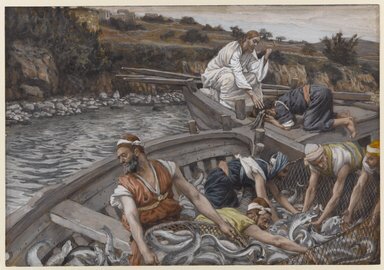
In today’s Gospel, Simon is at the shoreline cleaning off his nets; it had been a long night and he hadn’t caught any fish. Along comes Jesus, who gets into Simon’s boat and teaches from the water to the people on the shore. After he is done teaching, Jesus instructs Simon to lower his nets into the water, and behold, the nets are full of fishes.

Simon is a fisherman—he owns his fishing boat, owns his nets, he fishes for a living, it’s his profession. Simon is a professional fisherman. When Simon goes out to fish he isn’t doing a lazy, recreational activity. He is doing hard labor: lifting heavy nets, moving bait around, dealing with waves, being dirty and smelly. A fisherman by trade knows that there is a right way to fish and a wrong way to fish. A fisherman by trade knows that certain fish bait at certain times of the day—given the climate in Israel, hot and dry, the higher temperature of the water would force the fishes to dive deep below to be at a cooler temperature. At night, the water temperature would cool off and fishes would swim upwards, closer to the surface. Simon, a professional fisherman, knew all of this and thus went fishing at night. But even with all his knowledge and tactics, he didn’t catch any fish. Imagine Simon’s first reaction when he hears Jesus tell him to cast his nets into the water. I imagine his initial reaction to be a little bit of annoyance that a carpenter is telling a fisherman how to fish and to cast nets in the middle of the day. You hear a little bit of Simon’s hesitation when he says, “Master, we have worked hard all night and have caught nothing…”

How many times have you doubted that God would provide for you? How many times did you not listen to what Jesus had to say to you? Too often I’ve been like Simon at the beginning of the Gospel, doubting. I have even questioned God: “Really? Is this really how it’s supposed to be? Are you sure this is what you want me to do?”

Notice that the beginning of the Gospel begins with the people listening to the word of God. When we listen and are obedient to God’s word, we change. This change allows us to fully accept God’s grace. Simon changed when, in his obedience, he casted his nets into the deep waters: “but at your command I will lower the nets.” In that instance Simon became Simon Peter. This internal change in Simon Peter allowed him to see that Jesus was not only Master but Lord.

We need to let go of any hesitations. Let go of all doubt. Or at times we need to let go of the pride. Sitting at meetings with the subcontractors on my job always leaves me baffled. How can we finish a building without the plumber or without the electrician? We simply cannot; we need all the skilled workers. Likewise we cannot build our own homes without the foundation of Jesus Christ.

No matter what we do in our lives, what we are skilled at, how many times we have done something and succeeded or done something and failed—let’s give that up to Jesus. Let us always remain humble and listen to each other and listen to what God has to tell us. In our society we take our jobs and our volunteer positions as finite. Let us remember that we’re good at what we do because God deemed it that we’d be good at it. And our work needs to be fruitful in such a way that it glorifies God. Sometimes, we aren’t so good and we fail. That is all right. In this failure we are reminded to trust in God. When Simon couldn’t catch any fish, Jesus entered his boat and Simon Peter caught an overwhelming abundance of fish.

Allow Jesus to enter your own boat—make yourself open so he can walk into your life, and cast nets wherever he tells you to cast them.

Image Credit: The Miraculous Draught of Fishes by James Tissot [Public Domain]