
Elijah appealed to all the people and said,
“How long will you straddle the issue?
If the LORD is God, follow him; if Baal, follow him.”
– 1 Kings 18:21
Therefore, whoever breaks one of the least of these commandments
and teaches others to do so
will be called least in the Kingdom of heaven.
But whoever obeys and teaches these commandments
will be called greatest in the Kingdom of heaven.
– Matthew 5:19
—
How long will I straddle the issue?
I love it when Scripture speaks so plainly. Reading this, the second verse from today’s readings, stopped me in my tracks. How long have I straddled issues in my life? What doubts, chronic sins, or bad habits have I allowed to take root in me?
So many times I get caught up in the lie of trying to get the best of both worlds (or more accurately in this case, ‘the best of both Heaven and Earth”). I want to be holy, but I want to be admired. I want to be deep, contemplative, and thoughtful, but I want to be recognized for it. I want to preach the Gospel, but I don’t want to come off as “preachy”.
How long will I straddle the issue?
Fitting, then, that today’s strong verbiage is accompanied by a strong saint’s feast day: St. Anthony of Padua, who is apparently also known as the “Hammer of the Heretics” (though the citations for this are dubious… but it’s a great name so let’s stick with it). St. Anthony’s witness was his life of prayer and preaching; he was (quite literally) tossed and turn on the waves of life and ended up following a much different path than expected: instead of risking martyrdom to preach to the Moors in Morocco, Anthony found himself in decidedly Catholic Italy. What could easily have felt like defeat, or at the very least a blow to his ability to live for God’s glory, instead led to the exact path he needed for sainthood.
St. Anthony shares much in common with our patron Pier Giorgio, chiefly a zeal for service and the Gospel of Jesus Christ. Wealth, glory, and fame were certainly within both of their respective reaches in life, and yet illnesses sidetracked their earthly plans to bring about even greater glory for God.
These men are an inspiration to me, giving me courage and faith that I could be a champion for God’s kingdom, even here and now in my current, humble state in life. What is needed is zeal and decisive faith. Elijah is calling to me: “If the LORD is God, follow him.”
 Today is the feast of St. Mary Magdalene de Pazzi, the patron of the parish I attended growing up. On a trip to Florence, Italy, years ago, I was able to visit her tomb and see the chapel where she experienced many mystical visions. The austerity of her life as a Carmelite, juxtaposed with the wealth and dominance of her prominent Renaissance family that was so evident throughout Florence, was striking.
 Beginning at the age of nine, St. Magdalene practiced mental prayer, cultivating an intimate friendship with Jesus. This is what prepared her for all her mystical experiences and desolations to follow. Through it all, she maintained this friendship, speaking to Jesus as a dear friend with frank sincerity and playful banter. When Jesus told her, “I called and you didn’t care,” she responded, “You didn’t call loudly enough.” She asked Him to shout His love. She was honest and genuine in her conversations with Jesus, and this intimacy was what gave her the grace to bear the sufferings she endured. Her ultimate motivation was to return the love of Jesus Christ: Love incarnate, who was neither known nor loved.
 Blessed Pier Giorgio Frassati and St. Mary Magdalene de Pazzi share a few things in common: both were born into prosperous Italian families that valued status and wealth, both chose to forego earthly treasures and esteem for the sake of serving Jesus. Both were nourished by daily Communion, and both persevered in faith through many unexpected trials. Their charisms and personalities were very different—Pier Giorgio was a man of action, while St. Magdalene was a Carmelite devoted to contemplative prayer—but each was motivated first and foremost by a relationship with Jesus. This enabled them to discover their own unique gifts and callings and to offer everything back to Him in love.
 A few weeks earlier, Peter had stood outside the courtyard of the high priest, weeping bitterly. He had disowned Jesus not once, not twice, but three times, just as Jesus had predicted. Peter was filled with grief when he realized what he had done: despite the fact that he had vowed to stand by Jesus in every possible trial, despite his complete devotion, he had buckled at the first bit of pressure and cast aside the One who meant everything to him.
 Yes, there will be consequences for defending Christ. But there are worse consequences for denying Him. We can’t allow the possible reactions of others to distance us from the Source of all joy and love, as though their approval were the real key to our happiness. And in fact, we might be surprised at others’ openness to our faith—it might end up being a point of connection between us.
 Our God is a God of second chances. How tender Jesus was to Peter, to grant him this moment: He set the scene over again, with a charcoal fire burning just as there was in the courtyard of the high priest, and asked Peter three times, “Do you love me?” And three times, Peter was able to reply, “Yes, Lord, you know that I love you.” He was given a second chance, a do-over of the worst mistake he’d ever made. Jesus saw Peter’s sorrow and contrition, and in His mercy He stepped in to restore the relationship. Not only that, but He entrusted the Church to Peter as the first pope. He cast Peter’s sins as far as the east is from the west, giving him a fresh start. He does this for us, too. No matter how badly we’ve messed up, he will give us another chance if we’re willing to try again—and, this time, to call upon His help to guide us.
 Today’s first reading
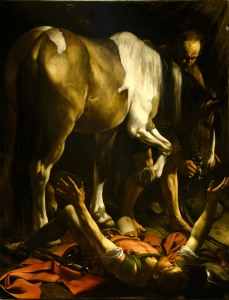 The great things that Paul achieved after his conversion stemmed from this intense closeness with God and awareness of God’s perfect love. This is what opened Paul’s heart to allow God to work through him rather than imposing his own will. When the scales fell from his eyes and he saw his life with sudden clarity, he fell to his knees in humility before God. Throughout the rest of his life, as he wrote and preached and converted a great many souls, he was ever aware that it was all due to God working in him: It is no longer I who live, but it is Christ who lives in me (Galatians 2:20). Paul knew all too well the cold, cruel man he would be without God, and thus he was able to recognize that any good fruits that flowed from his work were not due to his own power or talent or goodness, but from Jesus Christ working through him.
 Frassati Reflections