INRI: Jesus the Nazorean, the King of the Jews

The greatest love story ever told is that of Jesus Christ dying on the Cross for you.

What makes this so great is that this love story is not fictional, it is not a fairy tale, it is not a myth. This love story, of Jesus Christ dying on the Cross for you, is 100% real historical truth.

This week I was teaching my students about the importance of the Cross: how Jesus celebrated the Last Supper with his disciples and instituted the Eucharist, how Jesus was betrayed by a close friend and handed over to the Roman soldiers, how Pontius Pilate sentenced him to be crucified like a criminal, and how Jesus knew all of this would happen and willingly chose to die for each of us because he loves us.

We know how this love story ends. It ends with victory on Easter morning, because Jesus Christ rose from the dead. One student, knowing about the Resurrection of Jesus, asked if Jesus and Judas became friends again after he came back from the dead. If Judas had not killed himself and instead asked forgiveness for his offenses, do you think Jesus would forgive the man who turned him over to his death? Yes, he would. Jesus loves everyone, and Jesus dying on the Cross was for the forgiveness of everyone’s sins, no matter how big or small. You just need to ask from your heart for forgiveness.

In today’s first reading, from the book of Isaiah, we read about the suffering servant—the prophecy that spoke about Jesus Christ bearing all the sins of the world upon himself and taking them all to his death.

Yet it was our infirmities that he bore,
our sufferings that he endured,
while we thought of him as stricken,
as one smitten by God and afflicted.
But he was pierced for our offenses,
crushed for our sins;
upon him was the chastisement that makes us whole,
by his stripes we were healed.
We had all gone astray like sheep,
each following his own way;
but the LORD laid upon him
the guilt of us all.
—Isaiah 53:4–6

It was no coincidence that it was Jesus Christ on that Cross—it didn’t happen by chance. This was God’s plan for salvation. The prophets in the Old Testament told all of Israel that a servant of the Lord would bear their sins. Israel was told that the servant of the Lord would be ridiculed, humiliated, harshly treated, mocked, and scourged. It would be this servant, a man of great suffering, who would redeem the world. We often run away from suffering—not wanting to be weighed down or made to feel small and useless. We turn away and lament to be in pain, distress, or hardship. We think suffering is to be weak. But we must not think of suffering as society tells us it is—we need to look at the Cross and know that suffering is to be strong; suffering as Jesus suffered is to love.

God is not distant from us. Mankind was made in the image and likeness of God. He breathed life into us and is in the dwelling place of our hearts. God loves his children so much that his plan was to send his beloved Son to earth, so the Son could experience the hardships of sin. The second reading, from the letter of St. Paul to the Hebrews, tells us that “we do not have a high priest who is unable to sympathize with our weakness, but one who has similarly been tested in every way” (Heb 4:15). Jesus knows the anguish that you are feeling. He knows that you are scared. He knows that you are full of anxiety. He knows that you worry about how you will be able to pay your bills. He knows that you worry about the health of your family and friends. Jesus knows it all because he is fully human and fully divine. And he wants you to trust in him. Trust in the sacrificial love of Jesus.

What ever sins you have committed in the past, sins that you think are too great to be forgiven, know that Jesus has already paid the price for them. If you think that you cannot be forgiven because you commit the same sin over and over, know that Jesus wants you to go to him because he will forgive you again. If you think you are in sin and suffering because you deserve it, that is a lie. Jesus has already suffered for you and wants you to have everlasting life. Out of suffering comes good; therefore, we call the day that Jesus died GOOD Friday. It is Good Friday because our God is good. It is Good Friday because God’s love is good. It is Good Friday because out of Jesus’ suffering and death, the gates of Heaven were opened, and his Blood was poured out for you and for many for the forgiveness of sins—this is all good.

Because of his affliction
he shall see the light in fullness of days;
through his suffering, my servant shall justify many,
and their guilt he shall bear.
Therefore I will give him his portion among the great,
and he shall divide the spoils with the mighty,
because he surrendered himself to death
and was counted among the wicked;
and he shall take away the sins of many,
and win pardon for their offenses.
– Isaiah 53:11-12

This Good Friday, I invite you to meditate upon the Crucified Jesus who died for your sins. While Jesus was hanging on the Cross he said, “It is finished,” and bowed his head handing over the spirit—he did so because he loves you.
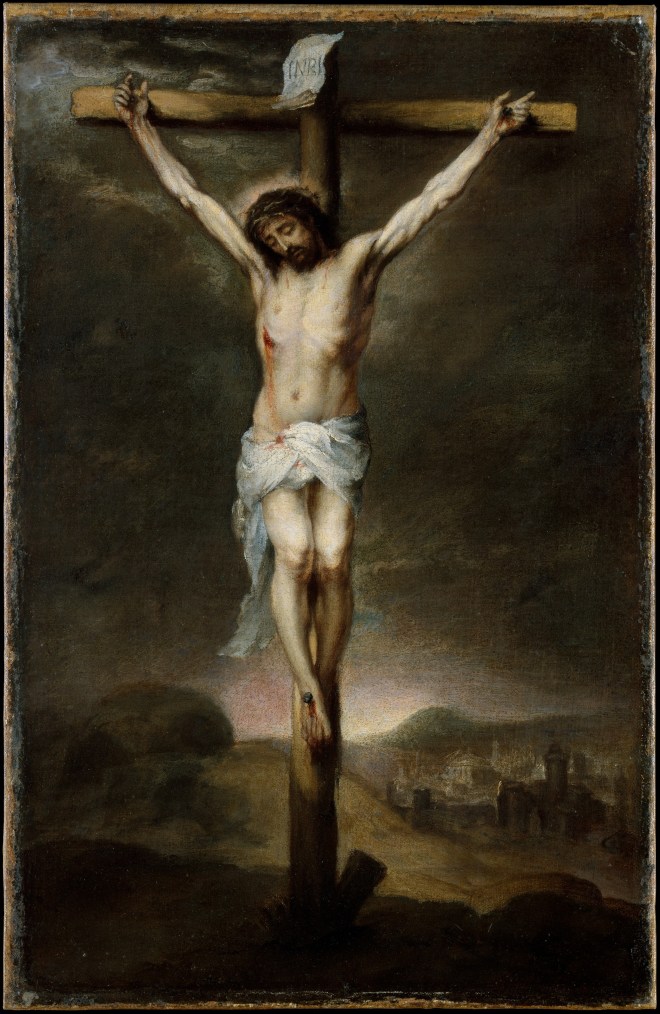
Crucified Jesus
Image Credit: The Crucifixion by Bartolomé Estebán Murillo ca. 1675 [Public Domain: Met Museum]

Hope, O My Soul


Hope is the “sure and steadfast anchor of the soul . . . that enters . . . where Jesus has gone as a forerunner on our behalf.” (CCC 1820)

Today is my mom’s birthday, which is fitting since I felt called to write on a virtue I have learned from and observed in her: Hope. My mom radiates a steadfast love for the Lord. She possesses an enduring faith. In my own lifetime, I’ve seen her place her trust in the Lord time and time again, a virtue that had been growing in her years before I was born. My mom has experienced trials and tragedy beginning in her childhood that would make many question God – yet her trust in and love for Him is what has defined her life. She has truly placed her hope in the Lord and she knows He is faithful to His promises. As Hebrews 10:23 says, “Let us hold fast the confession of our hope without wavering, for he who promised is faithful.”

Right now, the world at large is in need of hope. What does is mean to have hope? It is important for us to remember that hope is something we can grow to attain, that we can come to possess. As Catholics, we understand that Hope is a virtue. It is one of the three theological virtues – faith, hope, and charity – meaning it relates us directly to God and disposes us to live in relationship with the Holy Trinity (Catechism of the Catholic Church, para. 1812). Hope is rooted in God.

Through the eyes of faith, we see that Hope is the response to the desire for happiness that God has placed in the heart of humankind (CCC 1818). Our desire for happiness is good; our longing to have something to hope for has been placed within us by God Himself. And what is it we hope for? “In every circumstance, each one of us should hope, with the grace of God, to persevere ‘to the end’ and to obtain the joy of heaven” (CCC 1821, emphasis added).

Are you personally finding it difficult to have hope right now? If you are, you are not alone, and God wants to meet you there and grow this virtue in you. If you do have hope, praise the Lord, and let’s keep going! I know there is plenty of room for all of us to grow deeper in this beautiful virtue. And the world needs it.

The first step is re-establishing our faith in Jesus Christ and our trust in God’s promises. The Catechism gives us a simple, practical, yet profound way to both “express” our Hope and “nourish” it so it may grow: prayer. And specifically, praying the Our Father, “the summary of everything that hope leads us to desire” (CCC 1820).

So today, I ask you to join me in praying the Our Father, specifically asking the Lord to increase Hope in each of us. I encourage you to pray it slowly, pausing after each line, to allow the Truth to sink in and to profess it whole-heartedly to our Father in Heaven. This is an act of faith that will serve to remind us of the truth, the truth in which our hope is grounded. I also encourage you to call to mind Scriptures that you lean on in times of trial. Dwell on these truths to nourish your hope. I will list some Scriptures below that have been nourishing my soul lately:

Joshua 1:9 – “Have I not commanded you? Be strong and courageous! Do not tremble or be dismayed, for the LORD your God is with you wherever you go.”

Philippians 4:6-7 — Be anxious for nothing, but in everything by prayer and supplication with thanksgiving let your requests be made known to God. And the peace of God, which surpasses all comprehension, will guard your hearts and your minds in Christ Jesus.

John 16:33 — These things I have spoken to you, so that in Me you may have peace. In the world you have tribulation, but take courage; I have overcome the world.”

We must stay grounded in God’s truth. He is faithful to His promises. This will be the source of our Hope.

My friends, it is a blessing to be united in prayer with you in the midst of this difficult time. I am praying for each one of you – that the Lord is especially close to you and that you are drawing near to Him. I encourage you to take a minute now to thoughtfully pray the Our Father. …and can I ask a favor? Can you lift up my mom on her birthday — the woman who first taught me what hope looks like? I know she will appreciate that gift! Lifting up you and your intentions, my friends. May God be with you.

Hope, O my soul, hope. You know neither the day nor the hour. Watch carefully, for everything passes quickly, even though your impatience makes doubtful what is certain, and turns a very short time into a long one. Dream that the more you struggle, the more you prove the love that you bear your God, and the more you will rejoice one day with your Beloved, in a happiness and rapture that can never end.

St. Theresa of Avila, Excl. 15:3

The Land of Not Yet

One day when my friend Heidi’s son Nicholas was just two years old, he was playing in the next room with his baby sister. Suddenly little Theresa started to cry. Their grandfather called out to Nicholas, “Nicholas, are you hurting your sister?”

An honest little voice piped back, “Not yet…!”

Even at two, Nicholas understood that there was a measure of inevitability in the words “not yet.”

And yet so often as adults, when God seems to say, “not yet,” we translate that as “no” and throw toddler-like tantrums of despair. We take for granted the inevitability of bad things, but waver when it comes to good things. As the pandemic of fear spreads across the country and doomsday predictions increase, we are invited to remember the inevitability of God’s goodness, the fulfillment of all His promises.

In today’s First Reading, Abram is shown the Promised Land, but is invited to take up residence in a land of Not Yet.

He is told that he will be the father of many nations (this is repeated, multiple times), but at the moment he is the father of none, not even of one son. In fact, he will have to wait twenty-six years for Isaac! He is shown a land that will be the permanent possession of his descendants, but it is the land of Canaan. He is told that an everlasting blessing will come through him, but his life in the subsequent chapters of Genesis doesn’t show, externally, a lot of blessing. This blessing will come after hundreds of years, in Jesus.

The New Testament speaks of Abraham as “our father in faith.” Faith, Hebrews 11:1 tells us, “is the assurance of things hoped for, the substance of things unseen.”

Abraham is our father in faith because he moves through a land of promises; he lives with trust in the One who makes, and keeps, His Promises.

Abraham does not do this perfectly. In fact, after some years, he seems to doubt God’s timing, when the promised son has not materialized. He tries to speed up the promise by conceiving a child, not with his wife, but with her servant Hagar.

But even so God renews His covenant with Abraham, renews His promise for a son. Isaac is the son born of Sarah, although both she and Abraham are advanced in years.

And then God asks Abraham to sacrifice Isaac.

We cannot imagine what was going on in the heart of Abraham at that moment. What kind of a father would comply with such a command? Only one who knew the heart of his Father. He knew that God was good, that He would in some way bring good from whatever might look like disaster.

God blessed Abraham’s trust in His heart. He revealed for all time that it was not in fact His desire that we sacrifice the blood of other humans to show our love for Him. Indeed, in Jesus He would sacrifice His own blood to show His love for us.

Hebrews 11 continues:

By faith Abraham, when called to go to a place he would later receive as his inheritance, obeyed and went, without knowing where he was going. By faith he dwelt in the promised land as a stranger in a foreign country. He lived in tents, as did Isaac and Jacob, who were heirs with him of the same promise. For he was looking forward to the city with foundations, whose architect and builder is God. (Hebrews 11: 8-10)

Abraham lives in the Promised Land before it is realized externally. He is able to do this because he lives in the heart of God, lives in trust of the Promise.

This living in the land of promise, the land of Not Yet, will continue for the descendants of Abraham for centuries. Much of the Old Testament involves the seeking of this land, fighting for it, claiming it, only to be exiled from it, to return, only to be exiled again, to return, only to be living under foreign occupation.

When Jesus comes, the people are living in the Promised Land, but they are under enemy occupation. They expect the Messiah to free them.

Instead He shows them that He is the Promised Land. We know Jesus is the only Son, we know He is the descendant through which everlasting blessing will come. Do we also realize that He is the Promised Land?

This promised land is more than a real estate acquisition. It, He, is the place of providence and protection, the place for God’s family to live together in love.

Jesus Christ Has Won. Love Has Won.

Lord, hear my prayer, and let my cry come to you.
O Lord, hear my prayer,
And let my cry come to you.
Hide not your face from me
In the day of my distress.
Incline your ear to me;
In the day when I call, answer me speedily.
—Psalm 102:2–3

The responsorial psalm for today is piercing through my soul. Due to the current COVID-19 crisis in the world, how many of us are crying out to the Lord in distress, praying for a miracle? Many of us. How many of us might be feeling anxiety, fear, and loneliness? Many of us. How many of us are clinging to faith in this time of uncertainty? I hope, too, that the answer is many of us.

The last time in which I celebrated communion, I did not know it would be “the last time.” I had accepted the Body of Christ and rejoiced in a beautiful Holy Hour. I remember feeling FULL, feeling HAPPY, feeling THANKFUL. I am holding on to those feelings of peace as I obediently wait for the church doors to be opened to the public again. But, as I wait, I know that the Church is ALIVE. I know that God the Father loves all His children. I know that Jesus Christ has won.

In today’s first reading, the people of Israel were complaining about the manna bread that God had given them to eat in the desert. They had been wandering in the desert for years, only eating of the miraculous manna bread that fell from heaven to sustain their lives. Yes, they were in the hot and lonely desert. Yes, they did not have a variety of food to choose from. But the people of Israel failed to see the good within the situation that they were in; they had much to be thankful for. First, they were freed from slavery in Egypt—they had been enslaved for 400 years and God broke their chains. Second, they had food and water—the manna bread does not naturally grow in the desert; it was bread from heaven that God provided for His children to eat so they’d be nourished and remain strong. And have you heard of this rolling rock that just followed them in the desert and provided water?

As humans sometimes we tend to only focus on the bad and choose to sit with it. We neglect to acknowledge all the good that God has already done in our lives. And at times, even in the midst of living in the good of life, we fail to give proper thanks to God. The people of Israel eventually realized their sin in complaining against God and asked for mercy. God then instructed Moses to make a serpent out of bronze and mount it on a pole; anyone who had previously been ill had only to look at the mounted serpent and would be healed.

How interesting that God chose the image of a serpent to be mounted on the pole. A serpent was the creature that manipulated Adam and Eve to eat from the tree of knowledge of good and evil, causing the fall of mankind. A serpent, representative of sin; that is what the people of Israel looked at to be healed—their sins hung on a wooden pole. We also need to look at our own sin. We need to acknowledge our wrongdoings, acknowledge when we complain against God and ask for mercy. We need to look at Jesus Christ crucified on the cross. We need to see the Son of God sacrificed for our salvation. Look at the cross, walk towards it, lay all that is weighing you down at the foot of the cross, and let Jesus heal you.

Throughout the bad that is present in the world, we must keep faith to that which is good. Our faith tells us that the battle is already won. Jesus Christ died and was nailed to a cross for the forgiveness of our sins. Love has won.

These are very difficult and unprecedented times. The COVID-19 virus has affected all of us. But have faith, the Church remains alive. Pray and invite God into your life for peace. The people of Israel asked for prayer—I encourage you to submit your prayer intentions HERE so that, as one body in Christ, we can pray for you as well.

the-bronze-serpent
Image Credit: Moses showing the bronze serpent, mounted on a pole to the people of Israel [Public Domain].

What Kind of God

Recently it seemed that a wish was about to come true. It was the wish that I made the last three years while blowing out birthday candles. The wish that I had been working tirelessly for and praying for on a daily basis. I worked feverishly to prepare, past the point of pain, and then on the promised day enlisted all my friends and family to pray as well.   I was confident that God had heard my prayer, sure that it was all finally going to work out as I had hoped.

It did not.

The disappointment was crushing. At first I could only laugh at the horror of it all. But fatigue and frustration fed my feelings which quickly turned black and melodramatic. Not only was there no light at the end of the tunnel, the tunnel itself had fallen in, and an entirely new tunnel would have to be built.

The Opposition Voice began to whisper words of doubt and discouragement. “Surely if God were good, He would have heard and answered your prayer…”

I have at times in my life felt a supernatural joy, disproportionate to the circumstances, from a source that had to be More than human. This was the opposite. For just a few moments, my heart felt burdened with an inhuman aching; the pain of promises broken and dreams dashed and all the failed expectations of all my friends and family and those I don’t even know seemed to take over. Miscarriages. Broken marriages. Failed operations. Caskets lowered into the ground. Unanswered prayers of every kind. “What kind of a God do you believe in?” the voice taunted.

The devil always overplays his hand. In his very taunt he offered me the antidote: I believe in a God who is good.

I don’t know how God will bring good into or out of all of these situations. But I know He is good.

This trust in the goodness of God: the virtues of faith and hope—these are the weapons of life in the desert.

In today’s Gospel, Jesus seems to be rejecting not only the Syrophoenician woman’s request for the healing of her daughter, but the woman herself. “Let the children be fed first. For it is not right to take the food of the children and throw it to the dogs.” Yikes!

But despite the apparent harshness of Jesus’ rebuke, the woman persists, and cleverly turns around this unflattering epithet: “Lord, even the dogs under the table eat the children’s scraps.”

Scripture scholar Mary Healy notes that not only is this Gentile woman filled with chutzpa in her persistence, but she is the only person in all of Mark’s Gospel who addresses Jesus as Lord. This remarkable recognition of Jesus’ sovereignty comes not from an Israelite, but from a foreigner. She pays Him homage, falling at his feet, and in her reply expresses confidence that His goodness will include Gentiles as well.

Her faith and her persistence move Jesus to grant her request. Her daughter is healed.

The Syrophoenician woman turns out to be a model of Christian faith…She refused to take no for an answer—and her boldness is rewarded. The clear lesson in this story is that the Lord does hear our prayers, and even his apparent refusals are meant to awaken in us a yet deeper faith, which opens us to receive the gift he has for us. Few sayings of Jesus are recorded more often than his reassurance that what we ask in prayer with faith we will receive. –Dr. Mary Healy

Lord, grant us the grace to trust always in Your goodness, even when we cannot see your plan.

Michael_Angelo_Immenraet_-_Jesus_and_the_Woman_of_Canaan

Source: Healy, Mary.  The Gospel of Mark. (Grand Rapids, Michigan: Baker Academics, 2008) pp. 143-145.

Image: Michael Angelo Immenraet [Public domain]

Overcome

“Our Savior Jesus Christ has destroyed death
and brought life to light through the Gospel.” -2 Timothy 1:10

You will not be overcome.

Jesus is the Master of our hearts, and He has won the victory over sin and death. It was impossible for our Savior to be held by the bonds of evil (Acts 2:24).

This reality changes everything for us if we let it. If we dare to live fully in the truth of Jesus’ death and resurrection for us, we will be set free—not to live recklessly, but to live with radical trust and surrender to the will of God at each moment of our lives.

It’s one of the hardest things to surrender with joy to God when we’re faced with a situation that makes no sense or one that absolutely wrecks us. It can be tempting to fall into thinking that somehow we will be overcome. It can be tempting to grasp at control.

In those moments, God whispers to us, “Wait and trust.” He calls us to stick right there with Him, to keep our eyes locked on His and to let Him guide each step of the way. We can stay so close to our Lord, trusting that He will lead us in every moment, never failing us.

We are His children, and He grabs us by the hand to guide our steps, like a parent helping a child learn how to walk. He won’t let go of you.

You belong to God, and this means that His victory over all evil is your victory, too. He won’t let any amount of evil ever win in the end.

You are so loved. Sometimes, we just need to take a breath and receive that simple yet profound reminder: you are so loved by God. And you will certainly not be overcome. Let this settle into your heart.

Amen, hallelujah!

“In darkness, at times of tribulation and distress of the spirit, Jesus is with you. In such a state you see nothing but darkness, but I can assure you on God’s behalf that the light of the Lord is all around you and pervades your spirit…You see yourself forsaken and I assure you that Jesus is holding you tighter than ever to His divine Heart.” -St. Padre Pio

A worship song recommendation for this theme is “Overcome” by Sarah Kroger!

He Knows Your Heart

“The word of God is living and effective,
able to discern reflections and thoughts of the heart.” -Hebrews 4:12

Your heart is known.

Each and every part of your heart is known by our Lord, even the parts no one else knows about, the parts that carry our deepest desires and our deepest scars. And to be known by God is to be tenderly, intimately loved by God. There is nothing to be afraid of in Him knowing all of us, because He loves us totally and completely.

God knows our hearts and loves our hearts. He desires to so badly pour His love into every nook, cranny, and crevice of our hearts. The Lord waits for you in each moment to fill your soul to overflowing with His dazzling peace, with His wondrous light that shatters all darkness.

Sometimes we can find ourselves crying out to God with questions of, “why?”, “how?”, or “when?”, especially when we are struggling. God always hears and answers these questions, but oftentimes with a “who.” In those moments of uncertainty and questioning and wrestling, God so tenderly answers by pointing us to Himself.

You see, the more we know who God is and who we are as His beloved sons and daughters, the easier it is to trust that He has got every single one of our whys, hows, and whens on His Heart, too, and that He’s already working on it before we can even utter a single word.

When He knows our hearts, He loves our hearts, and everything on our hearts has His complete and total attention. He is always working for our good, in every situation.

Let yourself be known by God, and receive the beautiful intimacy of who God is, for He is love.

Praying in the Name of Jesus

There are probably a lot of souls that have been saved because of their grandmother’s prayers.

This was the thought that was said almost two years ago during a Frassati Bible study. We were studying the Gospel of John; somehow the conversation went from the topic of healing to the works of St. Augustine, which led to talking about St. Monica because it was her prayers that helped her son’s conversion, then we were talking about the intersession of our heavenly mother the Blessed Virgin Mary, and at the end of that discussion someone said that there were probably a lot of souls which have been saved because of their grandmother’s prayers. The entire discussion was led by the Holy Spirit.

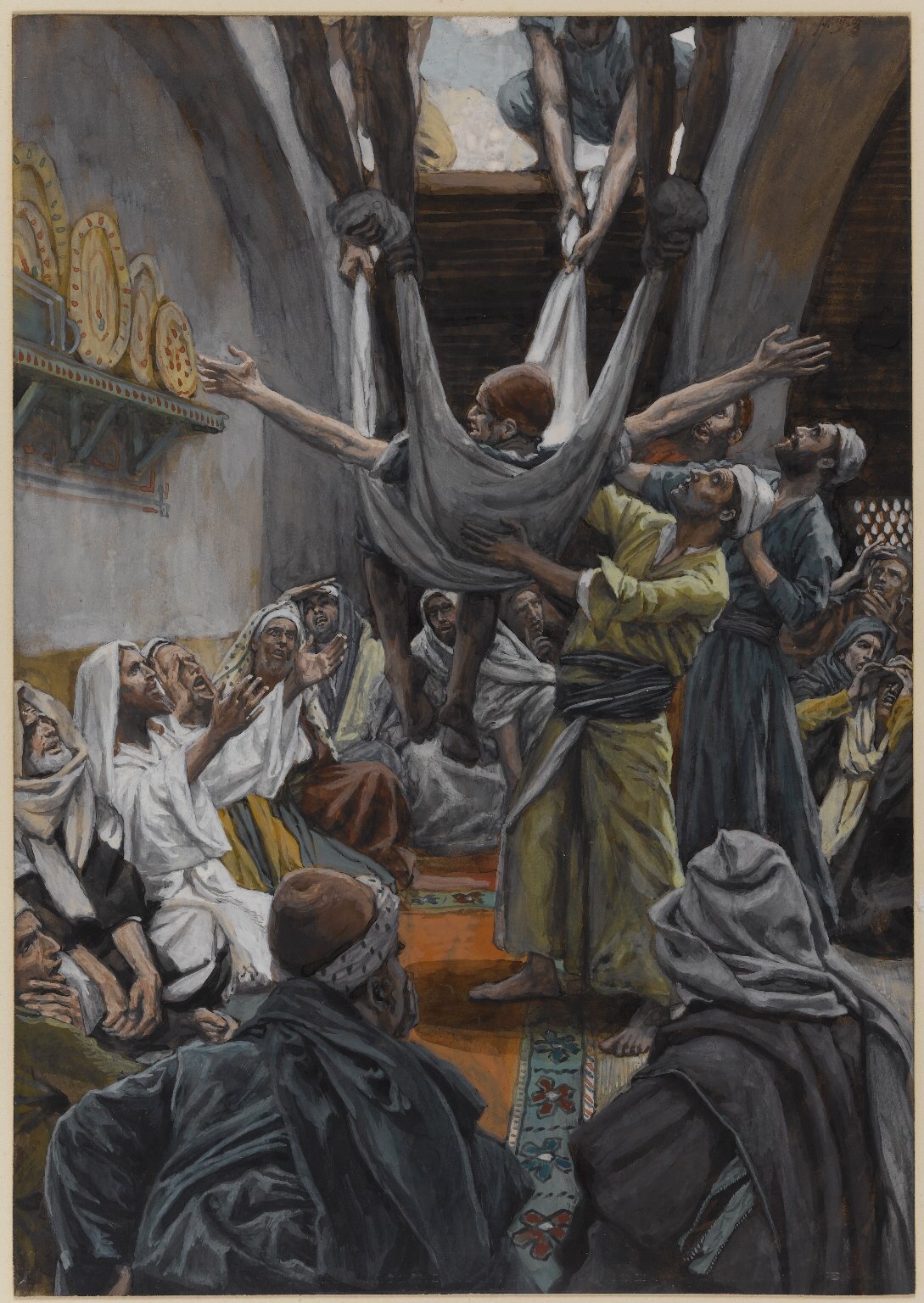
Today’s Gospel reading is about the paralytic man who gets up, picks up his mat, and miraculously walks to his home. It’s an incredible and powerful passage in Sacred Scripture. Jesus’ ministry was growing; people had come to know about his preaching and healing. While he was at Peter’s house many went over to see Jesus. So many people went to see him that the house was full—there was no room for anyone else to enter. But there was this group of friends determined to see Jesus. You see, their friend was paralyzed and unable to move, but they fully believed Jesus could heal him. As there was no room for them to enter the house through the front door, they cut a hole in the ceiling and lowered their friend into the room where Jesus was. Can you see the magnitude of their faith? Who knows the distance that they had already traveled while carrying their friend to get to the house? Then they got there, and instead of things being easy, it got complicated. They were blocked from getting to Jesus, who, they knew, could heal. I imagine them talking amongst each other at this point, encouraging one another not to lose faith and to keep doing anything possible to get to Jesus. What other way is there to get in? People will not move out of the way, it’s too crowded. We must get him inside to Jesus. He will be able to heal him. You’ve heard of all the wonders and signs he’s done. Let’s get our friend in through the roof. Yes, let’s cut open the roof to get him inside. Yes, let’s do it for our friend, to get him to Jesus!

The paralytic man was healed because of the faith his friends had; he was healed because his friends prayed, believed, and carried him to Jesus Christ. Those are the types of friends we all need. Those are the types of friends we should all be. If your friend is spiritually paralyzed due to the sin in their life, sin that is stopping them from walking on their own toward Jesus—help them. You can be that light that guides them. You can set a good example of how to live a virtuous Christian life. You can pray for them. A prayer is a conversation that your soul has with God.

Prayer, in itself, and the importance of praying for others have taken a very important part in my life. We cannot be like the people in the first reading who thought God wasn’t with them to fight in battle at their side. God is always with us helping us to fight our battles. Whether those battles be spiritual brokenness or physical illness, God is always by our side. When his children cry out, He listens. And I believe He takes delight in listening to the prayers of His children, especially those prayers (that act of love!) where we put our own needs aside and pray for the needs of others, when we pray for someone else to be healed and for them to encounter God’s love. Praying in the name of Jesus is powerful! He commanded the twelve apostles (and in turn commanded us) to “cure the sick, raise the dead, cleanse lepers, drive out demons” (Matt 10:8). God has freely given us these gifts to heal through prayer in His name, and we should freely give these gifts to others—so they may come to know Jesus Christ.

In the Gospel, after the paralytic’s friends bring him to Jesus, Jesus heals his soul and his body. The forgiveness of sins heals both the spiritual and the physical. After this miraculous healing the paralytic gets up and walks home—not just to any home, but he takes his first steps of healing amongst those who followed and believed in Jesus; he takes his first steps to walk home into the Church.

Let us give thanks to our devoted grandmothers (or anyone else!) whose prayers brought us to the Church and kept our faith alive. In turn, let us pray for our friends and relatives so they may be healed, in the name of Jesus, and so they may get up and walk home into the Church.

Image Credit: James Tissot (French, 1836–1902) The Palsied Man Let Down Through The Roof, 1886–1896 [Brooklynmuseum.org]

The Rock

Last Christmas a very generous friend gifted me a Know-It-All watch. It knows when I am sleeping, and how well. It knows when I am sitting—and buzzes “Move!” when I do so for too long. It knows my heart rate and will buzz frantically “Abnormal…!”—often during particularly still moments such as the Consecration—assuring that said heart rate will quickly climb even higher.

I keep this omniscient tyrant for two reasons: one is that it alerts me to calls, which is helpful because I frequently forget where I’ve left my phone. The other is that it tracks my steps, motivating me at least in theory to take more of them.

One morning this past spring I was traveling with some friends from college, and we were planning to enjoy a leisurely brunch before heading our separate ways. I decided to take advantage of the hotel treadmill and get my steps in early. I was pleased that by the time we sat down to brunch, I was just 50 steps short of 10,000.

It was worth it. The food was delicious and it was a delight to just relax and enjoy extended conversation. But suddenly, mid-sentence, I felt the familiar bossy buzz and looked down at my watch to see the fireworks going off, signaling that my steps goal had been reached. I was amused and bewildered. How could this be, since I had been sitting for the entire time?

“It’s because you’re Italian,” my friends laughed. “You talk with your hands….”

Today’s Gospel is about speaking with more than words. It is in fact our actions that speak to God most clearly. “Not everyone who says to me, ‘Lord, Lord, ‘will enter the Kingdom of heaven, but only the one who does the will of my Father in heaven,” Jesus tells His disciples.

Faith is something that we profess not with our mouths but with our lives. By our actions, we build our house on either rock or sand.

At the same time, faith is knowing that it is not by my own strength or power that I do good. Rather, God has made me good and empowers me to choose the good. We are free to say no to what would hinder His will, knowing that it would also hinder our happiness.

Recently I read an article with the rather bizarre assertion that Mary and Jesus could have been just as happy and holy had they told God, “No.”

The author was trying to make a case for the primacy of consent. That at the Annunciation, Our Lady had the freedom to say Yes or No to God’s proposal. This is true: Our Lady was not forced to bear the Son of God. She was invited to be the spouse of the Spirit, the Mother of the Son, but she could have said No. All heaven awaited her answer.

Any man who proposes knows the intensity of such a moment, of held breath, awaiting a reply. No lover worthy of the name would make it a matter of force. She must always have the power to choose.

And yet, with the power to choose comes the power to choose tragically. Mary could have said No. But it would indeed have been a tragedy. Nothing else she could have chosen would ever approximate what God had in store for her. Her empty autonomy could not have been on par with being the mother of the Savior of the world.

Mary, full of the love of God, trusted the goodness of God. She knew He could not and would not propose something that was not good. She knew that whatever He does through us, He also does for us. She was free to respond fully and joyfully, and she did.

We also build our actions on the rock of Christ when we trust His promises, when we choose to say Yes to something (Someone) greater than ourselves. If instead we choose to trust in human ideas, in human strength, in human plans, then we find we have built on sand.


Gratitude a Platitude?

I smiled politely but inwardly rolled my eyes and sighed. I had come far, driving for several hours across state lines for this conversation. I was searching for peace, the peace that I heard Jesus promise and holy people speak of, but that was elusive in my own life. I was experiencing darkness and angst, teetering on the edge of depression. I thought this holy priest would offer helpful advice, transformative insight, something beyond: “Try keeping a journal of things you are grateful for.”

Gratitude?!? It was vaguely offensive, this suggestion that my problems arose because I was ungrateful. And a Gratitude Journal seemed little better than a “self-help” suggestion. Surely, if self-help propaganda actually worked, it wouldn’t be an ongoing industry.

I roll my eyes harder, today, at the naïve and stubborn girl I was then. Because when I finally took this priest’s advice, years later, it was transformative.

He was right, of course, that gratitude brought with it an increase in happiness and tranquility. Science in fact confirms this: studies repeatedly show that those who practice gratitude are generally happier and healthier. But in the spiritual realm this truth runs much deeper. In recent years I have meditated often on this mystery of gratitude, and how in fact gratitude is at the heart of the spiritual life in ways that are not immediately apparent.

First, gratitude orients us toward God. Gratitude as grace is more than an expression of contentedness, more than an acknowledgement of the good things in our lives. It is a recognition of, a turning towards, the Giver of these gifts. It is not coincidence that the first prayer children learn to pray is the practice of gratitude, of receiving and responding to the goodness of God. Gratitude is the first expression of the faith that saves us.

When in today’s Gospel Jesus remarks with dismay that only one of the ten lepers He healed has come back to thank Him, it is tempting to read this as a scolding for a breach of etiquette, as though Jesus were little more than a divine first-century Miss Manners. But what Jesus is lamenting is a matter of relationship. We are called as Christians not just to be thankful for someTHING, but thankful to someONE. Gratitude turns the heart toward the Giver. It is the relationship, this coming to the Giver, that saves.

Second, gratitude increases our capacity for God’s gifts. Gratitude in turn unlocks other blessings. It is a mystery of faith that I have come to recognize experientially: our gratitude actually increases the gifts of God.

At first I was put off (again!) by this idea. It seemed to be just another quid pro quo, a means of “earning” grace by playing nice and saying the right things. Worse, it seemed to demean God, suggesting He was crankily waiting for us to respond properly before giving us more good things.

It was living in the country that I began to understand why this might be—why it was more than just spiritual tit for tat, a reward for good behavior. I had discovered early upon my move home on that our basement was vulnerable to floods, and when that spring brought prolonged record rainfall I feared the worst. But each day that I checked, the basement remained dry. It was only after weeks of dry and drought that a short burst of rain sent the water rushing in.

The reason is simple: when ground is dry it becomes hardened, and the water cannot penetrate quickly enough and so runs off the surface of it creating the flooding. But as the earth receives water, it softens, allowing it to receive more and more. Similarly, the more our hearts are open to God and His gifts, the more He can give to us without “drowning” us. The more we gratefully receive, the more we are capable of receiving what God gives us.

Finally, gratitude keeps present in our hearts and minds the goodness of the Giver. As we remember our blessings and the ways in which God has provided for our past, we carry the seeds of hope for our future, even in seasons of scarcity and suffering.

“For all that has been, Thanks. To all that shall be, Yes.”– Dag Hammarskjöld