Believe

For if you had believed Moses, you would have believed me, because he wrote about me. But if you do not believe his writings, how will you believe my words?

John 5:47

In today’s first reading, freed from slavery the Israelites are wandering in the desert. Surviving slavery, witnessing the plagues, the parting of the red sea, but more importantly, how God did not forget them, His people, yet, they quickly forgot Him who saved them. Moses leaves them to commune with God on top of Mt. Sinai, (a period of about forty days). In their perceived fear of abandonment, the Israelites ask Aaron to build the golden calf. “They have soon turned aside from the way I pointed out to them, making for themselves a molten calf and worshiping it, sacrificing to it.” They would rather worship human creations, something they can see right now, rather than wait for God who has freed them and is taking them to the promise land.

In the Gospel, the Pharisees, present a façade of faithfulness but Jesus knows, “I know that you do not have the love of God in you.”  They have had many witnesses that give evidence to who Jesus is, the writings of Moses (“But if you do not believe his writings, how will you believe my words?”), John the Baptist (“for a while you were content to rejoice in his light.“), the miracles of Jesus, and yet they refuse to see God in any of these things. “But you have never heard his voice nor seen his form, and you do not have his word remaining in you, because you do not believe in the one whom he has sent.” They worship their golden calf of pride, strict rules and empty encouragement; they too have turned away from God.

In both passages, the Israelites and the Pharisees believe they can attain the promise land or achieve eternal life on their own. We are not always wiser. Let us learn from Jesus, from scripture, from the witnesses in our lives, from the sacraments, from tradition, and from the personal relationship that the Father calls us to have with himself, that the way, the truth, and the life is through Jesus.  

In this season of lent, as we wait, as we journey further into the desert, as Jesus accompanies us, have courage and faith that the one who brought you to this point has not abandoned you, will not abandon you. Friends, believe that although you may not hear his voice, see the signs you want, have not heard a full yes or a full no, the Father’s promises are true. Believe that in your hearts, and strive to live a calling that witnesses to the immeasurable faithfulness and love of the Father. “The LORD relented in the punishment he had threatened.” His grace and his mercy are abundant and because of it, we are saved.  

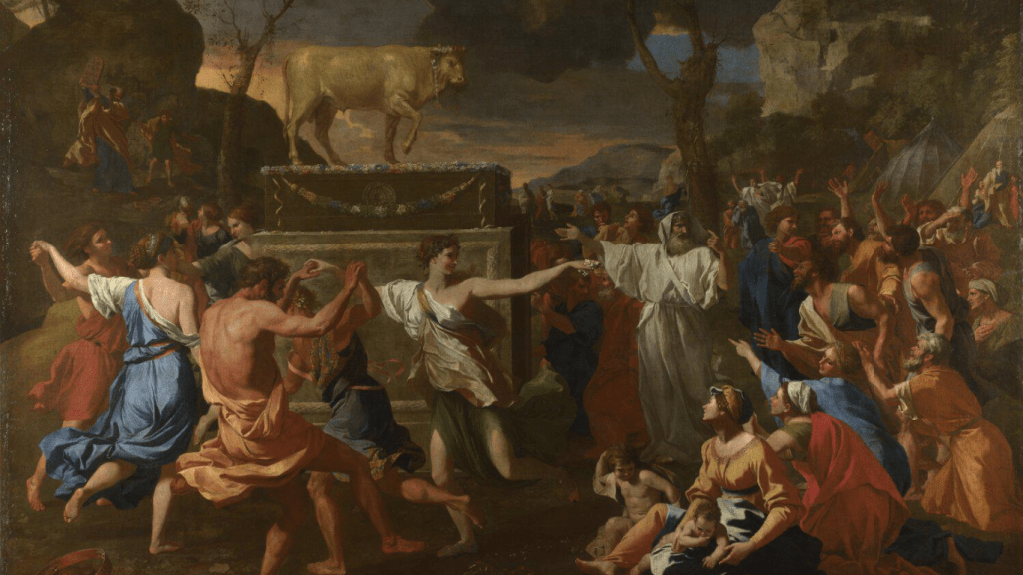
The Adoration of the Golden Calf
Nicolas Poussin

Water of Life

Water is known for its many healing properties. There is no living thing that can survive without it. Any nutritionist would emphasize that for the body to function properly, it must be hydrated. Water is the key component of every ecosystem.

“Wherever the river flows, every sort of living creature that can multiply shall live, and there shall be abundant fish.” Ezekiel 47:9

If there is fresh water, the land, the creatures and the people will be fruitful and multiply. God created water for this purpose. He gave us water to fuel ourselves and to use it in caring for this planet He created for us to live on. Water is the most crucial element on this earth. There is only one substance (or person) more crucial to life than water and He is Jesus Christ.

Jesus went into the desert for 40 days to fast not only from food but from water as well. This proves that Jesus is more powerful than the life-giving properties of water. If it is His will, we could live without water as we rest in Him, for the love of Jesus is strong enough to sustain us and even make us prosper.

This is not to say we should all give up water, believing the Lord will take care of us. God made water for our benefit. Nevertheless, just as Jesus is known as the Bread of Life, He is also called the Water of Life. When we accept Jesus into our lives and are baptized in water, our souls are revitalized with the Holy Spirit, and through faith we can see that Jesus Christ is the one and only life-giving presence we need. If we believe in Him, we will never be thirsty again.

The Greatest Commandment (Having a Heart like Jesus)

Three years ago, during Lent, part of my prayers were the words “give me a heart like Jesus.” I was in a very isolated place in my life, saddened and feeling betrayed. The only thing that gave me peace that year was reading the Bible. So, I dedicated myself to opening up the Word of God more often and I prayed that my heart could be like the heart of Jesus. I wanted the heart of that man who died loving the people who betrayed him. I wanted the heart of that man who forgave his enemies while they hammered nails into his hands and feet. I desperately needed a heart like Jesus so that I could be happy.

Each day during lent that year, I prayed for goodness and blessings for everyone which I had an estranged relationship with. It was the most intimate moment near the Cross. I prayed to the Lord, “God I don’t know what to do. I am angry and saddened. I feel hurt. I want to love these people. I want to forgive them. But I don’t know how. Take my heart and give me the heart of Jesus. Give me his heart so that I may love them. Give me his heart so that I may forgive them. Give me his heart so that I may truly want all the goodness and blessings for them that you want for them. Give me a heart like Jesus.”

The Cross is love. The Cross is happiness. The Cross is obedience.

In today’s Gospel reading Jesus is asked what is the greatest of all the commandments? In first-century Palestine it was much of a debate to know which of the 613 mosaic laws was the most important to follow. Jesus immediately quotes Scripture saying the Shema, “Hear, O Israel! The Lord our God is Lord alone!” Loving God above all else, with all of our souls, with all of our hearts, with all our minds, with all of our strength— that is the first of the greatest commandment. Quickly Jesus says that the second greatest commandment is loving your neighbor as yourself.

It almost seems as if Jesus gave the scribes two different answers when their question was in search for one answer, the most important commandment of all. But the scribe understood what Jesus meant in giving them the two greatest commandment together. There is only one God in all the universe who created everything, and to love the God of Israel with everything that you are automatically means that you love your neighbors, God’s children. These two commandments are inseparable. You cannot fully follow one while ignoring the other.

How can you say you love God, but in your everyday actions you dismiss and ignore the needs of your brothers and sisters in Christ? How can you say you love God when you ignore those that are hungry, without shelter, are sick, or imprisoned? Can you say you love God when you walk past someone in the midst of their struggles, marginalized and not see the face of Jesus? God would never ignore us, never abandon us in our need. To follow the greatest commandment is to love like God, to have a heart like Jesus and be charitable towards everyone because you recognize their dignity— that they were made in the image and likeness of God.

Following the greatest commandment isn’t easy. I have failed and fallen many times. I have purposely told God, no I’m not loving this person today because they made me upset or I’m not loving that person today because their struggles don’t affect my way of life and I am going to sit with my anger and my comfort for a while and not care for them. I allowed sin to consume me. But Jesus died out of love for his enemies! He died out of love for you and for me. The virtue of charity calls for us to be all self-giving. Blessed Pier Giorgio Frassati says that to follow the greatest commandment is to conform our entire lives to loving God and loving our neighbor because this is the essence of the Catholic faith.

Pray friends, that this Lenten season brings you closer to the Lord, that you may grow in the virtues of faith, hope, and charity. That you may have a heart like Jesus and through him be obedient to the greatest commandment.

“Each of you knows that the foundation of our faith is charity. Without it, our religion would crumble. We will never be truly Catholic unless we conform our entire lives to the two commandments that are the essence of the Catholic faith: to love the Lord, our God, with all our strength, and to love our neighbor as ourselves… With charity, we sow the seeds of that true peace which only our faith in Jesus Christ can give us by making us all brothers and sisters. I know that this way is steep, and difficult, and strewn with thorns, while at first glance the other path seems easier, more pleasant, and more satisfying. But the fact is, if we could look into the hearts of those who follow the perverse paths of this world, we would see that they lack the serenity that comes to those who have faced a thousand difficulties and who have renounced material pleasure to follow God’s law.” – Blessed Pier Giorgio Frassati

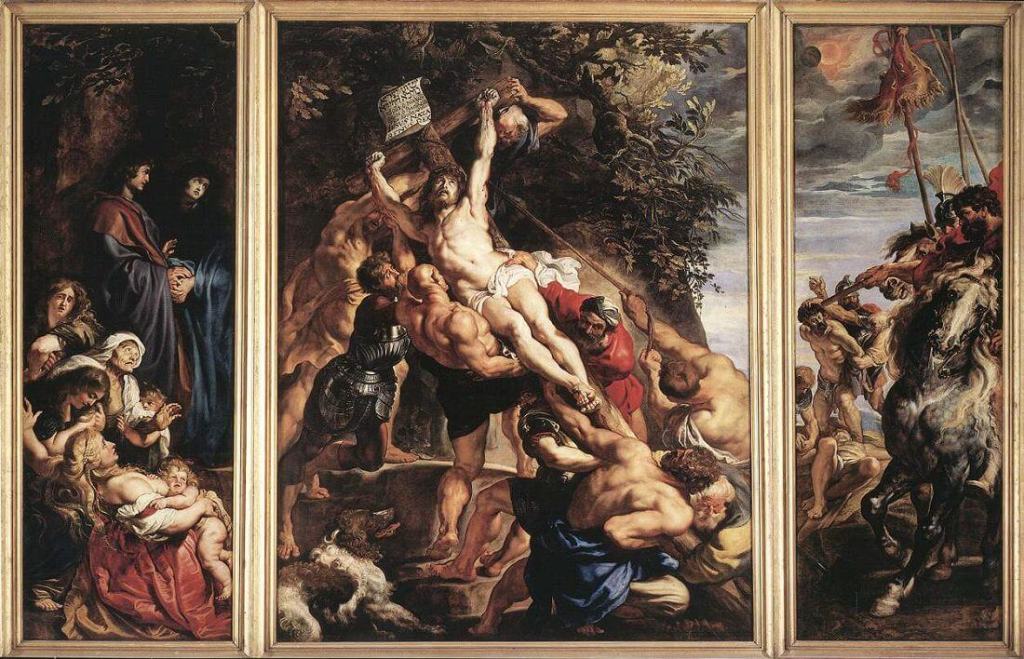
Peter Paul Rubens. The Raising of the Cross. 1610. Cathedral of Our Lady Antwerp, Belgium.

Divisiveness

Jesus was driving out a demon that was mute,
and when the demon had gone out,
the mute man spoke and the crowds were amazed.
Some of them said, “By the power of Beelzebul, the prince of demons,
he drives out demons.”
Others, to test him, asked him for a sign from heaven.
But he knew their thoughts and /quotesaid to them,
“Every kingdom divided against itself will be laid waste
and house will fall against house.
And if Satan is divided against himself, 
how will his kingdom stand?
For you say that it is by Beelzebul that I drive out demons.
If I, then, drive out demons by Beelzebul,
by whom do your own people drive them out?
Therefore they will be your judges.
But if it is by the finger of God that I drive out demons,
then the Kingdom of God has come upon you.
When a strong man fully armed guards his palace,
his possessions are safe.
But when one stronger than he attacks and overcomes him,
he takes away the armor on which he relied
and distributes the spoils.
Whoever is not with me is against me,
and whoever does not gather with me scatters.”

Luke 11:14-11:23

What a reading for today’s gospel, friends. Today I was given the privilege of discussing one of the most oft-quoted passages in the gospel: “Every kingdom divided against itself will be laid to waste and house will fall against house. And if Satan is divided against himself, how will his kingdom stand?”

As many of you may know, it’s one of the most famous lines of the gospel, and plenty of theological discussion has been had about just these two verses. It has of course, even seeped into larger popular culture and if you’ve ever seen Seinfeld, you know how it’s mentioned—it’s even reached sitcoms, albeit with the message subverted for some comedic effect. But moving on from my tendency to ramble on or make pop culture references, there are two things to note from today’s gospel reading.

First, note how Jesus rebuffs the townspeople who demand a sign from Him to prove He is from Heaven. Jesus, of course, “knew their thoughts,” and rather than give in to their demands, Jesus simply gave words of wisdom. Jesus, of course, also rebuffs Satan in a similar fashion when He is in the desert for 40 days. (Feed himself and abstain from fasting? No. Christ speaks, “Man does not live on bread alone.” See the temptation of Christ in Matthew, Mark, and Luke.)

Rather than forcefully show his divinity to appease people, Jesus speaks the truth as He does to Satan. However, on another dimension, this often reminds me of the relationship we may have with Christ. Do we often make “deals” with Christ to prove He loves us? Do we often “ask for a sign from Heaven?” Have any of us ever prayed for something and claimed we’ll change our ways or stop habits that engender sin if we get something in return? And do we then simply forget to lead lives of virtue not because it was “proven” to us that God loved us, but because we should strive for lives of virtue because loving God is the ultimate good? This focus on virtue is something I want us to keep in mind because it’s significant. Thomas Aquinas cites caritas as “love,” or more specifically, the type of friendship based in the “the love which is together with benevolence, when to wit, we love someone so as to wish good to him.” (See Second part of the Second part, Question 23 of Summa Theologica.) Additionally, Aquinas writes that caritas moves us to order our lives properly, gradually leading us to love and desire God for His own sake and nothing else. This “good” and the move towards virtue is what I want to focus on.

Second, God, Christ, and the Holy Ghost are one and united within the Holy Trinity. We are united with Christ, and we should expect to be in His good graces by living lives of virtue, leading others to Him, and by of course, loving Him. Why else did Christ call for the Great Commission? Well, for one, Christ knows that Satan is the one who causes division. This is especially apt when Christ makes the townspeople ask themselves, “If I drove out the demons by Beelzebul, well ok, how do you do it then?” This of course leaves them speechless. But which division am I speaking of? For some, it could be a loaded question. There is, of course, enough division in the American political sphere but that’s not where I’m going. In my experience, we as Catholics often do not present a united front or send an accurate reflection of our beliefs to Catholics and non-Catholics alike. Many explanations have been given from time to time for a decline in faith in America—changing cultural practices, postmodernism, inaccurate catechesis, etc. There is no singular answer, and debates rage on. The Lord said to His disciples that the gates of hell would not prevail against His Church, but we could still lose an untold number of souls if we send often-conflicting messages and signals to others about our beliefs and practices. If the mission of Holy Mother Church is about saving souls, then sometimes we should be aware that how we may act and express ourselves could be sowing division. Even unintentionally!

Disagreements are often messy, but necessary. But I’m not talking about differences in opinion, I’m talking about divisiveness within the larger Church and the family unit. And as you can imagine, it can be an awkward conversation and can stir a lot of passions from a lot of people.

When the fall of man happened, a consequence of original sin was a disruption in our relationship with God. We know this and the Catechism of the Catholic Church talks about this as well.  We know this almost immediately from reading Genesis because upon eating the forbidden fruit of the tree, Adam does two things. First, he hides from God, because his relationship with the Lord has been disrupted due to sin. Second, he almost immediately blames Eve for his sin. This is something I have often seen in talking to spouses and it’s unfortunate—blaming your spouse for one’s sin. We have to remember—we’re supposed to be helping lead our spouse to Heaven! This is something we often see in families, often a core element of one’s growing up—a lot can be traced to early family life. Even sociologists and adolescent psychologists speak about how a child’s performance in school can be affected due to a messy and turbulent home. I don’t want to quote Jordan Peterson at length or ask your opinion of him, but he’s not exactly wrong when he states that for a lot of men, we have to keep our “house” (literal and metaphorically) in order. If we’re divided against ourselves due to sin or despair, how can we lead lives of virtue?

I’ve spoken at some length previously in prior reflections how one’s home life—however unfortunate—can lead to disruption in the life of faith. Adam refuses to take responsibility for his actions, blames his wife, and he is in essence, a symbolically divided individual. For me, when my father left at an early age, I traced the absence of an earthly father to our Heavenly Father not caring for me. In my experience (at least anecdotally) in talking with other Catholic men, this rings true. An absence of a father, divided families, leads to disruptions in the life of faith and brokenness and woundedness that we then unfortunately (and incorrectly) associate with God not caring or “abandoning us.”  Because the adage goes, if we can’t trust an earthly father, how can we trust our Heavenly Father? (We of course can. I am of course not dismissing woundedness in any way.) This then, of course, leads to a symbolic and literal divisiveness in each one of us. That’s divisiveness in the family and in our own lives affecting the life of faith.

However, there is another kind of divisiveness that I see that happens in how we express our thoughts on other Catholics we may disagree with. And I’ve been guilty of doing it a few times just as well. We often lob terms of “liberal” or “conservative” Catholic as insults and pejoratives in the context that we feel certain groups of people are not fully living holy lives. Mind you, however, that’s not to say fraternal correction is never necessary. It absolutely is needed at times. And Church teaching is well, Church teaching for a reason. Doctrine is not subject to change. I don’t have to explain what these terms mean—you’ve all heard some variation of what they mean and simply giving my take on what terms these may or may not mean isn’t instructive in the slightest. Point being—both of them have nuggets of truth, but not in ways you might expect. My larger point? Every Catholic should be “conservative” in that we wish to pass on, live, and conserve sacred truths of the Apostolic and lived faith. Every Catholic should also similarly be “liberal” in that we wish to “liberate” people from sins as Holy Mother Church asks of us so that we all can lead truly holy lives. I’m reminded of my therapist’s tattooed wrists—she tattooed broken chains on her wrists to demonstrate her life of faith was to show that by following Christ, she was choosing a life away from sin. Free of the chains of sins. Liberated.

But why do people use the terms “liberal” and “conservative”? For one, It’s often a woefully convenient (and inconvenient) shorthand in American politics, but it’s not entirely accurate and it unfortunately leads to a lot of divisiveness. One may have “liberal” or “conservative” ways (on a larger level of public policy for example) how best to feed the hungry, give drink to the thirsty, and clothe the naked. But most people will tell you they want to alleviate poverty and show the poor person Christ’s love. And of course, perform the corporal works of mercy. And why shouldn’t we?

Today’s gospel reading is not lost on me during this time of Lent. Divisiveness leads us away from Christ, Our Lady, and Holy Mother Church. Jesus is not ambiguous or vague. We should put our faith in Him and turn away from lives of sin and turn to Him. Or scatter.

Pillar of Cloud

“For what great nation is there
that has gods so close to it as the LORD, our God, is to us
whenever we call upon him?
Or what great nation has statutes and decrees
that are as just as this whole law
which I am setting before you today?

“However, take care and be earnestly on your guard
not to forget the things which your own eyes have seen,
nor let them slip from your memory as long as you live,
but teach them to your children and to your children’s children.”

—Deuteronomy 4:7–9

In today’s first reading, Moses speaks to the Israelites and reminds them of all that the Lord has done to lead them out of Egypt, through the wilderness, and into the Promised Land, which they are about to enter. His admonition to carefully keep God’s commandments is accompanied by this call to remember, to repeat the stories of the marvels God has done for this people through every generation. Moses knows that the people will struggle to carry out God’s commands, but if they keep those stories close and kindle a devotion to the God who has rescued them from slavery and led them through the wilderness, they will be more likely to observe God’s law because of their love for Him.

While they traveled in the wilderness, God led them in a more tangible way: in a pillar of cloud by day and a pillar of fire by night. As they enter into the Promised Land, His guidance will not be so immediately apparent. As they enjoy all the new comforts of the land, it will become all too easy to forget their need for God. And so Moses implores the people to remember: to keep God’s Word engraved upon their hearts, instilled in the minds and hearts of their children, and ingrained within all their habits and traditions. The covenant God has made with them is everlasting; it should be the root and foundation of their lives, for all generations. We see Jesus affirm this in today’s Gospel reading, that He has come not to abolish but to fulfill the law. Jesus brings to fruition every letter of these promises that Moses is asking the Israelites to remember.

Right now, we are approaching spring, both literally and metaphorically. The snowbanks are melting, and buds are just starting to appear. We are still in the midst of the long winter of this pandemic, but it feels like we might be beginning to see the light at the end of the tunnel. During this past year, we have been brought to our knees by suffering, loss, anxiety, and helplessness. As our lives start to get somewhat back to normal, let us look to Moses’s admonition and not forget what God has done for us in the wilderness. Even in the most difficult moments, even when we strayed and complained and doubted in Him, He has been leading us. As we transition from night into day, God will continue to lead us, but by a pillar of cloud instead of a pillar of fire; we must adjust our eyes to keep our focus upon Him.

By day, we are led by Mystery; by night, we are led by Fire and Light. In our darkest moments, the Lord draws us forward by illuminating the path at our feet: always just the next few steps, leading us as a beacon in the night. We may be overwhelmed by the unknown terrors that surround us, but He stays before us, and we follow close, utterly dependent on His Light. But in the daylight of our lives, when we are surrounded by so many distractions and could go any way we choose, His Presence is the one thing that is veiled in mystery, drawing us toward a divinity beyond our comprehension. In the daylight, it can be all too easy to allow our eyes to drift away from that pillar of cloud and instead grasp toward things that we can take hold of and understand.

Sometimes it seems easier to follow God by night, when we are in survival mode and it seems there is only one possible step to take at a time, than by day, when we are overwhelmed by distractions and indecision. Whenever we find ourselves in this place, let us remember Moses’s call to remember, to set God at the center of our hearts and recall all the marvels He has worked in our lives. Then, as we travel onward, we can turn our eyes toward the cloud of His Presence, gently guiding us deeper into His Mystery.

Prayer of St. Elizabeth of the Trinity:
O my God, Trinity whom I adore, help me to forget myself entirely that I may be established in you as still and as peaceful as if my soul were already in eternity.
May nothing trouble my peace or make me leave You, O my Unchanging One, but may each minute carry me further into the depths of Your Mystery.


1. Benjamin West, Joshua Passing the River Jordan with the Ark of the Covenant / PD-US
2. Ivan Aivazovsky, Passage of the Jews through the Red Sea / PD-US

Tough Love

The Lenten readings lately have been filled with seemingly harsh messages presented by the Lord to His people. It might be easy to fall into the comfort our faith usually provides–God is “love” after all. Nevertheless, we need to remember that true love stories are not simply “gumdrops and butterflies.” My dad repeated a quote from Matthew to me recently: “And do not be afraid of those who kill the body but are unable to kill the soul; but rather fear Him who is able to destroy both body and soul in hell.” (Mt 10:28). My dad made the point that Jesus was not referring to Satan, the one I always assumed Jesus was speaking about. Jesus was referring to His Father, our Father. How easy it is to forget the immeasurable power of God! Satan can tempt us, torture us, and try to kill us but he has no control of who is actually damned to Hell. That decision is God’s and God’s alone.

Lent is a season of reflection, when we look back at our sins and repent. We owe everything to God; without Him, we are dust and into dust we will return. One of the most difficult issues I personally struggle to overcome is selfishness. I become so upset when my life goes awry–I immediate ask God to fix the problem, and because He is my Father, I expect Him to do so. Then I remember that without Him I have absolutely nothing. There is no reason I can present to Him that would provide solid grounds for Him to give me anything I want. The only reason He does what He does for me is His divine mercy.

These lessons that Jesus sets before us in the recent readings are harsh and can create fear in us at times. What is to stop our Master from handing us over to the torturers until we pay back the whole debt, as Jesus speaks of in the parable in today’s Gospel. It harkens back to that central truth: God is Love. Because He loves us so much, He wants us to learn from these harsh lessons. He wants all His children to enter the kingdom of Heaven, and the only way to get there is to love Him enough to take these lessons to heart. Love is hard; it is not meant to be easy. Jesus came to show us not just the beautiful side of love, but its tough side as well.

The Voice of Jesus

Recently, I have been sensing in myself, friends, and family what I’ve heard called “pandemic fatigue.” It’s been about a year now of tragic loss, lockdowns, and gripping fear. Sometimes we forget what ‘normal’ felt like. We are ready for this pandemic and its effects to be over.

Where do we turn with our pandemic fatigue? As Christians we know we can always turn to Jesus Christ. And hopefully we do. And hopefully we feel the strength, grace, and love He gives us. If it’s been difficult for you to feel His love for you, I encourage you to reflect on your days and ask Him to help you recognize Him.

Today’s readings tell us the Old Testament story of Joseph and his jealous brothers. His brothers, envious of their father’s esteem and love for Joseph, sell him into Egyptian slavery. Ultimately, his brothers devious plan can’t keep God’s plans for Joseph from coming to fruition and Joseph becomes a great prophet in Egypt. When his brothers meet him years later they don’t even recognize him until he reveals himself to them.

The Gospel tells us a parable with a similar theme — a vineyard owner leases his land to tenants who fail to produce the fruit of the vineyard and mistreat and kill those who the landlord sends for the fruit of the harvest. He sends his son expecting them to respect him and instead they kill him hoping to get his inheritance. However, their blindness will cost them their true inheritance and the Kingdom of God.

Both of these stories foreshadow Jesus Christ himself and remind us that there are those who reject Jesus and those who receive Him. The latter will bear great fruit for the Kingdom of God and inherit it. It is important to note that Jesus was telling this parable to the chief priests and elders of the people — a group who likely thought of themselves as pious and holy.

Therefore, I say to you,
the Kingdom of God will be taken away from you
and given to a people that will produce its fruit.

Matthew 21:43

This trying pandemic season rightfully has us weary and yearning for times and experiences we once took for granted. Let us learn from the bad examples in the readings today — it is all too easy for us to fail to recognize Christ in our day to day and moment to moment. We aren’t called to a feigned happiness, but we are called to a true gratitude and joy in the knowledge of the blessings He has given us, beginning with the possibility of eternity with Him. No weariness, no burden, no sadness is to deep that He has not lived in the depths of it. And somehow, if we invite Him into whatever we are experiencing, He promises joy in the midst of it. We must challenge ourselves to recognize Him. Let us not reject the cornerstone, let us seek and recognize Him.

Lord Jesus, help me to see you. Help me to recognize you daily. I bring all of the joys and sorrows of my day to you, and I ask you to be with me through it all. I want to see you. Help me to see your hand in my life. I give you thanks and praise for all that you are and all that you’ve done. Amen.

I encourage you to listen to this song and allow the lyrics to wash over you: I Heard the Voice of Jesus (link also below).

I heard the voice of Jesus say, 
“Come unto me and rest.
Lay down, O weary one, 
lay down your head upon my breast.”
I came to Jesus as I was, 
so weary, worn, and sad.
I found in him a resting place,
and he has made me glad.

I heard the voice of Jesus say, 
“Behold, I freely give 
the living water, thirsty one; 
stoop down and drink and live.”
I came to Jesus, and I drank 
of that life-giving stream.
My thirst was quenched, my soul revived,
and now I live in him.

I heard the voice of Jesus say,
“I am the dawning light.
Look unto me, your morn shall rise,
and all your day be bright.”
I looked to Jesus, and I found 
in him my star, my sun,
and in that light of life I’ll walk 
till trav’ling days are done.

The Lord Has Spoken

When the Lord speaks, His people listen. When Jesus came to earth, He was the Word of God made flesh. During His ministry, it is noted several times that Jesus spoke “with authority.” Before Jesus Christ, the Jewish people listened to “rabbis” because they had authority. The Scribes and the Pharisees had learned the law of Moses and this entitled them to their high position.

Suddenly, a carpenter’s son arrives on the scene and speaks with the same authority, but instead of agreeing with the rabbis, He rebukes them. “Therefore, do and observe all things whatsoever they tell you, but do not follow their example. For they preach but they do not practice” (Matthew 23:3). Jesus was speaking the Lord’s words and consequently, people listened.

It must have been truly difficult for Jesus’ audience to accept Him. People still had no idea who He really was. Nevertheless, people gave up everything to follow Him because they recognized the truth. Today, we know who Jesus is and that the words He spoke are truth. However, the temptation not to listen remains.

This might be the greatest example of the power of sin. Through our faith, we cannot deny who Jesus is and what He is asking us to do, yet we continue to stray. We may not have Pharisees and Scribes to whom we could listen, but we have political figures, celebrities, and social media. “All their works are performed to be seen. They widen their phylacteries and lengthen their tassels. They love places of honor at banquets, seats of honor in synagogues, greetings in marketplaces, and the salutation ‘Rabbi'” (Matthew 23:5-7). Just as the people of Jesus’ time were influenced by the Pharisees, people today are drawn to the false glamour of this world promoted by other leaders.

In this time of Lent, we are presented with an opportunity to repent and listen to the word of God once again. The act of humbling ourselves and remembering who our Father is and what He has done for us may not be easy, but the rewards of taking advantage of this opportunity are great, so great that we cannot even begin to imagine the rewards that await us in Heaven.

Prayer

When I was growing up, saying my daily prayers was just a chore or an obligation that I had to do because my parents told me to. I would recite the words as instructed by them. I probably knew the “Our Father” before I knew my ABCs. My kindergarten teacher called me her “prayer warrior” and said I knew what was important! Now prayer seems to have become impossible to get right for the average person. By the time I entered high school I had mostly given up on the practice of prayer because I assumed I wasn’t doing it correctly.

Reciting prayers didn’t work because I focused on the memorization of the words in each prayer. Once I did memorize one, saying it became more habitual, instead of actually being able to meditate on the words it contained. When I tried simply speaking with God, I fell into the temptation to give Him a long wish list of what I wanted: prayer transformed into the Godly version of a letter to Santa at Christmas. Making the situation more complex, there are countless books about prayer and the “right” way to pray. I have never been a reader, and never did well with being told how to do a task; I usually just gave up.

Taking all these factors into account, I wonder why Jesus Himself says that the right way to pray is through the “Our Father.” For the majority of my life, I thought Jesus meant that the only way to talk to God was by saying those exact words. Jesus was providing a gateway–when I am completely lost and don’t have any words and all my strength is gone, I say the “Our Father.” The true miracle happens next, when the “Our Father” empowers me to keep going deeper into prayer. “Thy will be done” allows my mind to release its own inhibitions and the prayer is no longer my own–it is the Holy Spirit’s. The key to prayer is not to worry about getting it right, but to open your soul and allow the Holy Spirit to take control and guide you to “Our Father.”

Choose to Live

“I call heaven and earth today to witness against you:
I have set before you life and death,
the blessing and the curse
.
Choose life,” Deuteronomy 30: 19-20

“I have set before you life and prosperity, death and doom.” Moses will experience this soon, as he will be unable to enter the promise land. The choices we make in life everyday are about life and death. Is that too dramatic? Yes and no. Yes because we are bound to fail but God can always take our crooked paths and straighten them. No, because we have to choose to say yes to God, daily.  

Are we making decisions based on God’s will or our will? Are we allowing God to penetrate those dark places in our hearts and mind and illuminate them? Are we allowing him to transform us? We live in a world where every desire seems available to us, every need you could have should be met, everyone has a talent or gift displayed on social media. People seem to be living very much abundantly…but it is all distorted if those gifts, talents and desires are not orientated towards God.

Let us pause and think of our current appetites, wants and needs. Are they of God? Or is it of greed? Lust? Desperation? Do they bring glory and honor to God? Or am I ready Lord to put it to death? To surrender what I think is life and give it to you? This is what Jesus calls us to do, “daily.” To give up our trappings, what we believe are necessities, so that He can gives us the gift of a full life.  “If anyone wishes to come after me, he must deny himself and take up his cross daily and follow me.”(LK 9:23) Jesus asks us to put death those things that get in the way of our joy, loving the lord.

I can admit that this is the first time I have read this sentence and noticed the word, “daily.” Daily, is not only during lent, it is every day. Every day we must choose the abundant life that God has imagined, created and laid out for us…even if we cannot see it or even feel it on some days. There is hope in every new day. Say yes again. It is not always easy because God’s timing is His, and my way seems faster and easier, but no decision I have made without Him, outside of Him, was better.

Choose life, then, that you and your descendants may live, by loving the LORD, your God, heeding his voice, and holding fast to him, for that means life to you.” (Deut. 30: 20) Everyday allow yourself the space and time to ask the Holy Spirit for wisdom and bring those decisions (big or small) before the Lord. Allow God to transform your will so that it is conformed to His will for you. Choose to live and hold fast to him, for He is your life. 

Lord today we pray for our conversion, daily. For our hearts, ears and mind to be transformed by your love and wisdom. That we put to death, daily, the disordered appetites and thoughts that prevent us from loving you with our whole life. In Jesus’ name we pray amen.