Born Again

There was a Pharisee named Nicodemus, a ruler of the Jews.
He came to Jesus at night and said to him,
“Rabbi, we know that you are a teacher who has come from God,
for no one can do these signs that you are doing
unless God is with him.”
Jesus answered and said to him,
“Amen, amen, I say to you,
unless one is born from above, he cannot see the Kingdom of God.” 
Nicodemus said to him,
“How can a man once grown old be born again?
Surely he cannot reenter his mother’s womb and be born again, can he?”
Jesus answered,
“Amen, amen, I say to you,
unless one is born of water and Spirit
he cannot enter the Kingdom of God.
What is born of flesh is flesh
and what is born of spirit is spirit.
Do not be amazed that I told you,
‘You must be born from above.’
The wind blows where it wills,
and you can hear the sound it makes,
but you do not know where it comes from or where it goes;
so it is with everyone who is born of the Spirit.”

Jn 3:1–8

Hello friends,

Today I’m given one of those passages that is often misquoted or used in a way unfamiliar to us—this is often called the “born again” dialogue. If you’re like me, you probably have family members that are non-Catholic Christians. I have several family members that are Jehovah’s Witnesses and take the born-again dialogue much differently than we do. In fact, they read the born-again dialogue quite literally, and in a way unfamiliar to us.  A lot of people are surprised when I tell this story, but I was once raised as a Jehovah’s Witness for several years in my youth under the recommendation of my aunt. She is still a Jehovah’s Witness. I, of course, am not. For many years, this resulted in many, many arguments—ironically stemming from a dialogue in the gospels about seeing and accepting Jesus as our Lord and Savior.

Oftentimes, in my younger years, the conversation would go like this: “Are you born again, Ryan?” “Yes, Tía Pilar, I was born again when I was baptized.” “No, no, you have to be born again in water, and as a Jehovah’s Witness.” (Tía means aunt in Spanish. All of my family members are of Ecuadorian descent. The majority of them have since splintered to Europe or the States.) This, of course, in my much more combative years, resulted in me being combative about how the truth needed to be discussed, rather than my being more charitable with a family member even though we stringently disagreed on matters of faith. The one thing we absolutely agreed upon was that baptism was the way the unsaved were brought to Christ. Ironically enough, this “born again” dialogue led to divisiveness between me and several family members. We weren’t talking about Jesus anymore, we were arguing over the phone. (Even though I pray for her that she returns to the Catholic Church, we no longer argue over the phone.) Evangelization, as you’re quite aware, can often lead to quite heated moments.

Amusingly enough, we were talking about evangelization in my Lay Dominican formation class. It was a separate discussion that diverged from a larger discussion about Aquinas and the works of mercy. But one point we all agreed upon is that taking a largely combative stance during evangelization efforts “makes you lose the floor.” That’s sort of how it also is during arguments, right? Even amongst significant others and friends, if you raise your voice, both of you lose the floor. Even politics is tinged in this way for a reason—seeing a politician upset or livid about anything garners sound bites whether they’re in the right or wrong.

Jesus Himself says, “Amen, amen, I say to you, unless one is born from above, he cannot see the Kingdom of God,” and, “Amen, amen, I say to you, unless one is born of water and Spirit he cannot enter the Kingdom of God.” For Nicodemus, he was obviously baffled, because he at first takes Jesus’ words literally—how can anyone return to their mother’s wombs? Jesus, of course, speaks of being born of water and Spirit. The Catechism of the Catholic Church speaks of this further, “One becomes a member of this people [the Church] not by a physical birth, but by being ‘born anew,’ a birth ‘of water and the Spirit,’ (John 3:3–5) that is, by faith in Christ, and Baptism” [CCC 782].

For my aunt, this is where the biggest point of contention was—what being born again consisted of. For my aunt, it sort of amounted to the fact that I must have had a major, epiphanic, “come to Jesus moment” in my adulthood. However, what I would tell the non-Catholic Christians I have disagreements about this with is to remember that we do have “come to Jesus” moments. At every Mass, I confess my sins and accept Christ, and every time I go to confession I accept Christ and accept His forgiveness and try to keep on the path towards holiness. The early Christians and Church Fathers knew of “being born again” via a trinitarian baptism, for example.

St. Pope John Paul II takes this a bit further, and this is really what I want to end on. He wrote in Catechesi Tradendae of “the problem of children baptized in infancy [who] come for catechesis in the parish without receiving any other initiation into the faith and still without any explicit personal attachment to Jesus Christ” (CT 19). To make the point more explicit, St. Pope John Paul II says, “It is true that being a Christian means saying ‘yes’ to Jesus Christ, but let us remember that this ‘yes’ has two levels: It consists in surrendering to the word of God and relying on it, but it also means, at a later stage, endeavoring to know better—and better the profound meaning of this word” (CT 20). In other words, being born again as following Christ requires a *commitment* to follow Him as His disciple.

What I want to focus on is this “yes.” Do we say yes? Or do we adopt an attitude of combative behavior while we evangelize? Do we focus on commonalities while evangelizing and then take it from there? When we make critical remarks about other Christians, are we still making that commitment to that “come to Jesus moment” we have at Mass? Are we helping others come back to faith when they struggle or when they feel they have strayed too far? When we see others who are perhaps misinformed or have sincere questions about the faith, do we scoff at them? Or do we help them understand what the faith and catechism teaches? The old adage of “it takes a village to raise a child” does have some merits when we remember that we—all of us—are the Body of Christ. Even while we believe trinitarian baptism is valid, the work is simply not finished once we are baptized. Baptism is almost like a constant and enduring “yes” to Christ and that is something that we should all remember.

Yesterday was Divine Mercy Sunday, and this fact has not escaped me while writing this. I have met many Catholics in my travels and conversations this past year. COVID or job loss had contributed to a loss—or struggle—of faith in some of them. And if you have struggled with belief before, you sometimes know this struggle with faith can often lead to sin that we later regret. I reminded someone yesterday of Jesus’ words to St. Faustina, “The greater the sinner, the greater the right he has to my mercy.” Jesus always, always commits to embracing us when we return to Him. But are we always committed to Him?

St. Faustina, pray for us.

St. Pope John Paul II, pray for us.
Eucharistic Fire – Beach Barbecue with Jesus

I have gone fishing once in my life. I thought it was the most boring activity ever. Fishing is one of those activities that you need to truly enjoy the silence and the slowness of it. We spent the majority of the day on that lake and I caught nothing. My friend had caught the tiniest of fishes and threw it back in the lake. If the purpose of going fishing is to catch fish, I would classify our trip as unsuccessful. And for those people that enjoy the activity of fishing simply for the leisurely pleasure of fishing, whether they catch fish or not, I do not understand and can’t see how the act of fishing is to be exciting.

At the end of that day, we packed up all the fishing gear into the car and I thought to myself, in my frustration, “I’m not doing that again.” I imagine the disciples had a little bit of that frustration after spending an entire night at sea and not catching anything. For the disciples fishing wasn’t a leisurely activity, as it was for my friend; fishing for them was a necessity of life. Having just lost a truly special friend—Jesus, who was crucified by the Romans—they were also in grief.

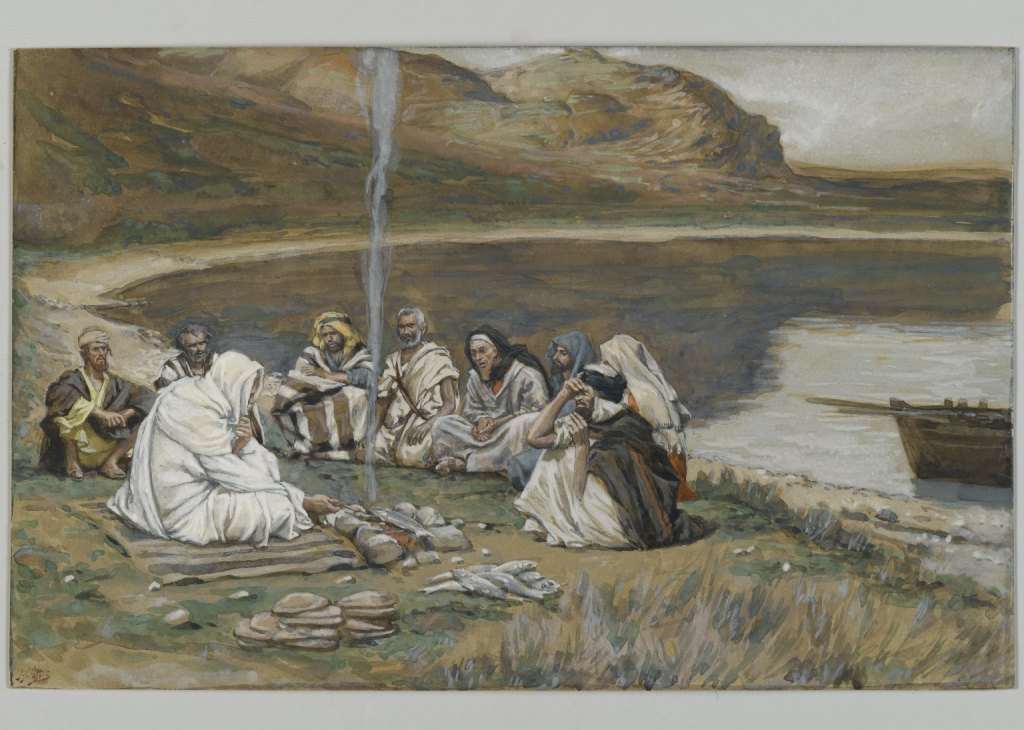
In the Gospel of today seven disciples go out fishing at night but catch nothing. At dawn the resurrected Jesus appears to them and asks, “Children, have you caught anything to eat?” After they admit that they could not catch any fish, Jesus tells them to drop the nets on the right side of the boat, and behold, they catch 153 large fish. John, the beloved disciple, is the first to realize that it is the resurrected Lord. And Peter, at hearing John say this, jumps into the Sea of Tiberias in all his clothes and swims to shore to be with Jesus.

When Peter reaches the shore, he finds that Jesus is in the middle of a barbecue on the beach! Jesus had a fire going with fish and bread on it. He invites the disciples to have breakfast with him. Peter with immense strength brings over the catch of 153 large fish to Jesus and all the disciples break bread together. I would consider their fishing trip a success.

A few things I will admit about my own fishing trip: it was hard, it took dedication and patience, it took the cooperation of nature and my own skills together. I have the fortune of just going to the fish market if I want fish—I don’t need to struggle like the disciples had struggled throughout the night. However, I struggle in other ways in life. I have difficulties at work, I have strained relationships with people, I fall into temptation. In all these instances I have to remember that I am not alone. Jesus is with me. If my human-way is too difficult in accomplishing the task, I need to listen to God’s voice and follow the way He tells me to do things. This is precisely what the disciples did—they listened to Jesus’ command!

How much easier life is when we listen to the Lord! We find that Jesus makes all things easier and that God already knows what we truly need. Just as Jesus knew that after a long night at sea the disciples needed a good meal, a meal being prepared in which Jesus already had all the necessities to feed the disciples. I imagine that beach barbecue to be amazing, for that fish and bread to be sweet as honey, for the company and love shared to be everlasting. We may come across obstacles on our mission to build up the Kingdom. But Jesus will help us through. There will be times where we feel unequipped, but like the charcoal fire on the beach burning hot, know that the Holy Spirit is burning a light within you to do the Father’s will. Like the seven disciples bringing fish to Jesus, we too are called to bring souls to Christ. We do this together as a family.

“When you are totally consumed by the Eucharistic fire, then you will be able more consciously to thank God, who has called you to become part of His family.”

–Blessed Pier Giorgio Frassati

To God, nothing is ever “unsuccessful.” Those moments which we don’t see as “successful” have a role to play in our formation. I needed to go fishing and not catch anything to understand how patience and cooperation of nature go together—God is in control. Even the death of God’s only Son was a success because it was part of His divine will. Through Christ’s death the sins of the world were forgiven, and through his Resurrection we partake in a share of eternal life in heaven. The beauty of this mission to be “fishers of men” (Matt 4:19) is that we get to fish with our friends. And bringing souls to Christ is always exciting.

James Tissot. Meal of Our Lord and the Apostles (Repas de Notre-Seigneur et des apôtres), 1886-1894. Brooklyn Museum, New York, USA.

See, Hear, Understand

Think about the moments you spend in prayer. Those moments when you are so close to Christ you have no idea what is going on but deep in your heart you know something important is happening. When I reflect on the greatest moments of my life, for most of them I am never conscious of how monumental those moments actually are until after they have passed. It is only when I bring those moments to prayer and invite the Holy Spirit in that the truth is revealed and miracles have then transpired.

During this time of deep prayer, it feels as though the Holy Spirit lifts a veil from my eyes. Suddenly, I become completely aware of how great and strong a presence Jesus has in my life. These times of understanding can be almost unbearable because my human body is so close to the divine. If these encounters in prayer were that powerful, no wonder I was unable to comprehend the immense impact of those moments at the time they actually occurred.

If experiences like these we have in prayer are so life-altering, it is hard to imagine what it must have been like for the disciples who were in the true physical presence of Jesus Christ. It took me awhile to understand the stories told in the gospel like the one we read today about the road to Emmaus. How could these devout disciples not recognize their Savior?

“And it happened that, while he was with them at table, he took bread, said the blessing, broke it, and gave it to them. With that their eyes were opened and they recognized him, but he vanished from their sight.” Luke 24:30

In truth, if these disciples had recognized Jesus immediately, the story told in the Gospel would not have been the same and would not have held the same impact. Jesus had His divine plan and chose to reveal Himself at pivotal moments.

What a blessing these disciples were given. They had this time with Jesus where they could relive other intimate moments with Him during His ministry, and then in the instant He showed them who He actually was, they could look back and see those moments unveiled just as I do in prayer.

We are all human and our ability to understand the divine can be limited because of sin. Nevertheless, when we are fortunate enough to gain insight into what the Lord is doing in our lives, that realization becomes totally and entirely life changing.

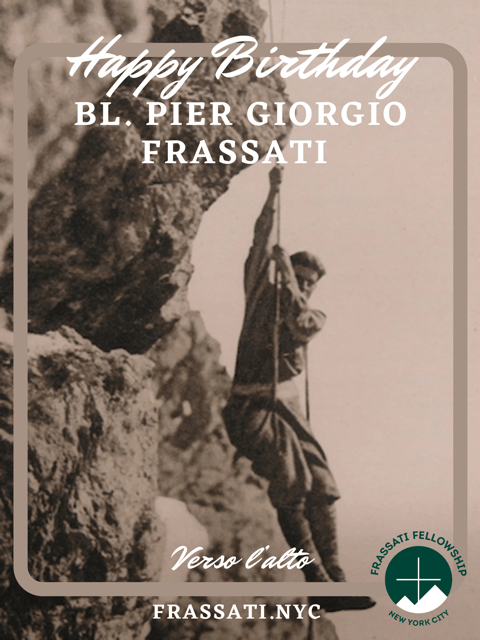
Happy Birthday, Blessed Pier Giorgio Frassati!

Blessed Pier Giorgio Frassati was born in Turin, Italy, on the eve of Easter on April 6, 1901. What a joy for Alfredo and Adelaide (Pier Giorgio’s parents) to hold their newborn baby boy and celebrate the Resurrection of Jesus Christ! God of all creation blessed the Frassati family with a son as the entire world began to celebrate the Resurrection of His Son. 

Today is the 120th birthday of Bl. Pier Giorgio Frassati. I imagine, while he was alive, his family showering him with affection and birthday blessings. “Buon compleanno” would be said all throughout the house—throughout Turin by those who knew him by his good works. 

My favorite part of celebrating someone’s birthday is writing a birthday card. The little gesture of picking out a card, writing an inscription that tells them about their quirky qualities, how thankful I am that they are in my life, prayerful wishes for health and blessings from God. Many of my friends are not Catholic, but I do not fail to thank God in their birthday cards because they are alive and healthy. A reminder of the gift of life. In Bl. Pier Giorgio’s letters, when a friend or family member had a birthday coming up, he too would thank God for their life and health. 

Last year, with all the COVID-19 precautions, many of us probably didn’t get to celebrate our birthdays with loved ones nor Easter with our communities. The contrast of last year’s celebrations and this year’s made me think of the date of Bl. Pier Giorgio’s birthday, April 6th. Being born in the first week of April, his birthday would fall in the cycle changes of the Triduum and Easter—Jesus’ death and Resurrection. On some birthdays Pier Giorgio would reflect on the death of Jesus and on other birthdays he would reflect on the Resurrection of Jesus. Reflecting on life and death was something I did a lot this past year. 

On the eve of Easter, I joined my community and sang profoundly, Alleluia. A reminder that there is so much life and goodness in the world, so much to be thankful for. Throughout his life Bl. Pier Giorgio had brought much happiness to all those around him. He cared greatly for his family, his friends, the poor and sick of Turin. As today’s responsorial psalm reminds us that “the earth is full of the goodness of the Lord,” we know that this goodness was shared by Pier Giorgio to everyone he encountered.

Birthdays are special. Blessed Pier Giorgio prayed for each of his family members and friends on their birthdays. Today, we will pray for him on his birthday. In one of his letters to his friend Bonini, Frassati writes, “I would like for us to pledge a pact which knows no earthly boundaries nor temporal limits: union in prayer.” To join in prayer and celebration on the 120th birthday of Bl. Pier Giorgio Frassati, click here.

Image shows Bl. Pier Giorgio, an avid lover of the outdoors. [Public Domain]

Great and Holy Friday | A Reflection from the Byzantine Catholic Tradition

The Deposition (Descent) from the Cross
Joseph of Arimathea and Nicodemus taking Christ down from the cross after his crucifixion (John 19:38-42)

“Together with Nicodemus, Joseph took you down from the wood –
you who are wrapped in light as with a robe
and beholding you dead, naked and unburied,
he began to mourn you with deep sympathy saying:
Woe is me, sweetest Jesus!


Just a little while ago, the sun saw you hanging on the cross
and veiled itself in somber hues.
The earth rocked with fear and the curtain of the Temple was torn in two. Now that I see how you willingly underwent death for me,
How can I bury you, my God? How will I wrap you in a shroud?
How will I touch your spotless body with my hands?
What dirges shall I sing at your departure, O Compassionate One?


I extol your passion and I praise your burial together with your resurrection,
crying out: O Lord, glory to you.”
(Apostichera from Good and Holy Friday Vespers – Byzantine Catholic Tradition)

Good and Holy Friday can be a difficult day as we remember in sorrow the crucifixion, death, and burial of our Savior Jesus Christ. These age-old Holy Friday prayers of the Byzantine tradition remind us of the hope we can always cling to. These ancient words of the church teach us that we can indeed ‘praise His burial together with His resurrection.’ As we sorrowfully remember His death, we wait in hope for the joy that is to come — the salvation Christ promised. Praise Him whose ultimate sacrifice has saved us. Glory to you, O Lord Jesus Christ!

May we end this Holy Friday reflection guided by Joseph of Arimathea and, most poignantly, the wisdom of Christ’s Mother, our Mother, as depicted so beautifully in this closing hymn:

“Come, let us bless the ever-memorable Joseph,
who went to Pilate by night to beg for the Life of all:
Give me this Stranger, who has no place to lay his head.
Give me this Stranger, who was handed over to death by his wicked disciple.
Give me this Stranger, whose Mother wept, seeing him hanging on the cross,
mourning and crying out in a motherly lament.
Woe is me, my child!
Woe is me, my Light, my Beloved whom I bore in my womb.
What was foretold by Simeon in the temple comes to pass today:
A sword has pierced my heart,
but change my tears into the joy of your resurrection.
We bow to your passion, O Christ!
We bow to your passion, O Christ and to your holy Resurrection!”

(Closing Hymn from Good and Holy Friday Vespers – Byzantine Catholic Tradition)

I encourage you to spend some time praying with the Descent of the Cross icon at the beginning of this reflection. Icons are windows into Heaven, a sacred way for us to pray and be in the presence of the Lord. May God be with you in a special way on this most sacred day of our Catholic faith. Wishing you a truly Holy Good Friday. Glory to Jesus Christ!

The Light in this World

“For God so loved the world that He gave His one and only Son.” John 3:16

This may be the most-repeated verse in the Bible. Unfortunately, after hearing it so much, the true depth and breadth of the significance might be ignored or not contemplated fully each time it is proclaimed. God does not just love us–He is love itself. There have been many more moments that I would like to admit when I have felt unworthy of this love. I am sure many others have shared this feeling, but I do also have good moments when I feel completely in touch with the will of God and His plan for me. Everyone of us is bound to experience their own good and bad moments accepting the love of their Creator, including Judas, the betrayer of Jesus Christ. No matter how terrible his final actions of life, he was still a child of God, created out of divine love.

Pondering the power of the Lord’s love in that context can seem almost unimaginable because from a human perspective, the behavior of Judas can cloud our judgment of him. I often forget that Judas was one of Jesus’ chosen 12 apostles. God has a purpose and plan for everything and everyone, and He can bring light even to the darkest circumstances.

As children of God, we can make the conscious decision to seek the Light as well. “I will make you a light to the nations, that my salvation may reach to the ends of the earth.” Isaiah 49:6. We were created to serve as lights in this world, just as Jesus was before us. We are now approaching the end of Lent, the time of reconciliation, and looking forward to the resurrection of our Savior. This Easter Sunday, we will once again rejoice in reflecting on the new hope restored by Jesus rising from the dead. No matter how many struggles and failures we have suffered, Easter remains a reminder of our constant hope. God is love, and this Sunday we have the opportunity to be filled with His light, so we can shine it in our darkened world.

Our Gift of Love Is Never Wasted

By Sister Maria Frassati, S.V.

+Totus Tuus

“Why has there been this waste?”

The Passion Narrative that kicks off Holy Week begins with the account of the woman in Bethany with the alabaster jar of costly spikenard. To the utter shock of all those present, she breaks the alabaster jar loaded with nard over his head, letting it pour and anoint the head of our Lord. Some are filled with anger at the perceived waste. But Jesus responds, “Let her alone. Why do you make trouble for her? She has done a good thing for me” (cf Mark 14:6). The Gospel account of this woman’s love for Jesus can become the lens through which we see the whole of Holy Week: the power of a total gift-of-self to Jesus, a gift which is never wasted, and is such a consolation to His heart.

Wait a minute– aren’t we supposed to be spending Holy Week contemplating the total self-gift of Jesus to us? Is this backwards? Both are important.  God loved us first, as St. John tells us (cf. 1Jn 4:10).  But when we come to know His crazy, reckless love in pouring out everything for us, as if it were for me alone, this realization inspires the response to the Divine initiative; a total self-gift in return.  St. John Paul II repeatedly reminds us in his writings that “Man cannot find himself except through a sincere gift of self.”  And still more, Jesus, in His total self-giving, reveals to us our deepest identity and calling (cf. Gaudium et Spes, 22).

In giving myself, I come to discover who I really am. That’s a bold statement in a culture that revolves around self-fulfillment and gratification.  And, when I unite my life to Jesus in this total gift, not only is nothing ever wasted, but I become more myself, more truly who God made me to be.  Peter was no longer simply a charismatic fisherman, but a fisherman of souls who radically pierced the hearts of those who heard him with the power of God’s love. And Our Lady, through her constant yes throughout the life of Jesus as His earthly Mother, became a spiritual mother to all who believe in Jesus.

We can admit that this is hard. It often takes an act of faith to believe that my gift-of-self matters, that His grace is at work deeper in me than I can perceive.  What do I do when it feels fruitless, meaningless?

First, we can only give ourselves in trust when we are grounded in His gift of love to us, a gift He renews each day through the Holy Sacrifice of the Mass. He tells us, you are worth everything. He would have given all for even just a single soul.  Jesus once said to St. Julian of Norwich, “It is a joy, a bliss, and endless delight to me that I suffered my Passion for you; and if I could suffer more, I would suffer more.”  Only when we know we are infinitely and unconditionally loved by the Father in Jesus, a truth we must steep ourselves in again and again, can we have the confidence to give ourselves to Him in total abandon.  Secondly, whether we feel it or not, it is in the Mass that we are reminded that His total offering of self in love gives value to all our offerings of love.  

Woman of Bethany: Our Gift of Love is Never Wasted.

In this, we also discovered another truth: He delights to receive our love, our company.  It matters to Him when we are simply there, with Him.  Do we have any idea how much our gifts to Him console His heart?  Not because we add anything to God or make Him more, since He is all-perfect and in need of nothing.  The woman in Bethany, before Christ’s Passion, reflects to Him her understanding of what He is about to do. And in this, she is with Him, demonstrating that she knows and supports the intentions of His heart.  During the pandemic, we heard stories upon stories of elderly married couples who would stop at nothing to visit their spouses in nursing homes and hospitals, even if it meant only standing on the other side of a window. They knew they couldn’t help or heal or ‘fix the problem’; they knew they simply had to be there.  Love desires to be with the one they love.  And this is what matters most to Jesus, that we are simply with Him.  In this, we can share the weight of His heart. St. Padre Pio once remarked that in the Garden of Gethsemane, even while Jesus was weighed down in agony by the sins of humanity, He was also consoled by the love of His future disciples who would give everything for Him. Even now, our efforts to be with Him and love Him console His heart more than we can ever know in this life.

As we enter the intensity of Holy Week, striving to contemplate His mysteries in the middle of our busy work, we can take comfort in the fact that spending time in prayer doesn’t need to be complicated. Just be with Him. And wherever you’re drawn in the mysteries of this week, give yourself permission to stay there. If we allow ourselves to simply sit in His presence, wherever we find ourselves —the garden, the pillar where He was scourged, His tomb on Holy Saturday—He will work to quietly transform us in His grace. And as He draws the mysteries of our lives into the mysteries of His own, nothing will ever be wasted; rather our lives will become more closely conformed to the mystery of His own, as we are brought to know the tender love of the Father through Him.

Planning Charity

“Blessed are they who have kept the word with a generous heart and yield a harvest through perseverance” (Lk 8:15).

How can we keep the word with a generous heart? How can we keep the Word of God, Jesus, at the center of our lives, so that we may love God with all our heart, soul, and mind (Lk 10:27)? In today’s first reading, Shadrach, Meshach, and Abednego’s love of God gives them the strength to persevere and refuse to worship the god of King Nebuchadnezzar, leading the king to exclaim, “Blessed be the God of Shadrach, Meshach, and Abednego, who sent his angel to deliver the servants who trusted in him; they disobeyed the royal command and yielded their bodies rather than serve or worship any god except their own God” (Dn 3:95). There are times in our lives when, by the grace of God, we see the harvest of our perseverance in ordinary and extraordinary ways.

There are times in our lives when we do not keep God’s word and fail to see him in the people and events we encounter. The first reading is juxtaposed with today’s Gospel reading, in which Jesus rebukes those who believe in him, “I know that you are descendants of Abraham. But you are trying to kill me, because my word has no room among you” (Jn 8:37). As Holy Week approaches, how can we make room for the Word of God and keep the word with a generous heart? How can we prepare our hearts to follow Jesus to the cross?

Saying “yes” to the small things in our everyday lives can train us to say “yes” to greater things, especially when it comes to loving and following the Word of God during difficult moments. Father Roger Landry, author of the book Plan of Life, suggests that we ask ourselves, “What do we do to concretize our love for God and others?” He describes how charity needs to be planned, such as planning to offer up each day for someone and reaching out to them. In the words of Fr. Landry, instead of showing random acts of kindness, we should plan acts of kindness. This Holy Week, let us fully participate in the holiest week of the year by planning our time around God and the people he places in our lives.

Choose and Obey

Why is it so easy to get angry at God? The Old Testament seems to provide examples of a constant tug-of-war between God and the Israelites. The Israelites are presented with an inconvenient situation; they get angry and complain to God, then God in turn becomes angry with the Israelites and inflicts a punishment on them. Finally the Israelites come to their senses and return to God, begging His forgiveness. Over two thousand years later, we, the modern day Israelites, still find ourselves engaged in this tug-of-war. The crucial difference between us and them is that we are fortunate enough to have a Savior who came before us and has already taken on the wrath meant to be inflicted on us due to our sins.

I admit I have fallen prey to this behavior. I found myself angry at God this past weekend. During this time of the liturgical year, we should return to our Lord and renounce any anger toward Him. In these final two weeks leading up to Easter, it is customary to cover all the statues in churches, including the crucifix–Jesus on the cross. This practice is symbolic of Jesus retreating from public ministry as He awaited His time to die on the cross. Although the Lord promises never to leave us, the symbolism we find before Holy Week holds great significance and the notable absence of the Savior is evident.

In my vulnerable and sinful state, my first response was anger and I wanted to cry out to my Father with the same words Jesus used: “My God, my God, why have you abandoned me?” I know deep down He will never abandon me, but there are moments when it feels as though He has. This might be why God’s chosen people have always fallen back into the tug-of-war started in the Old Testament. We are made from dust and to dust we shall return; we really do not deserve anything from our Lord except those punishments that He justly bestowed on the Israelites. Nevertheless, we long for our Father’s love because we are His children. As children, it is natural for us to want things from our Father, and if we don’t get them, we throw temper tantrums. Like a good Father, He reminds us of who we are and who He is. No matter what, everything He does, He does for our ultimate good, even if it is difficult to accept at times.

“‘The one who sent me is with me. He has not left me alone, because I always do what is pleasing to him.’ Because he spoke this way, many came to believe in him.”

John 8:30

The beauty of God’s design gives us free will. Just as Jesus before us, we have the choice to follow the Lord in spite of every hardship along the path. In choosing to obey our Father, we can trust and believe He will never leave us to be alone.

The Name of God is Mercy

Jesus went to the Mount of Olives.
But early in the morning he arrived again in the temple area,
and all the people started coming to him,
and he sat down and taught them.
Then the scribes and the Pharisees brought a woman
who had been caught in adultery
and made her stand in the middle.
They said to him,
“Teacher, this woman was caught
in the very act of committing adultery.
Now in the law, Moses commanded us to stone such women.
So what do you say?”
They said this to test him,
so that they could have some charge to bring against him.
Jesus bent down and began to write on the ground with his finger.
But when they continued asking him,
he straightened up and said to them,
“Let the one among you who is without sin
be the first to throw a stone at her.”
Again he bent down and wrote on the ground.
And in response, they went away one by one,
beginning with the elders.
So he was left alone with the woman before him.
Then Jesus straightened up and said to her,
“Woman, where are they?
Has no one condemned you?”
She replied, “No one, sir.”
Then Jesus said, “Neither do I condemn you.
Go, and from now on do not sin any more.”

Jn 8:1–11

Friends, in today’s Gospel reading, we are given the story of the woman caught in adultery. Similar to the content in my last reflection, this passage is one of the most studied Biblical accounts. (First, a kingdom divided against itself cannot stand. Second, about not casting the first stone. Two in a row ain’t bad.)

We are given some food for thought when we pray upon today’s first reading in conjunction with the Gospel reading for today—Susanna and the elders in the Book of Daniel. And this section of the Book of Daniel and today’s Gospel are very much related, but in different ways. The first reading relates to Susanna triumphing in the face of a potential miscarriage of justice. When Susanna rebuffs the two elders’ lustful advances, she is accused of wanting to be alone in the company of a man in order to bed him. Susanna is wrongfully accused, the elders bear false witness, Susanna is in danger of being put to death, Daniel speaks up for virtue, and Susanna is subsequently acquitted. The elders are subsequently put to death. Virtue and justice triumph. But there is more at work when you take the stories of Susanna and the woman caught in adultery together.

Susanna was married. The law of Moses dictated that she would be unavailable to the elders. The elders knew this, and yet their lust was so strong it clearly began to affect their moral judgment. It is said in the story of Susanna and the elders that they desired to “seduce her” and that the elders did not speak of their lust for her publicly. This indicates two things: they were aware that what they were doing was morally wrong because they felt shame, and they made a conscious decision to sin and go against the law of Moses. It’s not difficult to think that Jesus perhaps had the story of Susanna and the elders in mind when He remarked in the Gospel of Matthew, “Everyone who looks at a woman with lust has already committed adultery with her in his heart. If your right eye causes you to sin, tear it out and throw it away; it is better for you to lose one of your members than for your whole body to be thrown into hell” (Matthew 5:28–29).

In today’s Gospel reading, Jesus comes across a woman caught in adultery. This woman, unlike Susanna, actually did commit adultery. According to the law of Moses, she is subject to death. The elders demand she be stoned to death. The woman knows this is inevitable since she was caught breaking the Mosaic law. Jesus steps in and asks if the elders themselves are free of sin; if they aren’t, they may stone her to death. One by one, the elders leave, and the woman is told by Jesus to sin no more.

The two events are related, albeit differently. Most significant is that they are relatable on a personal level and pertain to our lives of prayer in ways we perhaps may not have thought about. We have probably all had accusatory, condemnatory, judgmental, and self-righteous attitudes at some point in our lives. Do we often see ourselves as Susanna or the woman caught in adultery? Being accused by loud voices, perhaps falsely? When we do sin, are we given a chance to repent, or are we hurt by the stirred passions of others in a too-quick pursuit of justice? Do we see ourselves as the elders, motivated by malice or self-righteousness? Or do we act like Jesus, with patience and mercy? In the Gospel, Jesus shows that He forgives, regardless of what we have done. No sin is too great. According to the Mosaic law, the woman caught in adultery could have been put to death. Jesus knows this, but instead of advocating for the old Mosaic law, He forgives her.

In my younger years, when I first came back to the Church, I very much had a gung-ho mentality about the “rules.” Not that there shouldn’t be any—there are. And for good reason. We know what mortal sins are. We know what constitutes venial sin. But in my pursuit of “the rules” after I came back to the Church, I was acting more like an elder driven by self-righteousness and not like Jesus. Time after time, I felt driven to “call people out,” sometimes even publicly, rather than speak to them and to show mercy, especially if they were struggling and wanted to turn away from whatever sin they were struggling with (gossip, struggling with chastity, etc.). As a Lay Dominican, I am driven by veritas (truth). In a world that has often been labelled as “post-Christian” or “postmodern,” the urge to succumb to a rallying cry for justice when we see individuals acting in a fashion that is anything but Christian—or in a way that is not consistent with virtue ethics—is a very real urge. Fraternal correction is indeed necessary, but even St. Thomas Aquinas recommends we speak to individuals privately first, not publicly as the elders did. In our pursuit of fraternal correction, do we also try and act like Jesus? Jesus indeed reprimanded plenty of people, but He was so, so merciful.

One woman (Susanna) was falsely accused and sentenced to die, but she placed her life in God’s hands and trusted Him. Daniel spoke up for the woman, and she was released. The other woman (the woman caught in adultery) was justly accused and was sentenced to die. She did not have any hope because it was the law that she was to die for her sin. Jesus spoke up for her, and she was forgiven. Jesus Christ did not come for the righteous but for sinners. Christ’s compassion for the adulteress surpassed the old rules. Pope Francis wrote a text, The Name of God is Mercy. (This coincided with the Year of Mercy.) This is no less relevant here. Pope Francis himself remarked, “Jesus is the face of the Father’s mercy.”

Palm Sunday is soon upon us. Palm Sunday is often remarked as Jesus’ triumphal entry into Jerusalem. After this, Jesus will soon be sentenced to death, carry His Cross, go through excruciating pain that we cannot possibly imagine, and then be crucified. He will ask God to forgive those who called for his death. He will even soon forgive Peter, the man who would become pope. Even after he denied him three times. Let us not forget that when Jesus eventually rises from the grave once Lent is over, it is also a victory for mercy.