Bakhita

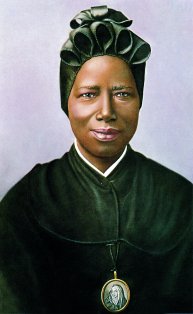
Bakhita_Szent_Jozefina.jpegToday is the feast of St. Josephine Bakhita, a woman of incredible strength and perseverance. Kidnapped at age seven from her home in Sudan and sold into slavery, she was given the name Bakhita, meaning “fortunate.” She suffered daily beatings and abuse at the hands of her captors. Eventually, she was sold to an Italian family, the Michielis, and worked as their maid. While in Italy, Bakhita was introduced to the Canossian Sisters of Venice—and through the Canossian Sisters, she began to learn about God and the Church. The more she learned, the more her heart became inflamed with love for Jesus.

When the Michielis wanted to bring Bakhita with them to Africa, where they had acquired a large hotel, Bakhita firmly refused to leave the convent in Venice. While Mrs. Michieli tried to force the issue, eventually the Italian court ruled that because slavery was illegal in Italy, and had in fact also been outlawed in Sudan before Bakhita’s birth, Bakhita had never legally been a slave. All of a sudden, she was free to choose her own path.

Bakhita was baptized in the Catholic faith at age thirty, receiving all three sacraments of initiation on January 9, 1890, and taking the name Josephine. She took vows as a Canossian Sister three years later. For the rest of her life, until her death in 1947, she was known for her joyful, welcoming presence, her love of children, and her encouraging spirit toward the poor and suffering.

What is particularly remarkable about Josephine is her ability to see God’s hand at work through every chapter of her story, even those filled with darkness and tragedy. When she was introduced to Christ through the Canossian Sisters, all the pieces of her life began to fall into place and make sense to her for the first time. She said, “Those holy mothers instructed me with heroic patience and introduced me to that God who from childhood I had felt in my heart without knowing who He was.”

Josephine stood up for herself and put an end to the injustices she suffered, but she did not brood over past wrongs or dwell in resentment for all the trauma she had undergone. On the contrary, she actually expressed gratitude for her past experiences. When a young student asked her what she would do if she were to meet her captors, she responded without hesitation: “If I were to meet those who kidnapped me, and even those who tortured me, I would kneel and kiss their hands. For, if these things had not happened, I would not have been a Christian and a religious today.”

I am far from grateful for my own sufferings, but I pray that through the intercession of St. Josephine Bakhita, I might allow my eyes to be opened to the ways God is working in every aspect of my life. May my deliverance from resentment and cynicism be sparked by an interior conversion of heart, a turning toward gratitude and unrestrained love for God.

The Power of Letting Joy Spark


Dear fellow pilgrims,

What better describes your spiritual life: a “gloomy darkness” or a “festal gathering”?

I have to admit, my default spirituality is “gloomy darkness”. But a holy “gloomy darkness,” like Lent. (Or at least that’s what I tell myself.) I love Lent, it’s Easter that is harder for me to get into. Who is with me??? Why is it hard for us Lent-lovers to truly celebrate and embrace joy while enduring and dealing with suffering is easier? The first reading today reminds us that Jesus’ life, death, and resurrection has established a new covenant between humans and God characterized by joy, not trembling and fear.

A huge thing I’m learning, though, is this part of me isn’t really operating out of a deeper understanding of suffering at all if it’s easier for me to accept suffering rather than joy. As God has been healing this strange tendency of mine, I’m discovering joy in new ways while I am also letting go of faulty ways I have understood the role of suffering and fear in my life.

In short, I have come to understand that one of the reasons why it is hard for me to truly, deeply, and consciously experience joy in my life is because I have a hard time believing God gives good things to us freely, without a hidden agenda.  All too often, my subconscious response to fun events or moments of potential joy or happiness in life is resisting feeling it deeply in the moment. Why? Well, just in case God wants to take whatever is giving me joy away in the future. In short, I’m trying to cut expected future losses by disengaging from potentially joy-filled moments in the present.

But yeah… that’s not how God works. Those subconscious beliefs do not reflect who God really is, nor do they reflect who I really am to God. I still have a ways to go in truly believing in the relationship Jesus’ sacrifice and resurrection made possible with all of my being, even to the depths of my subconscious.

What is the truth? I am a daughter of God and God is my Father who delights in giving me good things because He delights in my delight. God is not pleased when I am afraid of Him and back away from His good gifts. When I encounter suffering, God does not relish the fact that I am suffering. He only allows it so that a greater good might come about.

God’s inheritance for all of us is goodness, is the Resurrection, is eternal bliss in Heaven, and He wants us to live in that joy as much as we can on earth, not only for our good but for attracting others to claim that same inheritance.

The devil wants to suppress our joy, because “the joy of the Lord is [our] strength”! I know God has given me a large heart, and I feel things very deeply and profoundly, and when I am confident in the Lord, I am joyful. When I am joyful, or actively trust in His promise and inheritance of joy amidst suffering, I am unstoppable. And the devil doesn’t want that. He wants us to keep our beliefs about how we can earn good things and also deserve every bad thing that comes our way.

But this balance of joy and pain in our lives is not up to us! All we encounter in life is allowed by God in order to cultivate within us a deeper understanding of Heaven, of God’s ultimate desire for our hearts, of joy and peace and unity with Him.

Brothers and sisters, I pray the Holy Spirit reveals to each one of you how your own faulty understandings of God and yourself hinder experiencing His joy in the present. I pray that we would live our lives out of an unshakeable belief in the goodness of our inheritance as daughters and sons of God, an identity and gift won for us by Jesus that we can neither earn nor lose on our own merits.

Pax Christi!

-Alyssa

“Daughter!”

Two-year-old Zippy has recently discovered FaceTime.  She loves to talk to Nonna and “A’Reece” (Aunt Grace), but is sometimes a bit confused as to how the technology works.  She will giggle with delight when we answer and our faces appear on the screen, as though we have come to visit her.  “Hi Zippy! Hi Honey!” we say.  “Hi Zippy, Hi Honey!” she says in happy reply.  

She is dismayed however if we don’t share our snacks; she is always generous with hers, trying to put them through the phone (her mother’s turn to be dismayed).  She waves the phone around to show us her dinner or her dolls, and we try not to get dizzy.  Sometimes she will sit and “talk” for awhile—sometimes not saying anything, sometimes chattering away, while we get a steady view of her eyebrows and the top of her head.

During the recent government shutdown, her father came up to visit us and help out for a bit while he was out of work.  When we called to FaceTime, Zippy was ecstatic to suddenly see Daddy on the phone as well.

Shortly after he had returned home to Maryland, the whole family called on FaceTime.  My brother passed the phone to Zippy, who was excited to talk to us, but unhappy that we wouldn’t show her Daddy.  “Zippy see Daddy!” she implored. “I am right here!” my brother laughed behind her.  But Zippy was not placated until Daddy moved around so that she could see his face in the small screen she was holding.  “Daddy! Dere you are!”  she laughed delightedly.

*            *            *

In today’s Gospel a woman is seeking Jesus.  She has had a flow of blood for twelve years; doctors have only made things worse.  And this flow of blood has in turn made her “unclean”—a spiritual outcast, barred from the temple and the touch of other people.

She has heard great things about Jesus and thinks that if she could but touch the hem of His garment, she would be cured.  She moves quietly through the crowd, comes behind Him, and touches His clothing.  Immediately, she realizes she is healed.

Jesus, however, recognizes a deeper desire for connection.  He knows that healing power has gone out of Him, and asks the confused crowd “Who touched me?” 

The woman must then confess; she comes forward, revealing herself and tells what has happened.

“Daughter,” Jesus replies, “Your faith has made you well.”

She had sought merely the restoration of her health. Jesus restores her identity, her relationship with her Father.  “Daughter…”

This deep desire—was it only on the part of the woman? 

It is a central mystery of Christianity that our love, desire, and faith actually begin as God’s initiative toward us.  It is He who first loves us; He who calls us to prayer, who plants the desire in our hearts, who is the source of both our longing and its fulfillment.


Adam

Photo Credit: Michelangelo, Public Domain

Among the Tombs

Today’s Gospel tells of the healing of the Gerasene man possessed by many demons. Mark’s narrative says that the man had been living among the tombs. The demons had taken ahold of him so greatly that he was literally living among the dead, and probably feeling very close to death himself. I imagine his great anguish every single day, feeling utterly tortured and helpless and unwanted by everyone else. We don’t know how this man became possessed or what happened, but that is not necessarily important to dwell on in light of the glory of Jesus revealed to us here.

Do we not sometimes find ourselves feeling as though we are living among the tombs? The sin we can’t shake, the constant narrative of self-beratement in our minds, the masks we put on to pretend we’re okay when we’re not, the images we hide behind on social media, the mindless scrolling to numb or distract ourselves, the desperate strife to earn the love we do not have to earn, resigning ourselves to thinking we just have to suffer and God won’t come through for us, etc.

Brothers and sisters, we are made for so much more. The tombs of our lives do not define us and will never have the last word. Let’s call to mind another tomb—a tomb where the glory of our salvation occurred, the tomb where, in the middle of the night, our Savior rose and Heaven was opened. The tomb of Jesus. The tomb of His resurrection is the only tomb that will ever define us, because His tomb is empty and death is defeated.

As the man in today’s Gospel comes before Jesus, the demons within him tremble. Even they recognize Jesus’ power and His glory. We can place our hope in the all-powerful God! Jesus cares so much for this man that he not only casts all the demons out from him, but he sends them into the swine so that they will never return. In the death of the swine, this man’s salvation was possible.

You are beloved. God is calling you out of whatever your tomb is. There is nothing to fear—He loves you so. Lay your heart bare before Him in prayer today, and don’t stop there: listen for His response. Let Him fill you with His love. He will give you exactly what you need. Let Him declare the victory of His resurrection over you today!

Toward the Light

He said,
“To what shall we compare the Kingdom of God,
or what parable can we use for it?
It is like a mustard seed that, when it is sown in the ground,
is the smallest of all the seeds on the earth.
But once it is sown, it springs up and becomes the largest of plants
and puts forth large branches,
so that the birds of the sky can dwell in its shade.”
—Mark 4:30–32

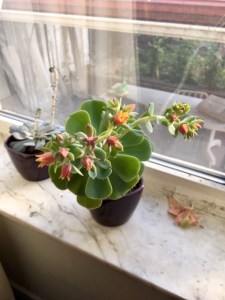
IMG_1982I have two plants sitting on my windowsill that have been there for two years now, and quite honestly, I’m very surprised that they’re still alive. It’s safe to say that I do not possess a green thumb, and my apartment doesn’t get a lot of sunlight. But somehow these plants have persevered—sometimes looking a little worse for the wear, yet thus far still surviving my neglect and horticultural ineptitude.

It amazes me how tall these plants can climb, upward toward the sunlight. To think that they started as just a tiny seed—a seed that contained within itself the capacity to grow and flourish—is incredible. They’ve even survived being repotted after outgrowing their containers. Their growth is not really any credit to me, as I’ve done less than the bare minimum to keep them alive. It is more a testament to the design of God, who has created beautiful things to flourish even amid adverse conditions.

In Jesus’s parable of the mustard seed, we hear how God brings tremendous growth out of tiny beginnings. We, too, are small; and yet we are created completely whole. Within each soul is the capacity for greatness. All it needs is to be nurtured by water and light, to be broken open so that roots may stretch out from its core and new buds may blossom outward into the day. We are created as tiny seeds, but we are not meant to stay that way. We are meant to climb toward sainthood.

But growth happens slowly. We must learn to be patient with ourselves and with others; our transformation will not happen overnight. We must place our trust in the Master Gardener and let Him do His work. Sometimes it may seem like we won’t survive in new soil, but really we only need to extend new roots. If we have patience through the spiritual dry spells and cold fronts (and even, perhaps, a polar vortex), God will guide us to adapt and grow through every circumstance. All we have to do is keep craning our heads upward toward the light.

“Man was created for greatness—for God himself; he was created to be filled by God. But his heart is too small for the greatness to which it is destined. It must be stretched.”
—Pope Benedict XVI

Last Minute–Why?

Growing up, I did not know that Don Bosco was a saint; I thought he was a family friend.  I would hear things like “Don Bosco got Daddy a job” or “Don Bosco helped us pay that bill.”  Friends’ parents shared similar names: Ron, John and my father, Don, gathered together regularly for coffee.  When I heard “Don Bosco” I just added him to the mix.

Saint John Bosco (known popularly as Don Bosco) first came to our attention before my parents were particularly religious.  They were having financial troubles, and his intercession was sought as a “patron saint of unpaid bills.”  I was just a child at the time and so the precise details were hazy, but there was a medical bill that my parents were unable to pay.  As it went to collection with no resources in sight, my grandmother proposed a novena to Saint John Bosco.  Figuring “What can it hurt?” my parents prayed to Don Bosco for nine days.  But on the last day of the novena, an envelope arrived from a mail order contest for the exact amount of the bill!

Answers like this appeared throughout my childhood, and then into adulthood.  Time after time, Saint John Bosco came through, often at the very last minute.  This followed the pattern of his own lifetime, of last-minute miracles.  He started an Oratory for troubled boys in Turin, but there was not often an excess of funds.  More than once, he sat the boys down for dinner with nothing to feed them with.  Then, suddenly, there would be a knock on the door with a last-minute donation of food.

Other times Don Bosco seems to have been granted miracles of multiplication.  One such story is recounted by Francis Dalmazzo, who had decided after just a few days to leave the Oratory, and had even sent for his mother to come and get him.  But that morning, he witnessed a few rolls become enough to feed the four hundred boys.  As each boy received his roll, there was another in its place for the next boy, until all had eaten—and in the basket Francis saw the original few rolls still there.  He told his mother that he had decided to stay after all. 1

Last-minute miracles took many forms.  There were death-bed conversions, including that of the man who had spent his life in opposition to Don Bosco’s work.  There was the time when St. John Bosco seemed too late—a boy in the Oratory had died without making a good Confession.  Don Bosco raised him from the dead, and the boy received the sacraments.  There was the time he wanted to build a basilica to Mary Help of Christians—to whom he had entrusted all his needs and work.  He gave the astonished architect a down payment of eight cents, promising that “Mary would build her own basilica.”2  We visited that Basilica on a Frassati pilgrimage in 2010.

It is easy to admire a saint for such radical trust in God.  Real-time waiting and last-minute rescues, however, do not make for an anxiety-free life.  I often wished that as an intercessor, Don Bosco would not wait until that last minute.  And sometimes it seemed that his idea of last-minute went well beyond mine.  Other times he didn’t seem to answer my prayers at all.

I am not going to lie—there have been times when I was tempted to move Saint John Bosco to my other listSaint.Joseph for one, is a lot more prompt… And then I wonder just why John Bosco is in my life to begin with.  What does this saint have to teach me, in particular about last-minute answers?  About trusting in Providence?  About waiting?

In the Gospels Jesus tells the strange story of a persistent widow, who hounds a judge until he gives her justice.  Jesus tells us to imitate her tenacity when asking favors of God.  He also tells the story of a man who wakes up his friend in the middle of the night to ask for bread for a visitor.  The friend responds, not out of friendship, but because he wants the knocking to stop.

These are not appealing images.  Most of us go out of our way NOT to be a nuisance, not to impose on others.  Yet Jesus tells us to keep asking past the point of feeling comfortable about continuing.

The vision of God that this parable proposes does not seem at first to be any more appealing.  Why would He insist that we ask, repeatedly, when as Jesus tells us, He already knows what we need?  Does He really demand that our petitions reach critical mass before deigning to reply?  Is it only when we’ve worn ourselves (and Him) out like the judge that He is reluctantly persuaded to give us what we ask? 

We know theologically that God is good.  We know from Scripture that “it is your Father’s desire to give you the kingdom.”  But from the first sin in the Garden, our lived faith in His goodness is shaky.  But Jesus wants us to call on and trust the Father.

Don Bosco was a father to the boys in Turin, and later to the Salesian order.   He first attracted the boys by performing magic tricks to get their attention, but ultimately they stayed because they experienced his personal love and care for each of them.  They learned first to trust in him, and in his fatherly love for them.  His fatherly care and provision of their earthly needs pointed always and ultimately to the heavenly Father.


Saint John Bosco
Feast Day January 31st


Notes:

1 http://www.salesians.org.za/index.php/bi-centenary/25-don-bosco-miracles-in-his-life

2 http://www.donboscowest.org/saints/donbosco

Image credit: Unspecified [Public domain], via Wikimedia Commons

Want to be a Saint? Pray This.

+

It is the essence of the prayer of Our Blessed Mother at the Annunciation— “Behold, I am the handmaid of the Lord. May it be done to me according to your word.” (Lk 1:38).

It is the core of the prayer of our dear Jesus Christ in the Garden of Gethsemane— “…still, not my will but yours be done.” (Lk 22:42).

It is the focus of the prayer echoed in the depths of the heart of each Saint.

Here am I, Lord, I come to do Your will. (Ps. 40)

10 simple words.

10 simple syllables.

And yet, with this prayer, an explosion of grace sets to work in our souls.

When we let this be the guiding prayer of our every moment, we give the Lord our “yes” in letting His will be fulfilled in us. We take up the role that He has set apart for us in His plan of salvation.

Each time we renew our commitment to following the will of God, we essentially live out the lyrics of one of my favorite songs —“I give it all to you God, trusting that You’ll make something beautiful out of me.”

In the simplicity of this desire is the recognition that while we yearn for deep fulfillment in our lives, we know that apart from God we will never find it. We are released from anxieties and restless self-seeking. Indeed, “In [His] will is our peace.” (St Gregory Nazianzen)

With this entrustment of our lives to the Divine Will, we accept the invitation to sit with the Lord, to become His family.

“And looking around at those seated in the circle he said,
‘Here are my mother and my brothers.
For whoever does the will of God
is my brother and sister and mother.’”
(Mk. 3:34-35)

Jesus calls us by name to be His family! An honor beyond belief!

Belonging to the family of Jesus means we each have a unique and specific mission to fulfill that affects not only our souls, but the souls of those whom God has entrusted to us. God’s desire for us is nothing short of our becoming saints. And He will complete His good work in us, if only we seek Him earnestly.

Belonging to the family of Jesus calls for us to continuously discern and to do the work of God, in whatever state of life we find ourselves. It is the ongoing work of conversion, taking up our crosses daily to follow the Lord. We must not delay not in committing to daily prayer (the Rosary, especially), Mass, Communion, frequent Adoration, Confession, earnest study of our Faith, and works of charity and sacrifice.

Let our lives witness—whether in times of darkness and desolation or joy and consolation—that we know who we are and Whose we are; that we trust the Lord’s hand is at work in every circumstance.

Here am I, Lord, I come to do Your will.

It is this spirit of loving obedience and bold humility that allowed the Blessed Virgin Mary to repeat her Fiat, her “yes” to the Lord, every step of the way—from the Annunciation to the Passion and beyond.

It is this spirit of authentic childlike trust that truly raises us “verso l’alto”—to the heights of sanctity that God has dreamed for us.

It is this spirit of generous surrender that is so wildly needed today in these dark times:

“One day seeing the state of his country, St. Martin of Tours, a former Roman soldier whose father was in the famous Imperial Horse Guard, asked the Lord in tears, ‘What will it take to save my country?’ ‘What will it take?’ The Lord responded, ‘One saint!’  And a saint he did become. What will it take to save our present world? One Saint! May that Saint be YOU! May the devil say of you what he said of St. John Vianney, ‘If there were two of him my kingdom would end!’

Let us ask the Holy Spirit to give us the graces we need to persevere in the living out this prayer. Let us ask Our Blessed Mother to guide our steps and form our souls as we seek to imitate her in her surrender to God. Let us ask St. Joseph for his protection as we follow the Lord. And may Bl. Pier Giorgio Frassati, and all our brave brother and sister Saints, pray for us!

“My child, make the resolution never to rely on people. Entrust yourself completely to My will saying, ‘Not as I want, but according to Your will, O God, let it be done unto me.’ These words, spoken from the depths of one’s heart, can raise a soul to the summit of sanctity in a short time. In such a soul I delight. Such a soul gives Me glory. Such a soul fills heaven with the fragrance of her virtue. But understand that the strength by which you bear sufferings comes from frequent Communions. So approach this fountain of mercy often, to draw with the vessel of trust whatever you need.” (1487 – Jesus to Suffering Souls) –Diary of Saint Faustina

Suggested Reading– Conversion: Spiritual Insights Into an Essential Encounter with God by Fr. Donald Haggerty

Fight the Right Battle

“If a kingdom is divided against itself, that kingdom cannot stand.
And if a house is divided against itself,
that house will not be able to stand.” -Mark 3:24-25

The devil is sneaky, yet so predictable when we realize what he is up to. He nags at our insecurities, picks at the scabs of our wounds, and tries to whisper shame into our identities. The devil comes to steal, confuse, distort, and destroy.

We have to fight the right battle. Sometimes when conflicts arise with those we love, whether that be family or friends, I think we can tend to forget that we are fighting on the same team. But the devil doesn’t want us to see it that way, because then his darkness will have no choice but to flee. Instead, he tries to pin us against one another, making us lose sight of the common goal of mutual love.

Lord Jesus, heal our families, our marriages, our friendships, our relationships.

I just want to shed the light of Christ on some lies that may be in your heart. When Christ’s light shines, darkness cannot overcome it. Let’s call the lies out for what they are today and not let them have dominion over our hearts.

If you are feeling like you are defined by a sin you struggle with or that there is no hope for healing, that is not of God. You are defined as a beloved, delighted-in child of God.

If you are feeling defined by your past hurts or past brokenness, that is not of God. God doesn’t see you as defined by your sins and wounds.

If you are feeling stuck and that God will never answer your prayer, that is not of God. God hears each prayer, thought, and longing of your heart. Seasons change.

If you are feeling like your vocation is lost or will never happen, that is not of God. He has marvelous plans for you that can never be forgotten or lost.

If you are feeling isolated, alone, or abandoned, that no one understands your deepest longings or deepest pain, that is not of God. He is always with you, and you are never left orphaned.

If you feel that things will never get better, that is not of God. He brings good out of the darkest of storms.

If you are feeling unlovable, that is not of God. You are His beloved one. You are held.

If you are feeling like God doesn’t care about you or that He is far away, that is not of God. He knows you better than you can ever know yourself. He loves you infinitely.

If you feel like the weight of the world is on your shoulders and you are responsible for every little thing, that is not of God. You do not have to be the hero.

If you feel like you’ve been given too much to handle, that is not of God. Let Him work through you.

If you feel like you don’t have what it takes or that you aren’t capable or good enough, that is not of God. He has already given you everything you need, and He wouldn’t call you to something you couldn’t do.

If your efforts to love God and love others feel unseen, that is not of God. God sees. He rejoices when you take steps to love like He does.

If you feel hopeless, that is not of God. There is always hope.

Jesus, we rebuke these lies in Your Name. Deliver us from evil.

The devil wants us to forget that Jesus has already won the victory. He wants us to see ourselves and one another as defined by our failings and wounds. He doesn’t want us to live from our core identity as beloved sons and daughters.

Not today, satan. Not today. Jesus, You are the Master of our hearts, minds, bodies, and souls. Jesus, You reign. Jesus, You are greater.

Following

Saint Paul’s address in today’s First Reading sounds a lot like the start of a testimony: “I was educated strictly in our ancestral law and was zealous for God, just as all of you are today” (Acts 22: 3).

His words make me think back on my own life: I was educated in the Catholic faith and loved God. My faith was a routine part of my life. However, one thing that stood out in this routine was praying to the Holy Spirit on the drive to school with my mom. It was a simple, single sentenced prayer, but I believed it held all of the power to grant me the good grades to get into college.

Four years later, when I began my freshman year, my mom gave me a little blue booklet that included the prayer for the gifts of the Holy Spirit. I didn’t really understand the full meaning of this prayer, which was written in Polish, and I probably wouldn’t have grasped its meaning if it were written in English. But I said this prayer religiously every evening… because I thought it would give me good grades.

Of course, God had something greater in store. Just like Jesus finds Saul and proves him wrong for persecuting his Way, Jesus proved me wrong about my self-centered priorities. The more I prayed, the more I began to understand and internalize the words of this prayer. My life took on a more beautiful meaning as I began to follow his Way.

Jesus calls every one of us to follow him. He continually stops us along our way and proves us wrong over and over again. On this Feast of the Conversion of Saint Paul, let us pray to the Holy Spirit, that we may see more clearly and gain strength to “Go into the whole world and proclaim the Gospel” (MK 16: 15).

Prayer for the Gifts of the Holy Spirit

Holy Spirit,
Divine Consoler,
I adore You as my true God,
with God the Father and God the Son.
I adore You and unite myself to the adoration
You receive from the angels and saints.

I give You my heart
and I offer my ardent thanksgiving
for all the grace which You never cease to bestow on me.

O Giver of all supernatural gifts,
who filled the soul of the Blessed Virgin Mary,
Mother of God, with such immense favors,
I beg You to visit me with Your grace
and Your love and to grant me the gift of holy fear,
so that it may act on me as a check to prevent me
from falling back into my past sins,
for which I beg pardon.

Grant me the gift of piety,
so that I may serve You for the future with increased fervor,
follow with more promptness Your holy inspirations,
and observe your divine precepts with greater fidelity.

Grant me the gift of knowledge,
so that I may know the things of God and,
enlightened by Your holy teaching, may walk,
without deviation, in the path of eternal salvation.

Grant me the gift of fortitude,
so that I may overcome courageously all the assaults of the devil,
and all the dangers of this world which threaten the
salvation of my soul.

Grant me the gift of counsel,
so that I may choose what is more conducive
to my spiritual advancement
and may discover the wiles and snares of the tempter.

Grant me the gift of understanding,
so that I may apprehend the divine mysteries
and by contemplation of heavenly things detach my thoughts
and affections from the vain things of this miserable
world.

Grant me the gift of wisdom,
so that I may rightly direct all my actions,
referring them to God as my last end;
so that, having loved Him and served Him in this life,
I may have the happiness of possessing Him eternally in
the next.

A Companion in Darkness

“What? You too? I thought I was the only one!”
-C.S. Lewis, The Four Loves

In the communion of saints, we are lucky to hear the stories of men and women who ran to Christ together, including Our Lady and St. Joseph, St. Catherine of Siena and Bl. Raymond of Capua, St. Francis of Assisi and St. Clare, St. Teresa of Avila and St. John of the Cross, and so many others. These kindred spirits desired nothing less for their friends than for them to be led “further up and further in” to the very love of Christ. The anthem of their lives? “Draw me after you! Let us run!” (Song 1:4)

St. Francis de Sales, whose memorial we celebrate today, and St. Jane de Chantal were one such pair of friends who “were a gift of God to his Church, and their love was fruitful far beyond the mutual personal sanctification of the two involved” (Hinnebusch, 46). St. Francis met St. Jane after she had suffered the deaths of her husband and several children, mistreatment at the hands of her father-in-law, and years of longing for such a friend and guide. An immediate affection sprang up between the two, and he became her spiritual director. “They wanted nothing from their love but God’s glory and their own mutual holiness” (51), and their holy friendship led to St. Jane founding the Visitation sisters, which had been St. Francis’s cherished dream.

A friendship like this is a special kind of friendship. These friends are not drawn together just because of some mutual benefit, as classmates or colleagues may be. They don’t just share similar interests or enjoy spending time together, as many friends do (and should!). These true friends, at their deepest level, share a common commitment to the same ultimate good outside themselves, and that foundation will not crack. When both friends want what is best for the other and act accordingly, even though their own hearts could be “wrung and possibly broken,” we begin to see the love and joy of Christ. St. Francis had this kind of friendship with St. Jane, as “his heart…rejoice[d] in her heart as in itself” (51). He told her, “I am going to try to keep you ever exalted on the throne which God has given you in my heart, a throne based upon the cross” (51).

When a friend like this enters your life, even for a little while, give thanks and praise to God for the gift of their life, “praying always with joy” (Phil. 1:4) in your every prayer for them. These friends, ones to whom we can entrust our hearts, are unmerited gifts from God. How can our souls not proclaim the greatness of the Lord? As Fr. Paul Hinnebusch, O.P., writes, “I am especially blessed if God gives me a very close friendship with some specific person who is filled with the grace of God and divine love, and who has received a special faith, hope, and love for me” (53). Remain in his love always, “encourage one another” (1 Th. 5:11) as you encounter the joys and sorrows of life, let your friendship bear fruit, and evermore point your friend “further up and further in” to the heart of Christ, the source and summit of your joy, and the only ultimate good which will fully satisfy your hearts.

If you are longing for a friend like this, just as St. Jane was while waiting for St. Francis, or if you are reeling from being separated from such a friend, as St. Jane was after St. Francis entered eternal life, know that you are not alone. Among the “great crowd of witnesses” in the communion of saints, you have hidden friends loving you and praying for you—and none intercede for you as ardently as Our Lady does. She whose own heart was pierced by a sword of sorrow will lead you deeper into the thorn-crowned heart of her son, Jesus, who is your greatest friend.

“No one has greater love than this, to lay down one’s life for one’s friends” (Jn. 15:13), and he already has. Christ has chosen you as his friend, delights in you, and will never leave you. He longs for us to love as he does so we may be filled with his joy, even if the road is sowed with tears and strewn with briars. Lean into the love of the cross, and know that every tear has power when united to his passion. Be patient, for “the faith and the love and the hope are all in the waiting.” Remain in his love always, take courage, and know that joy will come, even when all seems dark—for his joy will be in you, and your joy will be complete.

Reading List
Fr. Paul Hinnebusch, O.P., Friendship in the Lord