Dressing for a Wedding

Inevitably, among the daily news about politics and sports and celebrity break-ups and make-ups, there is at least one big post about fashion. In particular, whenever there is a star-studded event, be it the Oscars or Met Gala or somebody’s sixth wedding, we are treated to a slideshow of who wore what, who wore it better, fashion faux-pas and beautiful bodies wearing anything or almost nothing.

There must be quite a fan base for fashion news. I would not, however, expect God to be among those keeping track of wedding guest attire. And yet, in today’s Gospel, we hear the parable of the wedding garment. A man shows up at a wedding improperly attired. His punishment is not merely goggling or gossip, but being cast out—“into the outer darkness, where there will be wailing and gnashing of teeth.”

If there is one thing decidedly not in fashion it is Hell. And that God would send someone there for a failure to keep a dress code is more shocking than what the starlets aren’t wearing. What is going on?

When I was young I hated today’s Gospel. If todays’ feast, the Queenship of Mary, highlights the beauty of the faith, the story of the poor slob kicked out in the darkness of Hell seems to be representative of its ugliness. It seems unfair that being underdressed, even for a wedding, could warrant damnation. What kind of a God do we worship?

It was only later that I learned about first-century customs underlying today’s story. Guests who arrived a royal wedding were given the garments necessary for that wedding. The king knew that his subjects could never afford fitting attire, could not produce the appropriate festive garments on their own. And so the king himself provided them.

The man in the story was guilty of refusing a gift. He preferred to cover himself. Why? Was he like the Pharisee, who tried to justify himself with good works? Like Adam and Eve, who tried to hide nakedness with fig leaves? Or just like a regular old sinner who doesn’t think that he is that dirty?

The garment symbolizes sanctifying grace. “Nothing unclean can enter heaven.” In order to be happy in heaven with God, we need to be purified, to be in His grace.

Grace by definition is not something that we can achieve on our own; it is pure gift. We receive this gift at baptism, often as babies, when even the choice is made for us. If we forfeit it through mortal sin, God offers us restoration in the sacrament of Reconciliation. He continues to provide us with the grace to resist sin, and to repent when we fail. It is however up to us to choose to accept this gift, to put on the garment that He offers us.

The feast of the Queenship of Mary highlights this gift, and the goodness of God. It is His delight to share His glory with us! This is pure gift. Mary was not filled with grace on her own. She was saved, as we all are, through her Son. She could not have conceived Jesus by sheer willpower. (Couples who struggle with infertility can attest that even a purely human pregnancy cannot be achieved by willpower alone).

Yet here is a little Jewish girl chosen out of all women to be the Mother of God, and now enthroned as Queen of the entire universe. What did God ask of her? Her assent. She says yes to letting God clothe her, lead her, choose her destiny. The destiny that seemed so humble while she lived on earth became something beyond the wildest of human imaginings and aspirations.

Today God asks of us a yes. To put off the shabby rags of our sinfulness, to take on His robes of righteousness. These robes won’t merit a spread in the fashion pages. We are dressing not for today’s news but for a wedding in eternity.
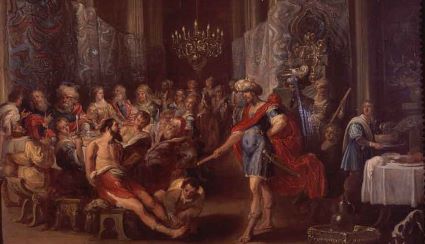
Vincent_Malo_-_Wedding Guest Resized

Featured Image: Vincent Malo [Public Domain] via Wikimedia Commons

Being the Beloved

Things can go wrong very quickly when we are not living from our belovedness.

That’s what happened to the Israelites in today’s first reading. At the first sight of trouble, they turned away from God and worshiped other gods. Even when the Lord mercifully sent judges to help them, they still turned away, and worse than their ancestors.

How often are we, too, like the Israelites? When things go wrong or even when things are going well, we can struggle with trusting in God. We put the armor of self-protection on and soldier on in our own way, while the Lord longingly cries out to us, “Let Me love you!”

It is so much easier to trust in the Lord, even in the darkest of storms, when we live from a place of being His beloved sons and daughters. When we know in the core of our very being that we are delighted in and loved, that changes everything. It frees us. Because we don’t have to restlessly strive to earn God’s love, protection, and peace. He loves us with reckless, wild abandon just because we are His.

So those fears? He’s got them. That conflict you’re in? He’s already conquered it. Your sins? His mercy is there. Your deepest insecurities and self-loathing? He sees it, knows it, and wants to help point you back to the truth of His love. He didn’t promise a life with Him would make all our problems go away, but He promised to be with us. And that’s more than we could ever ask for or need.

God wants to give good things to us. He wants to spoil us with His love, if only we would let Him, because we belong to Him. He is crazy about us. He can’t stop talking about us.

Today, let’s let the Lord scoop us up into His arms like His little children that we are and let Him bring us back to the place of being His beloved ones. We can renew our trust in Him with childlike freedom and joy. He is here. He is here, gazing at us with the utmost joy and delight. His gaze heals, frees, and captivates. We are fully known and truly loved in His sight. He. Is. Here.

Created for Communion

Some Pharisees approached Jesus, and tested him, saying,
“Is it lawful for a man to divorce his wife for any cause whatever?”
He said in reply, “Have you not read that from the beginning
the Creator made them male and female and said,
For this reason a man shall leave his father and mother
and be joined to his wife, and the two shall become one flesh?
So they are no longer two, but one flesh.
Therefore, what God has joined together, man must not separate.”
They said to him, “Then why did Moses command
that the man give the woman a bill of divorce and dismiss her?”
He said to them, “Because of the hardness of your hearts
Moses allowed you to divorce your wives,
but from the beginning it was not so.
I say to you, whoever divorces his wife
(unless the marriage is unlawful)
and marries another commits adultery.”
—Matthew 19:3–9

As human beings, we are made for communion with one another. God created us in a way that makes it impossible for us to go it alone, for He made us in His own image. Just as He exists as a loving community of three Persons, we also are designed to live in relationship with Him and with one another. We see this in the complementarity between men and women: each is a reflection of the love of God, but they express this in different ways. Their complementary strengths bring them closer together.

Whether our need for communion is fulfilled through the vocation of marriage—a relationship that echoes the love of the Trinity—or through consecrated life—a sacred relationship with God Himself—it points to a deep desire written upon our hearts: to love and be loved, to make of ourselves a gift to others. Even while we are still waiting upon our vocation, God still calls us, here and now, to be part of His family. Each time we receive Jesus in the Eucharist, it is an opportunity for intimate connection with our Beloved.

Jesus is the Bridegroom, and we, the Church, are His bride. He lays down His life as a gift for us, and He assures us that His promises to us are eternal, never to be broken. When Jesus speaks against divorce, it is not to shame His disciples or to place burdens and restrictions upon us. He even acknowledges that in some cases, the marriage was unlawful and fundamentally lacking in what is needed to establish a true, healthy marriage as He intends for us. Rather, He wants us to understand that marriage is a great gift, not to be carelessly tossed aside. It is not merely a well of contentment that eventually dries up; rather, it is an opportunity for us to fulfill our deepest purpose through serving one another. To be truly fulfilled, we must each offer a gift of our whole selves—not just the parts we like about ourselves, not just one stage of our lives, and not just a surface-level desire for comfort.

God has blessed us with many great gifts, but do we truly understand their purpose? Or do we see them only for our own benefit? Our own personal gifts are meaningless if we cannot understand ourselves in relation to others—how we are called to serve them, what we have yet to learn from them, and how we need to rely upon them. We can form a true sense of self only when we look outward.

His Own Mother

We were walking home from church when four-year-old Lucy suddenly stopped in her tracks, incredulous. “Wait…you mean God made His own Mother?!?”

The mystery of Mary is not just something to startle four-year-olds. Reflecting on Mary highlights the truth of the Incarnation, and the glorious plan of God.

The Maker of the Universe entered that Universe in the smallest way possible, as a single cell, hidden in the womb of a young girl in a small town itself almost unknown.

God could have come to earth in any way He pleased. He chose to enter the womb of the Virgin Mary. He did not choose her merely as a vessel, but as a Mother. He chose to be carried in a human body, to be nursed at human breasts, to be changed and swaddled and rocked in human arms. We are told that He was obedient to her and to Joseph, allowing His own creatures to teach Him to walk, to eat, to read and write, to pray.

In today’s Gospel we hear the story of the Visitation. Mary is carrying the newly conceived Jesus beneath her heart as she hastens to the hill country to her cousin Elizabeth.  The mothers meet and so do the children within, as Baby John the Baptist leaps for joy at Mary’s voice and the presence of his Cousin.

“Who am I that the Mother of my Lord should come to me?” wonders Elizabeth aloud. There is an echo of royalty in her words—this title was used for the mother of the king. But we must not rush past the very simple reality that a human mother was the Mother of God. The work of God was to be mediated through human bodies.

The Council of Ephesus had to confront the heresy of Nestorianism, which basically separated the humanity and divinity of Jesus and considered Mary the mother only of His humanity. The truth is that Jesus is One Person, who is both God and Man, and His Mother is Mother of that complete Person. She was affirmed in Ephesus as Theotokos, the God-bearer, and, incidentally, when the crowds heard this they rioted for joy!

Mary carried the child, God, first within her womb, and then in her heart as He walked the roads of Galilee, Jerusalem, and ultimately up the hill to Calvary. There at the Cross Jesus expanded Her motherhood to include the Beloved Disciple, and thereby all of us: “Woman, behold your son.”

Just as her motherhood of Jesus was not merely spiritual, but bodily, so also her concern for each of us and all of our needs. Her first prayer of intercession was only four words, “They have no wine.” A lack of wine would embarrass the wedding hosts. But Mary was also aware and awaiting the wine of a greater feast that Her Son would one day initiate.

Today we celebrate the feast of the Assumption. At the close of her earthly life, Mary was brought body and soul into heaven. She is a sign of our hope, as it is God’s desire that we too shall join Him in heaven, body and soul. She is also confirmation that the plan of God is to glorify what is human, including the human body.

Let God be Mighty

“For the LORD, your God, is the God of gods, the LORD of lords, the great God, mighty and awesome.” -Deuteronomy 10:17

Sometimes it’s hard to let God be God.

In some cases, we put Him in a box, restricting what God is able to do in light of our own human expectations. We put limits on our limitless God, putting finite restrictions on His infinite nature and love. We forget that He is outside of time, can move mountains in an instant, and is always working for our good.

In other cases, it is really hard to let go of control, especially when faced with a stressful or anxiety-inducing situation. Sometimes, we know deep-down what we need to do, and the only thing holding us back is the fear that when we take the leap, we will fall to our destruction rather than falling into His arms.

Sometimes, our big hearts swell with the desire to heal and fix problems and be everything to everyone. But we can’t: only God can be God. Jesus calls us to love like Him, knowing that we can’t be Him. And He doesn’t want us to or expect us to. Even in the most dire situations, He whispers, “Let Me be the Savior.”

Can we let God be mighty? Can we let Him surprise us with His love? Can we let Him rescue and save us, our families, and our friends, especially those closest to us who are hurting?

Today, let’s loosen our grip on control and fall to our knees with open hands, asking great things of our almighty God. He wants to do great things for us. He wants to save, heal, restore. And He can and will—we can’t. We are nothing without Him, but we have everything with Him.

Jesus, You are the almighty Savior, Lord of Lords, Prince of Peace. You are infinite love, mercy, and goodness. You can do all things. You are the way, the truth, and the life. We surrender all we have and all we are to Your almighty, all-powerful hands, trusting that You always have us and those we love in Your tender care. You are God, we are not, and we praise You for that. We let go of all we’ve been holding onto and fall into Your arms. Amen.

An Infinite Love

edith stein

I will espouse you to me forever:
I will espouse you in right and in justice,
in love and in mercy;
I will espouse you in fidelity,
and you shall know the LORD

These words were read at Mass today in celebration of a very special saint of our times, St. Teresa Benedicta of the Cross (Edith Stein). A saint very close to my heart, St. Teresa Benedicta is one of the main reasons for my conversion back to my faith.

Edith was raised in a Jewish family in the early 1900s in Germany, eventually converting through an encounter with Christ through philosophy and the lives of the saints. A prominent philosopher, teacher, and speaker, Edith earnestly searched for the answers to who we are as human beings, what that means regarding our call to relationship with God. She died in Auschwitz during World War II, serving others whole-heartedly until her final moments.

The words from Scripture today are from the book of Hosea, words which God spoke to Israel. He desired an all-consuming and faithful relationship with His People. Even in their unfaithfulness, He kept pursuing them with this love.

The reason the Scripture reading was picked for St. Teresa Benedicta’s feast is that she lived her vocation as a human person, in particular, as a woman, to the fullest. She knew that she was created by Love and for Love. She had been captivated by the love of God, and in that, felt she could not contain that message of His love. Her life is a witness of what it truly means to allow God to love us.

When I read the words of the Scripture reading today, in all honesty, my heart is uneasy. I desire to be loved with such unconditional, all-consuming, and infinite love. But how often do I settle for less? In my own heart, I find that when I resist these words from God, it is because I doubt He is enough.

While we each have these desires for such love, it is so much easier to settle. We fill our hearts with finite things which give temporary satisfaction, in order to fill that inner void. But these temporal goods, while gifts from God, are not enough. They are finite. They are gifts which ultimately are meant to point us to Him. 

Today, as we pray through these words of Scripture, place yourself in a position of receptivity. Hear them as Jesus speaking them directly to you. Let us ask ourselves, “What are those things which I grasp onto to try and fill that spot in my heart meant only for God?”

Give these desires to Him, and allow Him to fill them. Give him the doubt in your heart, and allow Him to surprise you!

As we celebrate today’s feast, let us ask for St. Teresa Benedicta of the Cross to intercede for us. She received the love of Christ the Bridegroom, trusting that her heart’s desires were given to Her by God for a reason. She was one who was not afraid to allow Herself to be loved.

St. Teresa Benedicta of the Cross, intercede for us and help us to surrender wholeheartedly to the one who loves us. Give us the interior freedom to receive His all-consuming love without fear!

For more information on St. Teresa Benedicta of the Cross’s life, go to http://www.vatican.va/news_services/liturgy/saints/ns_lit_doc_19981011_edith_stein_en.html

Recommended reading on St. Teresa Benedicta of the Cross:

Life in a Jewish Family: https://www.amazon.com/Life-Jewish-Family-Autobiography-Collected/dp/0935216049

Essays on Woman: https://www.amazon.com/Essays-Woman-Collected-English-German/dp/0935216596

In the Folds of His Mercy

O inconceivable and unfathomable Mercy of God,
Who can worthily adore you and sing your praises?
O greatest attribute of God Almighty,
You are the sweet hope of sinners.
—The Diary of St. Faustina

One of the largest thorns in the crown of Jesus is the distrust of souls, a lack of trust first sown when Adam and Eve were tempted to doubt God’s steadfast love for them. Unable to see or understand the plans of their father, they grasped at a way to protect themselves, hardening their hearts. This original lack of faith was passed on through salvation history, as we see in today’s readings. In the first reading, the Israelites panic when they cannot see any water in the desert and seem to forget how God had just led them out of slavery. Even Moses comes to a breaking point as their leader. In the Gospel, Peter recognizes Jesus as the Son of God, the living water, but even he resists God’s plan when he cannot understand why Jesus will have to suffer.

Still, this “truly necessary sin of Adam” sparked the greatest story ever told: the story of redemption and merciful love. God did not give up on the grumbling Israelites, who were stuck in their own circle of misery, or on Peter, who later abandoned Christ during the passion and was left in bitter tears. As Robert Stackpole, director of the John Paul II Institute of Divine Mercy, writes, “Saint Thomas Aquinas defined mercy in general as ‘the compassion in our hearts for another person’s misery, a compassion which drives us to do what we can to help him’ (ST II-II.30.1). Divine Mercy, therefore, is the form that God’s eternal love takes when He reaches out to us in the midst of our need and our brokenness. Whatever the nature of our need or our misery might be—sin, guilt, suffering, or death—He is always ready to pour out His merciful, compassionate love for us, to help in time of need.”

St. Dominic, the founder of the Order of Preachers, and whose feast we celebrate today, poured out his life to show people the truth of the love of God as our merciful father. He had a great love for souls, for the suffering Christ, for the doctrines of the Church, for Mary, and especially for the Mass and the Blessed Sacrament, and relied on Divine Providence, even when he could not see or understand what God’s plans were. He was known to be moved to tears of contrition and love in the presence of the Eucharist, overwhelmed by this ultimate sign of God’s mercy. He was filled with sorrow for his own sin and an intense longing for others to come home to the love of God, which came through in his joyful, indefatigable preaching and in the love and kindness with which he cared for all he encountered. Instead of hardening his heart, he allowed it to be broken and shared it willingly.

Blessed Jordan of Saxony, O.P., puts it best: “Whilst he thus laboured to make his own soul pleasing to God, the fire of divine love was daily more and more enkindled in his breast, and he was consumed with an ardent zeal for the salvation of infidels and sinners. To move the divine mercy to regard them with pity, he spent often whole nights in the church at prayer, watering the steps of the altar with abundance of tears, in which he was heard to sigh and groan before the Father of mercy, in the earnestness and deep affliction of his heart; never ceasing to beg with the greatest ardor, the grace to gain some of those unhappy souls to Christ.”

Is it any wonder that St. Dominic had a special, ardent love for Mary, considering that her trust in God’s love is meant to counter the distrust of Eve, and that she also longs to lead us to Jesus, her Son, the new Adam? As the Nashville Dominicans note, “His life, his work, his Order were placed under her protection, and he invoked her in every difficulty and danger… The Blessed Mother filled him with heavenly favors, watched over him with motherly care, and gave him the habit of his Order. A tradition cherished in his Order… ascribes to him the first teaching of devotion to the recitation of the Rosary. His disciples were called ‘Friars of Mary,’ and have carried her Rosary and scapular to the uttermost parts of the earth.”

St. Dominic wasn’t just known for his tears, for his lifetime of studying, and for his preaching: he was also known for his joy. Just as Mary burst into song with her Magnificat, St. Dominic sang, even in the midst of darkness. Since he knew God as his merciful, loving father, how could his heart not overflow? Let us then follow their example, as the psalmist says today, and “sing joyfully to the Lord.” Light of the Church, teacher of Truth, rose of patience, ivory of chastity. You freely poured forth the waters of wisdom. Preacher of grace, unite us with the blessed. St. Dominic, pray for us! Amen.

Reading & Listening Suggestions
Fr. Guy Bedouelle, O.P., In the Image of St. Dominic
Kentucky Thomism podcast, The Tears of Dominic
St. Dominic novena
St. John Paul II, Dives in Misericordia
Robert Stackpole, What Does Divine Mercy Actually Mean?

Down the Mountain

Have you ever experienced a moment in time when you knew you were in the presence of God?  At such a moment, life completely stops, all your cares and worries vanish, and the world suddenly somehow makes sense.  Most of all, you are overwhelmed by a certainty and trust that everything is “okay.”  This must have been what the disciples felt when they witnessed the transfiguration of the Lord.  They were among the divine, which was so incredible for mere mortal fishermen, that it was simply too much for their minds to comprehend.

“Master, it is good that we are here;
let us make three tents,
one for you, one for Moses, and one for Elijah.”
But he did not know what he was saying.” (Luke 9:28–36)

Peter, along with James and John, was given a special glimpse of a meeting much bigger than himself, so he attempts to deal with it in a concrete way, honoring these glorified beings with the only skill he can contribute.  It is essential in a life of faith to acknowledge these moments and give thanks for them, holding them close in our hearts to remember for the future.  While these times are life-changing, they cannot last forever, and we all must return to reality.  On one of my pilgrimages, as we were preparing to resume our daily lives, our priest reflected on the transfiguration, asking us to imagine what it must have been like walking down the mountain, how disorienting for the disciples.  No matter how miraculous the experience, the reentry into reality will always be difficult.  We will once again be confronted by doubt and fear, especially the doubt as to whether or not what we just experienced was actually real.

Although the walk down the mountain will always be a trial, I take heart that the harder the walk is, the more I can have faith that what I just went through really did happen.  The account of the transfiguration gives us hope as believers and followers of Jesus Christ.  After the transfiguration, only He remained with His disciples.  This holds true for us as disciples today.  Jesus Christ remains with us, ready to give us courage and to support us as we walk down the mountain and continue our everyday journeys in our daily lives.

Eat and Be Satisfied

In today’s readings, we see two different stories of God providing for His people. In the book of Numbers, the Israelites are given manna in the desert, sustenance for their journey to the promised land. But they grouse and complain about the blandness of this heavenly food. They remember the fish that they ate “without cost” in Egypt, forgetting that it came with a very dear cost indeed—the cost of their freedom. They are so quick to forget what God has done for them, the miracles He wrought to deliver them from slavery in Egypt.

In contrast, the Gospel reading presents the story of Jesus’s multiplication of the loaves and fishes. Here, Jesus provides for His followers with simple yet nourishing food, and they accept it gratefully. Where the Israelites in the desert turned their nose up at the food God offered them, these crowds “ate and were satisfied.”

The juxtaposition of these two stories reminds us how important it is to be receptive to God’s providence in our lives. He is always seeking to nourish our souls and provide for our every need, but we often miss out on it because it comes in a way we don’t expect. If we hold too tightly to our own ideas of what we ought to have, we might overlook the gifts that are right before us. Truly, God showers us with gifts each and every day of our lives, even if they might come amidst a difficult journey. What a shame it would be to allow our pride to hold us back from living in gratitude and wonder.

People can always find reason to complain. We serve others not to receive their praise and thanks but because it is the right thing to do. Just as God continued to feed His people with manna even despite their ingratitude, so are we called to imitate His kindness and generosity.

Today is the feast of the dedication of Santa Maria Maggiore, one of the four major basilicas of Rome, which houses the relic of Christ’s manger. (Several years ago, I got the chance to attend midnight Mass there at Christmas, which was especially beautiful!) Mary, as the Theotokos, or “God-bearer,” was in a sense the original manger, the first home for Jesus. But a manger is not a typical cradle; it is a feeding trough for animals. When Mary laid her divine Child in the manger, it prefigured His role as food for the world. He offers His very Self to nourish us, and she lays down her own life to become the means through which we can receive Him. God’s providence for us truly knows no bounds. As He continues to feed His people, may we receive Him gratefully, eat, and be satisfied.

Mighty Deeds Will Happen

Jesus grew up in Nazareth. Imagine him there as a little boy playing outside, saying hello to his neighbors, helping with chores around the house, going to the synagogue to pray in community. As an obedient young man, imagine Jesus by Joseph’s side helping him do woodwork. At this time, in his early years, Jesus hadn’t made his divinity known. He was experiencing a fully human life and thus having fully human interactions with people.

After Jesus was done teaching in Capernaum he went back to Nazareth, his hometown. In Nazareth, Jesus began to teach at the Synagogue and do good works. The people who saw Jesus started to question him. The Gospel tells us that the people were astonished at Jesus, but not in admiration; they were in disbelief and denial. Most likely these were people Jesus grew up with, neighbors he said hello to, the fellow children he played with, his classmates. Now they became people who doubted the good works that Jesus was doing. “Where did this man get such wisdom and mighty deeds? Is he not the carpenter’s son?”

How many times have your actions been questioned? How many times have people doubted in what you could do? Perhaps they thought you didn’t deserve to be in a position of leadership or weren’t worthy enough to be promoted at work. One of the fears in today’s society is being stationary in one place for too long and not being able to grow in other areas. For example, in the design world, it may look negatively if you’ve only done work in commercial real estate and then want to move into residential design. In the fashion world, it may look negatively if you’ve only been in children’s wear and then want to move into high-end fashion. Or in the marketing world, it may look negatively if all your ad campaign work is on one brand and then you change brands. In all these scenarios when change happens people question your ability to be able to do the new work because they only knew you as you were in your previous position. Now can you imagine why the Nazarene people questioned Jesus’ doings? They saw big change happening. But, they only knew him as “the carpenter’s son” before the start of his ministry, before the miracles that came through his full divinity were known. They heard him preach and saw his miracles but chose not to believe. Remember this, you are never stationary in life and God calls you to different places at different times, always for the greater good of His glory and within that you will always grow.

You and I know Jesus better than those who had disbelief in Nazareth. He wasn’t just the carpenter’s son. We know that Jesus is fully human and fully divine. He is Son of Man and he is Son of the Father. We know the mighty deeds that he has done and we believe in future mighty deeds to come through God’s grace. I know and believe all of this and yet sometimes my own humanity makes me doubt the good things that will be to come. When work is stressful, when I fail an exam in school, when my family and I are at odds, I forget about God’s graces. In that moment I am like the people in Jesus’ hometown, doubting him. My friends, through the Frassati fellowship, have reminded me to focus on Jesus’ love. In moments of little faith I need to offer all of it up to God. He will do great things for me.

Continuing in the Gospel, after being rejected Jesus says that “a prophet is not without honor except in his native place and in his own house.” People may expect us to be one particular thing, but our truth lies in God’s calling for where He wants us to be. We are not defined by our social status nor our jobs. We are sons and daughters of God, brothers and sisters in Christ. God will always do great things and we are destined, through His will, for greatness.

At this moment, I am with missionaries from the Frassati fellowship in Peru. We are all far from our own houses. Prophets in our own distinct ways. We are in community and in prayer with each other and the people of Laderas, the small community in Peru in which we are on mission bringing the Gospel and building homes for the poor and most in need. Through the power of the Holy Spirit, we will do God’s will and mighty deeds will happen here.

Saint Eusebius of Vercelli, who believed in Jesus’ full divinity, on your feast day today, pray for us.

Blessed Pier Giorgio Frassati, for your love of community that has brought this ministry of young adults together in Peru, pray for us.