Justice in the Smallest Things

For the last few weeks the word “justice” has been following me around. I’ve seen it in Bible verses, heard it at Mass, met parish members whose work focuses on it—the word is everywhere. We often see or hear it in mainstream media and conversations, but do we really know what it means to be “just”?

In today’s first reading, we are given glimpses of what it means to be just in a biblical sense. In Jeremiah 23:5–6, it says, “See, days are coming…when I will raise up a righteous branch for David; As king he shall reign and govern wisely, he shall do what is just and right in the land. In his days Judah shall be saved, Israel shall dwell in security. This is the name to be given him: ‘The LORD our justice.’” Although there’s much to be said about the verses, I believe the highlights of those verses are that those that are just do the following: 1. Act wisely & execute fairly; 2. Provide safety to others who wouldn’t have so otherwise; 3. Have a connection with our Lord.

While you might be thinking, yeah, that’s great and all, but what does a king or a chapter from the from the Old Testament have to do with me? Well, a lot. If you reside or work in New York City, or any metropolitan area, you’re bound to come across unjust circumstances and societal issues. Homelessness. Hunger. Poverty. Things that are beyond the average citizen’s control. Yet, despite that, I believe everyone is called to be just in their daily interactions with others. We are called to act wisely and fairly. We are called to provide safety and comfort to those without. We are called to connect with our Creator. It is through our connection with God that we are able to employ just, or fair, practices. God continuously has mercy on us, and we’re called to do the same with others, no matter what stage of life they’re in.

Being just might look differently for everyone, but in practical terms it could mean having patience during rush hour, serving a homeless individual with the dignity and respect he/she deserves, welcoming a new member of your parish with open arms, or even giving your employee another opportunity at work. During this time of Advent, as we prepare our hearts to receive our Lord, I ask that you meditate on what it means to be just and how you can apply today’s readings to your daily life.

If you need an example of what that might look like, St. Joseph is a marvelous example of someone who acted with righteousness and wisdom. When Mary discovered that she “was… with child through the holy Spirit” (Matt. 1:18), she had only been betrothed to Joseph, and they hadn’t yet moved in together. In her time, adultery was a grave sin punishable by death, so being pregnant without any “logical” explanation as to how it occurred would have given Joseph enough justification to punish her publicly. Despite that, Joseph decided against punishing her because he was “unwilling to expose her to shame” and “decided to divorce her quietly” instead. This action in itself was radical and uncommon at the time, which gives us insight into the kind of character Joseph had. Instead of publicly humiliating her, at best, or stoning her, at worst, he decided to quietly settle his affairs with Mary so that their divorce wouldn’t make her an outcast or target of the community.

How often can we say this about ourselves? Do we purposefully and intentionally try to cause as little harm as possible to others during our daily interactions? Or do we sometimes act from a place of hurt and anger, thereby perpetuating the cycle? God calls us to treat others as He treats us, from a place of justice and mercy.

Joseph, however, didn’t just stop there, as we all know. He eventually accepted Mary into his home after an angel appeared to him in a dream:

“He did as the angel of the Lord had commanded him and took his wife into his home” (Matt. 1:24).

Although we can only guess what occurred then, it would be enough to speculate that Joseph might not have fully understood what was going on. He might not have understood why God was calling him to accept this woman, with whom he’d had no relations, into his home and take her as his wife. Yet he did so anyway. Just like Joseph, God calls us to follow Him through the uncertainty and discomfort. Through the sacrifices. Through the difficult decisions one must make in order to act justly. Despite how overwhelming all of this might sound, take comfort in knowing that our God gives us all the grace and strength we need. Through Him, we can obtain the wisdom and grace we need to bring a little more justice into this world we live in.
What a Powerful Name It Is

“He himself said to [the chief priests],
‘Neither shall I tell you by what authority I do these things.’” -Matthew 21:27

What great authority lies in Jesus’ Name! Even just speaking the Name of Jesus out loud changes a room.

In Jesus’ Name, the blind regain their sight, demons are cast out, and the deaf hear, as we heard in yesterday’s first reading and Gospel. In Jesus’ Name, healing reigns. Death is no more. Destruction, despair, and ruin are not the defining characters in our story, nor is that how our story ends.

Through Him, with Him, and in Him, we can face any agonizing trial or stubborn obstacle.

Let’s be real, friends. Sometimes God can seem excruciatingly far away. Sometimes we wait and wait and wait for an answered prayer, feeling like it’ll never come. Sometimes it seems all-too tempting to give up and to give into hopelessness.

It is these exact moments where we need to declare who God is and who we are, claiming the authority in Jesus’ Name given to us in our adoption as beloved sons and daughters of the Father.

Say it with me out loud: “In the Name of Jesus, I renounce….”

What do you need to renounce today? Hopelessness? Despair? Fear? Self-pity? Anger? Pride?

Again, say it with me out loud: “In the Name of Jesus, I renounce….”

When God seems far and when prayers seem unanswered, rise up as best you can in the authority of Jesus Christ, our King. Even if all you can muster is whispering His Name, yes and amen.

God is not done with you, and He’s not done with your story. He never is! Keep going. Keep showing up. Keep pressing in to His Sacred Heart. Keep seeking and knocking. He never tires of you, never tires of all that’s on your heart, and never tires of doing good things for you.

Lord Jesus, increase our faith to blossom into expectant faith. Help us to claim authority in Your Name when we feel weakest. Help us to show up and keep seeking You even when You feel painfully distant. We know and trust that You desire great things for us. Give us a new spirit of hope today. Come, Emmanuel, come! Amen.

A Great Light

The Christmas season is marked by light.  Lights strung around the tree, candles burning in windows, fireplaces warming homes, storefronts decorated with lights…  Many families will take a drive to go see the lights or see a tree in their city adorned with lights.  The beauty of light clearly draws us in. 

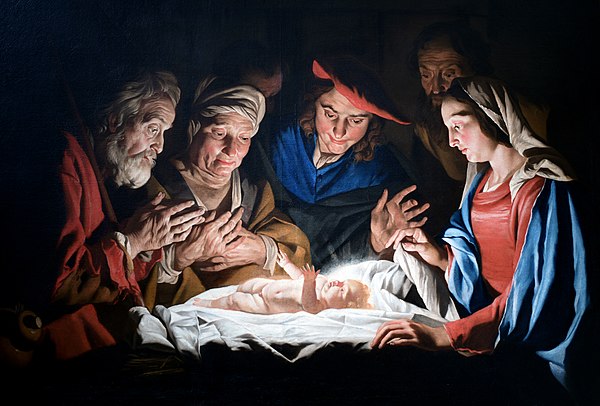
I’ve been rediscovering the glory of light as I watch my 2.5-month-old stare at lights — not just Christmas lights, but any kind of light.  I am realizing that we are born with an innate draw to the gift and mystery of light.  And while my sweet little baby stares with wonder at light, she is often being stared at by the people around her.  When we introduce her to friends and family, people find themselves circled around her, staring in wonder in the same way she herself stares at a light.  I’ve had two friends say in the past week that babies are like campfires — you feel like you can just stare at them forever.  There is a beauty, a wonder, and a joy in the presence of a baby and in the light of a campfire that draws our hearts.  This mystery of light is at the beginning of creation, as God himself created light before anything else (Genesis 1:3).  And this mystery of light is revealed to us further at the beginning of the Gospel, the beginning of our re-creation in Christ, as the Light of the world comes to us as a newborn baby.  How everyone present at Christ’s Nativity must have stared at this baby with an unmatched wonder and awe, as they stared at the One True Light Himself.  

Those who follow you, Lord, will have the light of life.

The refrain of today’s Psalm taken from the Gospel of John (Jn 8:12) reminds us that as Christians, we possess the gift of light, for Christ is the fullness of light.  It is through Christ that we are called into union with the Creator of light, the Father, and made partakers in this light by the fire of the Holy Spirit. We may already be well aware that as Christians we possess the light of Christ, but this Advent, perhaps the Lord is calling us deeper, asking us to receive His light more fully. What area or aspect of your heart or life remains in darkness? These areas may take some prayerful digging to find. Anxiety, fear, hopelessness… Ask the Lord to reveal this place to you, in His gentleness and love. This is where the Lord yearns to be invited. To bring an end to any remaining darkness with the light of life.   

I hope that every light we see this Advent and Christmas points us to the One True Light Himself. The Savior of the world, God Himself, was born to us a beautiful, sweet baby. Come let us adore Him, and stare in wonder at the baby Jesus, the Light who changed everything.  

Adoration of the Shepherds by Matthias Stomer, 1632

Flowers in the Desert

“Flowers in the desert” my friends and I would call these little graces, gifts of hope or promise during times that seemed dominated by absence.

They varied in nature or significance: A chance encounter on a plane. An intriguing new addition to the social circle. An anonymous gift of a $100 bill. A word from a friend that was undoubtedly in fact a word from God.

These little things would be signs that would carry us through.

But they were only signs; therein lay the thorn on the rose. Pressed too hard, they did not deliver, but would in fact disappoint if mistaken for the Gift.

The airplane conversation opened windows to vision, but no doors. The new relationship was flattering and fun, but not “The One.” The money was quickly spent. The word brought peace for a time, but then back to waiting and wondering, “Where am I Lord? What am I doing? What are You doing? Are you even there?”

Anyone who has walked in the faith for some time has likely come to know the seasons of the soul. There are days of spring, when all things seem to proclaim the glory of God, when streams of grace flow amply and flowers bloom everywhere. In such seasons my heart knows easily the nearness of God, quickens with a song or a verse or just the simple suggestion of Presence.

But there are other seasons, seasons of winter, when it seems that life lies buried under the frozen dry ground. When the same words that once caused my heart to flutter, read again do not move me at all. When prayer feels like an empty exercise, a movement of the mind and will, while the heart is cold and still.

It is in the winter desert that faith becomes real.

Once upon a time, I thought that this meant that I was being tested, that I would prove myself a real Christian with heroic acts of faith, hope and charity that rose above my feelings. But I am no more able to produce these than a wanderer in the desert can produce water or an oasis. In the desert, it is God who provides.

Centuries ago on a hill called Tepeyac Our Lady appeared to Juan Diego. She asked him to go to the bishop with the request that a chapel be built in her honor. But the bishop was uncertain and asked for a sign. Our Lady provided.

She sent Juan Diego to gather roses from the desert hillside, of a kind that had no business growing in winter. Juan Diego is delighted with this gift, sure that it will be what the bishop is seeking. Our Lady carefully arranges the roses in his tilma, and Juan hurries to the bishop’s palace.

But as we know, the roses were only a means to reveal something greater. When Juan Diego opens his tilma, it is Our Lady’s own image that is revealed.

There are many moving details to this story, but of special significance are the eyes of Our Lady in this image of Guadalupe. The image itself confounds scientists—that there are not brush strokes, that it has been held by the rough cactus fibers, that is has survived for centuries—all indicate something miraculous. But a close look at the eyes in the image is even more startling—the iris and pupils show the images of people, as would appear in eyes that were photographed. And the proportions of these people are different in each eye, as a true photograph would show—but this image on the tilma predated the invention of photography. Even the microscopes used to reveal these images in the eyes did not exist at the time that Mary’s image appeared.

Many believe that the people shown in Our Lady’s eyes are Juan Diego, the bishop, and those present at the unveiling of the tilma. That even as they were looking to see signs, Mary saw each person present, held them in her gaze—and does so to this day.

Roses in winter reveal the vision of God. We are seen by heavenly eyes, held by hands that we cannot see. Even in such times, we are not alone. It is not the gifts that we seek, but the Giver.

“Am I not here, who am your Mother?” Our Lady tells Juan Diego. Her image shows her belly, swollen with Presence. She who became Mother to Emmanuel mothers us too, and calls us always to her Son.

In today’s Gospel we hear the first proclamation of the Incarnation, the Good News of the coming of Emmanuel. The name Emmanuel means God is With Us.

It is He Himself who comes to save, to be with us. More than a sign, He is the reality our hearts long for.


Flowers in the Desert Delfino

Photo by Delfino Barboza on Unsplash

A Highway for Our God

There are some moments in our lives where we just feel lost and out of place. For me, the moment of complete and utter confusion happened my senior year of college. In preparation for my future, this should have been the year in which I checked off all the boxes on my master plan. But that was not the case; I checked off none. I didn’t even have a plan. I was lost. Although I knew my physical location—on the University campus—I couldn’t find myself anywhere on the map. Someone could have arranged fluorescent direction markers and flagged me down with bright orange batons and I still would not have known in which way to turn. I would have blindly walked past them, lost and uncertain with myself.

I have known about the parable of the lost sheep since I was a child—seeing this Biblical passage through the eyes of a child, I always saw a perfect, fluffy sheep in a picture book. I didn’t realize the impact in my heart this parable would make until my adulthood, when I found myself, no longer lost, in the Catholic Church.

In today’s Gospel reading, Jesus tells us that a shepherd has one hundred sheep and one of them goes astray and is lost. Just one. Jesus asks for our opinion, will you go in search of the lost sheep? I’m sure the disciples listening to Jesus were thinking: “Well, the man has ninety-nine other sheep left. He should be fine. He has more than what he lost. He should just let that one sheep go.” Jesus, however, continuing with the parable tells them the answer to his question: the man will leave the ninety-nine on the hill and go off in search of the one lost sheep. In the children’s picture book the shepherd and even the perfect, fluffy sheep look happy surrounded by beautiful green pastures and mountains, both underneath a beautiful blue sky. The reality, in first-century Palestine, is that a shepherd must have been crazy to leave ninety-nine sheep behind and travel the dangerous, unknown, and hard terrains of the mountains for one lonely sheep.

Who would realistically do this? God would. God would do this for you. Because out of one hundred, one thousand, one million, one billion sheep in his flock, God loves you and He will go after you.

Notice that in the parable it’s not the shepherd who loses the sheep. It’s the sheep that went astray. We are that one sheep. We expect God to love only those who listen to Him and follow His commandments. We forget that God does not love by the boundaries of this world. His love is immeasurable and powerful because God is love. Where we limit our love to those who are undeserving, where we neglect those who disobey or do not follow orders—God gives them His love. He follows these lost sheep, and when they are ready, He guides them home.

In the first reading the Israelites have been called back home after being in exile. They have been in the wilderness, and the Biblical passage describes the way they need to travel from Babylon to Jerusalem. Normally it’s a dangerous and rough journey, but God is with them in preparing the way for them to come home. Every mountain and hill is made low and the rugged lands will be made plain and easy to travel. Here is God gathering his lost sheep and leading them home.

“A voice proclaims: In the wilderness prepare the way of the LORD! Make straight in the wasteland a highway for our God! Every valley shall be lifted up, every mountain and hill made low; The rugged land shall be a plain, the rough country, a broad valley.”

Back in my senior year of college, my lost years, I found myself on my knees lovingly admiring the altar. The place of sacrificial love. I kept thinking about the lost sheep and painfully acknowledged that it was me. I kept thinking that I wasn’t the sheep from my childhood picture book. I wasn’t “fluffy and perfect.” I was a mess. Dirty. Broken. Defeated. I realized that I was looking at myself through the world’s eyes and wrongly thought I didn’t deserve love. But God’s love knows no boundaries. The sheep in the picture book is “perfect” because God always sees you as his perfect child. In the Catholic Church looking at Jesus on the cross, truly knowing that the good shepherd had walked through the wilderness to find me and bring me home—I believed him when he told me he loves me. God’s love is unconditional and no matter how long ago you’ve gone astray, what mountain or valley you’re lost in, no matter how deep of a mess you’ve made of things, if you haven’t gone to Mass in years, or you carry anger or guilt, nothing that you do will take away from God’s love for you. The good shepherd is in search for his lost sheep to come back home. And He will help you to “make straight in the wasteland a highway for our God!

Image Credit: The Lost Sheep [Public Domain]

Her Immaculate Heart Beats for Us

“My Immaculate Heart will be your refuge and your safe path to God.” –Our Lady of Fatima

Happy Feast of the Immaculate Conception! Today we rejoice in the grace Mary was given to be conceived without sin, so that she could give herself fully to being the Mother of the Son of God, and in turn, our Mother (CCC 494). In the moment she came to life in St. Anne’s womb, she was “full of grace,” becoming the beautiful vessel through which God’s grace could flow for you and for me (Luke 1:28).

Mary’s Immaculate Conception doesn’t make her unrelatable or distant; no, she is very near! She is our loving Mother—always there, always guiding us to her Son. When we are in need, we can run to our Mom and find security in the comforting folds of her mantle. Like a good Mother, she holds us in her arms, snuggled against her Immaculate Heart. If we listen closely, we will hear the heartbeat of her Son Jesus in each beat of her Immaculate Heart.

Thanks to Mary’s Immaculate Conception, she was able to make her courageous fiat to being the Mother of our Savior—and in this, we gain a Mother, too. Mary’s gentle, pure, courageous, trusting, fierce heart beats for you, with the ache of wanting you to know her Son’s love and mercy.

Mary’s heart was wounded (Luke 2:35), and she knows your pain. Though she was without sin, her life was one of trials, unknowns, grief, and heartache. But she rose up and said another fiat in each moment. She surrendered her whole self to the Lord, even when it didn’t make sense and she couldn’t see the way. Mary, being full of grace, never lost hope and never lost her great joy in the Lord. May she help us to do the same.

You are safe and held in her Immaculate Heart. Mary will never fail to bring you to Jesus, carrying you in her motherly arms into the arms of our Savior.

Immaculate Heart of Mary, pray for us!

Here is a beautiful song honoring our beautiful Mother!

The Long Night

And out of gloom and darkness,
the eyes of the blind shall see.
—Isaiah 29:18

The LORD is my light and my salvation;
whom should I fear?
—Psalm 27:1

During this time of year, when we have more hours of darkness than of daylight, the days can feel impossibly short and the nights endlessly long. It happens every year, but somehow we still find ourselves surprised every December when we walk outside at 5pm and the sun has already retreated. These long nights are the backdrop of our yearly Advent preparations and a blank canvas for all our Christmas light displays.

This week while teaching my Confirmation class, I asked my middle-school students whether they’ve ever gone stargazing. They replied with stories of watching the stars while traveling with their family, out in the country or even in the middle of the desert, where they could see the constellations clearly. Then I asked if they’d ever tried stargazing in Manhattan. They laughed and said that while they’d tried, they couldn’t really see anything from the city, and whenever they did it usually turned out to be a plane. Why is that, I asked? Well, because we have so much artificial light here that you can’t see anything else. Then I asked them to picture the night of Jesus’s birth, the first Christmas. Why did Jesus choose to come into the world during the darkest, coldest time of year, amid a sparsely populated desert, in the middle of the night? Could it be possible that all of that darkness made it easier for the wise men to see the light of the star? Might Jesus have come into the world amidst its cold, lifeless season as a sign of who He is for us?

O holy night, the stars are brightly shining;
It is the night of our dear Savior’s birth.
Long lay the world in sin and error pining
‘Til He appeared and the soul felt its worth.
A thrill of hope, the weary world rejoices,
For yonder breaks a new and glorious morn.

The child Jesus, born in the middle of a cold winter’s night, is the Light that shines in the darkness. In order to prepare ourselves to celebrate his arrival at Christmas, let us spend this Advent entering into the night, allowing ourselves to feel the emptiness of our human condition, and daring to quiet the noise of the world around us to breathe in the silence. Let us meditate upon the darkness that enveloped the world before His arrival, so that we can see His brilliance more clearly.

During this time of year, it can seem harder than ever to find a few minutes of silence and permit ourselves to be still. But God speaks to us in the silence and meets us in our emptiness. Let us make space for Him to speak instead of crowding our lives with so many distractions that we cannot hear His gentle voice. There is so much artificial light that fights for our attention during Advent, so much so that it may blind us from noticing the true Light of the world. But if we’re willing to take a step back into the dark, quiet night and realize our need for Him, the Star of Bethlehem will shine all the more brightly in our hearts. Our world, weary as ever, longs to receive that Light.

St. Andrew Christmas Novena:

Hail and blessed be the hour and moment in which the Son of God was born of the most pure Virgin Mary, at midnight, in Bethlehem, in the piercing cold. In that hour, vouchsafe, O my God! to hear my prayer and grant my desires, through the merits of our Savior Jesus Christ, and of His Blessed Mother. Amen.

Adam_Elsheimer_-_Die_Flucht_nach_Ägypten_(Alte_Pinakothek)_2.jpg
Adam Elsheimer, The Flight into Egypt / PD-US

The Rock

Last Christmas a very generous friend gifted me a Know-It-All watch. It knows when I am sleeping, and how well. It knows when I am sitting—and buzzes “Move!” when I do so for too long. It knows my heart rate and will buzz frantically “Abnormal…!”—often during particularly still moments such as the Consecration—assuring that said heart rate will quickly climb even higher.

I keep this omniscient tyrant for two reasons: one is that it alerts me to calls, which is helpful because I frequently forget where I’ve left my phone. The other is that it tracks my steps, motivating me at least in theory to take more of them.

One morning this past spring I was traveling with some friends from college, and we were planning to enjoy a leisurely brunch before heading our separate ways. I decided to take advantage of the hotel treadmill and get my steps in early. I was pleased that by the time we sat down to brunch, I was just 50 steps short of 10,000.

It was worth it. The food was delicious and it was a delight to just relax and enjoy extended conversation. But suddenly, mid-sentence, I felt the familiar bossy buzz and looked down at my watch to see the fireworks going off, signaling that my steps goal had been reached. I was amused and bewildered. How could this be, since I had been sitting for the entire time?

“It’s because you’re Italian,” my friends laughed. “You talk with your hands….”

Today’s Gospel is about speaking with more than words. It is in fact our actions that speak to God most clearly. “Not everyone who says to me, ‘Lord, Lord, ‘will enter the Kingdom of heaven, but only the one who does the will of my Father in heaven,” Jesus tells His disciples.

Faith is something that we profess not with our mouths but with our lives. By our actions, we build our house on either rock or sand.

At the same time, faith is knowing that it is not by my own strength or power that I do good. Rather, God has made me good and empowers me to choose the good. We are free to say no to what would hinder His will, knowing that it would also hinder our happiness.

Recently I read an article with the rather bizarre assertion that Mary and Jesus could have been just as happy and holy had they told God, “No.”

The author was trying to make a case for the primacy of consent. That at the Annunciation, Our Lady had the freedom to say Yes or No to God’s proposal. This is true: Our Lady was not forced to bear the Son of God. She was invited to be the spouse of the Spirit, the Mother of the Son, but she could have said No. All heaven awaited her answer.

Any man who proposes knows the intensity of such a moment, of held breath, awaiting a reply. No lover worthy of the name would make it a matter of force. She must always have the power to choose.

And yet, with the power to choose comes the power to choose tragically. Mary could have said No. But it would indeed have been a tragedy. Nothing else she could have chosen would ever approximate what God had in store for her. Her empty autonomy could not have been on par with being the mother of the Savior of the world.

Mary, full of the love of God, trusted the goodness of God. She knew He could not and would not propose something that was not good. She knew that whatever He does through us, He also does for us. She was free to respond fully and joyfully, and she did.

We also build our actions on the rock of Christ when we trust His promises, when we choose to say Yes to something (Someone) greater than ourselves. If instead we choose to trust in human ideas, in human strength, in human plans, then we find we have built on sand.


Waiting, Groaning, Hoping

Happy Advent, dear friends!

This beautiful season of Advent goes far beyond twinkling lights and perfect Nativity scenes. if we let God really speak to us this Advent, we are pointed back to the aches on our hearts, to our need for a Savior.

Sometimes things about this season seem so perfect and cozy and cute that we forget that Jesus took on human flesh to burst into our world, into our mess…and for our mess. If everything was right, we wouldn’t need a Savior. And how much we do.

How is your heart in need of redemption and restoration this Advent? I feel that all of us have things on our hearts, sometimes buried deep, that are places of aching, longing, and waiting. Maybe you’re waiting for a new job, aching for a vocation, or hoping for good news for that next medical test result from a loved one. Maybe you’re in a season of feeling overwhelmed and not enough. Maybe you’ve given up on praying about something.

Whatever it is, you’re not alone. In St. Paul’s Letter the Romans, he writes about how all of creation groans awaiting redemption (Romans 8:22-23). Bring it to our Savior. And have hope.

I will say it again, have hope! Jesus is here to save. He came into our world with a face, with a beating heart, and with a voice to speak: “I’m here. Be made well.”

We can enter into this Advent with expectant faith, entrusting each ache of our heart to our Savior. God never fails to come through, and He loves you through it all. Advent is a season for reawakened hope, because we are reminded that Jesus comes to meet us over and over again, that He’s constantly entering into our lives with His relentless love to heal, to restore, to redeem, and to hold us in His tender Heart.

For further reflection on this theme, check out this beautiful Advent song by the Vigil Project!

Here at the End of All Things

“In all that ruin of the world for the moment he felt only joy, great joy.”
–J.R.R. Tolkien

Today is the day after Thanksgiving. The table has been cleared, the extra chairs have been returned to the basement, and what is left of the turkey dinner (not much!) has been tucked into the fridge. The faint echo of last night’s laughter and chatter has faded into silence, following the taillights of cars that slowly disappeared into the darkness outside. Something you cannot quite place has ended, and something you cannot quite name has been lost—even if plans are already in place to put up Christmas trees, bake cookies, sing songs, and ring in the new year.

In those unattended moments, our hearts ache for something we cannot quite describe. Maybe we wish those happy times with loved ones could have lasted just a little while longer. Maybe we think of past holidays and grieve for those who would have filled the empty seats at the table this year. Or, maybe we tell ourselves that just one more smile or just one more hug would have been enough to stave off this feeling of an ending. For God “has made everything appropriate to its time, but has put the timeless into [our] hearts” (Ecclesiastes 3:11). However much we may long for the timeless, or even for just one more page in the chapter, all adventures, seasons, and stories upon this earth must come to an end.

The recent apocalyptic readings let us linger in that ache as we come to the end of the liturgical year, weeks before the crowds fill Times Square—but not for long. We hear about the passing of the world, the end of time, and stories we may wish would end quickly: terrifying beasts, kingdoms falling, people dying of fright, and even heaven and earth passing away! Much as Tolkien describes, “Towers fell and mountains slid; walls crumbled and melted, crashing down; vast spires of smoke and spouting steams went billowing up, up, until they toppled like an overwhelming wave, and its wild crest curled and came foaming down upon the land.”

Yet, even amid the chaos and ruin of the world, and even in the sorrow we face in our own lives, these readings also give us an anchor to cling to: Christ the King. He promises us the permanence our hearts long for now and in those end times, saying that “Heaven and earth will pass away, but my words will not pass away” (Luke 21:33). “He received dominion, glory, and kingship; nations and peoples of every language serve him. His dominion is an everlasting dominion that shall not be taken away, his kingship shall not be destroyed” (Daniel 7:14). In a sudden turn that makes our breath catch and our hearts lift, there is something—Someone—that lasts.

In the upcoming weeks of Advent, we will wait for the fulfillment of this promise: for Christ’s coming at Christmas and in the last days. It is a period of joyful expectation, steadfast preparation, and patient endurance while awaiting “the point of intersection of the timeless with time” (Eliot). As Tolkien again writes, “The Birth of Christ is the eucatastrophe of Man’s history. The Resurrection is the eucatastrophe of the story of the Incarnation. This story begins and ends in joy.” Each day we receive the Eucharist—or, thanksgiving—this joy comes from being with our beloved, our king. Even if our world is in ruin and our hearts yearn for more in ways we cannot quite describe, no one can take this joy, for our God is with us. And with him, we are called to watch and wait for the day we will see him as he is, beyond the appearance of bread and wine—for the day after thanksgiving, at the end of all things.

Reading & Listening Suggestions
Scott Hahn, Joy to the World
C.S. Lewis, The Weight of Glory
J.R.R. Tolkien, The Return of the KingOn Fairy Stories
Fr. Gregory Pine, O.P., The Xmas Soundtrack: Rudolph, Frosty, and Man’s Search for Meaning
Fr. Mike Schmitz, Joy to the WorldThe Promise