We Are All Tenants in This Life

A few weeks ago, I was teaching a group of 7th graders about ownership. We talked about land and property: the homes they lived in, the clothing they wore, the cellphones they had. At the beginning of the discussion they had given me a list of a few items they each owned. As the conversation progressed they realized that none of the property they used was actually their own. It all belonged to their parents, but as their children, they are able to enjoy these possessions. 

In the book of Genesis, God creates everything into existence. He made light, the earth, the sky, vegetation, animals, and mankind. He made everything and everything was good. As God is the creator of all things, so, rightfully, He is the owner of all things. Everything belongs to God, and we have been gifted the opportunity to be His stewards, to use all of what He has created and bear fruit.

Today’s Gospel talks about ownership and stewardship. Jesus is telling the chief priests and elders of the people the parable of the tenants. A landowner planted a vineyard and leased it to tenants. When the landowner sent servants and even his own son to collect the produce from his land, the tenants killed them. Jesus asked, “What will the owner of the vineyard do to those tenants when he comes?” 

We are all tenants in this life. Everything that we have was given to us by God. Today’s society might not agree, and you may hear echoes of “this is my land,” “my body,” “I worked for this.” The truth is that the land we occupy was created by God, your body was created by God and in His image, and all your possessions have been delivered into your hands by God. It is right that we thank Him. Through His divine plan, we have been given different gifts and we must use those gifts for good: to bear fruit. If you find yourself in a position of power, use your platform for the common good. If you find that you’ve been granted material wealth, use it wisely and in consideration of those in need. If you’re a part of a ministry/group/organization in which they look towards you for leadership, be prudent in how you lead that you may lead others to the Kingdom of heaven.

As everything in our lives is a gift, it is also leased out to us—waiting for the rightful owner to come back and obtain the produce that was cultivated. Jesus warns us about being a tenant with empty hands: “the Kingdom of God will be taken away from you and given to a people that will produce its fruit.” Whatever gift (big or small) you’ve been given from God, He wants you to use it and fully enjoy it, while at the same time producing fruits—that is, building up the Kingdom and bringing people closer to God.

825D6377-9757-47ED-B038-563723CBF830
Image Credit: Parable of The Tenants by Jan Luyken [Public Domain].

A New Heart and A New Spirit

“Cast away from you all the crimes you have committed, says the LORD, and make for yourselves a new heart and a new spirit” -Ezekiel 18:31

Here we are, a little more than a week into Lent. How are you feeling about your Lent thusfar? You may be feeling good in your Lenten commitments, having successfully passed on any chocolate or being off of social media. Maybe you have created time each day for intentional prayer. Or maybe you are feeling discouraged… maybe you haven’t kept up on Lenten commitments or you still haven’t quite decided what to “do” for Lent. Firstly, wherever you are right now, God sees and loves you. He is pleased with anything you have offered this Lent and He desires to draw your heart closer to His. Wherever you are, today’s Gospel verse Ezekiel 18:31 (see above), reminds us what lies at the heart of this season — a renewal of our hearts and spirits.

The Lord promises us a new heart and a new spirit when we seek His forgiveness. “Repent” is the first word of John the Baptist’s Gospel proclamation, and it’s always our first step in uniting to the Lord. No matter how many times we sin, whether it be a stumble or a big fall, the Lord receives us back when we repent and ask His forgiveness. In its original Greek, the word translated as repent is metanoia, which means to turn around and literally change direction. To repent is to turn ourselves around, away from our sin, to change direction and face Christ. He is already facing us, loving us even in the midst of our failings, but He asks us to turn away from those failings and the hurt they cause ourselves and others. He wants to transform us, to renew our hearts and spirits.

Lent is the liturgical time for us to dwell on this reality of the Gospel. I encourage you to read through today’s readings or listen closely to them if you are attending Mass. They guide us beautifully through a Lenten reflection far superior to anything I could write. Through these Sacred Scriptures, God speaks to us of His desire to forgive us and His desire for us to forgive others. Forgiveness brings freedom. God invites us into this freedom at every moment. Metanoia is the first step… repenting, changing direction from the darkness of our sin to the light of Christ. Through this action we take toward Him, God will give us a new heart and a new spirit. Our Lenten penances or practices are ways for us to live out our repentance. They are sacrifices and commitments that help foster in us a truly penitent spirit. And this contrite spirit is what God is seeking, for it leads us to Him, the One who is able to transform and renew our hearts and spirits by His all-consuming Love.

Lord, show each of us what we need to sacrifice or commit to this Lent to truly grow closer to you. You know each of us in our uniqueness and you know what we need. Guide us so that we may all emerge from the penitent spirit of Lent with a truly renewed heart and spirit this Easter. We all these things in the name of the Father, Son, and Holy Spirt, Amen.

God the Father, Our Father

My earliest memory of learning to pray is closely tied with my mother; as a child sitting with a rosary that I thought was pretty and sparkly, while very quietly mumbling through the words of the Our Fathers and Hail Marys that I did not yet fully know. That memory of learning to pray is always full of love. It’s a warm feeling of someone comforting me and gently guiding me towards good.

In today’s Gospel, this is how Jesus teaches us to pray:

“Our Father who art in heaven,
hallowed be thy name,
thy Kingdom come,
thy will be done,
on earth as it is in heaven.
Give us this day our daily bread;
and forgive us our trespasses,
as we forgive those who trespass against us;
and lead us not into temptation,
but deliver us from evil.”
—Mt. 6:9–13

I am imagining the reaction of the disciples and the crowds while listening to Jesus: Did he just call the Lord his Father? Abba? Dad? For at the time it was acknowledged that God was indeed “Father.” He was God and Father of Abraham, Issac, and Jacob. But at the same time, God was thought to be distant, someone far away and out of reach. God was to be respected, praised, and given sacrifice. But He remained at the temple, and you went back home. There wasn’t an established relationship. Jesus changed this. By teaching us to pray the Our Father (The Lord’s Prayer), Jesus taught us how to be in close relationship with God. That He is not just some distant God (as the false gods were) but that we are His children whom He loves, and He resides in our hearts. We are called to have an intimate relationship with God the Father, the same intimate relationship that God the Father shares with Jesus, His Son.

The Our Father is a perfect prayer, divided into seven petitions. The first three petitions are everything that belongs to God, given to Him first: thy name, thy kingdom, thy will. As Jesus calls us to be in relationship with God the Father, He also calls us to be in relationship with one another. Note that we begin the prayer as “Our Father,” not “My Father.” In the remaining four petitions we ask God for ourselves and for our community of brothers and sisters in Christ: give us, forgive us, lead us, deliver us.

I imagine God the Father as my protector, and I just want to run into His arms and be comforted by His embrace, knowing that each one of my worries or struggles is minuscule to the love He has for me. Everything is just oh-so-little in comparison to the love He showed by giving up His only Son for me and for you. He has given us everything we need. He has given us all of His love.

Friends, I encourage you to embrace the title of “daughter” or of “son” that’s given to you by the Lord. Allow yourself to be wrapped in the Mother’s mantle and gently rocked in the Father’s arms. To know that His name is Holy, to know that you have a place in His kingdom, and to always be open to do His will.

“At the Savior’s command and formed by Divine teaching, we dare to [always] say, Our Father.”

B624C9EE-84D2-4905-822B-0CACFF77814E
Image Credit: Art by Jen Norton; Painted prayer featuring the Our Father woven in the branches of an olive tree. [Public Domain]

The Theology of a Snooze Button

“Be holy, for I, the LORD, your God, am holy.” -Leviticus 19:2

“Behold, now is a very acceptable time;
behold, now is the day of salvation.” -2 Corinthians 6:2

One of the most challenging Lents I’ve had was the year I decided to give up my snooze button. I loooove my comfy and cozy bed, especially in the winter months, amen? I am the girl who sets a litany of alarms, all going off at perfectly-timed 7-10 minute increments to ensure that I squeeze in every last drop of rest possible. My room in the morning becomes a chorus of started and stopped worship songs as my alarms go off and promptly get snoozed.

In actuality, does that lead me to getting more rest? Probably not…okay, definitely not. I usually just end up lying in bed trying to pray but thinking about my long to-do list instead, turning to worry rather than greeting the new day with joyful surrender to all the Lord has for me.

St. Josemaria Escriva wrote about what he called the “heroic minute,” where you get up immediately as soon as your alarm goes off. He talks about it being a conquering of oneself for the Lord, to get up without hesitation and serve the Lord.

This all points to a deeper temptation within all of us…why do we delay our holiness? And for what?

I find myself asking these questions of my own soul, too.

“Now is a very acceptable time…”

What are the things that hold us back from giving ourselves entirely to our Lord? We can buy into the devil’s traps of busyness, fear, frustration, thinking we’re not good enough, thinking it’s impossible, or thinking radical holiness is for other people and not ourselves. We get comfortable in our routine, in whatever the equivalent of cozy beds and litanies of alarms is for you.

Striving for holiness is messy…and uncomfortable. But it is always worth it to dare to live up to the greatness God is calling us to. Will we fail? Yes. But that doesn’t give us any reason to not start at all. With God’s grace, we can do it, as best we can, each day.

Now is that acceptable time to leap out of bed, to dive to your knees in bold prayer, to talk to your friends about God, to wildly and radically love our Lord and other people in whatever way He has designed for your holiness. Eyes fixed on Heaven, we can be holy, all by His grace that sustains us and His Spirit that moves us.

Each time I hit that snooze button on my alarm, it cuts off the worship song that I have set as my alarm tone, and that doesn’t sit right with me. In a deeper way, decisions like these stifle the song of praise that my life is meant to be. I turn inward instead and away from my fullest potential of holiness. Our lives are meant to be a continuous song of worship flowing from resting in God’s heart. He calls us to live fully alive in Him, living in each moment to love Him and love others by reflecting His love. And with Him, all this is possible!

Jesus, make our hearts like unto Yours, so that we may be holy as You are holy. May all our words be Your words, all our thoughts be oriented towards You, and all our actions be an outpouring of Your amazing love. Amen.

A Heart Contrite and Humbled

My sacrifice, O God, is a contrite spirit;
a heart contrite and humbled, O God, you will not spurn.
—Psalm 51:19

The disciples of John approached Jesus and said,
“Why do we and the Pharisees fast much,
but your disciples do not fast?”
Jesus answered them, “Can the wedding guests mourn
as long as the bridegroom is with them?
The days will come when the bridegroom is taken away from them,
and then they will fast.”
—Matthew 9:14–15

During this Lenten season, we talk a lot about we’re doing or giving up for these forty days. But let us not forget that the whole point of all these external activities and devotions is to form the interior disposition of our hearts. What God wants more than anything is to be close to us. In today’s Gospel reading, Jesus identifies Himself as the Bridegroom. Jesus desires union with us, to know us intimately, to cultivate relationship with us.

All our Lenten fervor should not be about mere self-improvement or testing our own strength. Rather, it should facilitate our union with Christ, perhaps making us even more aware of our weakness as we learn to depend upon Him. As we fast while waiting upon our Bridegroom, we leave space for the feast that is to come and open up room in our hearts for Jesus to enter.

If we go beyond the surface level of our Lenten devotions and allow them to truly form our hearts, it will affect how we act toward one another. When we create space in our daily routines and welcome the emptiness that Lent brings, we can begin to hear Jesus’s voice more clearly in the silence. And if we listen, we will hear His overwhelming love for us ringing out even in the desert. When we know we are loved beyond measure, our own capacity to love will deepen.

This type of fasting, which brings us closer to the Heart of God, is what will lead us to the promises described in the first reading from Isaiah:

Then your light shall break forth like the dawn,
and your wound shall quickly be healed.
—Isaiah 58:8

He is the Light in the darkness of Lent; He is the One who heals all our wounds. And He invites us to use these forty days to draw close to His Sacred Heart.

Take Me Back to the Garden

“For where jealousy and selfish ambition exist, there is disorder and every foul practice. But the wisdom from above is first of all pure, then peaceable, gentle, compliant, full of mercy and good fruits, without inconstancy or insincerity. And the fruit of righteousness is sown in peace for those who cultivate peace.” -James 3:16-18

Oof. One of the worst feelings is when jealousy comes, fear strikes, or selfish words and actions come out instead of compassionate, peaceful, life-giving words. These sins cut to the core and are so ugly and uncomfortable when we commit them. We choose to be the worst version of ourselves out of fear or frustration rather than choosing to put on Christ (Galatians 3:27), at the expense of others’ pain and damage to our own relationship with God.

As St. Paul says, “I do not do what I want, but I do what I hate” (Romans 7:15).

How quick our hearts can be prone to wander sometimes…and why?

It all goes back to the Garden.

“Take me back to the Garden

Lead me back to the moment I heard Your voice

Take me back to communion

Lead me back to the moment I saw Your face…”

Jesus, when we sin, oh help us to remember the constancy of Your love.

In those moments, we fail to trust the Lord will provide for our every need, that He is just that good. We forget that He is right there with us in any difficult moment, and that He will see us through. We rely on ourselves rather than casting ourselves into the arms of His mercy.

When jealousy, selfishness, fear, and uncompassionate words rear their ugly heads, we forget who we are, who God is, and who we are in God. It can be so easy to lose sight of His love for us and our belovedness in Him.

Jesus, when we sin, oh help us to remember when we first fell in love with You with childlike joy.

“You are closer, closer than my skin

And You are in the air I’m breathing in

And here’s where the dead things come back to living

I feel my heart beating again

It feels so good to know You are my friend…”

The invitation the Lord gives us is to be so radically immersed in His Sacred Heart, covered in His Most Precious Blood, and rooted in who we are in Him. Jesus has this available to us each moment of the day, ours for the taking, freely poured out by Him. He beckons each of our weary hearts to rest on His. He desires that we turn away from ourselves and our sin and be totally filled and satisfied by Him.

“This is where I’m meant to be

Me in You and You in me…”

As Lent begins this week, Jesus whispers to our hearts, “Come close to Me. Come back. Come home.” He so aches for you and so desires to fill you with His love and His mercy. When our hearts are fixed on His in constant, heart-to-Heart prayer, we don’t have to be afraid. We don’t have to let anger take over. We don’t have to be envious of others. Because He truly does provide for everything we need.

“This is where I’m meant to be

Me in You and You in me…”

(“Communion” by Maverick City Music ft. Steffany Gretzinger)

Beneath the Starry Mantle

“Do whatever he tells you.”
—John 2:5

On a cold February evening many years ago, a Dominican friar at my university’s parish handed me a copy of True Devotion to Mary by St. Louis de Montfort. As a spiritual father who made our Catholic community feel like a home away from home, he had taken it upon himself to lead us, a ragtag group of college students and community members, through the total consecration to Jesus through Mary. This 33-day period of prayer would culminate on March 25, the Annunciation—the day Christ entrusted himself to Our Lady in her womb.

Our friar explained that this consecration involved formally entrusting ourselves to Our Lady, who would always lead us to her Son. “As in the order of nature a child must have a father and a mother, so likewise in the order of grace, a true child of the Church must have God for his Father and Mary for his Mother” (The Secret of Mary, 11). Because her heart is so conformed to the heart of Christ, as seen in her fiat, she would be the “safest, easiest, shortest and most perfect way of approaching Jesus,” for “the more one is consecrated to Mary, the more one is consecrated to Jesus” (True Devotion, 55, 121). As a tender mother, mama bear, and tiger mom whose own heart was pierced by a sword of sorrow, she would take responsibility for us as her spiritual children and lovingly intercede for us to be formed into little Christs, into the men and women we were called to be.

Over the course of 33 days, we spent time in prayer and penitence, preparing for the season of Lent. Then, we spent time reflecting on ourselves, on Mary, and finally on Jesus. Our friar told us not to get discouraged if we didn’t understand the writing style, to keep going if we missed a day, not to be afraid of loving Mary too much, since we could never love her more than Jesus did (St. Maximilian Kolbe), and to watch out—for if we let her into our lives in this way, she would act! Also, we shouldn’t be too surprised if this path led to the cross—for all hearts longing for Christ are called in some way to the path of thorns and briars to become a little more like his heart, to be able to love with a love a little more like his love. Perhaps we would even wish that we had suffered more as we accepted our crosses, carried them to the heights, and let our own hearts be pierced and poured out for others in a sacrifice of praise. 

The consecration described in this one little volume is beloved by many saints and popes. St. Pope John Paul II says, “The reading of this book was a decisive turning-point in my life. I say ‘turning-point,’ but in fact it was a long inner journey. . . This ‘perfect devotion’ is indispensable to anyone who means to give himself without reserve to Christ and to the work of redemption. . . It is from Montfort [whose own motto was ‘God Alone’] that I have taken my motto: ‘Totus Tuus’ (‘I am all thine’).” It was a turning point in my own life as well, changing the arc of my story both through immediate graces and through deeply-rooted ones I am only just beginning to discover. I am so grateful to that friar for sharing his profound love for Our Lady—and through her, Christ, particularly in the Eucharist—with us.

Today is the day we begin this year’s 33-day period of prayer to entrust ourselves yet again to the spiritual motherhood of Our Lady on the Solemnity of the Annunciation. If you don’t have a copy of the book just yet, you can use these online resources. And if you miss a day, don’t give up! Just take courage, keep going, and keep your eyes on Christ—even if your feet are led to the foot of the cross or if your heart is pierced by a shining sword of sorrow. If you’re unsure or don’t completely understand everything right now, just take a chance, do the consecration anyway, and try not to be afraid to let Our Lady love you and intercede for you. And watch out: for if you let her into your life in this way, she will act!

Perhaps St. Bernard of Clairvaux says it best:

In dangers, in doubts, in difficulties, think of Mary, call upon Mary. Let not her name depart from your lips, never suffer it to leave your heart. And that you may obtain the assistance of her prayer, neglect not to walk in her footsteps. With her for guide, you shall never go astray; while invoking her, you shall never lose heart; so long as she is in your mind, you are safe from deception; while she holds your hand, you cannot fall; under her protection you have nothing to fear; if she walks before you, you shall not grow weary; if she shows you favor, you shall reach the goal.

So, come—let us run “further up and further in” to Love, to Jesus through Mary, and take the adventure that comes to us under her starry mantle!

Totus Tuus.


Reading & Listening Suggestions
St. Louis de Montfort, True Devotion to MaryThe Secret of Mary
Fr. Michael Gaitley, MIC, 33 Days to Morning Glory
Matt Fradd and Fr. Gregory Pine, O.P., Marian Consecration with Aquinas
Jackie and Bobby Angel, Consecration to Jesus Through Mary
Total Consecration Text

The Egg and the Rock

Today’s Gospel seems to tell a Tale of Two Peters. Jesus asks his disciples the pivotal question: “Who do you say that I am?” It is Peter who proclaims in reply: “You are the Christ!”

Peter is able to see supernaturally, beyond the humanity of Jesus to His divinity. God will continue to reveal to him what is more than human, and so give him the grace to lead the Church.

But like yesterday’s story of the blind man whose ability to see comes in two stages, Peter is still blind to the full mission of the Christ he has just professed.

Jesus “began to teach them that the Son of Man must suffer greatly and be rejected by the elders, the chief priests, and the scribes, and be killed, and rise after three days. He spoke this openly. Then Peter took him aside and began to rebuke him. At this He turned around and, looking at His disciples, rebuked Peter and said, “Get behind me, Satan. You are thinking not as God does, but as human beings do.” (Mark 8:31–33)

It is easy with 21st-century hindsight to scoff at Peter’s blindness. We who know the good of Good Friday, the joy of Easter Sunday, the promise filled at Pentecost—we can accept the mangled God on the cross, perhaps a little too easily. We can shrug off the scandal of suffering. We wear the cross around our necks, hang it above the doorway, see it every Sunday on the altar at Mass.

One of the most powerful, but deeply dark and disturbing, stories that I have ever read is told by Stephen Mosher in A Mother’s Ordeal. The book follows the story of Chi An, who comes of age during the Communist Revolution in China, and whose life later becomes entangled with China’s brutal One-Child Policy.

It is not an easy story to read, not just because of the shocking cruelty and violence, but because it lacks a comfortable division between victim and perpetrator. Chi An was both.

Following the birth of her son, Chi An became pregnant a second time, in violation of the population agreement she had been forced to sign on her wedding day. When her pregnancy was discovered, population control officers compelled her to go to the hospital to have an abortion. She and her husband were heartbroken, but reluctantly complied. “How can an egg break a rock?” her husband asked sadly.

In her pain, however, (or perhaps in part because of it?) she went on to implement the very policies which had cost her her child—and which had now become the infamous One-Child Policy. “By now my envy of women with more than one child had hardened into something akin to resentment,” she admits. Her primary role was to convince women to agree to abortion or sterilization voluntarily—but if they did not agree, more drastic measures were taken.

She became a primary enforcer of both mandatory sterilization and abortion. The stories that she tells are deeply horrifying. Women were subjected to extreme pressures to give in to “remedial measures” but when they did not comply, abortions were done anyway by force—even in the ninth month, even during labor. When one baby boy survived even that, she watched as the doctor quickly took care of it.

At one low point, Chi An’s own best friend Ah Fang went into hiding to protect her unborn child. Chi An ruthlessly tracked her down, finding her in her last month of pregnancy. When labor began, Ah Fang begged Chi An not to call anyone, to look the other way until her child was safe. Chi An did not.

Later, her doings caught up with her, as Chi An herself became pregnant with an illegal child. She sought asylum in America (where she was living temporarily due to her husband’s work). Even from afar the Chinese government exerted pressure to abort, threatening not only her but those she loved back in China with all sorts of punishments. She became again a victim of the same policies she had worked to enforce. As she fought to save her daughter, the guilt and grief over all of the horror that she had participated in began to fill her life. “‘What right do I have to have this child,’ I thought bitterly, ‘while so many others have lost theirs?’”

Chi An found no way to escape the pain of her past: “‘What good is your regret?’ I sneered at my newly awakened conscience. ‘How does it help the troubled and despairing women, now forever barren, who you tortured, aborted and sterilized?’”

One day, to her surprise, her husband suggested they go to church. She had no experience with Christianity—her family was atheist, and her husband’s family had been either atheist or Buddhist. Yet one Sunday she found herself in Saint Michael’s Catholic Church and, for the first time, was confronted with the crucifixion.

I was fascinated by the painful figure on the cross above the altar. Why would anyone worship a dead god? I thought to myself. Chinese gods were always robust and happy…the idea of a dead God was simply absurd. Surely the fact that this man had been killed proved that he wasn’t a God at all. Who would want to kowtow before a defeated creature, I thought, unless he was not a mere a creature at all but the Creator? But then why had he allowed himself to die? It was almost beyond belief, certainly beyond the human imagination. The wildest dreams of human beings, I was sure, could not have begun to conjure up a dead God. Perhaps there was something to this after all.

I remembered the hundreds of women who I had forced to have abortions, how they had writhed and screamed and cried. I remembered my own abortion, how I had writhed and screamed and cried. If this tortured figure was God, then surely he felt and understood the pain I had felt and caused. Was there in his death some larger meaning?

…Months later, I made my first confession—and felt at peace with myself for a long time. The little hands that had been clawing at me could no longer reach me in the new place where I lived. My mind laid the little-boy-who-would-not-die to his rest. From now on the only cries that would wake me at night were that of my newborn daughter.

I was forgiven, but justice demanded that I do more…how could I help women still in China? I resolved to begin by telling Steve my story, however painful that might be, so that he might write it.
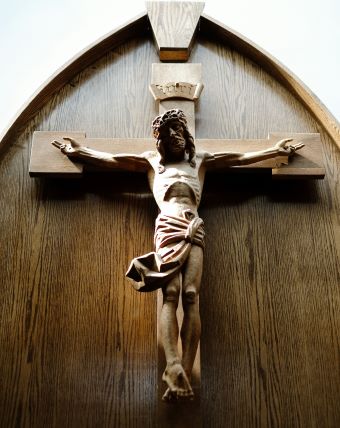
Applegate crucifix

*You can read Chi An’s story in its entirety in A Mother’s Ordeal: One Woman’s Fight Against China’s One-Child Policy by Stephen Mosher, published in 1993.  For those readers who have Amazon’s Kindle Unlimited, this book is currently available as a free selection.

Photo by Josh Applegate on Unsplash

Spiritual Understanding

It is so easy to look to the apostles for wisdom and understanding. Catholic children are often brought up with those well-known Bible stories where the apostles truly shine and present great examples of faith and trust in the Lord. Not many people choose to focus on the stories of when the apostles truly fell short of those grand expectations we all seem to have placed on them, just because they were the chosen apostles of Jesus Christ. This is the beauty of the Lord’s plan. He chose the lowest of the low from the society of His days on our earth. Why would He do this? For us! If Jesus had chosen highly esteemed people for His followers, we would be doomed to always fall short of God’s expectations. We would be faced with the fate of constantly striving to be the best because God only chose the best. God did not do this; He wanted to give us this hope and faith that every time we fall short, He would still love us for who we are, imperfections and all.

Jesus is calling us to strive and seek to be better, however. He taught His apostles so that through their imperfections, they could rise above their worldly selves and gain spiritual understanding. This Gospel reading is a perfect example of the Lord teaching His apostles and pushing them to achieve wisdom that surpasses the so-called wisdom of this world.

Why do you conclude that it is because you have no bread? Do you not yet understand or comprehend? Are your hearts hardened? Do you have eyes and not see, ears and not hear?
—Mark 8:14–22

Jesus was calling His apostles to step outside the basic way of thinking (we might call it “thinking outside the box”). Whenever Jesus gave them a warning, they only interpreted it based on society’s expectations regarding actual bread. At that point, the apostles really did not understand what Jesus was saying, but they would come to understand. This is how Jesus works with us; He uses everything in our lives to teach us and is always asking us to dive deeper and to pose harder questions. Everything that happens is for a purpose, and if we pay attention, it will lead us to a spiritual understanding that is as great as, if not greater than, the understanding the apostles achieved after Christ’s death on the cross.

Ephphatha!

A baby in the womb, at 18 weeks, can begin to hear noises. At 24 weeks, a baby can detect noise outside the womb and can turn their eyes and head towards the direction of the sound. Can you imagine a tiny human baby in utero searching for your voice as you talk to them from outside the womb? Then after they are born, often between parents there is a fun and friendly competition about whether the baby will say “mama” or “dadda” first. We talk to babies in ranges of voices. We make goofy faces and funny noises. They see us. They listen. And they try to imitate us. They try to speak back to us and eventually they do.

In today’s reading, Jesus heals a deaf man who had a speech impediment. The Gospel of Mark tells us that before Jesus healed this man, he took him away from the crowds of people to be alone. Jesus then “put his finger into the man’s ears, and spitting, touched his tongue.” Looking up to heaven Jesus groaned and said to the man, “Ephphatha!” and instantly the man was healed.

You will notice that someone who is deaf often times has a speech impediment. This is because they cannot hear their own voice, which affects their ability to speak. Being deaf, they cannot hear other people speak and distinguish speech and dialect. It makes sense that the deaf man in the Gospel had a speech impediment—it’s not that he couldn’t speak but that he couldn’t speak clearly. Jesus was known and sought after for his ability to heal the physical body. Every time he heals the physical body, he also heals the spiritual body.

At one point or another in our lives we were deaf and unable to speak. We couldn’t hear God’s voice nor his commanding Word. We couldn’t hear the Father because something was blocking our ears. As a result we could not speak about the Father, about his love, about his Son, Jesus Christ. What was it that you were doing at that point in your life? What worldly pleasure were you enjoying that made you turn away from God, that closed your ears to his voice? Jesus took the deaf man away from the crowds to heal him—away from the bad influences, away from worldly treasures, away from temptation, away from the indecent culture. Jesus took the man away to a place where is was just the two of them—to a place where the man, with newly opened ears, could freely listen and talk to God.

Let Jesus take you away to a quiet place, free of distractions, where you can listen to him. Let him into your life and allow him to heal you.

Ephphatha! Be opened to God’s love. Be opened to God’s mercy. Be opened to follow God’s Word. Be opened to accept him. And then you can clearly speak God’s truth to others.

Image Credit: [Public Domain] Christ healing a deaf and dumb man by Domenico Maggiotto