The Shepherd’s Voice

When I was in college, I had the opportunity to go on a pilgrimage to Israel. During my visit, I saw that the land lived up to the way it was depicted in the Bible–there were a lot of shepherds caring for a lot of sheep. As we toured the country, the question arose as to how an individual shepherd knew which sheep were his. Several times we saw herds of sheep with multiple shepherds watching them. So how did these shepherds keep track of their own sheep? It turned out that a more accurate question was how did the sheep know which shepherd to follow? They actually do learn the voice of their shepherd and will indeed follow the sound of their master’s voice.

Jesus often compares us to sheep through numerous metaphors in the Bible. Considering the general behavior of sheep, this is not the most flattering comparison for us. Sheep are not known for their intelligence, which is why they often wander off or just follow the rest of the herd, regardless of where it is going. Clearly, we are much more intelligent than the averaged sheep; yet, we can fall into sheep-like habits.

We human beings can become distracted and stray from our shepherd and our flock, but if we know our Shepherd’s voice we should always be able to find our way back to Him. Our Shepherd, of course, is Jesus, but we may choose to follow other “shepherds.” Jesus said, “The works I do in my Father’s name testify to me. But you do not believe, because you are not among my sheep.” John 10:25-26. In our modern world, many shepherds’ voices clamor for our attention: money, fame, power, etc. It is easy to follow those voices because they are familiar and can provide instant (though temporary) comfort. At this time, it is more important than ever to learn the voice of the true Shepherd. It may not be so easy to follow Him, but He can provide the ultimate comfort–everlasting life with Him in those “green pastures beside still waters.”

Be Happy or Holy

I was told by a Franciscan friar that many people believe that we have a choice: we can either be happy or holy, but the truth is that we can be both. Consider the story of Stephen, the first martyr of the early Church. He proclaimed the good news, yet the crowd who heard him rebuked him and then stoned him. “Stephen said, ‘Behold, I see the heavens opened and the Son of Man standing at the right hand of God.’ But they cried out in a loud voice, covered their ears, and rushed upon him together. They threw him out of the city, and began to stone him.” Acts 7:57 Even while Stephen was being tortured he still maintained a joyful appearance that surpassed all imagining.

Stephen was only the first of many early Christians who suffered and then were martyred for their faith. The stories of the trials and tribulations of most of the apostles ended in death. Nevertheless, these men went through all this pain while remaining devoted to the Lord. This devotion gave them holiness and because of their holiness, the Lord granted them happiness even in death by martyrdom.

Only God has the ability to instill the pure joy of knowing our Savior Jesus Christ within each of us. Stephen looked into the sky and saw Jesus standing at the right hand of God. That was enough. “Jesus said to them, ‘I am the bread of life; whoever comes to me will never hunger, and whoever believes in me will never thirst’.” John 6:35

There is no denying that life as a believer and follower of Jesus Christ can be difficult, sometimes unbearable, but if we hold fast to the word of God, we are guaranteed true happiness in life. In fact, we are guaranteed not only happiness, but we have the promise of so much more–the holiness that leads us to heaven.

We Are Witnesses

“God exalted him at his right hand as leader and savior

to grant Israel repentance and forgiveness of sins.

We are witnesses of these things,

as is the Holy Spirit whom God has given to those who obey him.”

Acts 5:31

Today in the first reading the Apostles, before the Sanhedrin, refuse to stop preaching the gospel. That Jesus is the long awaited savior, that he has come to grant repentance and forgiveness of sins!

My dear friends, Jesus is risen and he lives. How can we everyday be witnesses to the resurrected Christ? Not in a judgmental ” You are a heathen and going to hell, I’m so holy and close to Jesus,” way (I hope you have never heard those words from a Christian…I sadly have), but in a way that mirrors who our savior is, love.

God’s plan, completed with Jesus’ resurrection, is the plan of Israel’s and our salvation. To turn back (metanoia) to the Lord and receive forgiveness. To love God with all our hearts, and our neighbor as we love ourselves. Does my life as a Christian give witness to the person of Jesus? Do I speak boldly with charity, or boldly with injury seeking to condemn? Do I seek reconciliation or let judgement fester into malice? Do I seek to service God, or serve others? Do I walk humbly with my God or do I elevate myself?

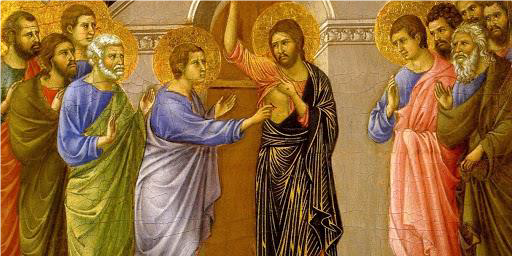
Jesus crucifixion was witnessed by many. Jesus’ resurrection, was seen by a few. Those few witnesses eventually turned into many! The apostles saw Jesus, resurrected, with wounds, in their mist. Not a ghost but our God fully alive. The joy of our hearts is to be an Easter people. The same way Jesus shows his wounds to the apostles, is the same way we must preach the Gospel. Through our vulnerability, our humbleness and our boldness to live God’s plan. We know we do not do it alone, God always leads the way.

The wounds we no longer carry because Christ heals us, tell everyone who encounters us, everyone we have will be a witness to, that sin and despair do not win, the joy of the gospel is real and is for all who receive it.

Despite the careless wounding words of a friend, despite the family member that ruined Jesus for you, and in spite of the Christian who judges you using God’s words, but does not judge their own lives by the same measure; yes, in spite of all and more of these things, God reigns. A few people struggling to reflect Jesus to all do not get to tear down or define Christianity.

God is alive! What a huge responsibility we have now that we have come to know mercy and love. Now that our life is continuously transformed by God’s grace. Now that the responsibility falls to us to continue to witness these things.

Lord today and everyday allow me to receive your teachings, your mercy, your love. Teach me to make my whole life a witness to who you are, Jesus. In Jesus’ name we pray. Amen.

Faith

Can you imagine standing in front of the apostles and handing over all your earthly belongings? You do this out of faith that these men will take and use what you give them for the benefit of many others. This actually happened in the earliest days of the Church; we find an account of it in the Acts of the Apostles.

“Those who owned property or houses would sell them, bring the proceeds of the sale, and put them at the feet of the Apostles, and they were distributed to each according to need.” Acts 4:34

We currently live in a world of abundance. The more people obtain, the more they desire; some believe they need more in order to survive. Jesus calls us to detach as He called the early Christians. A Franciscan friar once told me: “It is a lot easier not to care about money when you do not have any.” That may sound odd, but it is true–the best way to relieve financial worries is to give all your possessions away. Clearly, this may not be a realistic solution for the majority of us; however, it sets a good standard for which we can all strive.

“If I tell you about earthly things and you do not believe, how will you believe if I tell you about heavenly things? No one has gone up to heaven except the one who has come down from heaven, the Son of Man.” John 3:12

We go to church, we fast, we pray and we truly do believe that Christ came and died on the cross for us. We believe that He rose from the dead, yet somehow we struggle believing that He will take care of our day-to-day worries. Jesus calls us to have faith, only faith. What does it take to completely surrender yourself to Jesus, our Savior? We need to start listening to Him about these “earthly things” and then detach ourselves from them. Only then can we completely understand the “heavenly things” and believe.

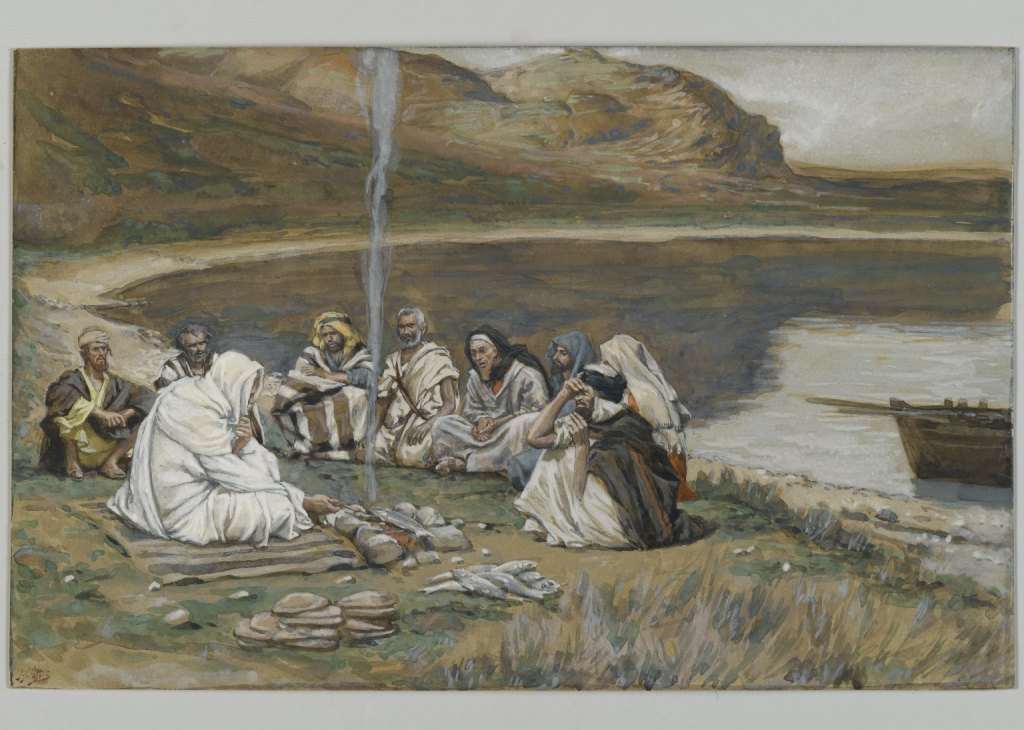
Eucharistic Fire – Beach Barbecue with Jesus

I have gone fishing once in my life. I thought it was the most boring activity ever. Fishing is one of those activities that you need to truly enjoy the silence and the slowness of it. We spent the majority of the day on that lake and I caught nothing. My friend had caught the tiniest of fishes and threw it back in the lake. If the purpose of going fishing is to catch fish, I would classify our trip as unsuccessful. And for those people that enjoy the activity of fishing simply for the leisurely pleasure of fishing, whether they catch fish or not, I do not understand and can’t see how the act of fishing is to be exciting.

At the end of that day, we packed up all the fishing gear into the car and I thought to myself, in my frustration, “I’m not doing that again.” I imagine the disciples had a little bit of that frustration after spending an entire night at sea and not catching anything. For the disciples fishing wasn’t a leisurely activity, as it was for my friend; fishing for them was a necessity of life. Having just lost a truly special friend—Jesus, who was crucified by the Romans—they were also in grief.

In the Gospel of today seven disciples go out fishing at night but catch nothing. At dawn the resurrected Jesus appears to them and asks, “Children, have you caught anything to eat?” After they admit that they could not catch any fish, Jesus tells them to drop the nets on the right side of the boat, and behold, they catch 153 large fish. John, the beloved disciple, is the first to realize that it is the resurrected Lord. And Peter, at hearing John say this, jumps into the Sea of Tiberias in all his clothes and swims to shore to be with Jesus.

When Peter reaches the shore, he finds that Jesus is in the middle of a barbecue on the beach! Jesus had a fire going with fish and bread on it. He invites the disciples to have breakfast with him. Peter with immense strength brings over the catch of 153 large fish to Jesus and all the disciples break bread together. I would consider their fishing trip a success.

A few things I will admit about my own fishing trip: it was hard, it took dedication and patience, it took the cooperation of nature and my own skills together. I have the fortune of just going to the fish market if I want fish—I don’t need to struggle like the disciples had struggled throughout the night. However, I struggle in other ways in life. I have difficulties at work, I have strained relationships with people, I fall into temptation. In all these instances I have to remember that I am not alone. Jesus is with me. If my human-way is too difficult in accomplishing the task, I need to listen to God’s voice and follow the way He tells me to do things. This is precisely what the disciples did—they listened to Jesus’ command!

How much easier life is when we listen to the Lord! We find that Jesus makes all things easier and that God already knows what we truly need. Just as Jesus knew that after a long night at sea the disciples needed a good meal, a meal being prepared in which Jesus already had all the necessities to feed the disciples. I imagine that beach barbecue to be amazing, for that fish and bread to be sweet as honey, for the company and love shared to be everlasting. We may come across obstacles on our mission to build up the Kingdom. But Jesus will help us through. There will be times where we feel unequipped, but like the charcoal fire on the beach burning hot, know that the Holy Spirit is burning a light within you to do the Father’s will. Like the seven disciples bringing fish to Jesus, we too are called to bring souls to Christ. We do this together as a family.

“When you are totally consumed by the Eucharistic fire, then you will be able more consciously to thank God, who has called you to become part of His family.”

–Blessed Pier Giorgio Frassati

To God, nothing is ever “unsuccessful.” Those moments which we don’t see as “successful” have a role to play in our formation. I needed to go fishing and not catch anything to understand how patience and cooperation of nature go together—God is in control. Even the death of God’s only Son was a success because it was part of His divine will. Through Christ’s death the sins of the world were forgiven, and through his Resurrection we partake in a share of eternal life in heaven. The beauty of this mission to be “fishers of men” (Matt 4:19) is that we get to fish with our friends. And bringing souls to Christ is always exciting.

James Tissot. Meal of Our Lord and the Apostles (Repas de Notre-Seigneur et des apôtres), 1886-1894. Brooklyn Museum, New York, USA.

See, Hear, Understand

Think about the moments you spend in prayer. Those moments when you are so close to Christ you have no idea what is going on but deep in your heart you know something important is happening. When I reflect on the greatest moments of my life, for most of them I am never conscious of how monumental those moments actually are until after they have passed. It is only when I bring those moments to prayer and invite the Holy Spirit in that the truth is revealed and miracles have then transpired.

During this time of deep prayer, it feels as though the Holy Spirit lifts a veil from my eyes. Suddenly, I become completely aware of how great and strong a presence Jesus has in my life. These times of understanding can be almost unbearable because my human body is so close to the divine. If these encounters in prayer were that powerful, no wonder I was unable to comprehend the immense impact of those moments at the time they actually occurred.

If experiences like these we have in prayer are so life-altering, it is hard to imagine what it must have been like for the disciples who were in the true physical presence of Jesus Christ. It took me awhile to understand the stories told in the gospel like the one we read today about the road to Emmaus. How could these devout disciples not recognize their Savior?

“And it happened that, while he was with them at table, he took bread, said the blessing, broke it, and gave it to them. With that their eyes were opened and they recognized him, but he vanished from their sight.” Luke 24:30

In truth, if these disciples had recognized Jesus immediately, the story told in the Gospel would not have been the same and would not have held the same impact. Jesus had His divine plan and chose to reveal Himself at pivotal moments.

What a blessing these disciples were given. They had this time with Jesus where they could relive other intimate moments with Him during His ministry, and then in the instant He showed them who He actually was, they could look back and see those moments unveiled just as I do in prayer.

We are all human and our ability to understand the divine can be limited because of sin. Nevertheless, when we are fortunate enough to gain insight into what the Lord is doing in our lives, that realization becomes totally and entirely life changing.

Great and Holy Friday | A Reflection from the Byzantine Catholic Tradition

The Deposition (Descent) from the Cross
Joseph of Arimathea and Nicodemus taking Christ down from the cross after his crucifixion (John 19:38-42)

“Together with Nicodemus, Joseph took you down from the wood –
you who are wrapped in light as with a robe
and beholding you dead, naked and unburied,
he began to mourn you with deep sympathy saying:
Woe is me, sweetest Jesus!


Just a little while ago, the sun saw you hanging on the cross
and veiled itself in somber hues.
The earth rocked with fear and the curtain of the Temple was torn in two. Now that I see how you willingly underwent death for me,
How can I bury you, my God? How will I wrap you in a shroud?
How will I touch your spotless body with my hands?
What dirges shall I sing at your departure, O Compassionate One?


I extol your passion and I praise your burial together with your resurrection,
crying out: O Lord, glory to you.”
(Apostichera from Good and Holy Friday Vespers – Byzantine Catholic Tradition)

Good and Holy Friday can be a difficult day as we remember in sorrow the crucifixion, death, and burial of our Savior Jesus Christ. These age-old Holy Friday prayers of the Byzantine tradition remind us of the hope we can always cling to. These ancient words of the church teach us that we can indeed ‘praise His burial together with His resurrection.’ As we sorrowfully remember His death, we wait in hope for the joy that is to come — the salvation Christ promised. Praise Him whose ultimate sacrifice has saved us. Glory to you, O Lord Jesus Christ!

May we end this Holy Friday reflection guided by Joseph of Arimathea and, most poignantly, the wisdom of Christ’s Mother, our Mother, as depicted so beautifully in this closing hymn:

“Come, let us bless the ever-memorable Joseph,
who went to Pilate by night to beg for the Life of all:
Give me this Stranger, who has no place to lay his head.
Give me this Stranger, who was handed over to death by his wicked disciple.
Give me this Stranger, whose Mother wept, seeing him hanging on the cross,
mourning and crying out in a motherly lament.
Woe is me, my child!
Woe is me, my Light, my Beloved whom I bore in my womb.
What was foretold by Simeon in the temple comes to pass today:
A sword has pierced my heart,
but change my tears into the joy of your resurrection.
We bow to your passion, O Christ!
We bow to your passion, O Christ and to your holy Resurrection!”

(Closing Hymn from Good and Holy Friday Vespers – Byzantine Catholic Tradition)

I encourage you to spend some time praying with the Descent of the Cross icon at the beginning of this reflection. Icons are windows into Heaven, a sacred way for us to pray and be in the presence of the Lord. May God be with you in a special way on this most sacred day of our Catholic faith. Wishing you a truly Holy Good Friday. Glory to Jesus Christ!

The Light in this World

“For God so loved the world that He gave His one and only Son.” John 3:16

This may be the most-repeated verse in the Bible. Unfortunately, after hearing it so much, the true depth and breadth of the significance might be ignored or not contemplated fully each time it is proclaimed. God does not just love us–He is love itself. There have been many more moments that I would like to admit when I have felt unworthy of this love. I am sure many others have shared this feeling, but I do also have good moments when I feel completely in touch with the will of God and His plan for me. Everyone of us is bound to experience their own good and bad moments accepting the love of their Creator, including Judas, the betrayer of Jesus Christ. No matter how terrible his final actions of life, he was still a child of God, created out of divine love.

Pondering the power of the Lord’s love in that context can seem almost unimaginable because from a human perspective, the behavior of Judas can cloud our judgment of him. I often forget that Judas was one of Jesus’ chosen 12 apostles. God has a purpose and plan for everything and everyone, and He can bring light even to the darkest circumstances.

As children of God, we can make the conscious decision to seek the Light as well. “I will make you a light to the nations, that my salvation may reach to the ends of the earth.” Isaiah 49:6. We were created to serve as lights in this world, just as Jesus was before us. We are now approaching the end of Lent, the time of reconciliation, and looking forward to the resurrection of our Savior. This Easter Sunday, we will once again rejoice in reflecting on the new hope restored by Jesus rising from the dead. No matter how many struggles and failures we have suffered, Easter remains a reminder of our constant hope. God is love, and this Sunday we have the opportunity to be filled with His light, so we can shine it in our darkened world.

Our Gift of Love Is Never Wasted

By Sister Maria Frassati, S.V.

+Totus Tuus

“Why has there been this waste?”

The Passion Narrative that kicks off Holy Week begins with the account of the woman in Bethany with the alabaster jar of costly spikenard. To the utter shock of all those present, she breaks the alabaster jar loaded with nard over his head, letting it pour and anoint the head of our Lord. Some are filled with anger at the perceived waste. But Jesus responds, “Let her alone. Why do you make trouble for her? She has done a good thing for me” (cf Mark 14:6). The Gospel account of this woman’s love for Jesus can become the lens through which we see the whole of Holy Week: the power of a total gift-of-self to Jesus, a gift which is never wasted, and is such a consolation to His heart.

Wait a minute– aren’t we supposed to be spending Holy Week contemplating the total self-gift of Jesus to us? Is this backwards? Both are important.  God loved us first, as St. John tells us (cf. 1Jn 4:10).  But when we come to know His crazy, reckless love in pouring out everything for us, as if it were for me alone, this realization inspires the response to the Divine initiative; a total self-gift in return.  St. John Paul II repeatedly reminds us in his writings that “Man cannot find himself except through a sincere gift of self.”  And still more, Jesus, in His total self-giving, reveals to us our deepest identity and calling (cf. Gaudium et Spes, 22).

In giving myself, I come to discover who I really am. That’s a bold statement in a culture that revolves around self-fulfillment and gratification.  And, when I unite my life to Jesus in this total gift, not only is nothing ever wasted, but I become more myself, more truly who God made me to be.  Peter was no longer simply a charismatic fisherman, but a fisherman of souls who radically pierced the hearts of those who heard him with the power of God’s love. And Our Lady, through her constant yes throughout the life of Jesus as His earthly Mother, became a spiritual mother to all who believe in Jesus.

We can admit that this is hard. It often takes an act of faith to believe that my gift-of-self matters, that His grace is at work deeper in me than I can perceive.  What do I do when it feels fruitless, meaningless?

First, we can only give ourselves in trust when we are grounded in His gift of love to us, a gift He renews each day through the Holy Sacrifice of the Mass. He tells us, you are worth everything. He would have given all for even just a single soul.  Jesus once said to St. Julian of Norwich, “It is a joy, a bliss, and endless delight to me that I suffered my Passion for you; and if I could suffer more, I would suffer more.”  Only when we know we are infinitely and unconditionally loved by the Father in Jesus, a truth we must steep ourselves in again and again, can we have the confidence to give ourselves to Him in total abandon.  Secondly, whether we feel it or not, it is in the Mass that we are reminded that His total offering of self in love gives value to all our offerings of love.  

Woman of Bethany: Our Gift of Love is Never Wasted.

In this, we also discovered another truth: He delights to receive our love, our company.  It matters to Him when we are simply there, with Him.  Do we have any idea how much our gifts to Him console His heart?  Not because we add anything to God or make Him more, since He is all-perfect and in need of nothing.  The woman in Bethany, before Christ’s Passion, reflects to Him her understanding of what He is about to do. And in this, she is with Him, demonstrating that she knows and supports the intentions of His heart.  During the pandemic, we heard stories upon stories of elderly married couples who would stop at nothing to visit their spouses in nursing homes and hospitals, even if it meant only standing on the other side of a window. They knew they couldn’t help or heal or ‘fix the problem’; they knew they simply had to be there.  Love desires to be with the one they love.  And this is what matters most to Jesus, that we are simply with Him.  In this, we can share the weight of His heart. St. Padre Pio once remarked that in the Garden of Gethsemane, even while Jesus was weighed down in agony by the sins of humanity, He was also consoled by the love of His future disciples who would give everything for Him. Even now, our efforts to be with Him and love Him console His heart more than we can ever know in this life.

As we enter the intensity of Holy Week, striving to contemplate His mysteries in the middle of our busy work, we can take comfort in the fact that spending time in prayer doesn’t need to be complicated. Just be with Him. And wherever you’re drawn in the mysteries of this week, give yourself permission to stay there. If we allow ourselves to simply sit in His presence, wherever we find ourselves —the garden, the pillar where He was scourged, His tomb on Holy Saturday—He will work to quietly transform us in His grace. And as He draws the mysteries of our lives into the mysteries of His own, nothing will ever be wasted; rather our lives will become more closely conformed to the mystery of His own, as we are brought to know the tender love of the Father through Him.

Choose and Obey

Why is it so easy to get angry at God? The Old Testament seems to provide examples of a constant tug-of-war between God and the Israelites. The Israelites are presented with an inconvenient situation; they get angry and complain to God, then God in turn becomes angry with the Israelites and inflicts a punishment on them. Finally the Israelites come to their senses and return to God, begging His forgiveness. Over two thousand years later, we, the modern day Israelites, still find ourselves engaged in this tug-of-war. The crucial difference between us and them is that we are fortunate enough to have a Savior who came before us and has already taken on the wrath meant to be inflicted on us due to our sins.

I admit I have fallen prey to this behavior. I found myself angry at God this past weekend. During this time of the liturgical year, we should return to our Lord and renounce any anger toward Him. In these final two weeks leading up to Easter, it is customary to cover all the statues in churches, including the crucifix–Jesus on the cross. This practice is symbolic of Jesus retreating from public ministry as He awaited His time to die on the cross. Although the Lord promises never to leave us, the symbolism we find before Holy Week holds great significance and the notable absence of the Savior is evident.

In my vulnerable and sinful state, my first response was anger and I wanted to cry out to my Father with the same words Jesus used: “My God, my God, why have you abandoned me?” I know deep down He will never abandon me, but there are moments when it feels as though He has. This might be why God’s chosen people have always fallen back into the tug-of-war started in the Old Testament. We are made from dust and to dust we shall return; we really do not deserve anything from our Lord except those punishments that He justly bestowed on the Israelites. Nevertheless, we long for our Father’s love because we are His children. As children, it is natural for us to want things from our Father, and if we don’t get them, we throw temper tantrums. Like a good Father, He reminds us of who we are and who He is. No matter what, everything He does, He does for our ultimate good, even if it is difficult to accept at times.

“‘The one who sent me is with me. He has not left me alone, because I always do what is pleasing to him.’ Because he spoke this way, many came to believe in him.”

John 8:30

The beauty of God’s design gives us free will. Just as Jesus before us, we have the choice to follow the Lord in spite of every hardship along the path. In choosing to obey our Father, we can trust and believe He will never leave us to be alone.