
After Jesus had revealed himself to his disciples and eaten breakfast with them,
he said to Simon Peter,
“Simon, son of John, do you love me more than these?”
Simon Peter answered him, “Yes, Lord, you know that I love you.”
Jesus said to him, “Feed my lambs.”
He then said to Simon Peter a second time,
“Simon, son of John, do you love me?”
Simon Peter answered him, “Yes, Lord, you know that I love you.”
He said to him, “Tend my sheep.”
He said to him the third time,
“Simon, son of John, do you love me?”
Peter was distressed that he had said to him a third time,
“Do you love me?” and he said to him,
“Lord, you know everything; you know that I love you.”
Jesus said to him, “Feed my sheep.
—John 21:15–17
 A few weeks earlier, Peter had stood outside the courtyard of the high priest, weeping bitterly. He had disowned Jesus not once, not twice, but three times, just as Jesus had predicted. Peter was filled with grief when he realized what he had done: despite the fact that he had vowed to stand by Jesus in every possible trial, despite his complete devotion, he had buckled at the first bit of pressure and cast aside the One who meant everything to him.
We might imagine that we would defend our faith in any circumstance, but when those situations actually arise, often our discomfort leads us to hide our true colors and pretend that we are just another face in the crowd, not a follower of Christ. There’s a fine line between trying not to force our faith upon others and hiding it altogether, and it can be all too easy amid a secular environment to act as though we are ashamed of our relationship with Jesus.
 Yes, there will be consequences for defending Christ. But there are worse consequences for denying Him. We can’t allow the possible reactions of others to distance us from the Source of all joy and love, as though their approval were the real key to our happiness. And in fact, we might be surprised at others’ openness to our faith—it might end up being a point of connection between us.
Chances are, at one point or another we’re going to mess this up. We’re going to drop the ball when presented with opportunities to witness to our faith, and we’re going to hide our light under a bushel basket out of fear. But Peter shows us that this, too, can be a path to grace. When we realize our shortcomings and failures, we can follow the way of Peter, the way of humility. We can begin to understand that we will never be able to carry out our grandiose plans on our own, that we are truly dependent upon Jesus for everything.
 Our God is a God of second chances. How tender Jesus was to Peter, to grant him this moment: He set the scene over again, with a charcoal fire burning just as there was in the courtyard of the high priest, and asked Peter three times, “Do you love me?” And three times, Peter was able to reply, “Yes, Lord, you know that I love you.” He was given a second chance, a do-over of the worst mistake he’d ever made. Jesus saw Peter’s sorrow and contrition, and in His mercy He stepped in to restore the relationship. Not only that, but He entrusted the Church to Peter as the first pope. He cast Peter’s sins as far as the east is from the west, giving him a fresh start. He does this for us, too. No matter how badly we’ve messed up, he will give us another chance if we’re willing to try again—and, this time, to call upon His help to guide us.
—
1. James Tissot, The Sorrow of Saint Peter / PD-US
2. James Tissot, Saint Peter Walks on the Sea / PD-US
3. James Tissot, Meal of Our Lord and the Apostles / PD-US

 Our patron, Blessed Pier Giorgio Frassati, was a joyful, exuberant young man who radiated hope. He loved to have a good time with his friends, sharing inside jokes and enjoying outdoor activities. But at the same time, he did not shy away from suffering. Although he easily could have stayed within the comfortable bubble of wealth provided by his family, he ventured into the poorest parts of his city, undeterred by the noise and smells, to seek those who needed company and support. He saw the beauty in each person he encountered and considered them friends. His passion for the Lord propelled him to serve, and even when he contracted a fatal disease through this service, he embraced this, too, as a gift. His love for Christ emboldened him to face every trial without fear.
 First of all, Jesus tells us we are friends, not slaves—if we do what He commands us. Wait. Do friends normally take orders from one another? Then He says we are not slaves because we know what our Master is doing. But…do we really? At the time He spoke these words, his apostles had no idea that He was about to suffer and die (though, to be fair, it’s not like He didn’t warn them). The disciples seemed pretty clueless most of the time about what Jesus was really up to. Can we truly say that we know what our Master is doing? I think more often we feel we are flying blind, having to trust Him without really understanding what His plan is. After all, so much of our Catholic worldview is grounded in the concepts of mystery and faith.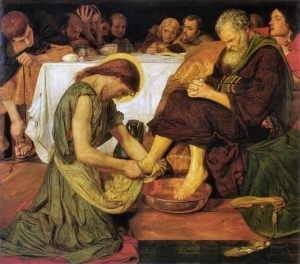
 Today’s first reading
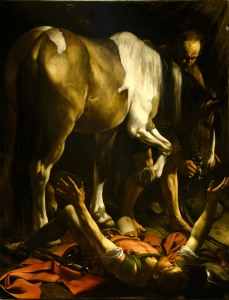 The great things that Paul achieved after his conversion stemmed from this intense closeness with God and awareness of God’s perfect love. This is what opened Paul’s heart to allow God to work through him rather than imposing his own will. When the scales fell from his eyes and he saw his life with sudden clarity, he fell to his knees in humility before God. Throughout the rest of his life, as he wrote and preached and converted a great many souls, he was ever aware that it was all due to God working in him: It is no longer I who live, but it is Christ who lives in me (Galatians 2:20). Paul knew all too well the cold, cruel man he would be without God, and thus he was able to recognize that any good fruits that flowed from his work were not due to his own power or talent or goodness, but from Jesus Christ working through him.
 Jesus has just taken five loaves and two fishes and managed to feed five thousand people. Not only that, but there are leftovers—twelve baskets full of scraps! There is more food left over than there ever was at the beginning. Which leads me to the question: If Jesus can multiply the loaves with such abundance, why does He ask His disciples to go to all the trouble of picking up the crumbs? Why would He need to be economical about saving all the scraps when everyone in the crowd can be satiated by His grace?
 Let us not forget that Jesus started with a few loaves in order to feed the five thousand—He began with a meager offering. He saw, then, in those leftover scraps afterward, the precious raw material for a miracle. We need Jesus to multiply our gifts, but we must begin by doing our own part, offering all that we can, however small it may seem. He will handle the rest.
 The disciples do not recognize Jesus until after they bring in a full net of fish and they realize He has performed a miracle before their eyes. Often we do not recognize Jesus working in our own lives until we see the fruits of His presence. When we accomplish things we know we could never have done on our own, when we grow through a difficult experience and become stronger because of it, when we become aware of our own unique gifts, we sense Jesus’s presence more clearly.


 So many of Jesus’s disciples abandoned Him in His time of greatest suffering. Surely it would be so difficult for them to bear, to see their beloved Jesus treated so brutally and their hope of His Kingdom buried along with Him. But I think we have much to learn from the ones who stayed—John, Mary, Mary Magdalene, and the other women beneath the Cross. In this most painful moment, they did not look away. They did not abandon the One they loved. They stayed to comfort Him as best they could and to truly grieve this injustice, this loss, instead of hiding from it. And even in their grief, they did not despair. Even when it seemed all hope was lost, they trusted that God had a plan.
 When it came to listening to His sermons and watching His miracles, Jesus’s followers were totally on board. But when He proclaimed Himself the Son of God, none of the Jews listening to Him—as we see in
 Frassati Reflections