Holding Heaven

“I’m holding heaven in my arms tonight!” the lyrics of an old country song came unbidden, as I gazed down at the little one cradled softly in my arms. The afternoon sun highlighted the perfect features of a tiny face, illuminating like a halo the downy hair peaking from beneath a newborn cap.  The baby girl’s name was Caeli, from the Latin word for heavens.

*            *            *

Her mother Regina and I were born just eleven days apart, and were best friends from the age of seven, when I convinced her to walk home with me from school one day.  I had her wait outside while I asked my mother if she could come over to play.  “Who is Regina?” my mother asked.  “The girl standing in our driveway…!”  She wouldn’t have to ask again, as Regina quickly became a permanent fixture in my life.

Three decades later, we were still the best of friends, but no longer shared a school or a zip code.  I was single, with my New York City work and shoebox apartment.  Regina and her husband had a house in the country, shared with eight young children.  I visited when I could, to entertain them with stories and give them sugar highs.

As I had every other time, I shared Regina’s enthusiasm when she announced that she was expecting again, due in the summer of 2014.  But then I shared her devastation, when, as the pregnancy progressed, there came sobering news.

Tests showed signs of anomalies, and more tests were suggested, followed by more doctor visits and somber consultations.  Eventually the fears were given a name: it was believed that the baby, to be named Caeli, had both Trisomy 18 and spina bifida. 

While spina bifida brought challenges that could be reduced or corrected by surgery, Trisomy 18 was more serious and life threatening.  An extra chromosome 18 brought with it high risk factors—only half of these babies live to be born, and only ten percent of those live past the first year.  Those who survived often had heart defects and/or damage to other organs, and ongoing health risks.  In fact, the specialist to which Regina and her husband Erik went for help refused to treat them, saying that there was no point. 

We began to pray a 54-day rosary novena for a miracle.  The miracle was Doctor Elvira Parravicini.    Dr. Parravicini was a Catholic neonatologist working at Columbia Hospital, who had begun a program especially for families in such situations.  She had come to New York at the suggestion of Monsignor Guissani, founder of Communion and Liberation

For her, to follow Christ in such a situation was to “follow” the child: that is, to respond to the needs of the child, including not only medical needs but also the need to be welcomed and loved, even if for a painfully short while.  In Caeli’s case, Dr. Parravicini met with the parents to provide good prenatal care, and to be prepared for surgery (necessary within 72 hours) should the baby require it.  She also arranged for the other children, Caeli’s siblings, to be at the hospital the day of delivery, so that they could meet and welcome her. 

Early on the morning of June 18th, Regina began procedures to induce labor, with Erik at her side.  Her brother, a priest, brought her mother and the other children awhile later, and staff provided activities for them while they awaited Caeli’s arrival. 

Across the city I waited anxiously, begging God for a miracle, that Caeli be healed and be allowed to live.  I don’t know that I have ever prayed harder for a miracle, as if I could move heaven with intensity alone.

Regina had gone into labor early that morning, but hours later I had heard nothing.  I tried to work, but was too distracted.  Finally, I sought refuge in the Church of St. Monica nearby.  I prayed to every saint I could think of.  And then out of desperation, I prayed to the future St. Caeli.  I knew that God is outside of time, and that Caeli was likely be a saint soon and always, and so I implored her help, too.

Just then, kneeling there in the front of the church, I was surprised by a peal of girlish laughter.  I felt this laughter rather than heard it—it is hard to explain what I even mean by that.  It was too real to deny, and yet beyond the realm of the normal.  But I was simultaneously sure of two things: that is was Caeli’s laughter, and that it was a laugh of perfect joy.  At once my anxieties fled and I knew that all was well; I couldn’t contain my own joy.

Later I would wonder at the timing.  It was shortly thereafter that I received the waited-for text, and I crossed town to Columbia as fast as city traffic would allow. 

But the little girl that they placed in my arms was too still.  There was no movement of breath; no tiny heartbeat as I held her close.  I saw Regina’s face etched with pain, as she lay in her hospital bed. 

Little Caeli had lived for just under half an hour.  She had been baptized by Dr. Parravicini, and then confirmed by her uncle, and all her siblings were gathered around singing the Regina Caeli as she moved from our world to the next.

If I was surprised by my earlier joy, I was more surprised by the magnitude of my grief.  Why?  I knew that even though it wasn’t the answer I wanted, that Caeli was in heaven, in perfect joy.  So why such pain?   As I prayed once again, I realized that my grief too was a gift.

I stood with Jesus at the side of the tomb where Lazarus was buried.  He too, knew the ending—better than I.  But He wept.  Not because of the power of death—which He would defeat; but rather, because of the power of life, which He gave and so loved.

And I found myself back further, at the dawn of time, when God looked over creation and said, “It is good.”  Then when He created humanity, He said: “It is very good.”  This pronouncement came before any human activity or achievements; before love could be earned or reciprocated.  It was God’s delight and love for human life itself.

“You can’t explain beauty, but your heart recognizes it, intercepts it…” said Dr. Parravicini.1  For a few minutes we were invited to heaven.  Invited to see with the eyes of a Father, to love with a Father’s heart, the matchless beauty of a human person.

Caeli was loved into existence.  The love which she received and mirrored was already perfect.  God had nothing more to ask of her, no further mission to accomplish than to witness to heaven. 

St. Caeli, pray for us.

Caeli Philomena June 18, 2014


Notes:

1From a 2012 blog post by Rev. Robert O’Connor on Dr. Parravicini.  The formatting has since become compromised but I strongly recommend reading it in its entirety—it may well be one of the most beautiful things I have ever read.

Two Minutes

We were thrilled when my little niece Zippy first began to speak in words we could understand.  From baby babble emerged the first recognizable vocabulary: “Mamma”; “Dadda”; “’nanna (banana)” and “shoes.”  However, when she said, early and audibly, “Two minutes!” we were both greatly surprised and greatly amused.

At age two Zippy still says “Two minutes!” and it is clear that while she has mastered the pronunciation, the actual meaning of the phrase still eludes her.  At times, she recognizes it as a stall tactic.  “Zippy, can I please have my phone back?” I ask.  “Two minutes!” Zippy replies, meaning I must wait.  However,  “Zippy talk two minutes!” means “Zippy wants the phone, NOW, this minute.”  She will ask to hear a song: “One!” by which she means, “One after another,” and listening for “Two minutes!” in that situation translates as “indefinitely…”

In general, the concept of time is confusing if not meaningless to two year-olds.  “I will be back tomorrow” does not console her; she throws herself on the floor, bereft.  (Yes, I am that cool).  “Later” is just a code word for “no.”  And she certainly doesn’t understand “this is not the time to sing” when she breaks out into “Baby Shark” during the Christmas homily, particularly when such a large crowd has gathered to hear her performance.

If the concept of human time is puzzling to toddlers, the concept of God’s timing is equally puzzling to us, even as adults.  I confess that when God says “Wait!” I do not always react well. 

I remember in college that God promised that a particular prayer intention would be answered, but that I must wait.  I thought, “Okay, I have a few minutes.”  Eighteen years later, His answer exceeded my expectations, but I learned the hard way that His time-frame did too.

Even now, I too am tempted to tantrums when God says, “Wait.”  I find myself bereft when He seems absent, wondering if I will ever seem Him again.  And when I pray for solutions to the problems of life, and they don’t come quickly enough, I wonder if He is listening.

In today’s Gospel, Jesus is preaching in a synagogue in Capernaum when he is interrupted by a snarky demon.  “I know who you are…the holy one of God!” declares the demon.  Jesus first silences him, then drives him out.  “Quiet!  Come out of him!”  Jesus commands in Mark 1:24.

Why doesn’t Jesus want the crowd to hear this declaration?  A few verses later, in Mark 1:34, we again hear of Jesus specifically preventing the demons from revealing his identity: “He healed many who were ill with various diseases, and cast out many demons; and He was not permitting the demons to speak, because they knew who He was.”

If Jesus has come to reveal His identity as the Son of God, why silence the demons?  Or perhaps a more interesting question: What would the demons have to gain by revealing it? 

It is the mystery of timing again.  God’s timing is perfect.  Patience is a virtue that we do well to cultivate.  But more importantly, the mystery of timing reveals another mystery: that the Christian life is about relationship, not results.

The answer to Jesus’ identity is not a bit of trivia, or even a theological proposition to answer correctly on an exam.  We come to know Him as He is WITH US (Emmanuel again).  Jesus wants the people to come to know God as revealed by His person, not just as a match to their expectations. 

His healings, His miracles, His teachings, and ultimately His gift of self on the Cross and in the Eucharist, reveal to us the face of God.  It is encounter that teaches us, and encounter that changes us. 

We need to hear Him say, to the leper within, “I do will—be healed.”  We need to experience the gaze of the loving eyes which behold the sinful woman weeping at his feet, to hear him say, as to the woman caught in adultery “Neither do I condemn you.  Go, and sin no more.”  We need to watch Him calm the storms without and within; to cast out demons and welcome back outcasts; to feed with a new Manna that is both Presence and Promise.

We want to rush ahead to the solution, to the answer: Who is this guy preaching in the synagogue? What does He plan to do to/for us?  But Jesus wants us to experience His presence.  To walk with Him, to listen, to question, to learn not only His message but His heart.

*            *            *

Over Christmas vacation I take Zippy on a walk to the library.  It is a two-minute walk if one goes directly.  But there is so much to experience along the way: leftover snow to touch, steps to climb up and down, puppies to shriek at delightedly and try to pet.  She wants to see her breath in the air; she wants to see what is in the half-frozen puddle in the driveway; she wants to pick up pebbles and watch them dance as she throws them on the path.  She wants to run and then be carried and then put down so she can meander down the sidewalk.  If we don’t make it all the way to the library; that’s okay.  Life is short.  Just two minutes.

How Many Loaves Do You Have? Go and See!

“Give them some food yourselves.”—Mark 6:37

At the beginning of today’s Gospel, we get a glimpse into the Sacred Heart of Jesus.  “When Jesus saw the vast crowd, His heart was moved with pity for them, for they were like sheep without a shepherd; and He began to teach them many things.”  As He teaches, their hunger grows, in more ways than one.  And soon it is “late.”

The disciples see the physical hunger of the crowd as a problem, and want both the problem and the people to go away.  “Dismiss them…so they can go and buy themselves something to eat,” they urge Jesus.

Jesus surprises them, instead saying: “Give them some food yourselves.”  They are stunned.  “Are we to buy 200 days wages worth of food and give them something to eat?”

He asks them, “”How many loaves do you have?  Go and see.”

It is important not to rush past this question.  Having read the spoilers, we know the answer: five loaves and two fish.  And we know what Jesus will do, and how the more than five thousand will be fed that day, and how there will even be twelve baskets of food left over.

But let us ponder for a moment this command and question of Jesus.  It is not enough for Jesus that His disciples hear His words as a message to be learned and taught.  Rather, He wishes for them to share in His heart, in His mission.  Nor can they pray from a safe distance for God to “take care of” the issue.  They are to be an integral part of His work.

First, however, they must come face to face with their inadequacy.  What do they have to offer? “Go and see.”  They are to encounter, concretely, their own inability to provide for the people.  On their own, they do not have what it takes.  They need God to work.  And yet, in the mystery of salvation, God calls them (and us) to cooperate with His work.  Our own experience of poverty does not exempt us from mission.  Humility rather makes room for God to work, but He nonetheless elevates us, drawing us into His divine mission.

The disciples bring the five loaves and two fish to Jesus.  Jesus could have fed the crowd with just one loaf, or with the bread and not the fish.  Or, being God, He could have provided His own loaf and fish.  Instead, He asked that they give what little they had, and all that they had. 

God invites us to experience our poverty, our nothingness—but then asks us to give anyway.  He loves us in our poverty, but doesn’t leave us there: He invites us to make a gift of what we have—all of it.  Sometimes we object because it seems too much.  But just as often, we object because it seems too little.

We prefer grandiose gestures, which make us look or feel good.  When God invites us to give lesser things, we balk.

Caryll Houselander writes of the woman who had a great desire to sacrifice her life to God as missionary martyr to cannibals, and was disgruntled that He never took her up on her offer.  But she was unwilling to offer God the sufferings of her infirmities and old age. 

“I knew once the primmest old invalid lady who could well have offered her helplessness to God, but she had a grievance against Him because He had not permitted her to be eaten by a cannibal for the Faith; she could not accept herself as a sick woman, but she would have achieved heroic virtue as a cutlet!” (Reed of God, p. 50)

We like to think of our saints as superheroes. But Saint Therese of Lisieux was by all accounts so “boring” that her fellow sisters feared there would be nothing to write in her obituary.  Hers was not a life of great deeds, but of great love. She offered to God the smallest of things—and all things—with this love, and in so doing became a great saint.  She was aware of her poverty and weakness and littleness, and so made room for God to act in her life in very big ways.

Father Walter Ciszek, on the other hand, lived a life of remarkable strength and courage.  He became a priest, and then went to Russia as a secret missionary.  His daily life there was one of marked suffering, even before he was arrested (accused as a spy) and imprisoned; he was tortured, and later sent the Gulag in Siberia.  The details of his sufferings are astounding, and can only be called heroic.  Yet for Father Ciszek, the defining moment of his life, his “conversion,” was a moment of abject failure.

While imprisoned he was subject to routine torture in a effort to get him to make a false confession.  He was determined to resist; determined to outwit his captors; determined if necessary to die for Christ.  Instead he capitulated and signed.

He was devastated; it was a moment of “great darkness” as he confronted his failure, his poverty, the realization that he did not in fact “have what it takes.”  Then suddenly grace gave birth to profound freedom, as he realized that it was precisely his weakness that God was asking of Him.  He had been relying on His own strength; henceforth he would trust completely in God’s will.

Very few of us will be called in the next twenty-four hours to make heroic offerings to God. Yet each of us is invited into the heart of Christ, to give what we have at His asking.  To begin with that first step in trust—to put bread into that first pair of hands, and then another, and then another.  To watch with reverent awe as God multiplies our poverty into abundance.

Image credit: Marten van Valckenborch [Public domain] from Wikimedia Commons

The New and the Now

I love New Year’s Day.  I love new beginnings, fresh starts, the first page of a clean new journal.  I love the idea of resolutions: the promise of new habits and the new happiness and order they will bring to my life.

I am not alone: last night, Times Square was filled to capacity, and millions more watched on television as the ball dropped, signaling an end to 2018 and the beginning of 2019.  It was a night of celebration and revelry; for many the penultimate holiday celebration, ushering in the promises of newness: New Year, New You, New Resolutions and hopes and dreams to plan and unpack.

Yet, just three weeks from today, January 21st, is Blue Monday, “The Most Depressing Day of the Year.”  By the third Monday of January, it seems, conditions have converged to create a cocktail of depression.  One is the dreary weather; another the post-holiday let down, and then the arrival of the post-holiday credit card bills.  (I am sure that fact that it is a Monday doesn’t help).  But the biggest factor?  By the third week in January most have failed to keep their new resolutions, and as a result have abandoned hope in their new happiness.

Today, January first and New Year’s Day, the Church presents for our contemplation the mystery of Mary, Mother of God.  At first, it seems something of a mismatch.  If there was anyone who didn’t need New Year’s resolutions, it was the Immaculate Conception.  Conceived without sin, she had no faults to renounce: she didn’t need to resolve to give up gossip, or gluttony, or even to give more of herself to God.  And it is hard to picture Our Lady promising to eat fewer carbs or even to exercise more: surely the fully pregnant mother who rode on a donkey all the way to Bethlehem didn’t need to get more fit, or to do more penance.

Yet when we entrust to Mary the Mother of God, our resolutions, we increase exponentially the likelihood of our keeping them.  First, because her intercession is invaluable in anything we wish to accomplish or offer.  Second, because in her role as Mother of God, she models for us how to keep them.

How can this be, for we who know too well the reality of sin?

The answer for the Christian is not a how or a what but a Who.  The child gestated in the womb of a Virgin, laid in the manger and held in her arms, first in Bethlehem and ultimately at Calvary, is Emmanuel: God is With Us.

God is With Us.  Not just in the new, but in the now.  Not with our future perfected or improved selves, or hobnobbing with the People We Ought To Be, but right now, in this imperfect moment.

Says Sister Wendy Beckett: “I would say that the essential test of whether you are a Christian is whether you actually pray.  If you don’t pray you don’t truly believe.  You believe in some kind of God who is an evil God because if you truly believe in the real God, then you want to be close to Him.”  Yikes.

It is in the Baby in the manger, the Baby cradled in Mary’s lap, nursing at her breast, that we can find the confidence to draw close to God without fear.

A baby changes everything.

Even a merely human baby has a remarkable power to effect change.  Voices are softened, curses omitted, touch becomes more gentle and loving.  Mothers addicted to nicotine or caffeine or alcohol in excess suddenly quit cold turkey when they become aware of the life growing within them.  Fathers who are “tough guys” melt into mush holding their child.  Parents can attest that what willpower could not accomplish, the needs of their child effects quickly: getting up earlier, giving up more of their time, sacrificing more of their money for someone other than self.

Father Richard Veras notes in his book Jesus of Israel: Finding Christ in the Old Testament that this experience of parenthood, this change effected by ENCOUNTER, is in fact the model of Christianity, not resolution fueled by willpower alone.   It is the encounter with Christ that changes us, that both inspires our right resolutions and empowers us to effect them.

If there is one resolution that will change your life definitively, it is to adopt the habit of daily prayer.  To spend some time, like Mary, reflecting on the mystery of Emmanuel.  To be present to the God that is always with you.  To allow Him to transform you, to make you new.  Sister Wendy again, not mincing words: “My filth crackles as He seizes hold of me.”

Gretchen Rubin, in her book Better than Before, writes about habits, and what helps and hinders them.  Much of her advice applies well to cultivating a habit of prayer.  Make the habit specific and concrete, she advises.  Set a specific time for prayer (morning habits are more likely to be kept, she notes).  Make the habit itself specific (for example, replace “to pray more” with “I will pray for fifteen minutes a day.”)  Make it a daily habit: “What I do every day matters more than what I do once in awhile.” (p.80)

Let Our Lady teach you how to pray.  (She taught Jesus, after all…)  Let her hand you the Christ Child to hold, even without words, and just be present and ponder the mystery.

Finally, as Gretchen Rubin notes, the time for a new habit is Now.  Not in tomorrow, which as the orphan Annie reminds us, is “always a day away.” The Good News is, literally, God is With Us Now.  Not in the museum of the past, nor in a perfect future, but in very moment in which we reside.

On this her feast day, let us invoke Mary’s maternal intercession as we pray for the two most important moments of our life: “Holy, Mary, Mother of God, pray for us now, and at the hour of our death, Amen.”

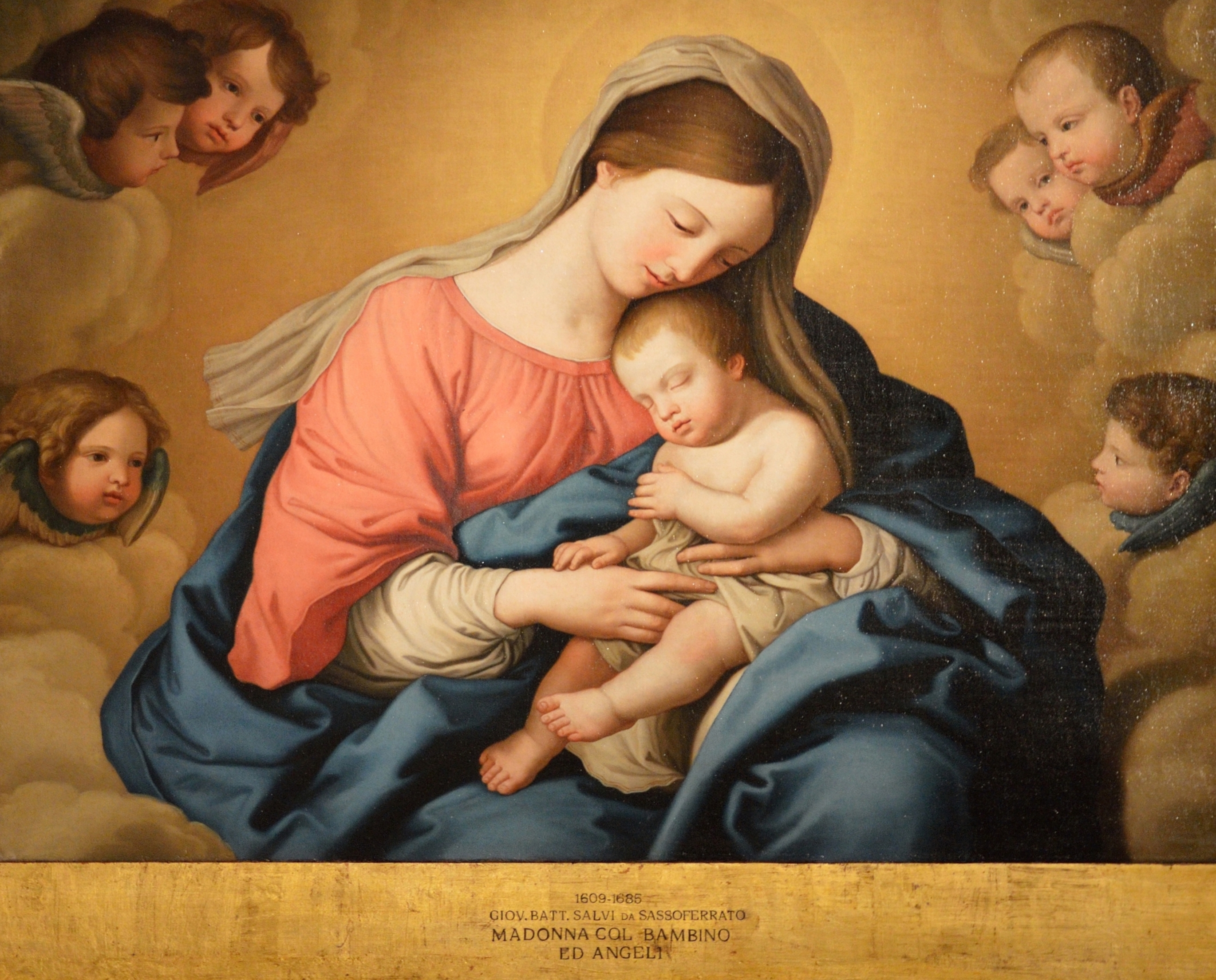
Madonna_with_child_and_angels

Image Credit:

Giovanni Battista Salvi da Sassoferrato [Public domain or CC BY-SA 4.0 (https://creativecommons.org/licenses/by-sa/4.0)%5D

Giovanni Battista Salvi da Sassoferrato [Public domain or CC BY-SA 4.0 (https://creativecommons.org/licenses/by-sa/4.0)%5D

Small Wonder

Once upon a time, a few millennia ago
they say a dreamer and a virgin
travelled by donkey to a far off land.
There the virgin had a baby
and the baby was God.

Imagine! The Infinite and Almighty
with tiny hands and feet
constrained by swaddling bands.

And because there was no room for such a God
they placed him in a manger full of straw
a feeding trough,
as though it were his destiny to be consumed.

The tiny face of God crinkled to cry with thirst
for milk, and something more
from a human breast.
(They say he cried this same cry, years later
from another bed of wood).

And to this scene strange searchers come:
wise men who followed a star
to find something brighter still,
and shepherds who also came guided by something in the sky
to find a new kind of lamb.

The sages and social misfits mingle
to adore a tiny helpless God.
How odd.

But stranger still, that time and eternity now linked
the eternal heart of God now forever beats with human blood.

And he is himself a searcher through the centuries
still looking for a room
and a human breast to hold him close.

Of course only a child could believe such things.

So let the worldly wise
settle for more realistic stories
of flying reindeer
and red round men sliding down chimneys.


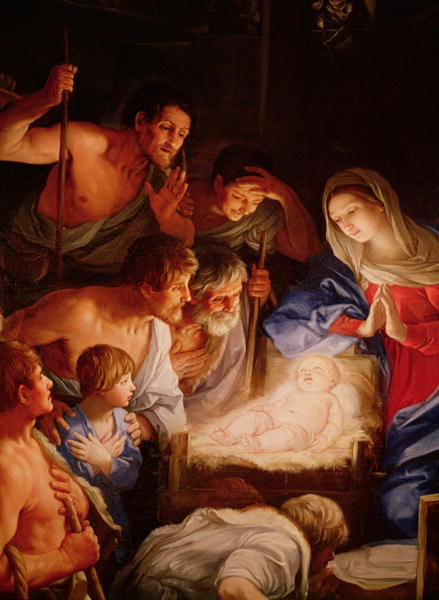
Adoration_of_the_shepherds_reni

Originally posted Christmas 2014.  Photo credit The Adoration of the Shepherds, by Guido Reni [Public domain], via Wikimedia Commons


Saint Joseph: Interrupted Plans

I used to feel sorry for Saint Joseph.  It can’t have been easy, living life sandwiched between the Immaculate Conception and the Incarnation.  He seemed such a quiet, shadow figure, more of a prop than a person, a necessary third to complete the family unit, but otherwise unnoticed and unnoteworthy. 

As I grew older, I became more aware of Saint Joseph’s usefulness.  Not just years ago, in the life of Jesus and Mary, but in the lives of various saints.  Saint Teresa of Avila, for example, always recommended devotion to Saint Joseph.  One could go to various saints for various favors, she would say, but to Saint Joseph, one could go “for anything.”  I found this to be true—he came to my rescue in some rather strange and significant situations.  And I was always grateful when his feast day fell on a Friday in Lent, the solemnity (for us as parishioners of Saint Joseph Parish) trumping the day of abstinence from meat.

In the last two years, I have come to love Saint Joseph, and to see in him a patron of the unplanned.  Or more specifically, of plans that were made, and then unmade.   Of interruptions.  Of re-routing.  Of offering up the idols of what one thinks life ought to look like.

If you’ve read my reflections for awhile you know about September 13, 2016, and how my life changed when I got the call that my mom was in the hospital—how I left to go home and never returned to the life I had known. 

But what I have not much talked about was January 8, 2017. 

We were all thrilled, when, after three months, my mother returned home just in time for Christmas.  But now the Christmas season was ending, and my siblings had left, and it was just me and my parents.  And it was time to face the fact that what had been a leave of absence for a crisis situation, was now to be indefinite.  Adrenaline had carried me through the crisis; now “peace” brought a different kind of panic.  There was no manual, no projected length of stay, no plan in place for providing for this new life. 

I was terrified.  More so than I had been in the days of crisis.  I didn’t know how I would do it, how I would live as a permanent caregiver for two people, without a job, without help. 

I wrote this meditation on Saint Joseph and the unraveling of plans.  It was a turning point for me, as my heart filled with peace in the praying and the writing, I believe as direct result of the intercession of Saint Joseph.  I did not know how many plans were still to be unraveled; I had no idea, that just a month later, it would be my father who passed out of this life into the next.  I had no idea, how many times, on a micro level as well as a macro level, my plans would have to be surrendered to make room for God.

Saint Joseph knew what it was like to have one’s plans, one’s ideas of how life should go, and then what it was like to have God write better ones.  To be interrupted.

Have you ever noticed how one thing that really upsets Jesus in the Gospels is when people would stop others from interrupting Him?  When the disciples want to stop the little children from coming to him.  When the crowd seeks to hush the blind Bartimaeus and stop him from calling out to Jesus.  When the Pharisee seeks to prevent the woman who cries over Jesus’ feet and washes them with her hair, or the woman who breaks the alabaster jar and pours perfume over His feet.

Jesus welcomes interruptions.  When He is heading to heal the daughter of Jairus, He stops to heal the woman who tugs at the hem of His garment—not only to heal her physically, but to speak to her, calling her back into relationship with her Father. 

He likens prayer to woman pestering a judge for a just decision, a friend bothering another friend in the middle of the night for a loaf of bread.

We know that Jesus is speaking about the patience and goodness of His heavenly Father.  But could it be that some of this patience was modeled for Him by His earthly, foster-father?

At the heart of patience is profound trust in the goodness of God.  Saint Joseph continually had to place his trust in God’s superior wisdom, in a plan that He could not see fully but only obey.  Such trust and surrender in turn makes room for fellow human beings, seeing them too as instruments of God’s plan.

Saint Joseph, pray that we too may welcome those who interrupt us. 

The_Dream_of_Saint_Joseph

Image Credit:

The Dream of Saint Joseph, Philippe de Champaigne [Public domain], via Wikimedia Commons

The Perfect Christmas

A year ago, at the start of December, I was determined to create the perfect Christmas scene.  I would have the perfect Advent—peaceful and prayerful, preparing. I would have the perfect Christmas, having cleaned and decorated early, so that we could all relax, and enjoy Christmas as it Ought to Be.

The first Monday of Advent I opened the mail to find a medical bill that was supposed to have been $125 was in fact more than $5000.  My sister called to say that she had been laid off.  Of the two burners on our stove that still worked, one had become increasingly temperamental. And then suddenly I found myself with a project that would take every waking moment of December, preparing for more necessary renovations, including packing up all of my belongings (again) to change rooms.  It was chaos.

It was tempting to temper Christmas, to skip the presents again, maybe even the tree.  But something in me refused to bow to the chaos.  I was determined that we would have a “real” Christmas.  So I bought the full size tree, at full price (not waiting until the last minute to get the more frugal Christmas Eve special as we did in years past).  I bought a new stove, and took pictures as it gleamed perfectly—determined to keep it shiny and new.

There is no need to name names, or identify the culprit who decided to inaugurate the new stove with a dinner of ham and sweet potatoes.  I don’t need to tell you who, exactly, pierced ten sweet potatoes and cooked them directly on the oven rack without a pan to catch the oozing juices.

But when I saw the veritable sea of black char covering the bottom of the new oven, my niece issued a strong warning for That Person.  “You better leave when we do…Aunt Grace won’t say bad words in front of me, but she might if I’m not here anymore…!”

The next day was Christmas eve.  We managed to get the lights up, and the tree decorated, and the presents placed, by early afternoon.  It was cutting it a little close, but it was beautiful and we could actually sit down and enjoy it for a little while before Christmas Eve dinner.

“A little while” is relative.  It was probably about five minutes, before we heard a small pop.   It was probably a few seconds later, when someone said, for the second time in two days, “I smell smoke.”  This time it was coming from the perfect Christmas tree.

Thankfully, we were using a surge protector, which could be unplugged from the wall.  Thankfully, because the light plug had melted into the socket, rendering both lights and surge protector permanently unusable.  Thankfully, we caught the whole thing just before the whole tree went up in flames.

That night, when I went to bed in an unfinished room, half-painted, with only my bed and lamp, and the window cracked open in spite of the freezing temperatures to mitigate the paint fumes, I didn’t cry.  I laughed.  Because of course it was the perfect Christmas.

Because Christmas is the antithesis of the perfect setting.  It is about God coming down to meet us in the mess.  I had written already about this, on many occasions.  From a Holy Thursday (yes!) meditation a few years before:

And so I thought about that feeding trough full of hay. Not the sanitized one we see on Christmas cards and sing about in carols. But rather one that might be found in a real stable–with hay that is speckled with dirt and animal spittle, perhaps with tiny spiders crawling in it, heavy with the odor of other things that animals may do in a barn.

And I thought about how Mary took the First Born of Creation and placed him in that manger, that feeding trough, for all of us.

In my mind of course I wish to offer Him a more perfect room, one clean and spotless and welcoming.  But there is no other room. There will not be on this side of eternity.

I can only welcome Him into the mess that is Me, or turn Him away.


final tree


The Final Trial

“Doomsday is coming!  Doomsday is coming!” the grim voice intoned loudly from the radio by my Grandfather’s chair.  This dire warning was repeated at frequent intervals throughout the weekend.  I asked, somewhat timidly, what “doomsday” was, and an older cousin gleefully told me about the End of the World.  I remember thinking that the adults were taking it awfully casually, continuing to joke and chat as if there were no big deal.  Even at age six, I thought there ought to be some sort of Preparation for such an event.

We returned home from our visit and the impending apocalypse was momentarily forgotten.  Until the following winter, when my (other) grandfather passed away and I attended his wake and funeral.

I still remember how cold it was that January day, as the drops of holy water froze in mid-air as they were sprinkled on the flower laden casket to be lowered into the ground.  I remember the casket itself, and how the night before at the wake, I had seen my Grandfather’s body, lying stately and still.  I was not disturbed, as some might worry, at seeing his body.  I was, however, secretly unsettled by seeing only half of it.

My instinct to prepare for “the End” again kicked in, and in the weeks after the funeral I would lie in bed after my parents had left the room, solemn and still like my Grandfather, my hands neatly folded above the crease in my sheets and blankets.  I kept these morbid contemplations to myself, until one day my concerns got the better of me.  “Mom, I think I am ready to die,” seven-year-old-me confided to my rather shocked mother.  “Except for one part….Why do they have to cut your legs off?”

If I was relieved to learn that Grandpa’s legs were not missing but merely concealed by the closed half of the casket, I was even more amused to learn, decades later, that the Doomsday proclamations of my childhood memory were in fact nothing more than a radio commercial.  As I grew older, my fear of death was eclipsed by other more pressing concerns—fear of embarrassing myself in public, for example, or of forgetting something necessary and important, like homework or a bathing suit.

The idea of preparation for judgment, however, stuck with me.

“If you were on trial for being a Christian, would there be enough evidence to convict you?”  The bumper sticker asked a question that deeply intrigued me.  I had been fed on martyr stories from a young age (which no doubt played well with my other morbid fascinations) and I knew which side I wanted to be on in the inevitable persecutions to come.

I set about, courageously at times, creating “evidence” that would prove my worthiness to God and man.  At first this meant being good.  Later, it meant good works: standing up for what was right, even when it wasn’t popular, fighting to effect change in the world, advocating for the needy and oppressed.  I adopted many good causes, working tirelessly throughout my teen years into adulthood.  I spent hours volunteering, running projects, making good things happen so that I could be a good Christian.

It is only in recent years that I have been struck by a profound realization: it is not good works that distinguishes followers of Christ.  Let’s be honest—our secular counterparts do many of the same things, and often better (with better funds, with more polish, with further reach).

What distinguishes the Christians is what they don’t do—what they give to God.  I realized this one morning when I was pressed for time with one of my many worthy projects.  I was sorely tempted to cancel my appointment with God, to skip my prayer time, so I would have more time to work on helping out.

But, I realized, if I am really a Christian—if God is first in my life, if I really believe He is in control, then my prayer time “doing nothing” is more productive than my “work time.”  Do I believe this?  Do I live this?

In today’s Gospel, Jesus warns that the centerpiece of the Jewish religion, the glorious temple in Jerusalem, will fall into rubble: “All that you see here–the days will come when there will not be left a stone upon another stone that will not be thrown down.”  Jesus doesn’t give advice on rebuilding or making do without.  His only commentary: “Do not be terrified.”  He then warns of false prophets that will come as the end draws near.  His advice?  “Do not be deceived.”

There is no preparation, no list of tasks for avoiding fear and deception.  Only intimacy with Christ can protect us against fear and deception in our lives and hearts.

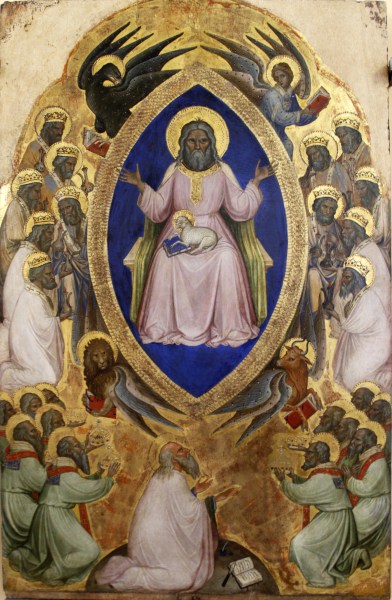
Final_Judgement_-_Polyptich_of_Apocalipse_-_Accademia_-_Venice_2016_-_crop

Image credit:  © José Luiz Bernardes Ribeiro /  from Wikimedia Commons


Parented by Gratuitous Love

There are many beautiful flowers in the nursery garden, but I am drawn at once to Baby M*.  Only a few weeks old, he is the smallest of all, weighing in at only 2.5 kilos—the equivalent of a small sack of flour with an extra tablespoon or two thrown in.  The list of his medical conditions is longer than he is.  He can do nothing for himself; only receive.

Abandoned at birth, he is without parents; even his name is a gift of the state.  Unlike the other children who reward my attention with laugher and hugs, Baby M lacks the strength even to smile.  He is too weak to suck from a bottle, and so a makeshift feeding tube helps to provide nourishment.  A colostomy bag compensates for his inability to digest and process food properly.  Even his cry is weak—unable to raise his voice, he raises plaintive eyes instead, and his tiny fist squeezes my heart.

*            *            *

Before holding this little one, I would wonder at the words of Jesus to Saint Faustina: “The greater the sinner, the greater his right to my mercy.”

Surely sin has no power, no rights.  But mercy is not about the power of the sinner, but the power of God’s love.  Our weakness draws and compels the heart of God.

“God doesn’t love the way human beings love. We love people because they’re attractive, funny, talented, rich, and powerful,” notes author Father Michael Gaitley.  “God loves us because we’re so weak, broken, and sinful.  God’s merciful love is like water that rushes to the lowest place.”2

In today’s Gospel, Jesus comes to Jericho, and we are told He “intended to pass through the town.”  But then Zacchaeus, the chief tax collector and sinner, the Bernie Madoff of his day, is moved by the desire to see Jesus.  He too was small—so short of stature that he is unable to see Jesus because of the crowd—and so he climbs a tree to get a better look.

One can only wonder at what must have been an awkward sight, a grown man gawking from a sycamore tree.  But Jesus stops and looks up, and says “Zacchaeus come down quickly, for today I must stay at your house.”

This desire of Zacchaeus that moves him to climb the tree to see Jesus, in turn moves Jesus, compels Him.  “I must stay at your house.”

The crowd is scandalized. “They began to grumble.”  Zacchaeus is a notorious sinner, a thief, one of the “bad guys”; he has not behaved in a way to earn God’s favor, he is not one of their own.  His smallness was not only physical. But Jesus explains the “must”: “the Son of Man has come to seek and to save what is lost.”

There is no recording of a preceding moral lecture by Jesus, no setting of prerequisites for His love.  Rather it is the invitation itself which causes Zacchaeus to hasten and “receive Him with joy.” It is the Encounter with Jesus which moves him to moral conversion: “Behold, half of my possessions Lord, I will give to the poor, and if I have extorted anything from anyone, I will repay it four times over.”

Moral behavior is not the prior condition for the love of God, but the consequence of it.  When we receive the unconditional love of God, we are freed to give it and to live it.  Yes—virtue is necessary; we cannot exempt ourselves from the laws of God.  But law is ultimately at the service of love.

It is our need and our desire which knock on the heart of God, which open the floodgates of His mercy.  There is nothing we can do to earn it; we can only accept or refuse it.

The church has always insisted on the right to baptize infants for this reason: all is gift.  We do not wait for proof of wisdom or virtue or even understanding.  We are parented by a love that is gratuitous, born of the goodness of God, not our own.

*            *            *

Baby M’s little heart is also weak, and it is clear from the beginning that his visit with us will be a short one.  And so we give him a special bath, and dress him in white, to prepare him to meet his Father.

On July 18th, his little body gives out, and he is transferred to a New Home, to be cradled in arms that will never let go.  And these days I ask for his help and intercession, that he might now assist me in my weakness.

Little saints, pray for us!

Baby Parenthood Finger Father Hand Love Mother

* Not his real name or initial

2 Father Gaitley explores this theme extensively in his highly recommended book, 33 Days to Merciful Love.  The quote cited is from this article: https://www.northtexascatholic.org/local-news-article?r=AGVJ9RUW3M

Image credit: (modified) from MaxPixel [CC0], via Wikimedia Commons

Another Saint I Learned to Like

“I am glad to hear that the Church considers her a saint, because I thought she was a witch!”  These words, allegedly spoken by a priest of St. Frances Xavier Cabrini, reinforced in my mind the already intimidating image of this saint, whose feast we celebrate today.

That she was fearless and feisty was to her credit, I supposed.  But I found myself cowed by her seemingly impossible standards of self-sacrifice.  It has been recounted how, when just a young girl, she wanted very much to be a missionary.  Then, one day, when about to eat a piece of candy, she was told that missionaries could not eat such sweets.  So she didn’t.  Not that day, NOT EVER AGAIN.  She didn’t complain—even when suffering from ill treatment, or ill health—and forbade her fellow nuns to complain about ANYTHING.  Not even the weather.  She was relentless in her pursuits, in both her numerous missionary projects (schools, hospitals etc. throughout the world) and in her pursuit of holiness.

Even the Girl I Ought To Be does not aspire to such herculean efforts, and Real Me, rather than taking inspiration from her, merely added her to the list of Saints I Don’t Like.  What common ground could I have with such a saint?

So it was something of a surprise when I found myself at her shrine, one morning in May, while preparing for a talk.  The shrine offered the best chance for Mass, so there I was, praying not a few feet from the altar under which her body is encased.

That night I was to give a talk on Mary’s Fiat, and while I had been preparing for some time, I felt a subtle urge to change what I was going to say.  To talk about fear.  Fear?  I questioned the voice inside.  How does fear relate to anything?

Was Mother Cabrini smiling, just a little, when the priest began his homily, and began to speak of fear?  How in fact the saint I saw as fearless had some very big fears indeed.  One of these was of water.  When she was a child of seven, little Francesca Cabrini would make paper boats, fill them with violets (pretending they were her missionaries) and float them down the river.  She was shy and quiet then, and this solitary activity brought her much peace and joy.  Until one day she fell in.

Nobody knows how she got out.  She was discovered on the water bank, soaked and shaken, with no memory of who had rescued her.  Credit was given to her Guardian Angel, and yet for the rest of her life Francesca had a deep fear of drowning.

God did not take away her fear.  Rather, He allowed her to offer it back to Him, repeatedly.  No less than twenty-seven times, St. Frances Cabrini crossed the oceans between continents.  This was more than a century ago, and so passage was by boat, and slow, a matter of days.  Yet she did it, again and again, in spite of her fears.

Her first time crossing the Atlantic brought her to New York City. Like her patron, St. Francis Xavier, she had wanted to go to China.  But the pope told her, “Not to the east, but to the west.”  And so New York it was, where she arrived with a few nuns to begin her first mission in a convent that had been prepared for them.  Only, there was no convent—there had been some miscommunication—there was in fact no lodging prepared at all.

Mother Cabrini and her nuns spent the first night in a boarding house infested with bed bugs and mice.  Mice, I was to learn, were another fear of hers (I see her smiling at me again).  She spent the whole night sitting up, using the occasion to intercede.   So began her work among the immigrants of NYC.

How did she do it?  Like the apostles in the boat, terrified of the storm about them, she was comforted by the voice of Jesus, saying “It is I.”  She knew that voice personally.  She had a strong devotion to the Sacred Heart (one of her nuns spoke to me of her mystical “exchange of hearts” with Jesus).  She knew that He would carry her, that He would provide for her poverty and weakness.  He continued to reward her trust in Him.

In April of 1912 she was scheduled to sail yet again from England to New York.  But urgent business directed her elsewhere that day, and she canceled passage for herself and another sister.  She can only have wondered, later, when she saw the news that the boat she was booked on, the Titanic, had sunk off the coast of Newfoundland.

Why was her life spared?  We can talk casually about the mysterious plans of God.  Other saints were on board that day when the ship went down.  But God had chosen her for further things.

Ultimately, for St. Frances Cabrini, for Our Lady at the Annunciation, for each of us—our Yes is not to an abstract plan, but to a Person.  To Someone, not merely something.

When we offer even our fears to God, He responds by giving us more gifts than we could imagine.  St. Frances Xavier Cabrini founded the Missionary Sisters of the Sacred Heart of Jesus, and more than 67 institutions throughout the world.  She was the first American citizen to be canonized.

May she carry our prayers to the heart of Jesus.


Jesus Walks on the Sea


Photo Attribution:

Jesus Walks on the Sea by Gustave Doré [Public domain], via Wikimedia Commons