

At the mountain of God, Horeb,
Elijah came to a cave, where he took shelter.
But the word of the LORD came to him,
“Go outside and stand on the mountain before the LORD;
the LORD will be passing by.”
A strong and heavy wind was rending the mountains
and crushing rocks before the LORD—
but the LORD was not in the wind.
After the wind there was an earthquake—
but the LORD was not in the earthquake.
After the earthquake there was fire—
but the LORD was not in the fire.
After the fire there was a tiny whispering sound.
When he heard this,
Elijah hid his face in his cloak
and went and stood at the entrance of the cave.
—1 Kings 19:9–13
A tiny whispering sound. How gentle God is toward us. He is all-powerful; He created mountains and earthquakes and fire and wind. He could drop anvils and send down lightning to try and get our attention. And yet He speaks to us softly and tenderly.
He is the still, small voice within our hearts. He does not seek to control us; instead, He delights in watching us find our own way. He is always whispering words of guidance and love—and if we aren’t distracted by our own noise, we will hear His voice. But He does not force Himself upon us; rather, He pursues us with gentleness and care.
We are called to imitate this example of gentleness: to be both strong and kind, brave and humble, confident and caring. To be sensitive toward our neighbors without compromising our own strength. To respond to others without feeling as though we have to intimidate them or prove what we’re capable of. To be secure in the knowledge that withholding force is not a sign of weakness in us, but of composure and mercy.
 Look to Blessed Pier Giorgio Frassati as an example: a strong, active young man who approached the poor and downtrodden with the utmost care. This was a guy who was popular and athletic, who regularly climbed mountains for fun. And yet he didn’t go around flexing his muscles to try and impress people; rather, his true strength showed through in his tenderness toward those who were weak.
When we feel frustrated and wish God would send us a big, loud, obvious sign from above, let us remember that maybe we wouldn’t actually be able to handle such a bold response. God speaks to us softly so as not to intimidate us, but also to draw us closer to Him. In order to hear His gentle whisper, we must draw ever nearer.
—
1. Abraham Bloemaert, Landscape with the Prophet Elijah in the Desert / PD-US
2. Portrait of Blessed Pier Giorgio Frassati / Brandon Vogt
 The Heart of Jesus, pure and tender, feels all human emotions more intensely and yet is not ruled by them. His Sacred Heart is not hardened or cold like our own, and so the feelings He experiences are powerful and raw: love, anger, joy, pity, solace, grief.
 Only when we are connected to the Sacred Heart of Jesus will we perceive the immense graces that come from being in tune with our emotions and aware of how God formed our hearts. They are a compass for us as we discern His plans and seek to understand who He created us to be. We will see the beauty of our human emotions, even when they make it harder for us to do what is right. We will find the mysterious grace of sharing in Jesus’s sorrow, knowing that He walks alongside us in our pain. We will remember His Passion amidst our greatest joys and His Resurrection amid our deepest sorrows, and everything will be offered up to Him. Jesus will grant us the heavenly perspective that will allow us to press onward through all the ups and downs of this life, knowing that this is not the end.
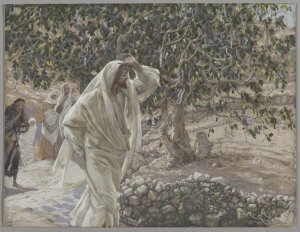 This passage from Mark is a tricky one to understand. At first glance, it seems as though Jesus cursed the fig tree out of spite when it didn’t provide Him with food. Why not bless the tree with abundant fruit, just as He multiplied the loaves and fishes, instead of condemning it to wither and die? Mark even notes that figs were out of season at the time. Why would Jesus curse the tree, then, for not providing figs? It seems a rather extreme reaction.
 The fig tree is a symbol used throughout Scripture to signify peace and prosperity for Israel. It requires patience and attention in order to grow and thrive, but it delivers rich rewards, bringing both a shady resting place and delicious fruit. The money changers sought shade without fruit, capitalizing on the community surrounding the temple while paying no regard to its sacred purpose. But for Jesus, their leaves could not conceal the barrenness of their hearts.
 Today is the feast of St. Mary Magdalene de Pazzi, the patron of the parish I attended growing up. On a trip to Florence, Italy, years ago, I was able to visit her tomb and see the chapel where she experienced many mystical visions. The austerity of her life as a Carmelite, juxtaposed with the wealth and dominance of her prominent Renaissance family that was so evident throughout Florence, was striking.
 Beginning at the age of nine, St. Magdalene practiced mental prayer, cultivating an intimate friendship with Jesus. This is what prepared her for all her mystical experiences and desolations to follow. Through it all, she maintained this friendship, speaking to Jesus as a dear friend with frank sincerity and playful banter. When Jesus told her, “I called and you didn’t care,” she responded, “You didn’t call loudly enough.” She asked Him to shout His love. She was honest and genuine in her conversations with Jesus, and this intimacy was what gave her the grace to bear the sufferings she endured. Her ultimate motivation was to return the love of Jesus Christ: Love incarnate, who was neither known nor loved.
 Blessed Pier Giorgio Frassati and St. Mary Magdalene de Pazzi share a few things in common: both were born into prosperous Italian families that valued status and wealth, both chose to forego earthly treasures and esteem for the sake of serving Jesus. Both were nourished by daily Communion, and both persevered in faith through many unexpected trials. Their charisms and personalities were very different—Pier Giorgio was a man of action, while St. Magdalene was a Carmelite devoted to contemplative prayer—but each was motivated first and foremost by a relationship with Jesus. This enabled them to discover their own unique gifts and callings and to offer everything back to Him in love.
 A few weeks earlier, Peter had stood outside the courtyard of the high priest, weeping bitterly. He had disowned Jesus not once, not twice, but three times, just as Jesus had predicted. Peter was filled with grief when he realized what he had done: despite the fact that he had vowed to stand by Jesus in every possible trial, despite his complete devotion, he had buckled at the first bit of pressure and cast aside the One who meant everything to him.
 Yes, there will be consequences for defending Christ. But there are worse consequences for denying Him. We can’t allow the possible reactions of others to distance us from the Source of all joy and love, as though their approval were the real key to our happiness. And in fact, we might be surprised at others’ openness to our faith—it might end up being a point of connection between us.
 Our God is a God of second chances. How tender Jesus was to Peter, to grant him this moment: He set the scene over again, with a charcoal fire burning just as there was in the courtyard of the high priest, and asked Peter three times, “Do you love me?” And three times, Peter was able to reply, “Yes, Lord, you know that I love you.” He was given a second chance, a do-over of the worst mistake he’d ever made. Jesus saw Peter’s sorrow and contrition, and in His mercy He stepped in to restore the relationship. Not only that, but He entrusted the Church to Peter as the first pope. He cast Peter’s sins as far as the east is from the west, giving him a fresh start. He does this for us, too. No matter how badly we’ve messed up, he will give us another chance if we’re willing to try again—and, this time, to call upon His help to guide us.
 Our patron, Blessed Pier Giorgio Frassati, was a joyful, exuberant young man who radiated hope. He loved to have a good time with his friends, sharing inside jokes and enjoying outdoor activities. But at the same time, he did not shy away from suffering. Although he easily could have stayed within the comfortable bubble of wealth provided by his family, he ventured into the poorest parts of his city, undeterred by the noise and smells, to seek those who needed company and support. He saw the beauty in each person he encountered and considered them friends. His passion for the Lord propelled him to serve, and even when he contracted a fatal disease through this service, he embraced this, too, as a gift. His love for Christ emboldened him to face every trial without fear.
 First of all, Jesus tells us we are friends, not slaves—if we do what He commands us. Wait. Do friends normally take orders from one another? Then He says we are not slaves because we know what our Master is doing. But…do we really? At the time He spoke these words, his apostles had no idea that He was about to suffer and die (though, to be fair, it’s not like He didn’t warn them). The disciples seemed pretty clueless most of the time about what Jesus was really up to. Can we truly say that we know what our Master is doing? I think more often we feel we are flying blind, having to trust Him without really understanding what His plan is. After all, so much of our Catholic worldview is grounded in the concepts of mystery and faith.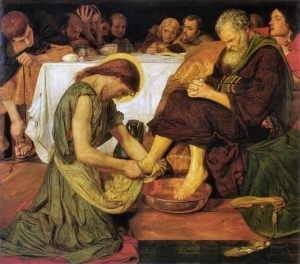
 Today’s first reading
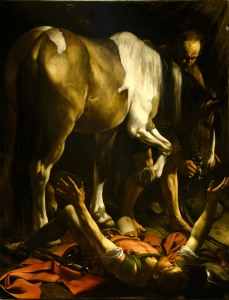 The great things that Paul achieved after his conversion stemmed from this intense closeness with God and awareness of God’s perfect love. This is what opened Paul’s heart to allow God to work through him rather than imposing his own will. When the scales fell from his eyes and he saw his life with sudden clarity, he fell to his knees in humility before God. Throughout the rest of his life, as he wrote and preached and converted a great many souls, he was ever aware that it was all due to God working in him: It is no longer I who live, but it is Christ who lives in me (Galatians 2:20). Paul knew all too well the cold, cruel man he would be without God, and thus he was able to recognize that any good fruits that flowed from his work were not due to his own power or talent or goodness, but from Jesus Christ working through him.
 Jesus has just taken five loaves and two fishes and managed to feed five thousand people. Not only that, but there are leftovers—twelve baskets full of scraps! There is more food left over than there ever was at the beginning. Which leads me to the question: If Jesus can multiply the loaves with such abundance, why does He ask His disciples to go to all the trouble of picking up the crumbs? Why would He need to be economical about saving all the scraps when everyone in the crowd can be satiated by His grace?
 Let us not forget that Jesus started with a few loaves in order to feed the five thousand—He began with a meager offering. He saw, then, in those leftover scraps afterward, the precious raw material for a miracle. We need Jesus to multiply our gifts, but we must begin by doing our own part, offering all that we can, however small it may seem. He will handle the rest.
 Frassati Reflections