A Posture of Humility

This week, I helped facilitate the confession line for a group of middle schoolers. Many were nervous; several had not gone to confession in years. I tried to help settle their nerves and calm their fears before going in, assuring them of God’s great mercy and that there was nothing to be scared about. A few children inspired me with their eagerness to enter the confessional—one who hadn’t been in six years, as well as one who had just gone last week. They didn’t allow any apprehensions to hold them back from receiving God’s mercy and forgiveness. They simply went forward with a sincere trust that by humbling themselves before God, they would experience grace. And what inspired me the most was that all these kids, even the ones who were most nervous, came out of the confessional beaming with joy and relief.

Kneeling in the shadows of the confessional, coming face to face with the reality of our sin and articulating it aloud—this is not something that demeans or diminishes us. Rather, it ennobles us, for it unites us more closely with our Creator as part of His Divine Body. By kneeling down and making ourselves small, we become part of a greater whole. Yet many of us hesitate to take this posture of humility. Sometimes a sense of perfectionism holds us back from admitting our mistakes, even to ourselves. But this sort of perfectionism is ultimately rooted in fear—that our faults will make others think less of us, or that God will be disappointed in us (as if He doesn’t already know all that we’ve done!). So instead of confessing our sins, we live in denial of their existence—and then we never receive the graces that will help us overcome them. We never come to understand that our goodness does not come from ourselves, but from the God who loves us so much that He laid down His life to redeem us in our sinfulness.

Jesus Himself has taken the ultimate postures of humility: on the Cross, with His arms spread open in surrender; and in the Eucharist, where He comes to us as Bread and Wine, food for us to consume. Through these gestures of love, He offers Himself as a gift to us. His arms are open wide to receive us; His Flesh nourishes and strengthens our souls. He offers His Body, broken and crushed, to heal us of our own brokenness:

For my Flesh is true food,
and my Blood is true drink.
Whoever eats my Flesh and drinks my Blood
remains in me and I in him.
—John 6:55–56

This week I also mourned the passing of John Aroutiounian, with whom I co-taught a Confirmation class three years ago. I was so moved by his eulogy, which reflects on the mystery of redemptive suffering and illustrates the fullness and meaning of his short life. John was very intelligent, had multiple prestigious degrees, and likely would have gone on to have a remarkable career. Yet when presented with a more humble calling—to suffer deeply, to physically waste away, to witness to the strength of the human spirit and the dignity of life even amidst great affliction, and to lay down his life at just 26 years old—he did not hesitate to embrace this cross. During his life, John fought to defend the dignity of every human life—even our enemies, even those who are inconvenient to us. He was a pro-life advocate and volunteered as a suicide hotline counselor. He believed at his core that life, every life, was worth living, and that each human soul has incalculable, eternal worth. He gave no greater witness to this conviction than through his own suffering and death.

We all have a natural desire to protect and shelter ourselves and our loved ones against suffering. However, it is through those painful experiences that we encounter the true meaning of our existence. Only when brought to our knees by suffering do we realize how deeply we must depend on God. A happy, complacent life can cause us to forget that, in the words of St. Thérèse, this world is our ship, not our home. We are meant for something greater; our deepest desires will not find fulfillment in this world but point us to the fulfillment that awaits us in heaven. And the path to heaven is through the Cross, following in the footsteps of our Redeemer.

Indeed, the fear of suffering can be worse than actual suffering. For when God allows us to suffer, He provides the graces in that moment to bear crosses we never thought we could carry, as long as we surrender to Him, acknowledge our own weakness, and trust that He will use every second of our pain for His divine purpose. Only by lowering ourselves into the depths of our humanity can we be raised into the divine Light. If we accept our crosses with a posture of humility, our suffering will surely bear fruit.

God in Our Midst

When she had said this, she turned around and saw Jesus there,
but did not know it was Jesus.
Jesus said to her, “Woman, why are you weeping?
Whom are you looking for?”
She thought it was the gardener and said to him,
“Sir, if you carried him away,
tell me where you laid him,
and I will take him.”
Jesus said to her, “Mary!”
She turned and said to him in Hebrew, “Rabbouni,”
which means Teacher.
—John 20:14–16

Noli_me_tangere_-_William_Brassey_HoleHow often our eyes are blinded to recognize the presence of God in our midst. Just as Mary Magdalene mourned the absence of Jesus without realizing it was Jesus Himself who was speaking to her, we also cry out into the void when we feel alone and abandoned, while all the while Jesus is there, listening and responding to our every word. We are never, ever abandoned or forgotten, no matter how it may seem to us in the moment.

Perhaps it seemed to Mary too good to be true that Jesus might really be present with her there in the garden; it was an idea too wonderful for her mind to grasp, and so she could not see the glorious reality before her eyes. That is, not until He spoke her name.

When she heard her own name spoken by Jesus, she recognized Him instantly. She knew it could only be His gentle voice, communicating God’s love for her in a way no one else could. In the same way, we begin to see God present in our midst when we move away from a detached, abstract idea of God and toward an intimate relationship with Him. When we realize that He knows us and cares for us with loving tenderness, everything changes.

The reality of Jesus’s resurrection certainly may seem to us at times too good to be true. But when we open ourselves up to receive the outpouring of love and unmerited graces that He desires to give us, we cannot help but realize that He is indeed alive and present in our midst. God calls each of us by name and draws us to Himself. May we, especially during this Easter season, recognize His voice in our lives and rejoice in His eternal presence.


Image: William Brassey Hole, Noli me tangere / PD-US

Hidden Fruits

He went back across the Jordan
to the place where John first baptized, and there he remained.
Many came to him and said,
“John performed no sign,
but everything John said about this man was true.”
And many there began to believe in him.
—John 10:40–42

Often, we do not see the fruits of our good works. We may plant a seed, for instance, by witnessing our faith to others, but true conversion will not come from us. It can only come through an encounter with Jesus. John the Baptist witnessed to the One who was to come, but many did not believe him. However, they remembered his words when they met Jesus Himself, and when they stood in Jesus’s presence, suddenly they saw John’s words in a prophetic light. John’s witness laid the groundwork for the moment of conversion that would come later, when they would meet Jesus face to face and recognize in Him the fulfillment of so many promises.

Let us not be discouraged when it seems are efforts to do God’s work are not yielding results. When we serve Him faithfully, in joy and gratitude, our efforts will never be wasted. We may not see the effects, but we can trust that God is using each of our actions—even our apparent failures—to build up His Kingdom. He takes the seeds we have planted and pours His water out upon them, bringing new life into the barren fields of our fallen humanity.

Blessed Pier Giorgio Frassati is a perfect example of this. During his lifetime, no one knew how much time he devoted to the poor in his community. Most likely, even he did not realize the extent to which he had affected so many souls and brought them toward Christ, and his family certainly had no idea. Not until the day of his funeral, that is, when they were shocked to find the streets flooded with mourners. So many people had been touched by Pier Giorgio’s everyday attitude of joyful service. He had gone out into the city and shown people an example of Christlike love, which laid the groundwork for them to encounter Christ Himself.

Not one of our actions is small or insignificant in the eyes of God. Any act done with great love, however little it may seem, can plant a seed. Even when we do not see those seeds sprout before our eyes, they are there. At every moment of our lives, we have the chance to prepare the way of the Lord and make a place for Him in the world around us.

Rooted in Love

The scribe said to him, “Well said, teacher.
You are right in saying,
He is One and there is no other than he.
And to love him with all your heart,
with all your understanding, 
with all your strength,
and to love your neighbor as yourself

is worth more than all burnt offerings and sacrifices.”
And when Jesus saw that he answered with understanding,
he said to him,
“You are not far from the Kingdom of God.”
And no one dared to ask him any more questions.

—Mark 12:32–34

If we truly love God with all our heart, all our understanding, and all our strength, then our natural response will be to keep His commandments—not out of a sense of guilt or mere obligation, not out of a desire to prove our worth to Him, but joyfully in love. When a person is in love, it affects their every thought and every action; when our hearts are infused with the love of God, that love will overflow into every aspect of our lives, and we will naturally desire to keep His commandments.

God commands us to love Him. By that very command, He makes it possible. He gives us the grace to love Him with a sacrificial love that echoes Jesus’s love for us on the Cross. He awakens us to recognize Him in every soul we meet. It is nearly impossible to love your neighbor as yourself if you are not already receiving God’s love, but when we have that awareness of the beauty of each soul, we can deeply and sincerely love people even when they are difficult to love.

The spiritual life is rooted in relationship; everything else flows from that. And a healthy relationship with God produces the fruit of trust in Him, from which flows obedience to His law. We must never fall into the mindset of viewing our relationship with God as transactional, consisting of a series of offerings we must make to atone for our wrongdoings or requests that we ask God to grant. God is not interested in a transactional relationship with us; He desires something much more meaningful—a close, loving, intimate relationship that wholly captivates our hearts.

Thus says the LORD:
Return, O Israel, to the LORD, your God;
you have collapsed through your guilt.
Take with you words,
and return to the LORD;
Say to him, “Forgive all iniquity,
and receive what is good, that we may render
as offerings the bullocks from our stalls.
Assyria will not save us,
nor shall we have horses to mount;
We shall say no more, ‘Our god,’
to the work of our hands;
for in you the orphan finds compassion.”

I will heal their defection, says the LORD,
I will love them freely;
for my wrath is turned away from them.

—Hosea 14:2–5

Redemption in the Present Moment

Notice the contrast between today’s first reading and Gospel reading. Matthew’s Gospel tells us that if a man is outwardly righteous and makes offerings before the altar of God, yet harbors anger within, then he will be “liable to fiery Gehenna.” Meanwhile, the reading from Ezekiel tells us that if a wicked man turns away from all his sins, “he shall surely live, he shall not die. None of the crimes he committed shall be remembered against him.” Interesting, that per Matthew our good deeds do not excuse us from our present selfishness and hatred, while per Ezekiel our past sins do not block any hope of our redemption. What matters, then, is not the track record of good deeds we can present before God but the state of our heart in the present moment.

What are the intentions behind our good deeds? Are we trying to prove our worth, to God or to others? Or does our service stem from a genuine love of God? If our good actions are merely done for show, then they are meaningless. There aren’t any shortcuts to holiness—no matter how well we “follow the rules,” we can’t become saints if we aren’t also willing to do the hard work of forgiving our neighbors and striving to see each person as a beloved child of God.

But the good news, too, is that no matter how misguided our “good deeds” have been in the past, we are never, ever too far gone to hope for heaven. There is always hope for us to turn away from selfish thinking and lukewarm faith. We cannot allow our regrets for past sins to consume us, nor our worries for the future: what matters is the present moment. Will we open our hearts to God here and now? Will we let go of our attachments to sin and instead be motivated by love? Will we address the causes of our anger and seek healing instead of bottling it up within ourselves? If we do, if we tend to the state of our heart and continually choose God in the present moment, we will surely live, we shall not die.

Delighting in the Law

Blessed are you, O LORD;
teach me your statutes.
In your statutes I will delight;
I will not forget your words.
Open my eyes, that I may consider
the wonders of your law.
Make me understand the way of your precepts,
and I will meditate on your wondrous deeds.
Give me discernment, that I may observe your law
and keep it with all my heart.
Lead me in the path of your commands,
for in it I delight.
—Psalm 119:12, 16, 18, 27, 34, 35

Often we think of the law as something that places limits on our freedom—God’s list of don’ts. But true freedom does not mean we can act however we please without punishment; rather, it means being grounded in the truth, so that we are free to act in accordance with the purpose we were designed for, without being held back by the snares of sin and self-importance. True freedom must be rooted in truth; thus, it must be objective, not bending to our subjective demands. God’s law is not a list of restrictions; it is a recipe for our well-being, meant to help us to thrive.

Whether or not we believe that God’s law is rooted in truth, we will face the consequences if we choose to disregard it. When we begin to see the ways in which God’s law protects us from harm, we move beyond a sense of mere obligation and start to obey out of love for the God who cares for us and keeps us safe. When we find our will is stymied by His law, we will trust that He has our best interest at heart and seek to understand why He has placed that barrier before us. Ultimately, like a parent who places an arm out to keep their child from a ledge, His law is always for our good.

Tradition

In today’s Gospel, Jesus rebukes the Pharisees for rigidly observing the letter of the law while completely disregarding the spirit of the law. In their hypocrisy, they carefully keep the traditions that were passed on to them but pay no attention to the true meaning behind those traditions. Jesus points out that their actions are empty if they are not motivated by love of God, quoting Isaiah:

He responded,
“Well did Isaiah prophesy about you hypocrites,
as it is written:

This people honors me with their lips,
but their hearts are far from me;
in vain do they worship me,
teaching as doctrines human precepts.

You disregard God’s commandment but cling to human tradition.”

—Mark 7:9

The idea of tradition was kind of a big deal at my college. Founded in the Catholic faith, we carried the idea of tradition further into nearly every mundane aspect of our lives—football Saturdays, dorm activities, dining hall meals, snowball fights. One of my professors was fond of telling us, “Remember, there’s a difference between traditions and dumb things you do every year. Just because you did it last year, it doesn’t need to become a tradition.” There’s a good amount of wisdom there. Traditions can be powerful, and they should reflect the priorities we want our lives to be centered around. There isn’t much sense in keeping up a tradition for tradition’s sake alone—it ought to reflect a deeper purpose. We have been handed down a treasure trove of beautifully rich Catholic traditions. Do we reflect on their meaning, or do we just go through the motions? Are they really traditions to us, or just habits?

We all know toddlers who insist on watching the same movie on endless repeat, who want to be twirled in just the same way or play the same exact game over and over again. This is the same underlying emotion that moves us to create traditions: that childlike cry of the heart that says, “Again, again!” When we are savoring the moments of our lives and experience something truly wonderful, we want to repeat it in the future. We want to re-experience and remember those things that have shaped us for the better. When we do this with intention, it forms a beautiful rhythm within our lives. But without intention, it becomes a fruitless quest to recreate the past, when really God wants to invite us to walk forward with Him.

Traditions are comforting and familiar to us. This is a good thing, but we should make sure that it’s not the only reason we’re clinging to them. God cares less about the words on our lips than on the devotion in our hearts, and everything we do should reflect that deeper purpose. As we grow older and our lives continue to change, new traditions and habits will likely replace old ones. We can welcome these changes by keeping our eyes on what matters most, on the God who understands our need for the comfort, familiarity, and structure that traditions bring. He has responded to that need with a wealth of tradition, formed over millennia, held within the treasures of the Church—and He invites us to delve deeper into reflecting upon and understanding these traditions instead of merely going through the motions.

Bakhita

Bakhita_Szent_Jozefina.jpegToday is the feast of St. Josephine Bakhita, a woman of incredible strength and perseverance. Kidnapped at age seven from her home in Sudan and sold into slavery, she was given the name Bakhita, meaning “fortunate.” She suffered daily beatings and abuse at the hands of her captors. Eventually, she was sold to an Italian family, the Michielis, and worked as their maid. While in Italy, Bakhita was introduced to the Canossian Sisters of Venice—and through the Canossian Sisters, she began to learn about God and the Church. The more she learned, the more her heart became inflamed with love for Jesus.
When the Michielis wanted to bring Bakhita with them to Africa, where they had acquired a large hotel, Bakhita firmly refused to leave the convent in Venice. While Mrs. Michieli tried to force the issue, eventually the Italian court ruled that because slavery was illegal in Italy, and had in fact also been outlawed in Sudan before Bakhita’s birth, Bakhita had never legally been a slave. All of a sudden, she was free to choose her own path.

Bakhita was baptized in the Catholic faith at age thirty, receiving all three sacraments of initiation on January 9, 1890, and taking the name Josephine. She took vows as a Canossian Sister three years later. For the rest of her life, until her death in 1947, she was known for her joyful, welcoming presence, her love of children, and her encouraging spirit toward the poor and suffering.

What is particularly remarkable about Josephine is her ability to see God’s hand at work through every chapter of her story, even those filled with darkness and tragedy. When she was introduced to Christ through the Canossian Sisters, all the pieces of her life began to fall into place and make sense to her for the first time. She said, “Those holy mothers instructed me with heroic patience and introduced me to that God who from childhood I had felt in my heart without knowing who He was.”

Josephine stood up for herself and put an end to the injustices she suffered, but she did not brood over past wrongs or dwell in resentment for all the trauma she had undergone. On the contrary, she actually expressed gratitude for her past experiences. When a young student asked her what she would do if she were to meet her captors, she responded without hesitation: “If I were to meet those who kidnapped me, and even those who tortured me, I would kneel and kiss their hands. For, if these things had not happened, I would not have been a Christian and a religious today.”

I am far from grateful for my own sufferings, but I pray that through the intercession of St. Josephine Bakhita, I might allow my eyes to be opened to the ways God is working in every aspect of my life. May my deliverance from resentment and cynicism be sparked by an interior conversion of heart, a turning toward gratitude and unrestrained love for God.

Toward the Light

He said,
“To what shall we compare the Kingdom of God,
or what parable can we use for it?
It is like a mustard seed that, when it is sown in the ground,
is the smallest of all the seeds on the earth.
But once it is sown, it springs up and becomes the largest of plants
and puts forth large branches,
so that the birds of the sky can dwell in its shade.”
—Mark 4:30–32

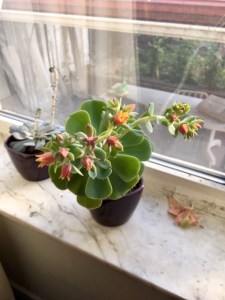
IMG_1982I have two plants sitting on my windowsill that have been there for two years now, and quite honestly, I’m very surprised that they’re still alive. It’s safe to say that I do not possess a green thumb, and my apartment doesn’t get a lot of sunlight. But somehow these plants have persevered—sometimes looking a little worse for the wear, yet thus far still surviving my neglect and horticultural ineptitude.

It amazes me how tall these plants can climb, upward toward the sunlight. To think that they started as just a tiny seed—a seed that contained within itself the capacity to grow and flourish—is incredible. They’ve even survived being repotted after outgrowing their containers. Their growth is not really any credit to me, as I’ve done less than the bare minimum to keep them alive. It is more a testament to the design of God, who has created beautiful things to flourish even amid adverse conditions.

In Jesus’s parable of the mustard seed, we hear how God brings tremendous growth out of tiny beginnings. We, too, are small; and yet we are created completely whole. Within each soul is the capacity for greatness. All it needs is to be nurtured by water and light, to be broken open so that roots may stretch out from its core and new buds may blossom outward into the day. We are created as tiny seeds, but we are not meant to stay that way. We are meant to climb toward sainthood.

But growth happens slowly. We must learn to be patient with ourselves and with others; our transformation will not happen overnight. We must place our trust in the Master Gardener and let Him do His work. Sometimes it may seem like we won’t survive in new soil, but really we only need to extend new roots. If we have patience through the spiritual dry spells and cold fronts (and even, perhaps, a polar vortex), God will guide us to adapt and grow through every circumstance. All we have to do is keep craning our heads upward toward the light.

“Man was created for greatness—for God himself; he was created to be filled by God. But his heart is too small for the greatness to which it is destined. It must be stretched.”
—Pope Benedict XVI

We Belong to Each Other

They came bringing to him a paralytic carried by four men.
Unable to get near Jesus because of the crowd,
they opened up the roof above him.
After they had broken through,
they let down the mat on which the paralytic was lying.
When Jesus saw their faith, he said to him,
“Child, your sins are forgiven.”
—Mark 2:3–5

Imagine how it felt for the paralyzed man to be so close to Jesus, and yet so far: within sight of the Healer, yet held back by the very impairments that needed healing, utterly helpless to bridge the gap.

In moments when we feel paralyzed and helpless, unable to fix things for ourselves, God does not want us to go it alone. He wants to heal us, and He seeks to work through the hearts of others in the process. He uses our frailties to bear greater fruit: not only in ourselves, but in others, too. We can only be healed if we are willing to admit our weakness and ask for help. We must allow ourselves to be lifted up, carried, and lowered into the arms of Jesus.

And when we lend a hand to help someone else, it is a privilege: to share in the sacred struggle of their suffering, to draw close to the fountain of grace and healing. God uses these moments of weakness to teach us to rely upon other people and knit us closer together as a community.

“If we have no peace, it is because we have forgotten that we belong to each other.”
—Mother Teresa