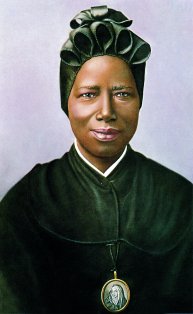
Bakhita

Bakhita_Szent_Jozefina.jpegToday is the feast of St. Josephine Bakhita, a woman of incredible strength and perseverance. Kidnapped at age seven from her home in Sudan and sold into slavery, she was given the name Bakhita, meaning “fortunate.” She suffered daily beatings and abuse at the hands of her captors. Eventually, she was sold to an Italian family, the Michielis, and worked as their maid. While in Italy, Bakhita was introduced to the Canossian Sisters of Venice—and through the Canossian Sisters, she began to learn about God and the Church. The more she learned, the more her heart became inflamed with love for Jesus.

When the Michielis wanted to bring Bakhita with them to Africa, where they had acquired a large hotel, Bakhita firmly refused to leave the convent in Venice. While Mrs. Michieli tried to force the issue, eventually the Italian court ruled that because slavery was illegal in Italy, and had in fact also been outlawed in Sudan before Bakhita’s birth, Bakhita had never legally been a slave. All of a sudden, she was free to choose her own path.

Bakhita was baptized in the Catholic faith at age thirty, receiving all three sacraments of initiation on January 9, 1890, and taking the name Josephine. She took vows as a Canossian Sister three years later. For the rest of her life, until her death in 1947, she was known for her joyful, welcoming presence, her love of children, and her encouraging spirit toward the poor and suffering.

What is particularly remarkable about Josephine is her ability to see God’s hand at work through every chapter of her story, even those filled with darkness and tragedy. When she was introduced to Christ through the Canossian Sisters, all the pieces of her life began to fall into place and make sense to her for the first time. She said, “Those holy mothers instructed me with heroic patience and introduced me to that God who from childhood I had felt in my heart without knowing who He was.”

Josephine stood up for herself and put an end to the injustices she suffered, but she did not brood over past wrongs or dwell in resentment for all the trauma she had undergone. On the contrary, she actually expressed gratitude for her past experiences. When a young student asked her what she would do if she were to meet her captors, she responded without hesitation: “If I were to meet those who kidnapped me, and even those who tortured me, I would kneel and kiss their hands. For, if these things had not happened, I would not have been a Christian and a religious today.”

I am far from grateful for my own sufferings, but I pray that through the intercession of St. Josephine Bakhita, I might allow my eyes to be opened to the ways God is working in every aspect of my life. May my deliverance from resentment and cynicism be sparked by an interior conversion of heart, a turning toward gratitude and unrestrained love for God.

The Power of Letting Joy Spark


Dear fellow pilgrims,

What better describes your spiritual life: a “gloomy darkness” or a “festal gathering”?

I have to admit, my default spirituality is “gloomy darkness”. But a holy “gloomy darkness,” like Lent. (Or at least that’s what I tell myself.) I love Lent, it’s Easter that is harder for me to get into. Who is with me??? Why is it hard for us Lent-lovers to truly celebrate and embrace joy while enduring and dealing with suffering is easier? The first reading today reminds us that Jesus’ life, death, and resurrection has established a new covenant between humans and God characterized by joy, not trembling and fear.

A huge thing I’m learning, though, is this part of me isn’t really operating out of a deeper understanding of suffering at all if it’s easier for me to accept suffering rather than joy. As God has been healing this strange tendency of mine, I’m discovering joy in new ways while I am also letting go of faulty ways I have understood the role of suffering and fear in my life.

In short, I have come to understand that one of the reasons why it is hard for me to truly, deeply, and consciously experience joy in my life is because I have a hard time believing God gives good things to us freely, without a hidden agenda.  All too often, my subconscious response to fun events or moments of potential joy or happiness in life is resisting feeling it deeply in the moment. Why? Well, just in case God wants to take whatever is giving me joy away in the future. In short, I’m trying to cut expected future losses by disengaging from potentially joy-filled moments in the present.

But yeah… that’s not how God works. Those subconscious beliefs do not reflect who God really is, nor do they reflect who I really am to God. I still have a ways to go in truly believing in the relationship Jesus’ sacrifice and resurrection made possible with all of my being, even to the depths of my subconscious.

What is the truth? I am a daughter of God and God is my Father who delights in giving me good things because He delights in my delight. God is not pleased when I am afraid of Him and back away from His good gifts. When I encounter suffering, God does not relish the fact that I am suffering. He only allows it so that a greater good might come about.

God’s inheritance for all of us is goodness, is the Resurrection, is eternal bliss in Heaven, and He wants us to live in that joy as much as we can on earth, not only for our good but for attracting others to claim that same inheritance.

The devil wants to suppress our joy, because “the joy of the Lord is [our] strength”! I know God has given me a large heart, and I feel things very deeply and profoundly, and when I am confident in the Lord, I am joyful. When I am joyful, or actively trust in His promise and inheritance of joy amidst suffering, I am unstoppable. And the devil doesn’t want that. He wants us to keep our beliefs about how we can earn good things and also deserve every bad thing that comes our way.

But this balance of joy and pain in our lives is not up to us! All we encounter in life is allowed by God in order to cultivate within us a deeper understanding of Heaven, of God’s ultimate desire for our hearts, of joy and peace and unity with Him.

Brothers and sisters, I pray the Holy Spirit reveals to each one of you how your own faulty understandings of God and yourself hinder experiencing His joy in the present. I pray that we would live our lives out of an unshakeable belief in the goodness of our inheritance as daughters and sons of God, an identity and gift won for us by Jesus that we can neither earn nor lose on our own merits.

Pax Christi!

-Alyssa

“Daughter!”

Two-year-old Zippy has recently discovered FaceTime.  She loves to talk to Nonna and “A’Reece” (Aunt Grace), but is sometimes a bit confused as to how the technology works.  She will giggle with delight when we answer and our faces appear on the screen, as though we have come to visit her.  “Hi Zippy! Hi Honey!” we say.  “Hi Zippy, Hi Honey!” she says in happy reply.  

She is dismayed however if we don’t share our snacks; she is always generous with hers, trying to put them through the phone (her mother’s turn to be dismayed).  She waves the phone around to show us her dinner or her dolls, and we try not to get dizzy.  Sometimes she will sit and “talk” for awhile—sometimes not saying anything, sometimes chattering away, while we get a steady view of her eyebrows and the top of her head.

During the recent government shutdown, her father came up to visit us and help out for a bit while he was out of work.  When we called to FaceTime, Zippy was ecstatic to suddenly see Daddy on the phone as well.

Shortly after he had returned home to Maryland, the whole family called on FaceTime.  My brother passed the phone to Zippy, who was excited to talk to us, but unhappy that we wouldn’t show her Daddy.  “Zippy see Daddy!” she implored. “I am right here!” my brother laughed behind her.  But Zippy was not placated until Daddy moved around so that she could see his face in the small screen she was holding.  “Daddy! Dere you are!”  she laughed delightedly.

*            *            *

In today’s Gospel a woman is seeking Jesus.  She has had a flow of blood for twelve years; doctors have only made things worse.  And this flow of blood has in turn made her “unclean”—a spiritual outcast, barred from the temple and the touch of other people.

She has heard great things about Jesus and thinks that if she could but touch the hem of His garment, she would be cured.  She moves quietly through the crowd, comes behind Him, and touches His clothing.  Immediately, she realizes she is healed.

Jesus, however, recognizes a deeper desire for connection.  He knows that healing power has gone out of Him, and asks the confused crowd “Who touched me?” 

The woman must then confess; she comes forward, revealing herself and tells what has happened.

“Daughter,” Jesus replies, “Your faith has made you well.”

She had sought merely the restoration of her health. Jesus restores her identity, her relationship with her Father.  “Daughter…”

This deep desire—was it only on the part of the woman? 

It is a central mystery of Christianity that our love, desire, and faith actually begin as God’s initiative toward us.  It is He who first loves us; He who calls us to prayer, who plants the desire in our hearts, who is the source of both our longing and its fulfillment.


Adam

Photo Credit: Michelangelo, Public Domain

Among the Tombs

Today’s Gospel tells of the healing of the Gerasene man possessed by many demons. Mark’s narrative says that the man had been living among the tombs. The demons had taken ahold of him so greatly that he was literally living among the dead, and probably feeling very close to death himself. I imagine his great anguish every single day, feeling utterly tortured and helpless and unwanted by everyone else. We don’t know how this man became possessed or what happened, but that is not necessarily important to dwell on in light of the glory of Jesus revealed to us here.

Do we not sometimes find ourselves feeling as though we are living among the tombs? The sin we can’t shake, the constant narrative of self-beratement in our minds, the masks we put on to pretend we’re okay when we’re not, the images we hide behind on social media, the mindless scrolling to numb or distract ourselves, the desperate strife to earn the love we do not have to earn, resigning ourselves to thinking we just have to suffer and God won’t come through for us, etc.

Brothers and sisters, we are made for so much more. The tombs of our lives do not define us and will never have the last word. Let’s call to mind another tomb—a tomb where the glory of our salvation occurred, the tomb where, in the middle of the night, our Savior rose and Heaven was opened. The tomb of Jesus. The tomb of His resurrection is the only tomb that will ever define us, because His tomb is empty and death is defeated.

As the man in today’s Gospel comes before Jesus, the demons within him tremble. Even they recognize Jesus’ power and His glory. We can place our hope in the all-powerful God! Jesus cares so much for this man that he not only casts all the demons out from him, but he sends them into the swine so that they will never return. In the death of the swine, this man’s salvation was possible.

You are beloved. God is calling you out of whatever your tomb is. There is nothing to fear—He loves you so. Lay your heart bare before Him in prayer today, and don’t stop there: listen for His response. Let Him fill you with His love. He will give you exactly what you need. Let Him declare the victory of His resurrection over you today!

Toward the Light

He said,
“To what shall we compare the Kingdom of God,
or what parable can we use for it?
It is like a mustard seed that, when it is sown in the ground,
is the smallest of all the seeds on the earth.
But once it is sown, it springs up and becomes the largest of plants
and puts forth large branches,
so that the birds of the sky can dwell in its shade.”
—Mark 4:30–32

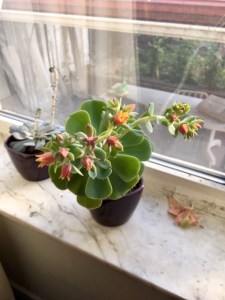
IMG_1982I have two plants sitting on my windowsill that have been there for two years now, and quite honestly, I’m very surprised that they’re still alive. It’s safe to say that I do not possess a green thumb, and my apartment doesn’t get a lot of sunlight. But somehow these plants have persevered—sometimes looking a little worse for the wear, yet thus far still surviving my neglect and horticultural ineptitude.

It amazes me how tall these plants can climb, upward toward the sunlight. To think that they started as just a tiny seed—a seed that contained within itself the capacity to grow and flourish—is incredible. They’ve even survived being repotted after outgrowing their containers. Their growth is not really any credit to me, as I’ve done less than the bare minimum to keep them alive. It is more a testament to the design of God, who has created beautiful things to flourish even amid adverse conditions.

In Jesus’s parable of the mustard seed, we hear how God brings tremendous growth out of tiny beginnings. We, too, are small; and yet we are created completely whole. Within each soul is the capacity for greatness. All it needs is to be nurtured by water and light, to be broken open so that roots may stretch out from its core and new buds may blossom outward into the day. We are created as tiny seeds, but we are not meant to stay that way. We are meant to climb toward sainthood.

But growth happens slowly. We must learn to be patient with ourselves and with others; our transformation will not happen overnight. We must place our trust in the Master Gardener and let Him do His work. Sometimes it may seem like we won’t survive in new soil, but really we only need to extend new roots. If we have patience through the spiritual dry spells and cold fronts (and even, perhaps, a polar vortex), God will guide us to adapt and grow through every circumstance. All we have to do is keep craning our heads upward toward the light.

“Man was created for greatness—for God himself; he was created to be filled by God. But his heart is too small for the greatness to which it is destined. It must be stretched.”
—Pope Benedict XVI