Two Minutes

We were thrilled when my little niece Zippy first began to speak in words we could understand.  From baby babble emerged the first recognizable vocabulary: “Mamma”; “Dadda”; “’nanna (banana)” and “shoes.”  However, when she said, early and audibly, “Two minutes!” we were both greatly surprised and greatly amused.

At age two Zippy still says “Two minutes!” and it is clear that while she has mastered the pronunciation, the actual meaning of the phrase still eludes her.  At times, she recognizes it as a stall tactic.  “Zippy, can I please have my phone back?” I ask.  “Two minutes!” Zippy replies, meaning I must wait.  However,  “Zippy talk two minutes!” means “Zippy wants the phone, NOW, this minute.”  She will ask to hear a song: “One!” by which she means, “One after another,” and listening for “Two minutes!” in that situation translates as “indefinitely…”

In general, the concept of time is confusing if not meaningless to two year-olds.  “I will be back tomorrow” does not console her; she throws herself on the floor, bereft.  (Yes, I am that cool).  “Later” is just a code word for “no.”  And she certainly doesn’t understand “this is not the time to sing” when she breaks out into “Baby Shark” during the Christmas homily, particularly when such a large crowd has gathered to hear her performance.

If the concept of human time is puzzling to toddlers, the concept of God’s timing is equally puzzling to us, even as adults.  I confess that when God says “Wait!” I do not always react well. 

I remember in college that God promised that a particular prayer intention would be answered, but that I must wait.  I thought, “Okay, I have a few minutes.”  Eighteen years later, His answer exceeded my expectations, but I learned the hard way that His time-frame did too.

Even now, I too am tempted to tantrums when God says, “Wait.”  I find myself bereft when He seems absent, wondering if I will ever seem Him again.  And when I pray for solutions to the problems of life, and they don’t come quickly enough, I wonder if He is listening.

In today’s Gospel, Jesus is preaching in a synagogue in Capernaum when he is interrupted by a snarky demon.  “I know who you are…the holy one of God!” declares the demon.  Jesus first silences him, then drives him out.  “Quiet!  Come out of him!”  Jesus commands in Mark 1:24.

Why doesn’t Jesus want the crowd to hear this declaration?  A few verses later, in Mark 1:34, we again hear of Jesus specifically preventing the demons from revealing his identity: “He healed many who were ill with various diseases, and cast out many demons; and He was not permitting the demons to speak, because they knew who He was.”

If Jesus has come to reveal His identity as the Son of God, why silence the demons?  Or perhaps a more interesting question: What would the demons have to gain by revealing it? 

It is the mystery of timing again.  God’s timing is perfect.  Patience is a virtue that we do well to cultivate.  But more importantly, the mystery of timing reveals another mystery: that the Christian life is about relationship, not results.

The answer to Jesus’ identity is not a bit of trivia, or even a theological proposition to answer correctly on an exam.  We come to know Him as He is WITH US (Emmanuel again).  Jesus wants the people to come to know God as revealed by His person, not just as a match to their expectations. 

His healings, His miracles, His teachings, and ultimately His gift of self on the Cross and in the Eucharist, reveal to us the face of God.  It is encounter that teaches us, and encounter that changes us. 

We need to hear Him say, to the leper within, “I do will—be healed.”  We need to experience the gaze of the loving eyes which behold the sinful woman weeping at his feet, to hear him say, as to the woman caught in adultery “Neither do I condemn you.  Go, and sin no more.”  We need to watch Him calm the storms without and within; to cast out demons and welcome back outcasts; to feed with a new Manna that is both Presence and Promise.

We want to rush ahead to the solution, to the answer: Who is this guy preaching in the synagogue? What does He plan to do to/for us?  But Jesus wants us to experience His presence.  To walk with Him, to listen, to question, to learn not only His message but His heart.

*            *            *

Over Christmas vacation I take Zippy on a walk to the library.  It is a two-minute walk if one goes directly.  But there is so much to experience along the way: leftover snow to touch, steps to climb up and down, puppies to shriek at delightedly and try to pet.  She wants to see her breath in the air; she wants to see what is in the half-frozen puddle in the driveway; she wants to pick up pebbles and watch them dance as she throws them on the path.  She wants to run and then be carried and then put down so she can meander down the sidewalk.  If we don’t make it all the way to the library; that’s okay.  Life is short.  Just two minutes.

He Sustains All Things

“In these last days, he spoke to us through the Son,     
whom he made heir of all things 
and through whom he created the universe,

who is the refulgence of his glory,
the very imprint of his being,
and who sustains all things by his mighty word.” -Hebrews 1:2-3

Happy chilly and wintry Monday, friends! To be honest, I had a whole post prepared about following Jesus based on today’s Gospel (Mark 1:14-20), but the Holy Spirit shook things up a bit. So here we are.

One of my favorite prayers is the Litany of Trust, written by the Sisters of Life. It really gets to the heart of the human struggle against the lies the devil tries to tear us down with. One of the lines from the prayer is:

“That You are continually holding me, sustaining me, loving me…Jesus, I trust in You.”

He sustains all things. He is faithful in all things.

Brothers and sisters, He sustains you.

Yes, you.

He never stops.

It’s one of the hardest things, isn’t it sometimes? To be dependent on God and to let Him truly sustain us? We live in a world of self-reliance, self-sufficiency, and control. “I’ve got this.” “I can handle this on my own.” “I don’t need anyone.” “I can only trust in myself.”

Any disposition of heart we have towards the world/our jobs/other people absolutely affects our relationship with God. So when we fight His sustaining power? Ouch. Our hearts are blocked; full, vulnerable reliance on God is severed. We hurt ourselves and separate ourselves from the One who desperately longs to hold us.

Have you ever seen a child who’s throwing a tantrum kicking and pounding their mother or father as they pick them up off the floor? But what do the parents do? They hold them anyway; eventually the kicking and screaming subsides, and they are comforted by their parent’s embrace.

This is how I imagine Jesus with us as He’s sustaining us. He loves us too much to leave us there. He will pick us up, even as we fight Him in our thinking we know better than He does, and He will hold us until the storm passes.

Jesus will keep holding you as you learn to allow yourself to lean into His embrace and be sustained by His love. He won’t stop His love for you.

I know this isn’t easy. This is a struggle for me, too. Vulnerability is never comfortable, acknowledging that we need help is hard, and relying on Jesus over yourself is a risk that requires a leap of faith.

Letting Him sustain us, truly sustain us in every way, means that we have to let Him into the darkest and most hidden places of our hearts. We have to allow Him to soften our hearts and go to the depths so He can heal, free, and redeem. This is an endeavor worth taking. We are so safe in His arms. Jesus is the “refulgence” (the brilliance, the splendor, the shining light) of God’s glory. Darkness flees in the presence of Jesus.

Let’s go there with Him. Jesus, break through. My prayers are with you.

P.S. This song speaks to the journey of letting Jesus sustain us.

The Odor of Sin

Blessed Pier Giorgio Frassati loved the poor wholeheartedly. He went out into the slums of Turin to visit them each day; he did this not to assuage his conscience or to give them something from his material excess, but rather to receive them, to visit with them, to love them as God’s own children and to offer his whole self to them. He saw Jesus in each of their faces. Once, a friend asked Pier Giorgio how he could bear the odor of the poor, the dirt and filth of the slums. He replied, “Don’t forget that even if the house you visit is very dirty, there you may find Jesus. Remember always that it is to Jesus that you go: I see a special light that we do not have around the, sick, the poor, the unfortunate.”

In today’s Gospel we hear Luke’s account of Jesus healing a leper. I would imagine that this man was used to people recoiling in his presence, shrinking away from the fetid odor of his infection. He would have learned to lay low, to avoid other people so as not to feel the sting of their repulsion. But when he saw Jesus, he did not back away. Had he already sensed, in that first glance, that Jesus did not look at him the same way as everyone else? He lay prostrate before Jesus and begged for healing. If the people were horrified to see a leper approaching Jesus, imagine their disgust when Jesus responded by reaching out and touching this man. He was not deterred by the stench; no, He was in fact drawn toward this man, filled with nothing but love for him.

We know where our sores and infections lie within our souls, and more often than not we try to cover them up. We expect that Jesus will be disappointed by our faults and failures, and so we try and mask the odor of our guilt. But Jesus is not deterred by the stench of our sin, and He does not want only part of us. He wants all of us, warts and all, for He seeks to love us totally and completely. He bends down to greet us, looks us in the eye; all He needs is for us to affirm our trust in Him to fully heal us. Lord, if you wish, you can make me clean.

How Many Loaves Do You Have? Go and See!

“Give them some food yourselves.”—Mark 6:37

At the beginning of today’s Gospel, we get a glimpse into the Sacred Heart of Jesus.  “When Jesus saw the vast crowd, His heart was moved with pity for them, for they were like sheep without a shepherd; and He began to teach them many things.”  As He teaches, their hunger grows, in more ways than one.  And soon it is “late.”

The disciples see the physical hunger of the crowd as a problem, and want both the problem and the people to go away.  “Dismiss them…so they can go and buy themselves something to eat,” they urge Jesus.

Jesus surprises them, instead saying: “Give them some food yourselves.”  They are stunned.  “Are we to buy 200 days wages worth of food and give them something to eat?”

He asks them, “”How many loaves do you have?  Go and see.”

It is important not to rush past this question.  Having read the spoilers, we know the answer: five loaves and two fish.  And we know what Jesus will do, and how the more than five thousand will be fed that day, and how there will even be twelve baskets of food left over.

But let us ponder for a moment this command and question of Jesus.  It is not enough for Jesus that His disciples hear His words as a message to be learned and taught.  Rather, He wishes for them to share in His heart, in His mission.  Nor can they pray from a safe distance for God to “take care of” the issue.  They are to be an integral part of His work.

First, however, they must come face to face with their inadequacy.  What do they have to offer? “Go and see.”  They are to encounter, concretely, their own inability to provide for the people.  On their own, they do not have what it takes.  They need God to work.  And yet, in the mystery of salvation, God calls them (and us) to cooperate with His work.  Our own experience of poverty does not exempt us from mission.  Humility rather makes room for God to work, but He nonetheless elevates us, drawing us into His divine mission.

The disciples bring the five loaves and two fish to Jesus.  Jesus could have fed the crowd with just one loaf, or with the bread and not the fish.  Or, being God, He could have provided His own loaf and fish.  Instead, He asked that they give what little they had, and all that they had. 

God invites us to experience our poverty, our nothingness—but then asks us to give anyway.  He loves us in our poverty, but doesn’t leave us there: He invites us to make a gift of what we have—all of it.  Sometimes we object because it seems too much.  But just as often, we object because it seems too little.

We prefer grandiose gestures, which make us look or feel good.  When God invites us to give lesser things, we balk.

Caryll Houselander writes of the woman who had a great desire to sacrifice her life to God as missionary martyr to cannibals, and was disgruntled that He never took her up on her offer.  But she was unwilling to offer God the sufferings of her infirmities and old age. 

“I knew once the primmest old invalid lady who could well have offered her helplessness to God, but she had a grievance against Him because He had not permitted her to be eaten by a cannibal for the Faith; she could not accept herself as a sick woman, but she would have achieved heroic virtue as a cutlet!” (Reed of God, p. 50)

We like to think of our saints as superheroes. But Saint Therese of Lisieux was by all accounts so “boring” that her fellow sisters feared there would be nothing to write in her obituary.  Hers was not a life of great deeds, but of great love. She offered to God the smallest of things—and all things—with this love, and in so doing became a great saint.  She was aware of her poverty and weakness and littleness, and so made room for God to act in her life in very big ways.

Father Walter Ciszek, on the other hand, lived a life of remarkable strength and courage.  He became a priest, and then went to Russia as a secret missionary.  His daily life there was one of marked suffering, even before he was arrested (accused as a spy) and imprisoned; he was tortured, and later sent the Gulag in Siberia.  The details of his sufferings are astounding, and can only be called heroic.  Yet for Father Ciszek, the defining moment of his life, his “conversion,” was a moment of abject failure.

While imprisoned he was subject to routine torture in a effort to get him to make a false confession.  He was determined to resist; determined to outwit his captors; determined if necessary to die for Christ.  Instead he capitulated and signed.

He was devastated; it was a moment of “great darkness” as he confronted his failure, his poverty, the realization that he did not in fact “have what it takes.”  Then suddenly grace gave birth to profound freedom, as he realized that it was precisely his weakness that God was asking of Him.  He had been relying on His own strength; henceforth he would trust completely in God’s will.

Very few of us will be called in the next twenty-four hours to make heroic offerings to God. Yet each of us is invited into the heart of Christ, to give what we have at His asking.  To begin with that first step in trust—to put bread into that first pair of hands, and then another, and then another.  To watch with reverent awe as God multiplies our poverty into abundance.

Image credit: Marten van Valckenborch [Public domain] from Wikimedia Commons

Go

“When Jesus heard that John had been arrested,
he withdrew to Galilee. 
He left Nazareth and went to live in Capernaum by the sea,
in the region of Zebulun and Naphtali,
that what had been said through Isaiah the prophet 
might be fulfilled:

Land of Zebulun and land of Naphtali,
the way to the sea, beyond the Jordan,
Galilee of the Gentiles,
the people who sit in darkness
have seen a great light,
on those dwelling in a land overshadowed by death
light has arisen.”

 From that time on, Jesus began to preach and say,
“Repent, for the Kingdom of heaven is at hand.” – Matthew 4:12-17

Today’s Gospel can often be glossed over and summarized as the start of Jesus’ public ministry. But I couldn’t get past the first line: “When Jesus heard that John had been arrested…” The weight of that hit my heart. Jesus had just spent 40 days and 40 nights praying and fasting in the desert, and now He hears of His cousin’s arrest and knows his death is imminent. Yet this news does not prevent Jesus from going where the Father is leading Him; I would even daresay it fuels Jesus to go where He needs to go, no matter what the sacrifice and no matter what the cost.

Jesus goes to Galilee not to hide and avoid being arrested Himself, but to fulfill the great prophecy from Isaiah that He is the Messiah! He is the Light who scatters all darkness! In hearing of John’s arrest, I imagine the reality of what Jesus was about to undertake in His public ministry, culminating in His own death, started to sink in. In a moment of what could have been great fear leading to inaction, Jesus begins to preach. The Word takes on a voice. And how the aching world needed His preaching, His healing, His love, His mercy.

What is it time for you to begin? What are you holding back from God? I think sometimes we all have a sense of where God is calling us, we’re just too afraid. I am right there with you in battling the fear. What steps can we begin to take to go where He is leading us?

Last week I wrote about the anointing we have received in Baptism, and today’s first reading proclaims twice that we belong to God (1 John 4:4-6). We can have great confidence in Who we belong to and in the One who goes before us in all things. Brothers and sisters, I don’t know what your specific mission is in this life. But I do know that you are needed. You, as Catholics, are desperately needed in this world. So whatever it is, wherever He is calling you, take that first step—make that phone call, speak up when you’d normally stay silent, write that song, go to Confession, take that time in prayer that you’ve been avoiding. Go. More of Him, less of us. All for His glory, all for His Kingdom, all according to His will.

What Are You Looking For?

John was standing with two of his disciples,
and as he watched Jesus walk by, he said,
“Behold, the Lamb of God.”
The two disciples heard what he said and followed Jesus.
Jesus turned and saw them following him and said to them,
“What are you looking for?”
They said to him, “Rabbi” (which translated means Teacher),
“where are you staying?”
He said to them, “Come, and you will see.”
So they went and saw where he was staying,
and they stayed with him that day.
It was about four in the afternoon.
—John 1:35–39

St. Elizabeth Ann Seton, whose feast we celebrate today, lived a busy life as a wife and mother of five in New York City. She was an upper-class socialite who entertained George Washington and Alexander Hamilton in her home, and her family had deep roots in the Episcopalian church. At the time of her birth in 1774, Catholicism was outlawed in New York City; by the time she was ten years old, the ban was lifted, but Catholics were still looked down upon by wealthy Protestant families such as Elizabeth’s. The modest wooden Catholic church, St. Peter’s on Barclay Street, was the home of lower-class immigrants; Trinity Episcopal Church, on the other hand, was a refined, elegant place for peaceful reflection among the social elite. Elizabeth’s sister once commented, “Let me be anything in the world but a Roman Catholic,” and saw Catholics as “dirty, filthy, ragged, the church a horrid place of spits and pushing.”

None of Elizabeth’s friends or family could have predicted her conversion to Catholicism. It was unthinkable, that she would lower herself to the depths of society, forgoing “civilized” worship to join a disorderly congregation with baffling beliefs. Serving the poor was one thing; joining them was another.

But Elizabeth had experienced Jesus calling her to His Church in a way she could not deny or explain away. While in Italy, mourning the death of her husband, she witnessed the beauty of the Catholic faith. She encountered the real presence of Christ in the Eucharist and fell to her knees before the monstrance in utter surrender to God. She had met Jesus in His Church, and after that there was no turning back. Even though her friends and family were shocked and bewildered by her decision, she sacrificed her reputation to enter the Catholic Church and receive Jesus in the sacraments. She so desired this greater intimacy with Jesus that everything else in her life seemed trivial in comparison.

Just as Jesus invited the disciples to follow Him, just as He invited St. Elizabeth Ann Seton, so He invites each of us in our own lives to follow wherever He leads. The above passage from today’s Gospel should not seem distant or foreign to us; Jesus is pursuing us in the same way. He interrupts our daily routines and asks, “What are you looking for?” What are we pursuing? Is it wealth or social prestige? Is it comfort and security? Or do we seek something deeper and more substantial, something that written on our hearts from the very first moment of our existence? Jesus beckons us, “Come, and you will see.”

At last God is mine and I am his….The awful impressions of the evening before, fears of not having done all to prepare [for my first Holy Communion], and yet even then transports of confidence and hope in his goodness.

My God….the fearful beating heart…the long walk to town, but every step counted nearer that street then nearer that tabernacle, then nearer the moment he would enter the poor, poor little dwelling so all his own—and when he did the first thought I remember, was, “let God arise, let his enemies be scattered,” for it seemed to me my King had come to take his throne, and instead of the humble tender welcome I had expected to give him, it was but a triumph of joy and gladness that the deliverer was come, and my defense and shield and strength and salvation made mine for this world and the next….

Now then all the excesses of my heart found their play and it danced with more fervor….Truly I feel all the powers of my soul held fast by him who came with so much Majesty to take possession of this little poor Kingdom….

My God is here, he sees me, every sigh and desire is before him.

—St. Elizabeth Ann Seton

The New and the Now

I love New Year’s Day.  I love new beginnings, fresh starts, the first page of a clean new journal.  I love the idea of resolutions: the promise of new habits and the new happiness and order they will bring to my life.

I am not alone: last night, Times Square was filled to capacity, and millions more watched on television as the ball dropped, signaling an end to 2018 and the beginning of 2019.  It was a night of celebration and revelry; for many the penultimate holiday celebration, ushering in the promises of newness: New Year, New You, New Resolutions and hopes and dreams to plan and unpack.

Yet, just three weeks from today, January 21st, is Blue Monday, “The Most Depressing Day of the Year.”  By the third Monday of January, it seems, conditions have converged to create a cocktail of depression.  One is the dreary weather; another the post-holiday let down, and then the arrival of the post-holiday credit card bills.  (I am sure that fact that it is a Monday doesn’t help).  But the biggest factor?  By the third week in January most have failed to keep their new resolutions, and as a result have abandoned hope in their new happiness.

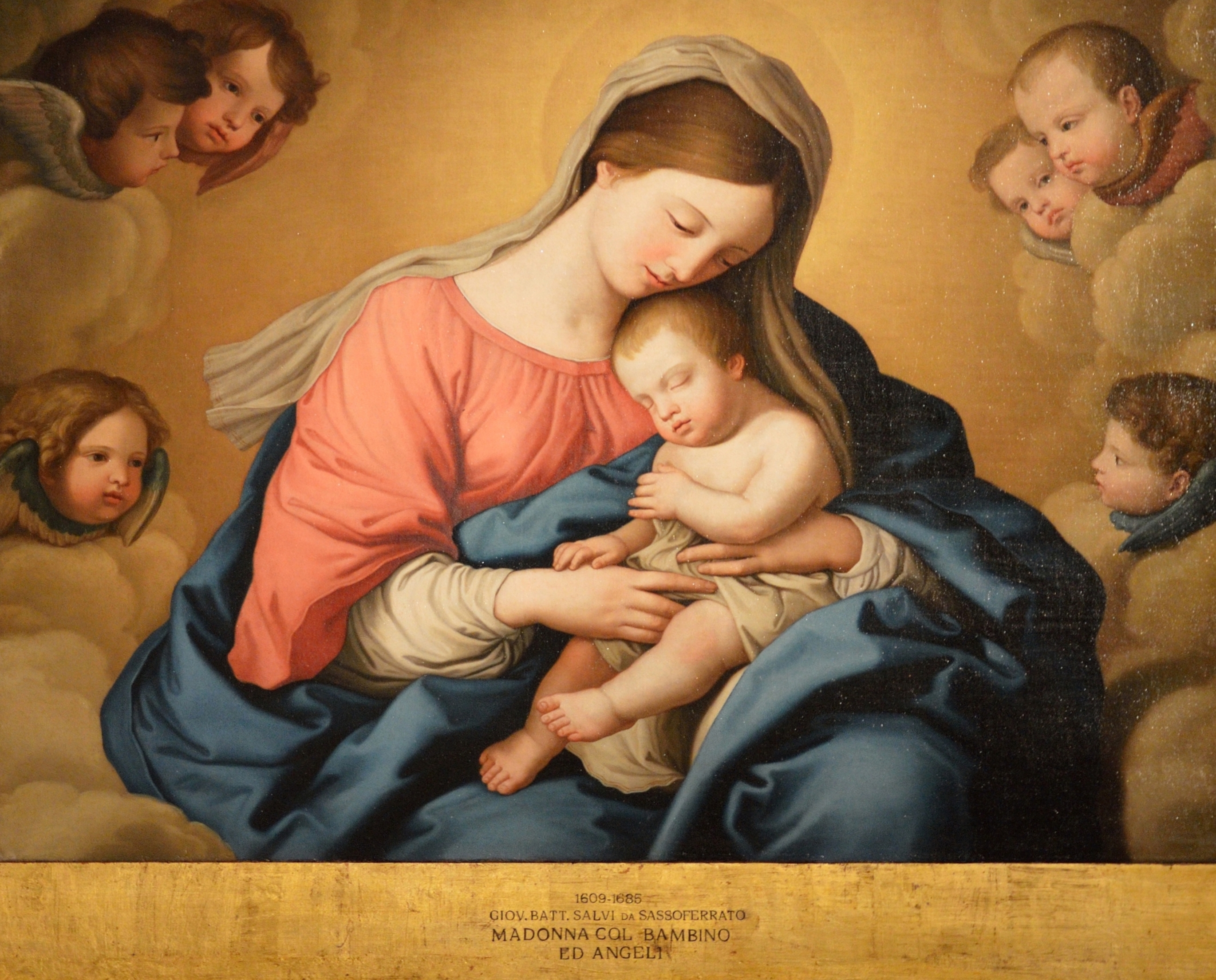
Today, January first and New Year’s Day, the Church presents for our contemplation the mystery of Mary, Mother of God.  At first, it seems something of a mismatch.  If there was anyone who didn’t need New Year’s resolutions, it was the Immaculate Conception.  Conceived without sin, she had no faults to renounce: she didn’t need to resolve to give up gossip, or gluttony, or even to give more of herself to God.  And it is hard to picture Our Lady promising to eat fewer carbs or even to exercise more: surely the fully pregnant mother who rode on a donkey all the way to Bethlehem didn’t need to get more fit, or to do more penance.

Yet when we entrust to Mary the Mother of God, our resolutions, we increase exponentially the likelihood of our keeping them.  First, because her intercession is invaluable in anything we wish to accomplish or offer.  Second, because in her role as Mother of God, she models for us how to keep them.

How can this be, for we who know too well the reality of sin?

The answer for the Christian is not a how or a what but a Who.  The child gestated in the womb of a Virgin, laid in the manger and held in her arms, first in Bethlehem and ultimately at Calvary, is Emmanuel: God is With Us.

God is With Us.  Not just in the new, but in the now.  Not with our future perfected or improved selves, or hobnobbing with the People We Ought To Be, but right now, in this imperfect moment.

Says Sister Wendy Beckett: “I would say that the essential test of whether you are a Christian is whether you actually pray.  If you don’t pray you don’t truly believe.  You believe in some kind of God who is an evil God because if you truly believe in the real God, then you want to be close to Him.”  Yikes.

It is in the Baby in the manger, the Baby cradled in Mary’s lap, nursing at her breast, that we can find the confidence to draw close to God without fear.

A baby changes everything.

Even a merely human baby has a remarkable power to effect change.  Voices are softened, curses omitted, touch becomes more gentle and loving.  Mothers addicted to nicotine or caffeine or alcohol in excess suddenly quit cold turkey when they become aware of the life growing within them.  Fathers who are “tough guys” melt into mush holding their child.  Parents can attest that what willpower could not accomplish, the needs of their child effects quickly: getting up earlier, giving up more of their time, sacrificing more of their money for someone other than self.

Father Richard Veras notes in his book Jesus of Israel: Finding Christ in the Old Testament that this experience of parenthood, this change effected by ENCOUNTER, is in fact the model of Christianity, not resolution fueled by willpower alone.   It is the encounter with Christ that changes us, that both inspires our right resolutions and empowers us to effect them.

If there is one resolution that will change your life definitively, it is to adopt the habit of daily prayer.  To spend some time, like Mary, reflecting on the mystery of Emmanuel.  To be present to the God that is always with you.  To allow Him to transform you, to make you new.  Sister Wendy again, not mincing words: “My filth crackles as He seizes hold of me.”

Gretchen Rubin, in her book Better than Before, writes about habits, and what helps and hinders them.  Much of her advice applies well to cultivating a habit of prayer.  Make the habit specific and concrete, she advises.  Set a specific time for prayer (morning habits are more likely to be kept, she notes).  Make the habit itself specific (for example, replace “to pray more” with “I will pray for fifteen minutes a day.”)  Make it a daily habit: “What I do every day matters more than what I do once in awhile.” (p.80)

Let Our Lady teach you how to pray.  (She taught Jesus, after all…)  Let her hand you the Christ Child to hold, even without words, and just be present and ponder the mystery.

Finally, as Gretchen Rubin notes, the time for a new habit is Now.  Not in tomorrow, which as the orphan Annie reminds us, is “always a day away.” The Good News is, literally, God is With Us Now.  Not in the museum of the past, nor in a perfect future, but in very moment in which we reside.

On this her feast day, let us invoke Mary’s maternal intercession as we pray for the two most important moments of our life: “Holy, Mary, Mother of God, pray for us now, and at the hour of our death, Amen.”

Madonna_with_child_and_angels

Image Credit:

Giovanni Battista Salvi da Sassoferrato [Public domain or CC BY-SA 4.0 (https://creativecommons.org/licenses/by-sa/4.0)%5D

Giovanni Battista Salvi da Sassoferrato [Public domain or CC BY-SA 4.0 (https://creativecommons.org/licenses/by-sa/4.0)%5D