Another Saint I Learned to Like

“I am glad to hear that the Church considers her a saint, because I thought she was a witch!”  These words, allegedly spoken by a priest of St. Frances Xavier Cabrini, reinforced in my mind the already intimidating image of this saint, whose feast we celebrate today.

That she was fearless and feisty was to her credit, I supposed.  But I found myself cowed by her seemingly impossible standards of self-sacrifice.  It has been recounted how, when just a young girl, she wanted very much to be a missionary.  Then, one day, when about to eat a piece of candy, she was told that missionaries could not eat such sweets.  So she didn’t.  Not that day, NOT EVER AGAIN.  She didn’t complain—even when suffering from ill treatment, or ill health—and forbade her fellow nuns to complain about ANYTHING.  Not even the weather.  She was relentless in her pursuits, in both her numerous missionary projects (schools, hospitals etc. throughout the world) and in her pursuit of holiness.

Even the Girl I Ought To Be does not aspire to such herculean efforts, and Real Me, rather than taking inspiration from her, merely added her to the list of Saints I Don’t Like.  What common ground could I have with such a saint?

So it was something of a surprise when I found myself at her shrine, one morning in May, while preparing for a talk.  The shrine offered the best chance for Mass, so there I was, praying not a few feet from the altar under which her body is encased.

That night I was to give a talk on Mary’s Fiat, and while I had been preparing for some time, I felt a subtle urge to change what I was going to say.  To talk about fear.  Fear?  I questioned the voice inside.  How does fear relate to anything?

Was Mother Cabrini smiling, just a little, when the priest began his homily, and began to speak of fear?  How in fact the saint I saw as fearless had some very big fears indeed.  One of these was of water.  When she was a child of seven, little Francesca Cabrini would make paper boats, fill them with violets (pretending they were her missionaries) and float them down the river.  She was shy and quiet then, and this solitary activity brought her much peace and joy.  Until one day she fell in.

Nobody knows how she got out.  She was discovered on the water bank, soaked and shaken, with no memory of who had rescued her.  Credit was given to her Guardian Angel, and yet for the rest of her life Francesca had a deep fear of drowning.

God did not take away her fear.  Rather, He allowed her to offer it back to Him, repeatedly.  No less than twenty-seven times, St. Frances Cabrini crossed the oceans between continents.  This was more than a century ago, and so passage was by boat, and slow, a matter of days.  Yet she did it, again and again, in spite of her fears.

Her first time crossing the Atlantic brought her to New York City. Like her patron, St. Francis Xavier, she had wanted to go to China.  But the pope told her, “Not to the east, but to the west.”  And so New York it was, where she arrived with a few nuns to begin her first mission in a convent that had been prepared for them.  Only, there was no convent—there had been some miscommunication—there was in fact no lodging prepared at all.

Mother Cabrini and her nuns spent the first night in a boarding house infested with bed bugs and mice.  Mice, I was to learn, were another fear of hers (I see her smiling at me again).  She spent the whole night sitting up, using the occasion to intercede.   So began her work among the immigrants of NYC.

How did she do it?  Like the apostles in the boat, terrified of the storm about them, she was comforted by the voice of Jesus, saying “It is I.”  She knew that voice personally.  She had a strong devotion to the Sacred Heart (one of her nuns spoke to me of her mystical “exchange of hearts” with Jesus).  She knew that He would carry her, that He would provide for her poverty and weakness.  He continued to reward her trust in Him.

In April of 1912 she was scheduled to sail yet again from England to New York.  But urgent business directed her elsewhere that day, and she canceled passage for herself and another sister.  She can only have wondered, later, when she saw the news that the boat she was booked on, the Titanic, had sunk off the coast of Newfoundland.

Why was her life spared?  We can talk casually about the mysterious plans of God.  Other saints were on board that day when the ship went down.  But God had chosen her for further things.

Ultimately, for St. Frances Cabrini, for Our Lady at the Annunciation, for each of us—our Yes is not to an abstract plan, but to a Person.  To Someone, not merely something.

When we offer even our fears to God, He responds by giving us more gifts than we could imagine.  St. Frances Xavier Cabrini founded the Missionary Sisters of the Sacred Heart of Jesus, and more than 67 institutions throughout the world.  She was the first American citizen to be canonized.

May she carry our prayers to the heart of Jesus.
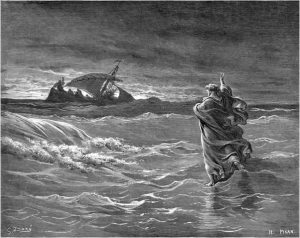
 

Jesus Walks on the Sea


Photo Attribution:

Jesus Walks on the Sea by Gustave Doré [Public domain], via Wikimedia Commons


Freedom in Forgiveness

“Jesus said to his disciples,
“Things that cause sin will inevitably occur,
but woe to the one through whom they occur.
It would be better for him if a millstone were put around his neck
and he be thrown into the sea
than for him to cause one of these little ones to sin.
Be on your guard!
If your brother sins, rebuke him;
and if he repents, forgive him.
And if he wrongs you seven times in one day
and returns to you seven times saying, ‘I am sorry,’
you should forgive him.”
And the Apostles said to the Lord, “Increase our faith.”
The Lord replied, “If you have faith the size of a mustard seed,
you would say to this mulberry tree,
‘Be uprooted and planted in the sea,’ and it would obey you.” (Luke 17:1-6)

“Have you forgiven him yet?” my friend asked as we sat in the driveway of my parents’ house, heat running in the car on a cold December night.

Her words pierced my heart. “Oh…” I said, “I thought I did. But I don’t think I actually meant it with my whole heart.”

Forgiveness—it’s sometimes so hard for us, yet always so easy for Jesus. See, I used to think that forgiveness meant I was saying it was okay that someone hurt me. It wasn’t until I was deeply wounded by another several years ago that I figured out what forgiveness was all about. I remember hearing someone say the words forgiveness and freedom in the same sentence. My gut reaction was, “I want that…is that really possible?”

In today’s Gospel, Jesus calls us to forgive, even if the same person hurts us seven times in one day. Forgiveness isn’t saying that someone else’s sin against you is okay—forgiveness says, “What you did hurt me, but I put you in God’s hands. I do not desire your destruction.” Forgiveness is surrender, casting our cares on the One who cares so deeply for us.

Forgiveness in graver matters takes time and is a journey, and that is okay. With the situation I mentioned above, I would kneel and say the words “I forgive_____” and pray a Hail Mary for the person every Sunday before Mass until I started to believe it in my heart.

Forgiveness softens our hearts; holding onto unforgiveness leaves us bitter, angry, and unhealed with walls around our hearts screaming, “DON’T come in!” Forgiveness frees; unforgiveness enslaves. We become chained to our hurt. If we don’t forgive, we may as well put a millstone around our own necks. Is there someone in your life you need to work on forgiving?

I find it fascinating that the Apostles’ response to Jesus’ teaching on forgiveness was, “Increase our faith.” Their hearts were pierced like when my friend invited me to truly forgive. I imagine them seeing the faces of the people they knew they needed to forgive flash before their eyes as Jesus was talking.

And how often do we struggle to forgive ourselves? I know I do sometimes. I’ve walked out of the confessional before only to beat myself up about my sin a few hours later. The liar of shame creeps in and tells us our sin defines us and that we’re not good.

When St. Margaret Mary Alacoque (the saint to whom Jesus encouraged devotion to His Sacred Heart) began having visions of Jesus, her spiritual director, St. Claude, was very skeptical at first. He told her to ask Jesus what the last mortal sin was that he confessed. Jesus answered, “I don’t remember.” How powerful is the ocean of mercy of our Lord!

Father, increase my faith so that I may more easily forgive others. Strengthen me to be courageous and put the people that have wronged me and wounded me into Your wounded hands. So often others’ own woundedness leads them to hurt me; help me to have an understanding heart towards that. Increase my faith so that I may better forgive myself. Help me to know that I am not defined by my sin but as Your precious child. Help me to forgive like You do, Lord Jesus, and set me free. Remove any shame, fear, hard-heartedness, or bitterness from my heart. May I have great faith in Your mercy, Your love song for Your people.

Sacred Spaces

Jesus answered and said to them,
“Destroy this temple and in three days I will raise it up.”
The Jews said,
“This temple has been under construction for forty-six years,
and you will raise it up in three days?”
But he was speaking about the temple of his Body.
—John 2:19–21

Do you not know that you are the temple of God,
and that the Spirit of God dwells in you?
If anyone destroys God’s temple,
God will destroy that person;
for the temple of God, which you are, is holy.
—1 Corinthians 3:16–17

As human beings, we are designed to live in communion with one another. The Church is meant to be a shared space in which we find shelter for our souls, serving one another and seeing each other with the eyes of Christ. A physical church building serves as this sacred space in its connection with the ultimate Temple, Jesus Christ Himself; and we, too, become temples of the Holy Spirit when we open our hearts to receive Him. No sacrificial offering at any temple could be greater than what Christ offered for us: His very self, His own Body. And so we unite ourselves with this perfect offering, and thus also with one another—all part of the sacred Body of Jesus Christ, one living, breathing organism.

In today’s Gospel, Jesus rebukes the money-changers in the temple for entering into this shared, sacred space not with the intention of communing with God but for selfish, materialistic purposes. They were not seeing their fellow men as God does but rather as potential profits, and they showed no compunction about carrying out this individualistic mentality in a communal place of prayer. Just as Jesus did, we also may experience feelings of anger toward those who profane what is sacred within the Church—particularly after the abhorrent clerical scandals that have been uncovered during this past year. It is profoundly upsetting to everyone else within the Body of Christ to see corruption and rot existing in what is supposed to be a sacred shelter for us.

We are called to drive out the money-changers in the temple on every level—to root out corruption in the larger Church, to foster interconnectedness and reverent prayer within our parishes, and to cleanse our own hearts from the stains of self-centeredness and greed. Imagine the commotion that the money-changers caused in the temple, distracting everyone from the presence of God. What things are creating noise and distractions within our own souls? What pursuits keep us from seeing ourselves as sacred vessels, carrying Jesus into the world? Let us begin there.

God builds his house; that is, it does not take shape where people only want to plan, achieve, and produce by themselves. It does not appear where only success counts and where all the “strategies” are measured by success. It does not materialize where people are not prepared to make space and time in their lives for him; it does not get constructed where people only build by themselves and for themselves. But where people let themselves be claimed for God, there they have time for him and there space is available for him. There they can dare to represent in the present what is to come: the dwelling of God with us and our gathering together through him, which make us sisters and brothers of one house….

The beauty of the cathedral does not stand in opposition to the theology of the cross, but is its fruit: it was born from the willingness not to build one’s city by oneself and for oneself.

—Cardinal Joseph Ratzinger (Pope Benedict XVI)

Leaves the Ninety-nine

Dear fellow pilgrims, 

In today’s Gospel reading, I hear Jesus responding to the Pharisees’ implicit belief that tax collectors and sinners are to be shunned, avoided, looked down upon. (“He welcomes them? Why?”) Interestingly, Jesus does not address a broader assumption of the Pharisees – that they are not sinners but those people obviously are – but rather, highlights His Identity as Redeemer, finder of the lost. Jesus is also responding to the Pharisees’ implicit beliefs in Him as someone who is on the earth to make an impression, be a big name, gain power, shake things up. (“Why would someone like him be with people like them?) 

No, Jesus tells them in two parables that He has come not to wine and dine with the elite, but to seek and find the lost. He is on a rescue mission, not a publicity tour promoting his new ideas about the world. The lost sheep are the ones He is looking for, because His joy is bringing them back into the fold. 

Perhaps you too thought of the very popular worship song “Reckless Love” by Cory Asbury when you read this passage. (“Leeeeaves the niiiiinety niiiine…”) I think this song has gotten so popular because it speaks the Gospel message to the heart of this generation of young people who longs to be seen and chosen out of the crowd as an individual worth losing everything for.

It’s easy to feel like your love as a millennial is being pulled in a thousand different directions. We are so used to calculating risk and reward with relationships – and also used to internet algorithms literally calculating which ads will draw our love and affection towards which products – that we are so compelled when we encounter a reckless, uncalculating love.  

Why did the sheep wander? Why do we wander from the fold?

I don’t know about you, but sometimes it’s easy to fall into the lie that our absence wouldn’t be noticed or appreciated. We forget how we are loved. We forget that we are irreplaceable. That image of the shepherd leaving all of his other sheep to find the one lost sheep speaks truth into that lie in  my heart of being forgettable. And even if I am forgettable to other people, Jesus will never leave or forsake me. 

In this passage, Jesus is helping the Pharisees see both the lost sheep as worth the sacrifice and Himself as the determined shepherd, looking to keep his flock together as one. And, even more so, He is highlighting that He seeks those who are lost because they are lost; He rejoices when they are found, and desires others to share in this joy. 

Jesus, may we yield to your pursuing of our hearts. 

Reclaim the lost of this world, especially those who are farthest from your heart. 

Show us the parts of our heart that are still far from You.

Thank you for never giving up your pursuit of our hearts. 

Pax, 

Alyssa

Counting the Cost, Reaping what He Sows

A brief one for you today:


Today’s readings provide some pretty sobering material for reflection. Phrases like “counting the cost” and “poured out like a libation” rarely make for light reading, no matter the context.

Yet it’s important to read past the easy interpretation of St. Paul and Jesus’ words as grim resolve or cynical fatalism. Look for the positive language; phrases like “children of God without blemish,” “rejoice and share my joy,” and “successfully oppose”.

During a recent small group session, one of the other men their talked about the challenges of having children who could, at some point in their life, stray from the faith. Our conversations moved from their to sharing our faith in general. How can we, imperfect men (and women of course, but you all weren’t at the small group!), make a compelling case for the Gospel of Jesus Christ?

One of the key themes we settled upon is sharing our excitement. What about our pursuit of the Kingdom of God excites us? How does the Lord bring us joy? What value do we see that makes “counting the cost” and “pour[ing ourselves] out” worthwhile?

Take some time over the rest of the week to reflect on the gifts from God that bring you joy. Try to share those things that make you happy. They may be simple hobbies or pleasures in your day-to-day life, or you might think of how Jesus has delivered you from significant sin or suffering. Take time to think of how the Lord makes your life better, and can do so every day

Then don’t hesitate to share it.


What’s For Dinner?

I used to think that my name, Grace, was a bit of irony from God.  But I have come to realize that it is in fact the best name for me.  Not because I am graceful (ha!), nor because I am full of it, but because it is what we say before food.  Even not-yet-two Zippy knows this.  When they tell her: “Say Hi to Aunt Grace!” she tries to make the sign of the cross, thinking that food must be coming.  And that’s about right.

As a lover of food, I can’t help but find today’s Gospel rather puzzling.  Who, when invited to a royal banquet, would prefer lesser things?  Who would say No to the promise of such a feast?  Who indeed.

The invitation to faith is the invitation to trust in the goodness of God. It is the invitation to reverse the sin of Eden, to reverse the decision to doubt, to reverse the decision to choose lesser but attractive foods.

True faith is trust in the goodness of God, in His Providence for us in all things.  It is also trust in the desires that He Himself gives us.

In C.S. Lewis’s novel Perelandra, a man named Ransom finds himself in a new paradise.  He is in a world of floating islands, filled with trees bearing the most wonderful fruits he has ever tasted.  Every need is provided for in this new Eden, but there is one catch.  Because the islands are floating, constantly changing, it is impossible to “save,” to “keep,” to “hold on to for future use” anything at all.  The Tempter comes, proposing an alternative: A Fixed Land.  The choice is proposed: trust in continued Providence, or choose the safety of control.

It is easy to know the right choice, turning pages from the comfort of an easy chair, with my cup of coffee and a chocolate chip muffin still warm in my belly.

But when the hunger sets in—and I have nothing saved for myself—do I still trust?

What if the hunger is itself food, itself a gift?

In the song Blessings Laura Story wonders if our sufferings—the “rain, the storms, the hardest nights” are in fact blessings in disguise.  But then she goes a step further:

…All the while, You hear each spoken need
Yet love us way too much to give us lesser things
…What if my greatest disappointments
Or the aching of this life
Is the revealing of a greater thirst this world can’t satisfy?

We all know that sometimes things that seem to be evil can turn out to be good.  But what if the longing for good, the thirst for God, is itself a good to be sought?  What if hunger is a gift?

C.S. Lewis argues that desire for heaven is one of the proofs for the existence of God.  He notes that all desires have a corresponding means of fulfillment on this earth, all but one—our desire for eternity.  “If we find ourselves with a desire that nothing in this world can satisfy, the most probable explanation is that we were made for another world” he concludes.

St. Augustine is known for saying “our hearts are restless oh Lord, until they rest in thee.”  He wrote extensively on the longing for God—and held that the longing itself increased the soul’s capacity for God.

“The deeper our faith, the stronger our hope, the greater our desire, the larger will be our capacity to receive the gift, which is very great indeed…The more fervent the desire, the more worthy will be its fruits. When the Apostle tells us: Pray without ceasing (1 Thessalonians 5:16), he means this: Desire unceasingly that life of happiness which is nothing if not eternal, and ask it of Him alone who is able to give it.”

Saint Thérèse  of Lisieux lived total confidence in God, was confident that He would make her a saint, in spite of her littleness.  She believed that her desire for God was itself a pledge, that He would not give her very great desires if He did not mean to fill them: “I am certain, then, that You will grant my desires; I know O my God! That the more You want to give, the more You make us desire.”

Indeed, many saints have written that as they have ascended the heights of holiness, plumbed the depths of prayer, that their desire for God, rather than being satiated, was only increased.

May we be fed today with renewed hunger for God.  See you at the feast!

Banquet_in_the_House_of_Levi_by_Paolo_Veronese_-_Accademia_-_Venice_2016_(2)

Photo attribution: Banquet in the House of Levi © José Luiz Bernardes Ribeiro 

Inhale

“Brothers and sisters:
If there is any encouragement in Christ,
any solace in love,
any participation in the Spirit,
any compassion and mercy,
complete my joy by being of the same mind, with the same love,
united in heart, thinking one thing.
Do nothing out of selfishness or out of vainglory;
rather, humbly regard others as more important than yourselves,
each looking out not for his own interests,
but also everyone for those of others.” -Philippians 2:1-4

I’ve been doing a study on the four female Doctors of the Church with a couple friends, and it has been wrecking me. Last week, we reflected on St. Hildegard of Bingen. She was a pharmacist, mystic, abbess, poet, theologian, and composer (so she was basically amazing at everything), and she wrote several books and over 300 letters.

St. Hildegard often struggled with self-doubt, but as she grew in allowing herself to receive Christ’s love into the deepest depths of her being, her voice was freed and the doors of her heart flew open to letting the Holy Spirit work through her in powerful ways.

Today’s first reading from St. Paul’s letter to the Philippians talks about participating in the Spirit. A few years ago, a friend of mine asked: “What would happen if we prayed for the same response to the outpouring of the Holy Spirit that the Apostles had at Pentecost?” My initial reaction was one of fear. “What kind of crazy things would God call me to?” I thought. How often fear prevents us from saying yes to the greatness the Holy Spirit wills to do in and through us.

This one mind, heart, love, and thinking that St. Paul is talking about is all wrapped up and rooted in the Holy Spirit. He is our healer, comfort, strength, and guide. We all have the awesome opportunity and responsibility to allow the Holy Spirit to bring life and transformation to others through our words and actions. Let’s not squander that gift.

Will we have the courage to respond? In order to lead others to Christ, we must first look inward and do a heart-check on ourselves. Last week at a retreat for my youth ministry teens, the speaker said, “God wants to breathe new life into us, but we have to inhale.” And not only that, but once we let the Holy Spirit fill our beings, we have to exhale His fruits for others, and never stop breathing in.

What gifts has God given you that the Holy Spirit is calling you to use? What is one way you can be obedient to the Holy Spirit and exercise those gifts today? It may be as simple as texting a friend that God puts on your heart to let them know you’re thinking of them. It may be having the courage to have a difficult yet needed conversation. Maybe God is calling you to serve Him in a new way.

God has given each of us a light that no one else in the world will ever be able to give. You are an integral part of building up God’s Kingdom, whether you feel like it or not. Do not give into the temptation that someone else will do it, that you are not good enough, or that He may ask too much of you. Why are we often so afraid to shine?

“We cannot live in a world that is interpreted for us by others. An interpreted world is not a hope. Part of the terror is to take back our own listening. To use our own voice. To see our own light.” -St. Hildegard of Bingen

Memento Mori

The souls of the just are in the hand of God,
and no torment shall touch them.
They seemed, in the view of the foolish, to be dead;
and their passing away was thought an affliction
and their going forth from us, utter destruction.
But they are in peace.
—Wisdom 3:1–3

In my catechism class this week, I was teaching about the saints, and my students all wanted to find out which saint’s feast day fell on their birthday. One girl said, “My birthday’s November 2. What feast day is that?”

“Oh, that’s All Souls Day! It’s when we pray for the souls in purgatory,” I answered.

Disappointed, she replied, “That’s…kind of morbid.”

I can understand her reaction—it’s hard to get excited about reflecting on death, especially as a kid on your birthday. It’s a topic that most of us avoid thinking about, because it makes us feel uncomfortable. But there has long been a Catholic tradition of meditating on death, not as some kind of penance or self-imposed misery, but rather as a way to transform our fear of death into hope in the Resurrection.

Memento mori—“Remember your death”—is a refrain to keep us grounded amid the distractions of this world. Thinking about death does not seem appealing to us, but ignoring it will not make it go away. Death is an inevitable reality, and it’s not something we can control. But if we approach it from a perspective of Christian hope, deeply rooted in the promises Christ has made to us, we will begin to see that we don’t have to be so fearful of death. It is more of a beginning than an ending, an obscure mystery that only begins to make any sense to us when we see it through the lens of the Gospel. Meditating on death is itself an act of hope: that as we look more deeply into this mystery, there will be more to discover than bleak, existential materialism. There will be redemption and rebirth.

Sr. Theresa Aletheia Noble, a young sister with the Daughters of Saint Paul, has been keeping a ceramic skull on her desk for the past year as a reminder of death and tweeting about Memento Mori each day. She says:

Death, I think, is a very, very unpleasant topic, especially if you don’t believe in God. When I was an atheist, it was something I definitely did not want to think about because it’s the annihilation of the self. But for people of faith, it has a totally different dimension. We’re able to think about the reality of death and how it’s been transformed by Jesus.

Meditating on death not only lessens our fear; it also increases our sense of urgency to answer the callings God has given us. We are called to become saints, and we have no time to waste. We can go forward to carry out this calling filled with joy, not with fear, confident that if we are united with Christ in death, we will also be united with Him in resurrection.

For if we have grown into union with him through a death like his, we shall also be united with him in the resurrection.
—Romans 6:5

All (of our) Saints Day

Dear Fellow Pilgrims,

Today we celebrated our Church Triumphant, that is, all the saints in Heaven who share the beatific vision of God Himself. They are those described in our readings today as “robed in white,” those who have “survived the time of great distress,” those who have “washed their robes and made them white in the Blood of the Lamb.” In the communion of the saints, we celebrate those who have gone before us triumphantly throughout life, holding onto Christ more and more during this life to then be carried by Him to their final destination: the very center of His Heart and Being. We praise God for our family in Heaven, who petition for us, the Church Militant, night and day.

My favorite description of what the Saints do for us is probably Fr. Mike Schmitz’s anecdote from one of the times he and his family completed an Iron Man competition. Side note: It always strikes me as odd how normal Fr. Mike talks about his family doing Iron Mans… because it’s totally not a normal thing to just say your family “does;” and Iron Man consists of a 2.4 mile swim, 112 mile bike ride, followed by running a FULL marathon – 26.2 miles. Anyways, each competitor has exactly 24 hours to complete this (insane) race, and if they do not finish within that exact time frame, they are marked as a “DNF” (did not finish), even if it’s one second after the 24 hour mark.

So, after Fr. Mike and his excessively physically gifted family finished their respective Iron Mans, they decided to wait at the finish line. He mentioned there is a tradition of some folks who finish their Iron Mans earlier on in the day to go back into the race and run alongside those who need extra encouragement to get to the finish line, and how fun it is to watch people finish the race again with others they have helped “run in.”

One year, Fr. Mike said there was one last guy who was a few miles out from the finish line and it seemed like he was not going to make it in before midnight, but the announcer encouraged people to go help run him in. After more and more announcements informing the rest of the Iron Man people about this man, it’s becoming actually possible that this guy may make it to the finish line in time. Fr. Mike describes this giant crowd of people who have already run their race running in with this guy, who is absolutely sprinting towards the finish line with everything he has. He ends up finishing the race with just a few seconds to spare, in an incredible effort that could have only been possible with the help of all of the people who had ran back to run with him and cheer him on.

This is such a powerful vision of what the communion of the saints is to our race in life, a family I like to think that I “married into” when I made vows to the Church during my Confirmation as an adult about seven years ago. And truthfully, a profound encounter with the communion of the saints was a huge impetus that led to my conversion to the Catholic Church from non-denominational Christianity.

I was just studying on a normal night in college during my freshman year at the University of Minnesota, Twin Cities. I was alone in my dorm room, nothing special was happening, until I felt a sudden onset of spiritual attack (a term I didn’t quite know or understand at the time). I felt bombarded in my mind and spirit, all at once, with feelings of doubt, despair, loneliness, confusion… it was an onslaught I didn’t understand, but knew intuitively that it wasn’t a mental breakdown. This was torment from outside me, not a symptom of dysfunction from within. I ended up calling or texting quite a few friends to come over and/or pray for me. No one picked up or texted me back, and I was feeling even more lonely as this attack continued. Then, I remember having an idea to “test out” this “communion of the saints” I knew about from my studies on Catholicism. It was as much as a last-ditch effort as it was a sincere SOS call into a spiritual realm I didn’t even fully believe existed.

“All you saints and angels in Heaven… if you’re there, please pray for me!”

And then, I felt an even greater onslaught of peace hit me like a giant ocean wave. The wave instantly quenched the fire burning within me. It left as abruptly as it arrived. I was left with a very clear conviction that the Saints’ intercession was real. I had felt it in my bones, in the depths of my soul. I had felt the effect of their intercession, and felt their love in that they responded to my call in a time of distress. I like to think in my own little story about my spiritual life that in that moment, all the saints who would help me in my life, who I would get to know personally, stepped forward and claimed me as their own (enter Pier Giorgio Frassati! “And I shall give her friends. She needs some friends.” followed by St. Therese “I can be her friend!” – she was my confirmation saint).

After that whole ordeal, I attended a praise and worship adoration event where I finally heard a definitive answer from God about His Presence in the Eucharist. (Read more about my testimony here if you’d like.) So now, when I look back on my whole testimony, I see how the evil one was trying to attack me on the precipice of a major encounter I was to have with God, and also how the Saints took me under their wings when I asked for their help. They ran and rallied behind me and helped me finish that little race, that challenge before me at the time.

And so, on every Solemnity of All Saints, I think back to when I first learned to believe in their goodwill for my life, and how powerful that intercession was. As a practice, when I go up to receive communion, I ask all of the saints to pray for a worthy and efficacious reception of the Eucharist. I’m sure there’s a way you can incorporate throwing up an “All you saints and angels, pray for me…” prayer during one of your spiritual or everyday routines.

The saints are always waiting for us to ask for their intercession. Let’s keep them busy.

Pax Christi,
-Alyssa