To an Unknown God

Hey Frassatians, I don’t have a lot of time for a reflection today, so I’m going to send out a draft I had written for two weeks ago, May 9th. Hop in your time machine and I hope you enjoy!

Then Paul stood up at the Areopagus and said:
“You Athenians, I see that in every respect
you are very religious.
For as I walked around looking carefully at your shrines,
I even discovered an altar inscribed, ‘To an Unknown God.’
What therefore you unknowingly worship, I proclaim to you.

—Acts 17:22-23

In terms of theatrics, today’s first reading is top-notch. St. Paul delivers a Spirit-infused, moving monologue about the Lord’s hidden hand behind all the Athenians hold dear, from creation to power over life and death. How do the Athenians respond? The reaction is…mixed, quite literally. Some scoff, others humorously defer (“Can you just tell us about overcoming death some other time, Paul? Pretty please? We’re really busy right now”), and others immediately follow St. Paul as disciples of Christ.

With the benefit of hindsight, it’s always easy to hear a reading like this and say, “Well, there’s their problem right there! They didn’t listen to Paul about Jesus!” Groundbreaking conclusion, that.

Anytime we hear about the crowd’s reaction in Scriptures, though, we’re being called to examine our own hearts. We’re asked to put ourselves in their place. If we had just heard Paul’s rousing proclamation of the Gospel, how would we react?

I first read today’s reading from Acts with a smugness that (at least in my case) comes in no small part from my identity as a cradle Catholic: while friends around me were dropping like flies from the Church and other churches were holding newer, hipper services, I took on the identity of martyr, and not the good kind. I was special. I could see something that others were missing. If only they knew the God that I knew. If only they knew how hard it was to stay Catholic while all of that was happening around me…

But after another read-through, I came to the truth of the matter that God wanted me to hear: That altar “to an Unknown God” is my own.

In a few recent reflections, I’ve touched on a theme pervasive in today’s faith climate: “I’m spiritual, not religious”. St. Paul’s words brought out the parts of me that had tacitly incorporate that mentality into my own faith. In the face of a political and social environment that discourages firm, immovable beliefs, tolerance is a logical outcome. Most people in NYC with whom I discussed my faith (that were not Catholic) had a similar response, sometimes stated and sometimes implied: “That’s great! ….for you.” Translation: “Don’t confront me or make me confront my beliefs, and I will be happy to politely hear about yours.” Sounds a lot like an altar to an Unknown God, huh?

And yet so often I felt this attitude of polite, partial tolerance was actually a reasonable and responsible approach. My own version of the above interaction went something like this: “We can’t possibly grasp the full mystery of God, so I’m going to leave my options open. I don’t want to push them away with firm truths.” I wasn’t questioning my faith, but I wasn’t willing to close the door on other spiritualities, either. I couldn’t bring myself to tell people that I disagree with their openmindedness. I, after having used my Catholic identity for years as evidence that I had a better faith life than so many of my peers, was unwilling to put my money where my mouth was, so to speak, and actually tell my non-Catholic friends why I believe what I believe and why I think it is the one and only Truth. I claim it with every Creed I pray, so why couldn’t I proclaim it?

When I first read Paul’s words, my reaction was something along the lines of, “Yeah, take that, Athenians!”

Upon further reflection, I realize that Paul was exhorting ME. I humbly thanked God for the lesson.


Pray with Scripture. It does things to your heart.

Divine Friendship

Jesus said to his disciples:
“This is my commandment: love one another as I love you.
No one has greater love than this,
to lay down one’s life for one’s friends.
You are my friends if you do what I command you.
I no longer call you slaves,
because a slave does not know what his master is doing.
I have called you friends,
because I have told you everything I have heard from my Father.
It was not you who chose me, but I who chose you
and appointed you to go and bear fruit that will remain,
so that whatever you ask the Father in my name he may give you.
This I command you: love one another.”
—John 15:12–17

Two lines from today’s Gospel passage may seem contradictory at first glance:

You are my friends if you do what I command you.
I no longer call you slaves,
because a slave does not know what his master is doing.

Andrea_del_Sarto_-_The_Last_Supper_(detail)_-_WGA00391First of all, Jesus tells us we are friends, not slaves—if we do what He commands us. Wait. Do friends normally take orders from one another? Then He says we are not slaves because we know what our Master is doing. But…do we really? At the time He spoke these words, his apostles had no idea that He was about to suffer and die (though, to be fair, it’s not like He didn’t warn them). The disciples seemed pretty clueless most of the time about what Jesus was really up to. Can we truly say that we know what our Master is doing? I think more often we feel we are flying blind, having to trust Him without really understanding what His plan is. After all, so much of our Catholic worldview is grounded in the concepts of mystery and faith.
What do we mean when we speak of the mysteries of God? Encountering mystery does not mean that we’ll never know the answers and should simply give up trying to understand. Rather, it means that no matter how deeply we study this complex truth, there will always be more layers of understanding to peel back, always something new to learn. Our human understanding is limited, but with God we can go deeper and deeper, until we are united fully with God in Heaven and can participate in His perfect understanding.

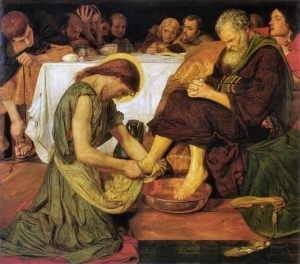
Jesus_washing_Peter's_feet

The more we plumb the depths of these mysteries, the more we grow in both understanding and wonder. But in order to get anywhere we must first have faith. We cannot grasp at this understanding for ourselves; we must draw closer to God so that He can help us see. We must trust Him. Our hearts must be open to soak in His wisdom, rather than trying to sharpen our own, which is a losing battle. Understanding the mysteries of God requires more than just intelligence; it requires divine relationship. It requires friendship with Jesus.

And Jesus offers us that friendship as a great, unmerited gift. We can begin to understand what He is doing—though it be far beyond our depth—through our love for Him. He says, “You are my friends if you trust me. And if you trust me, you will follow my commandments.” Our obedience springs from love and gratitude rather than fear and servitude. We can rest in the knowledge that we are loved and chosen, and we can return that love by recognizing Jesus in others and loving one another.

We are not mere servants; we are friends. And we are made to delight in a Love that is greater than we can comprehend. When we remain in Him, we can begin to bear the fruits of understanding, cultivated through love alone.


1. Andrea del Sarto, The Last Supper / PD-US
2. Ford Madox Brown, Jesus Washing Peter’s Feet / PD-US

Finding the Way

“Where I am going you know the way.”
Thomas said to him,
“Master, we do not know where you are going;
how can we know the way?”
Jesus said to him, “I am the way and the truth and the life.
No one comes to the Father except through me.”
—John 14:4–6

If we follow Jesus wholeheartedly, seeking first and foremost to know Him and grow ever closer to Him, then we will be on the right path. We might be led in very different directions than we imagined, we might be confused about the details as we go, but if we stay close to Him, we can trust that we’re on our way to the Father.

Like Thomas, we ask: How do we know the way?

Open your eyes, Jesus says. I am the way.

You are beholding God before you at this very moment. The Father’s house still awaits, but the Kingdom of God is already at hand.

How will you get there? Be with me. Focus on nothing else; do not worry yourself about directions. Stay with me, keep me company, let me delight in you. Relish this time we share together, even when you are disoriented, even when the path is steep. The journey itself is sacred.

The way to Heaven is not by intently navigating our path with maps and compasses and plans of our own making. The only way we’ll make it is with a guide—Jesus Himself. We cannot reach Heaven without embracing the way of Jesus: the way of the Cross, the way of mercy, the way of humility and love and truth.

Wherever God leads you today, seek the company of Jesus right where you are. Please pray for those of us who will be attending the Frassati retreat this weekend, to make the most of this opportunity to grow closer to God. And pray, too, for all those who are unable to attend—that they also will embrace the gift of this weekend and find the company of Jesus right where they are.

Truth Is a Person

The Jews picked up rocks to stone Jesus.
Jesus answered them, “I have shown you many good works from my Father.
For which of these are you trying to stone me?”
The Jews answered him,
“We are not stoning you for a good work but for blasphemy.
You, a man, are making yourself God.”
Jesus answered them,
“Is it not written in your law, ‘I said, ‘You are gods”‘?
If it calls them gods to whom the word of God came,
and Scripture cannot be set aside,
can you say that the one
whom the Father has consecrated and sent into the world
blasphemes because I said, ‘I am the Son of God’?
If I do not perform my Father’s works, do not believe me;
but if I perform them, even if you do not believe me,
believe the works, so that you may realize and understand
that the Father is in me and I am in the Father.”
Then they tried again to arrest him;
but he escaped from their power.
—John 10:31–39

Pantocrator.jpgWhen it came to listening to His sermons and watching His miracles, Jesus’s followers were totally on board. But when He proclaimed Himself the Son of God, none of the Jews listening to Him—as we see in today’s Gospel—could accept such an outrageous claim. They were familiar with prophets, men who proclaimed God’s truth and channeled His power to perform miracles, but a man who was God? Blasphemy.

We, too, can be susceptible to this mindset of imagining God not as a Person but as a distant, lofty idea, a series of teachings and traditions to be practiced. The truth of the Church is deep and complex, something that we can really sink our teeth into and deeply reflect upon on a theoretical level—but first and foremost, truth is a Person. Jesus is not merely a representative of the truth, a preacher of God’s Word; he is truth. The people struggled to grasp this; they couldn’t comprehend how a man could be so arrogant as to think himself on the same level as God Almighty. What they didn’t consider is that God would deign to lower Himself to our level, to take on human flesh for our sake. Jesus is telling them not that a man is God, but that God is a man. And this proclamation is not blasphemy but love: that the heart of the universe beats within the chest of this humble, ordinary-looking man. This Jesus—ever loving and peaceful, drawing crowds and crowds of followers anxious to see Him and to touch Him—this is the face of Yahweh.

We are called not only to know and understand God but also to be His hands and feet, vessels of God in the world. Christianity is not merely about studying and preaching God’s Word; rather, it is about relationship with the living Word. It is about offering our whole lives to become the manifestation of God’s Word.

As we approach Holy Week, let us draw close to God, peeling away the sins and fears that separate us from Him. Let us experience His Passion, Death, and Resurrection from a perspective of intimate relationship with Him instead of just going through the motions. And let us pray that we might manifest God in the world, so that through our presence others may encounter the Way, the Truth, and the Life.


Image: Icon of Christ Pantocrator, St. Catherine’s Monastery, Sinai / PD-US