Holy Innocents

When the magi had departed, behold,
the angel of the Lord appeared to Joseph in a dream and said,
“Rise, take the child and his mother, flee to Egypt,
and stay there until I tell you.
Herod is going to search for the child to destroy him.”
Joseph rose and took the child and his mother by night
and departed for Egypt.
He stayed there until the death of Herod,
that what the Lord had said through the prophet might be fulfilled,
Out of Egypt I called my son.

When Herod realized that he had been deceived by the magi,
he became furious.
He ordered the massacre of all the boys in Bethlehem and its vicinity
two years old and under,
in accordance with the time he had ascertained from the magi.
Then was fulfilled what had been said through Jeremiah the prophet:

A voice was heard in Ramah,
sobbing and loud lamentation;
Rachel weeping for her children,
and she would not be consoled,
since they were no more.

—Matthew 2:13–18

As Joseph and Mary anticipated Jesus’s arrival, surely they had some idea that they should expect the unexpected when it came to parenting the Son of God. After all, they had already received one giant surprise and had chosen to trust in God’s plan. Still, I don’t think they could have guessed this next curveball in their journey. After traveling to Bethlehem and delivering the child Jesus in a stable, Mary and Joseph were now asked to leave behind everything and everyone they knew, fleeing the country to protect their newborn son from being hunted by King Herod.

It is a testament to his unshakeable trust in God that Joseph responded to the angel’s warning without hesitation, picking up and leaving for Egypt immediately. After all, it was a big sacrifice to make for a message that had arrived in a dream. How did he know that this was truly God’s will for him and not some crazy manifestation of his own subconscious? Only by being so familiar with God’s voice through daily prayer was Joseph able to discern with clarity that this was a message he should heed. And he did so without wringing his hands wondering where they would stay, how they would get by in a foreign land, and why such senseless bloodshed must ensue at the hands of Herod. He dropped everything, including his own plans, to follow God’s call.

God gives grace for the situation, not for the imagination. The only way that Joseph and Mary were able to follow God so resolutely was by continually seeking His will in the present moment. They didn’t become distracted by worries and plans for the future; surely they had hopes and fears of what might lay ahead, but they placed it all in God’s hands and trusted that He would direct their steps.

Herod, on the other hand, was driven entirely by his own wild fears and self-serving plans. Filled with fear and insecurity upon hearing of the birth of this newborn king, he lashed out with merciless brutality and ordered the massacre of innocent children. But even this act of violence did not achieve its intended end, for the Holy Family had already escaped into Egypt.

Herod’s inflated ego numbed his conscience and skewed his perception of justice; he was willing to sacrifice whatever was necessary to preserve his own power, even innocent lives. Herod grasped for control when he perceived a threat to his power, but God was always in control of the situation. The newborn king would die at the appointed time and place, not through Herod’s feverish display of power and cruelty.

We are not in control, and that is a marvelous thing. Let us embrace the unknown path that lies ahead, knowing that we have a good and loving God who will lead us every step of the way. When unexpected situations arrive, may we trust that God will provide us the grace we need in the moment. And may we always be willing to speak up for the innocent and vulnerable, who are so often trampled upon and exploited by those in power.
Everything Is Grace

In today’s Gospel reading, Jesus presents to us a startlingly bold exhortation:

Whoever seeks to preserve his life will lose it,
but whoever loses it will save it.
—Luke 17:33

This does not mean, of course, that we should be careless about our own lives. On the contrary; if our bodies are temples of the Holy Spirit, then we should treat all life—our own included—as sacred and worthy of protection. But in doing so we must remember that our lives have been entrusted to us by God; they are not our own. If we try to preserve them for our own sake, instead of for God’s, then our lives will become detached from the purpose imbued by their Creator and thus lose their meaning.

Jesus speaks here with a sense of urgency, warning us not to be caught unprepared at the judgment. The reading shakes us out of our complacency and gives us the sense that everything can change in an instant. If this is really true, then every moment carries great weight and meaning. Every second of our lives is an opportunity to be a conduit of the inexhaustible Source of all truth, beauty, and goodness in the world.

Jesus’s words are an invitation for us to stop wading in the shallows of our life and go out into the deep. He challenges us to let go of the worldly attachments that keep us tethered to the shore and to go forth in courage. All the beautiful things in this world only have meaning insofar as they reflect the beauty of the Creator. If we love God first and foremost, then we will see His beauty in everything around us. But if we cling to the things of this world for their own sake, forgetting that they are gifts from God, then we will ultimately be left unfulfilled.

May we deepen our awareness that everything is grace, that our very lives are given to us as invaluable, unmerited gifts.

There is the great spiritual principle that undergirds the entire Gospel: detachment. The heart of the spiritual life is to love God and then to love everything else for the sake of God. But we sinners, as St. Augustine said, fall into the trap of loving the creature and forgetting the Creator. That’s when we get off the rails.

We treat something less than God as God—and trouble ensues. And this is why Jesus tells his fair-weather fans that they have a very stark choice to make. Jesus must be loved first and last—and everything else in their lives has to find its meaning in relation to him.

—Bishop Robert Barron

Another Saint I Learned to Like

“I am glad to hear that the Church considers her a saint, because I thought she was a witch!”  These words, allegedly spoken by a priest of St. Frances Xavier Cabrini, reinforced in my mind the already intimidating image of this saint, whose feast we celebrate today.

That she was fearless and feisty was to her credit, I supposed.  But I found myself cowed by her seemingly impossible standards of self-sacrifice.  It has been recounted how, when just a young girl, she wanted very much to be a missionary.  Then, one day, when about to eat a piece of candy, she was told that missionaries could not eat such sweets.  So she didn’t.  Not that day, NOT EVER AGAIN.  She didn’t complain—even when suffering from ill treatment, or ill health—and forbade her fellow nuns to complain about ANYTHING.  Not even the weather.  She was relentless in her pursuits, in both her numerous missionary projects (schools, hospitals etc. throughout the world) and in her pursuit of holiness.

Even the Girl I Ought To Be does not aspire to such herculean efforts, and Real Me, rather than taking inspiration from her, merely added her to the list of Saints I Don’t Like.  What common ground could I have with such a saint?

So it was something of a surprise when I found myself at her shrine, one morning in May, while preparing for a talk.  The shrine offered the best chance for Mass, so there I was, praying not a few feet from the altar under which her body is encased.

That night I was to give a talk on Mary’s Fiat, and while I had been preparing for some time, I felt a subtle urge to change what I was going to say.  To talk about fear.  Fear?  I questioned the voice inside.  How does fear relate to anything?

Was Mother Cabrini smiling, just a little, when the priest began his homily, and began to speak of fear?  How in fact the saint I saw as fearless had some very big fears indeed.  One of these was of water.  When she was a child of seven, little Francesca Cabrini would make paper boats, fill them with violets (pretending they were her missionaries) and float them down the river.  She was shy and quiet then, and this solitary activity brought her much peace and joy.  Until one day she fell in.

Nobody knows how she got out.  She was discovered on the water bank, soaked and shaken, with no memory of who had rescued her.  Credit was given to her Guardian Angel, and yet for the rest of her life Francesca had a deep fear of drowning.

God did not take away her fear.  Rather, He allowed her to offer it back to Him, repeatedly.  No less than twenty-seven times, St. Frances Cabrini crossed the oceans between continents.  This was more than a century ago, and so passage was by boat, and slow, a matter of days.  Yet she did it, again and again, in spite of her fears.

Her first time crossing the Atlantic brought her to New York City. Like her patron, St. Francis Xavier, she had wanted to go to China.  But the pope told her, “Not to the east, but to the west.”  And so New York it was, where she arrived with a few nuns to begin her first mission in a convent that had been prepared for them.  Only, there was no convent—there had been some miscommunication—there was in fact no lodging prepared at all.

Mother Cabrini and her nuns spent the first night in a boarding house infested with bed bugs and mice.  Mice, I was to learn, were another fear of hers (I see her smiling at me again).  She spent the whole night sitting up, using the occasion to intercede.   So began her work among the immigrants of NYC.

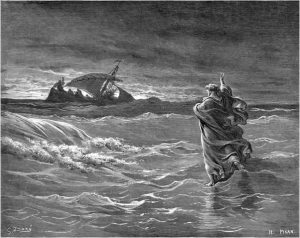
How did she do it?  Like the apostles in the boat, terrified of the storm about them, she was comforted by the voice of Jesus, saying “It is I.”  She knew that voice personally.  She had a strong devotion to the Sacred Heart (one of her nuns spoke to me of her mystical “exchange of hearts” with Jesus).  She knew that He would carry her, that He would provide for her poverty and weakness.  He continued to reward her trust in Him.

In April of 1912 she was scheduled to sail yet again from England to New York.  But urgent business directed her elsewhere that day, and she canceled passage for herself and another sister.  She can only have wondered, later, when she saw the news that the boat she was booked on, the Titanic, had sunk off the coast of Newfoundland.

Why was her life spared?  We can talk casually about the mysterious plans of God.  Other saints were on board that day when the ship went down.  But God had chosen her for further things.

Ultimately, for St. Frances Cabrini, for Our Lady at the Annunciation, for each of us—our Yes is not to an abstract plan, but to a Person.  To Someone, not merely something.

When we offer even our fears to God, He responds by giving us more gifts than we could imagine.  St. Frances Xavier Cabrini founded the Missionary Sisters of the Sacred Heart of Jesus, and more than 67 institutions throughout the world.  She was the first American citizen to be canonized.

May she carry our prayers to the heart of Jesus.


Jesus Walks on the Sea


Photo Attribution:

Jesus Walks on the Sea by Gustave Doré [Public domain], via Wikimedia Commons