Like Children

“Amen, I say to you, unless you turn and become like children,
you will not enter the Kingdom of heaven….
…If a man has a hundred sheep and one of them goes astray,
will he not leave the ninety-nine in the hills
and go in search of the stray?…
…In just the same way, it is not the will of your heavenly Father
that one of these little ones be lost.” Matt 18:1-5,10,12-14

Our peaceful Pentecost prayers were interrupted by the wail of an emergency siren.  It was emanating from my 18-month-old niece Zippy, who was making a compelling case that evolutionary descent was not from apes but from banshees.  “Owwwww” she wailed, convincing the entire congregation to look our way, expecting blood.  But it was just an abbreviation for “out” by which she meant “out of the pew”, “outside” and also “now.”

So I extracted her writhing figure and brought her outside to the statue of Joseph holding Jesus, where she was once again happy.  “Ball!” she said, noting the sphere in the hands of baby Jesus.  “Ball!” she said louder.  “That’s the world, Zippy, not a ball,” I explained, but she still thought that Jesus ought to hand it over to her.  I realized she had a good share of my DNA blended in with the banshee.

Several years ago I read a book about Saint John Paul the Great which deeply inspired me to want to be a saint.  “I am ready to get serious about my faith” I told God.  The images that came to me in prayer, however, were not of great sacrifices or even good deeds, but rather of a nursing infant.

“What does this mean?” I asked, and then followed another image, of myself as toddler, sitting on Jesus’ lap at the Last Supper.  I looked around with great delight.  “I am ready to sit with the big kids!” toddler-me told Jesus.  “I want to be one of the apostles.”  Then I thought for a moment, and toddler-me replied, “Actually Jesus, I want to be you.  I want to be in charge!”  Jesus only smiled, and I saw once again the nursing infant.

There was a time when serious-adult-me would have rebuked this little toddler, but now I only laugh, because I know that Jesus delights in her, in her big dreams and small stature.  Certainly a humility check is in order (and still in progress) but there is something in her honesty, in her way of relating to Jesus, her confidence in His love for her no-matter-what, that adult-me can learn from.

After Mass, we take Zippy to Red Robin for dinner, and order her mini meatballs from the kid’s menu.  Because I am an amateur, not a parent, I hand her the tomato sauce for dipping.  Moments later, I am sitting next to a pint-sized serial killer, covered head to toe in red.  Because I am an aunt, not a parent, I snap pictures in lieu of cleaning her up.

I hand her a cup of juice, which she sips daintily, careful not to spill any.  When she is finished, she indicates so by pouring the remaining juice directly into her lap.  She looks up, smiles, and reaches out her arms to be picked up.  She is confident that my love is greater than my aversion to sauce and stickiness.

I bring her outside to fend off impending sirens, and she hears some music from a nearby restaurant, and begins to dance.  She has not yet learned to judge herself on the reactions of others, the number of Facebook likes, or even her skill at dancing, which is only a slight improvement over her table manners.

I am reminded of teaching my four-year old class the story of The Found Sheep. For this one, Jesus leaves the ninety-nine to search diligently, until He finds it and carries it home jubilantly on His shoulders. At first I worried in the back of my mind that children in their sensitivity might worry about the ninety-nine—those poor sheep left behind while Jesus goes looking for the one.  But the child sees what adults do not: to Jesus, there is no ninety-nine.  There is only the one.

Children know the secret to holiness is simple.  Love. Dependence. Trust. Confidence in the goodness of God, in His care for us, in His willingness to love us even when we are messy or awkward or do things badly or even completely wrong.

The key to holiness is not the greatness of our deeds but the greatness of God’s love.  Prayer is not one of the good works performed by the holy, but rather the food which makes any other work possible.

A few months later I am standing at the seashore with little Zippy, the waves which wash pleasantly over my ankles are strong enough to push her off balance.  But unafraid, she reaches up her arms to be picked up.  Safe and comfortable in my arms, she points to the deep, trusting that she can go anywhere as long as she is held.

May we like little children be confident always in the Father’s love for us, trusting in His goodness and protection to feed us, to lead us, to carry us home.
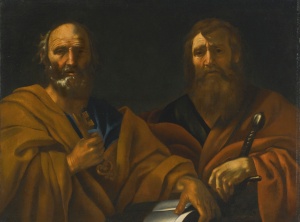
The Heart-Knowing of St. Peter

Reading 1

JER 31:31-34

The days are coming, says the LORD,

when I will make a new covenant with the house of Israel

and the house of Judah.

It will not be like the covenant I made with their fathers:

the day I took them by the hand

to lead them forth from the land of Egypt;

for they broke my covenant,

and I had to show myself their master, says the LORD.

But this is the covenant that I will make

with the house of Israel after those days, says the LORD.

I will place my law within them, and write it upon their hearts; 

I will be their God, and they shall be my people.

No longer will they have need to teach their friends and relatives

how to know the LORD.

All, from least to greatest, shall know me, says the LORD,

for I will forgive their evildoing and remember their sin no more.

Gospel

MT 16:13-23

Jesus went into the region of Caesarea Philippi

and he asked his disciples,

“Who do people say that the Son of Man is?”

They replied, “Some say John the Baptist, others Elijah,

still others Jeremiah or one of the prophets.”

He said to them, “But who do you say that I am?”

Simon Peter said in reply,

“You are the Christ, the Son of the living God.”

Jesus said to him in reply, “Blessed are you, Simon son of Jonah.

For flesh and blood has not revealed this to you, but my heavenly Father.

And so I say to you, you are Peter,

and upon this rock I will build my Church,

and the gates of the netherworld shall not prevail against it.

I will give you the keys to the Kingdom of heaven.

Whatever you bind on earth shall be bound in heaven;

and whatever you loose on earth shall be loosed in heaven.”

Dear fellow pilgrims, 

Our readings today remind us that the Lord wants our hearts, not merely outward actions.  His Heart and our hearts are the meeting place for this new covenant between God and His people, His children. This desire for our hearts is an equal and opposite reaction from our Lord giving us His Heart completely in His life, death, and resurrection. But this covenant, this relationship between God and Man has not always been this way.

The first reading’s description of how covenants would shift reminded me immediately of how relationships between children and parents develop: at first, a parent must take a more hands-on approach to teaching their child about how to act in the world (i.e. “I took them by the hand…”) when they are small. There are rules that are very black-and-white, involving a lot of commands, because children must understand the do’s and don’ts of the world before they develop the cognitive capacity to think more deeply about the reasons behind them.  (And, quite honestly, children need to know the do’s and don’t’s of survival so they can just literally live to develop that cognitive capacity for critical reasoning.) Then, as a child grows older, a parent has less direct control over them, and hopes and prays that the child has at least learned “right from wrong” and can make their own good decisions without constant reminders. Parents’ influences become internalized, or incorporated to subconscious habits or patterns, in older children. This human psychological shift parallels the shift in covenantal relationships between God and Man: God wrote the Ten Commandments on stone tablets, and God also “wrote,” or revealed, His new covenant on the Heart of His Son.  Jesus’ Heart reveals the Heart of the Father, the desire of the Father for a new, closer relationship with His children.  

We can oftentimes (at least I can) overly intellectualize or overthink what it means to actually know Jesus, and this is true especially if you are a cradle Catholic (so I’ve gathered).  THIS is the relationship God desires, and paid such a heavy price for even the chance to have with you, and I’m speaking to you cradle Catholics now: God desires that you would follow Him and not just the things “you know you should do.”  It’s the difference between calling your mom every weekend because you know you should do it and calling your mom every weekend because you just miss her and want to know how she is doing, and know she wants to hear how you’re doing and you know that this exchange will energize you both. (note: I know most of us do not have that ideal relationship with our parents, but these relationships can help teach us more of what our perfect Father is like according to where we may feel hurt or wounded by our biological parents.)

And so, God the Father sends His Son to earth to show His children Who He Is and not just “what He wants you to do.” And in the Gospel reading for today, Jesus holds what an overthinking, intellectual disciple might have seen as a “pop quiz.”  The disciples happily chimed in when Jesus asked who OTHER people said He was, for this was accessible objective knowledge. But… only one answered when Jesus asked who THEY said He was.  Salvation history was unfolding before their very eyes, but many disciples were probably still very unsure about the specifics surrounding Jesus. They all felt a grip on their soul, but few could take that risk to profess a specific faith in Jesus’ identity.  For this was truly a faith, especially so for these disciples who had yet to see Him die and rise again, fulfilling His role as Messiah.  We know the end of the story!  They didn’t.  But it was St. Peter who saw Who Jesus was, he saw with his heart, because he was willing to be led into an unknown knowing, a faith.  I think this is due to the “fool” of St. Peter that manifests in different ways throughout his discipleship.  This same foolish instinct led him out of the boat when Jesus called him to walk in the storm.  This seeming “foolishness” is actually the center of what Jesus heralds about children: there is a purity of reaching out towards what his heart feels but cannot articulate because he knows that this is actually the better part to act upon. 

And beautifully, Peter’s risky profession of faith in a moment of testing, proclaiming who Jesus was to him in a time of confusion and many opinions on the matter, led to Jesus proclaiming who Peter would be.  Peter’s confirmation of Jesus’ identity led to his own; seeing His heart helped him see his own.  This was a defining moment in the unfolding of Jeremiah’s prophecy: Peter was not being taught by another human about how to know God, He was getting to know Jesus, and would be led into knowing the depth of Jesus’ Heart by experiencing the weight of his own sins and redemption. His leadership of the Church would be based off of this knowing, not one of ancient books. Jesus’ law was being written within the hearts of men and women who followed Him, not on stone or paper. 

Jesus, I draw near to You. 

I ask You to silence the voices of self-revision in my mind. 

You long to hear me as I am. 

Tell me how you love me. 

Tell me how you see me. 

My heart longs to know Yours. 

Please meet me here, in my heart. 

Pax Christi,
Alyssa

Tiffiny

I felt sorry for her, the girl with crippled hands who had come to our Frassati dinner, so I invited her to come to my birthday party.  I now wince at the subtle condescension in my offer, as though I were bestowing a kindness.  I think of the woman at the well believing she is being asked to do Jesus a favor….  Meanwhile! “If you only knew the gift of God…” He tells her.

Tiffiny came to my birthday party at Max Brenner later that week, and so began my friendship with a saint.

We bonded at first over fine chocolate and our mutual love of good food.  Tiffiny was one who fully entered into and enjoyed life.  Her tastes tended toward the gourmet; she loved music, loved to dance, loved a good time with friends of all kinds.

She was very accomplished—we only learned how much so, in small doses over time, as she rarely spoke about herself.  It would be a casual remark “that time when I was recruited by the FBI and studied body language” or a brief anecdote about playing on the national golf circuit, or writing music and choreography at Carnegie Hall, or about the friends made while working in the fashion industry.  We would often laugh at how very many different areas she was gifted in, and how often we were taken by surprise by newly revealed talents.

Tiffiny was a facilities manager at Fidessa in downtown Manhattan when the planes flew into the World Trade Center on September 11th, 2001.  She was a witness to the carnage that day. Then, in part because of her service to others (including helping to pack up the personal effects of those who had fled), she became a victim herself.

It was then that she contracted toxic mercury poisoning, which triggered scleroderma.  Scleroderma is a fatal autoimmune disease which causes a hardening of the skin and organs, and was responsible for the disfigurement of her hands and face which I noticed that first day.  It also caused worse damage internally, and profound physical pain and suffering.  Before Tiffiny, the longest anyone had survived this diagnosis was only ten years.  Tiffiny lived for fifteen more years, until 2016, her body and abilities slowly giving out on her, but her soul was only strengthened by her sacrifice.

Many friends have remembered how Tiffiny listened patiently to our complaints, and we only realized later how much her suffering in those moments eclipsed our own often silly complaints.  Even while sick, Tiffiny’s schedule and accomplishments were amazing.  I thought I was busy and hardworking as a healthy person, but what she did put me in the shade.  Her joy was contagious, witnessed not only by those who shared her faith but by people of all walks of life.  “That girl is a saint” said the security officer in the building where she worked.  So many people were drawn to her, testifying to a life that was not hidden under a bushel but visible and always attractive.

I didn’t always see eye-to-eye with her.  Actually, when she first took over as leader of Frassati, I thought she was crazy.  We had started preparing monthly dinners after Mass at St. Vincent Ferrer, and things were not going smoothly.  I was ready to quit, having prepared the last one alone in the kitchen without help until five minutes before serving time.  Tiffiny’s first idea was to put out vases of flowers on the tables, and add table cloths (light blue, for Our Lady).  “You want to add more work?!?” I asked incredulously.

She was right, of course, as is evidenced by the fact that years later, our dinners host more than 140 people.  She knew that it was the little things that mattered, that beauty mattered, that hospitality was more than just meeting physical needs.

It was Tiffiny who began our weekly bible study, taught by then Brother Sebastian, ensuring that our friendships were formed around the faith.  When we had picnics or other events, they would always be preceded or followed by Holy Hour and/or Mass.

It was Tiffiny who taught me about prayer, taught me that it mattered, that it made a difference.  When she prayed for me, things happened.  More than once, I physically felt her prayers from afar.  She would occasionally be given prophetic words for me “X will happen as you are hoping, but Y will not.”

I would learn that this was because when she said “I will pray for you” it wasn’t a throw-away line—she meant it.  She would spend hours each night in prayer, in the presence of Jesus and Our Lady and the saints and angels, who she spoke of with intimacy and affection, as though she knew them personally.  I would later learn that she did—her life was touched with mysticism.

She was as a friend encouraging and supportive, but not afraid to challenge me.  “What makes you think that will make you happy?” she would interrupt my complaints, startling me into looking twice.  Or “But that is changing, isn’t it?” regarding something she had been praying for, and knew God was answering, before I did.  Sometimes she would stop me in mid-conversation: “Hold on, I am trying to hear what God wants me to say to you” and then deliver a wisdom that could only be supernatural.

It was her insistence that God was good, and her personal affection for Him and for Our Lady, in spite of all of her suffering, that was most formative for me.  Prior to her I saw God’s love only in providence and blessing, not in things that went wrong.  At best I would remark with Saint Teresa of Avila, “if this is how you treat your friends, no wonder you have so few!”

Tiffiny however saw her illness not as abandonment by God, but as fulfillment of her greatest desire—that He be at the center of her life.

In Tiffiny’s own words (from an interview in 2011)1:

In 1998, I had begged Him to show Himself more in my life, and from that day He has been preparing me for this, my cross. I was on my way to a fashion show when I got the diagnosis [of scleroderma]. I remember that I went to the show anyway, on the arm of a friend. I think I must have immediately given everything into God’s hands in order to continue with my daily life as I did. I went on with great hope and promise, which came from Another….

…It was almost a relief to know I would have to depend on him now.  God had to take each one of my gifts and talents away one by one for me to see what the real Gift is.  My life is no longer who I know, all my contacts, what I can do — because I can no longer do what I was able to do physically.  Now my life is just him, on whom I fully depend.  I still work in finance, designing office spaces.  I can’t play music anymore, but I still have my voice and I am composing music with the help of friends.  I have to give everything to everyone because I am so dependent.  But if I had not already been in a relationship of dependence on Christ, accepting so much help would be unbearable.  Instead, my friends are signs of him for me. 

Two years ago this week, on August 5th, 2016, Tiffiny went home to Him.  Tiffiny, our saintly friend, pray for us!

*            *            *

1The interview quoted initially appeared in Traces magazine.  The link is no longer available but was here.

Earthen Vessels

We hold this treasure in earthen vessels,
that the surpassing power may be of God and not from us.
We are afflicted in every way, but not constrained;
perplexed, but not driven to despair;
persecuted, but not abandoned;
struck down, but not destroyed;
always carrying about in the body the dying of Jesus,
so that the life of Jesus may also be manifested in our body.
For we who live are constantly being given up to death
for the sake of Jesus,
so that the life of Jesus may be manifested in our mortal flesh.

– 2 Corinthians 4:7-11

Look around you. Look at your spouse, your roommate, your good friend, your kids, your coworkers.

Do it. Right now. Look at them.

God the Father, through Jesus Christ, makes these people saints.

Tonight I attended a “Gospel Around the Grill” event put on by my local parish where we talked about the canonization process by which the Church proclaims Saints (with a capital “S”). The information was admittedly somewhat confusing and definitely fascinating, but ever since, my thought keep wandering back to the concept of humanity. Saints and their canonization are such an institution in the Church that sometimes it is easy to forget that they are not a separate category of being. They are not angels. They are not “other”. God did not hijack their humanity and release them as a holy automaton. The saints, every last one of them, were human.

Like your spouse, your roommate, your good friend, your kids, your coworkers.

Today we celebrate the feast of St. James the Apostle, and the readings selected for today certainly do not promote this narrative of saints as mythical creatures (if anything, they would almost seem a little harsh to anyone without the humility of a saint. Today’s first reading, much of which is presented above, talks about how Godly treasure resides in our “earthen vessels”. We’re dull clay pots holding golden, molten lava-fire-bright Grace, and if we play our cards right, it’s the Grace that does the walking, talking, and purifying. We can claim no accomplishment as our own: accomplishments, recognition, and glory are given by the Father alone, as today’s Gospel makes abundantly clear.

To paraphrase: “James, you will suffer with me, but it doesn’t necessarily mean you will celebrate in the eternal joy of Heaven with me. That’s for the Father to decide. He is the just Judge, He will search your soul and spirit to see if you spent your time shining up your earthen vessel to impress, or filling it with Grace to overflow.”

Today, please pray for the Grace to see the potential of God in every single person that surrounds you. Pray for the confidence that God can do that work in yourself.

And most of all: Pray and believe that the Father, through Jesus, will make you a saint.

Ora et labora

Today is the Feast of St. Benedict, whose 73-chapter Rule formed the foundation for monastic life as we know it. His principles were often boiled down to a much more succinct maxim: Ora et labora, pray and work.

To Benedict, prayer and action are partners: your prayer life inspires and ignites your passion for action, and your action provides experiences for later reflection and the opportunities to be God’s hands and feet in the world. In our lives, we are to do God’s Work, the Opus Dei. To truly accomplish this feat, we must know God through prayer and we must know work.

It’s no coincidence that these are often the two areas that challenge us most in life: dedicating the time and attention to prayer that we need and working in a way that unites our purpose to Jesus.

Today, in honor of St. Benedict and in lieu of a longer reflection, I want to issue a simple call/challenge: Spend the 10-15 minutes you might have dedicated to reading a reflection to silent prayer for the loved ones in your life. Pray deeply and truthfully for your family, for your friends. Ask the Lord to reveal what needs prayer in their life. Intercede, intercede, intercede.

Finally, ask the Lord for something you can do for any 1 person you prayed for. Be specific.

Lord, show me how to be your hands and feet in their life right here, right now.

Pray, and then act.

Maria Goretti, Pier Giorgio Frassati, and Freedom

This week we celebrate the feasts of two great saints. July 4 was the feast of our patron, Blessed Pier Giorgio Frassati, and today, July 6, is the feast of St. Maria Goretti, the Little Saint of Great Mercy. During this week as we reflect upon the meaning of freedom, we can look to these saints as examples of what true freedom really looks like. It may seem counterintuitive, based on our culture’s idea of freedom, to say that these two young people who closely followed the precepts of the Church and died before they were ever able to “achieve” anything of significance were paradigms of freedom. And yet their actions in the most crucial moments of their lives demonstrate how free they truly were.

Maria Goretti shows us the freedom that comes from forgiveness. Brutally murdered at the tender age of eleven after resisting attempted rape, she would have had every reason to feel an intense, righteous anger toward her attacker, Alessandro Serenelli. However, as she lay dying from fourteen stab wounds, she expressed nothing but concern for Alessandro’s soul, uttering words of forgiveness. She refused to harbor the venom of unforgiveness, even for an instant; she would allow it to poison neither her own soul nor Alessandro’s. While she acknowledged the weight of his grave sin, she didn’t brood over the damage that had been done or seek revenge. Instead, she let go of that burden and put it all in God’s hands.

Would Maria have been “exerting her freedom” if she had given in to feelings of outrage and resentment? Or would the weight of her anger have kept her from being truly free? No one would have blamed Maria if she had been unable to forgive this man, whose evil actions led to her excruciating death and ultimately tore apart her family. But she not only forgave him; she desired his conversion, saying that she wanted him with her in Heaven. She appeared to him after her death, expressing her mercy toward him. And Alessandro, who had been utterly unrepentant and vicious even in his imprisonment, was converted overnight—a miracle whose impact would play out over the course of his lifetime. This was possible only because of Maria’s interior freedom, her ability to resist the influence of all that would lead her astray and follow the voice of God.

Maria held fast to virtue even at the cost of her life, knowing that the joys and sufferings of this world are fleeting, that what truly mattered was preparing her eternal soul for Heaven—as well as Alessandro’s soul. She desired Heaven not just for herself, but for everyone, even sinners, even the very man who brutally murdered her. Even when he was at his very worst, she still understood that he was a human being, a child of God, meant for a life much greater than the one he was living. Not only that, she still believed there was hope for him, because she trusted in the boundless mercy of God.

Like Maria Goretti, Pier Giorgio Frassati was not swayed by the voices that tried to separate him from God. Even as he was surrounded by the noise of the world, he was firmly rooted in his faith and confident in doing what was right. He was willing to go against the current, championing political views that aligned with his deeply felt understanding of human dignity—unpopular though they were. Amid pressure to achieve success, wealth, and prestige, Pier Giorgio was unfazed, keeping his focus on God alone. Free from the expectations of others and from the fear of what consequences may result from doing what was right, he followed God’s call to serve the poor and galvanize Catholic young adults.

Pier Giorgio Frassati was born about eight hours north of where Maria Goretti was living in Italy, just fifteen months before her death. They overlapped on this earth for a brief period of time. Both died young, Pier Giorgio at 24 and Maria at just 11. Both suffered painful deaths without complaint—though Maria’s was certainly more traumatic and earned her the crown of martyrdom. But most importantly, both acted with tremendous interior freedom, resisting those who would keep them from becoming who God created them to be: His instruments in this world.

There are two types of interior slavery: the chains and pains of sin or the will of God. One is a slavery in which your will is in danger of being circumscribed; the other is where your will is given the necessary grace to act in accord with what is good and believe what is true. Pier Giorgio’s witness testifies that while the world might smack you around, your soul is a living dynamism that, when infused with the freedom of the love of God in Christ, no one can hold back. I believe Pier Giorgio sums up the feeling of true freedom when he said, “Our life, in order to be Christian, has to be a continual renunciation, a continual sacrifice. But this is not difficult, if one thinks what these few years passed in suffering are, compared with eternal happiness where joy will have no measure or end, and where we shall have unimaginable peace.”
Jared Zimmerer, “Pier Giorgio Frassati as a Model of Freedom”

Do Not Be Unbelieving

“Do not be unbelieving but believe”—John 20:27

I remember standing on the deck, enraptured by beauty, as we sailed through the sparkling blue of the Mediterranean to the Amalfi coast.  The temperature was perfect, the views spectacular, and my heart soared with delight.  I don’t know what the mystical experience of ecstasy is like, but this was as close I had ever come on a merely human level, and it may be that that moment was also infused with something of the divine.  “I don’t know how anyone could ever doubt the existence of God!” I remember whispering in awe.

This memory burned within me, when, months later, I was plunged into a terrifying spiritual darkness.  I had always paid lip service to the idea that faith is a gift, but I had not really known what that meant until it disappeared.

I had always believed in God, even when other parts of my spiritual life were in disarray.  Faith itself had always come easily to me, and while studying had bolstered my faith, it was not the foundation for it.  Now, suddenly, the entirety of the faith presented itself as an epic joke.  I was tempted to doubt not merely an individual doctrine or practice, but even the idea that there could be a God, the idea that there could be meaning behind all that I saw.  All of the cruelty of the universe—in human experience, in the violence of nature, and in particular in the weaknesses and scandals among Christians—screamed in mockery at me as I tried to hold on.  The more I tried to reason my way back to belief, back to peace, the more preposterous it all seemed.  My will was the only very fragile thread that kept me believing anything at all.

The darkness was terrifying and profoundly lonely.  More than once I cried in Confession—an act as mortifying to the poor priest as it was to me.  He tried to assure me that God still loved me, while I tried to explain that if there was no God, not only was I unloved but my whole life had been built on an illusion.

The memory of this is still so awful that I mentioned recently to my spiritual director how afraid I am that I could go back there. “Yeah, good thing you got yourself out of that!”  he replied, with no little sarcasm.

Because of course I did not, could not, get myself out of that.

I tried, in particular reaching out for answers to the questions that I could not answer—reading, researching and attending Bible Study with the ever-patient Brother John Mary.  There was one class in particular that I hoped would put an end to a particularly challenging question, and I looked forward to it with all the hope I could muster.  But instead an unavoidable calendar conflict caused me to miss it and so I never got my answers.

Then one day I went to Confession at Catholic Underground.  I had zero expectations but confessed my doubts with an almost hopeless resignation.  “What do you want from me?” the priest asked.  “Just absolution?  Or something else?”  I was surprised by the question, and said simply, “I don’t know.  Yes, absolution.  And if you have anything to say from God, I’d love that of course, but I am not expecting anything.”

He then told me then a story about St. Angela Foligno, a mystic whose periodic experiences of “abandonment” by God would leave her screaming like a crazy person, to the great embarrassment of her brother who was a priest.  Then she would regain her faith, and conclude that while God’s love was faithful, her own was “nothing but games.”  I don’t remember all of the details of the story—it doesn’t actually matter, because it wasn’t the story that was convincing.  Somehow, during the telling, it was as though a match was struck, and I was aware once again of the Light.  I could not see anything new—my faith would return more completely over time, but I was assured only of the reality of this Light.  I was not alone in the dark after all.

I don’t know all of the reasons God allowed this particular season in my life, although I can see some fruits.  Certainly I have more compassion for those who struggle with doubt.  I understand better now that faith is a gift I did not, cannot, earn, and that I should never take for granted.

But I also learned that faith is about more than answers.  It is about the One Who Answers.  In a mysterious way, I am in the hands of God, who is infinitely beyond understanding.

This is the One who appeared to Thomas, aware of his doubts and of the obstacles in him to belief.  He invited Thomas not only to touch the wounds in His hands, but to put himself into them.  “Do not be unbelieving, but believe.”  Saint Thomas, pray for us that we might receive ever more the gift of faith.

*            *            *

“It is not the task of Christianity to provide easy answers to every question, but to make us progressively aware of a mystery.  God is not so much the object of our knowledge as the cause of our wonder.” —Kallistos Ware (Orthodox church author)

Solemnity of Saints Peter and Paul

Simon Peter said in reply,
“You are the Christ, the Son of the living God.”
Jesus said to him in reply, “Blessed are you, Simon son of Jonah.
For flesh and blood has not revealed this to you, but my heavenly Father.
And so I say to you, you are Peter,
and upon this rock I will build my Church,
and the gates of the netherworld shall not prevail against it.”
—Matthew 16:16–18

Considering the fact that they often disagreed in life, it’s funny that Peter and Paul now share a feast day. However, despite their differing personalities, their stories have much in common. Both Peter and Paul were beacons of the early Church, instrumental in evangelization and leadership. Both gave their lives as martyrs, sowing the seed of the Church. And both underwent radical conversions after personal encounters with Christ.

Peter’s story in the Gospels is one of constantly trying, failing, and persevering. He is somewhat of a hapless apostle, trying to please Jesus but constantly making mistakes in the process. His sincere love for Jesus is fully apparent, alongside his flawed humanity, and through this combination he models for us how to fall upon the great mercy of God. If someone like Peter can not only be forgiven for his denial and betrayal of Jesus but also be named the first pope—well, then there’s hope for all of us, isn’t there?

Roman_School,_circa_1620_Saints_Peter_and_PaulPaul has perhaps the most famous conversion story of all time, the dramatic encounter on the road to Damascus. He too is a prime example of a flawed saint; before Jesus dramatically intervened, Paul was literally murdering Christians. Not a typical path to holiness. But Jesus took even that unlikely path and redirected it toward sainthood. Paul always recognized that it was only through God’s grace that he was able to carry out his good works; he had no illusions of his own inherent goodness.

I, Paul, am already being poured out like a libation,
and the time of my departure is at hand.
I have competed well; I have finished the race;
I have kept the faith…
The Lord stood by me and gave me strength,
so that through me the proclamation might be completed
and all the Gentiles might hear it.
—2 Timothy 4:6–7, 17

St._Paul_Visiting_St._Peter_in_PrisonPaul poured himself out until he was empty, an open vessel in which Christ could dwell. It was then that God’s grace worked in him most fully, supplying him with a transcendent strength to persevere in his mission. The words Jesus once spoke to Peter apply to Paul, too: “For flesh and blood has not revealed this to you, but my heavenly Father.” Peter and Paul both found their strength in weakness, by being receptive to divine revelation, allowing God to take control. Peter was particularly changed after receiving the Holy Spirit at Pentecost—before that moment, he was cowering in the upper room, but upon receiving those graces, he immediately stepped out in courage.

There is a lesser known story in which Jesus meets Peter out on the road and redirects his path. Instead of the road to Damascus, it is the road from Rome:

A legend has Peter walking along a road outside of Rome, fleeing arrest and certain death, when he comes to a crossroads: where the Appian Way meets the Via Ardeatina.

There he meets our risen Lord.

“Quo vadis?” Peter asks, to which Jesus replies:

“Romam vado iterum crucifigi.” I am going to Rome to be crucified again….

The end of the story, of course, is the end of Peter. He turns around and heads back towards Vatican Hill. This is the last time he would need to be redirected by Jesus.

Brad Miner

1601-2

Imagine Peter at that crossroads. It would not be the first time he’d found himself in that position—his abiding love for Jesus pinned against his all-encompassing terror of suffering and death. Here was a second chance to choose faith over fear. Perhaps this time, Peter would recall the words he once spoke to Jesus: “Master, to whom shall we go? You alone have the words of everlasting life.”

Just as Peter and Paul persevered despite their flaws and sins and mistakes, may we too find the courage to get up when we fall and keep moving forward. May we recognize that it is far better to stumble along the right road than to speed down the wrong one—for even if the wrong one is smoother and easier, it won’t take us where we need to go, and there is only one Way that leads to everlasting life.


1. Anonymous (Roman school), Saints Peter and Paul / PD-US
2. Filippino Lippi, St. Paul Visits St. Peter in Prison / PD-US
3. Annibale Caracci, Domine, quo vadis? / PD-US

The Narrow Way

I remember years ago, as a child, reading with awe the stories of great missionaries and martyrs.  And so when in China I met “real live people” who were daily risking their lives to bring the Gospel, I was somewhat starstruck.  I attended secret Masses with priests and nuns who had served in the Underground Church for decades, who had friends who had been arrested, beaten, or even killed for their faith.  I met women who taught small children the faith, despite the law that made it a crime to speak of God to anyone under eighteen.  I met men and women who had started orphanages and infant hospices to care for the abandoned and discarded little ones, and others who assisted women seeking to hide their “illegal” pregnancies from forced abortion.  Each of these daily put their livelihood and even their lives on the line, over a span of decades, and many had suffered terrible persecution but still persisted.

When I was invited to join some of them in a secret mission trip to another part of China, to join in speaking “illegally” about the faith, I was thrilled.  To be fair, the risk to me was insignificant—if caught I would only be deported, not killed.  But there was something in me that loved the idea of being a part of something that felt so missionary, to join these heroes even in a partial way.

But then, a few days before we were to leave, something felt wrong.  At first I thought the heat was finally getting to me.  We had taken a taxi to the Great Wall, and our driver like many elderly Chinese had a deep superstition regarding moving air.  He insisted on keeping the windows closed and the AC off, until we arrived and gratefully tumbled out into the much cooler 99 degree air.  But the weak, dizzy feeling continued well into the evening, even after we returned from the wall.

The next morning, my stomach began to lurch and make sounds that might have had me burned at the stake in earlier centuries.  It then violently designated “return to sender” pretty much everything I had ever eaten or ever considered eating.  Charity and basic decency ask me to censor the graphic details, but suffice it to say, I had never been so sick in my life.

In the United States, when one gets a stomach bug or food poisoning it usually end after 24 hours or so.  This did not.  After three full days my body was still violently and involuntarily turning itself inside out, and I alternated between thinking I was going to die and praying that I would.

I did not suffer nobly.  I did not smile serenely offering up my pain for the poor souls.  I was not peaceful, accepting whatever God would send me for His greater glory. I don’t even think I prayed, other than to beg God to let me die, quickly.  I had not known, until that moment, that it was possible to experience such pain and not die or fall unconscious.  I only wanted it to end.

It was ten days before I was back on my feet again, thanks to a combination of watermelon, Cipro and many prayers.  I missed the mission trip, and realized ruefully that that far from being a hero, I had more in common with the nameless companions who died of dysentery before ever reaching the missions.

I was tempted to be disappointed, at first, at not being permitted to do something “great” like the others.  And I was frustrated at how poorly I had suffered even my minor little cross, when I knew others who carried much bigger ones more gracefully.  But God’s plan for each of us is profoundly personal, and always perfect.

“Comparison is the thief of joy.”  We’ve all heard some variation on this, and know, (at least on some level) the harm in Park Avenue pretense, or Wall Street ambition, or any other human measuring sticks.  Yet sometimes this slips into our spirituality and our ideas of holiness.

It is a central strategy of the Opposition Voice to turn our eyes away from Christ, to look instead to the gifts, or faults, of others.  When we see those of seemingly greater gifts or callings we are tempted to doubt our own, to be ungrateful, or to let them go unused.  When we see the faults of others, we are tempted to excuse our own, saying “at least I am not as bad as him/her.”  My father used to warn me not to make others the measure of my soul: “You will always be able to find someone holier than you, and someone more sinful.  The fact that you are better than Hitler does not make you a good person.  You need to do the best you can with what you have been given.” Christ invites us to look to Him, to what He is calling us to individually.

The way is narrow because it is personal, a specific way for each person.  As Pope Benedict said, there are “as many ways as there are people.”  Not that each person invents his or her own way—nothing could be more disastrous!  Rather each person is uniquely called to follow Christ in a particular way, with particular gifts.  The one reason to do anything, great or small, is because He asks us to.

When giving is being filled

And your Father who sees what is hidden will repay you.
– Matthew 6:18

Today’s Gospel is likely a familiar one. It’s a strong teaching about how praying, fasting, or giving alms, while good acts, are hollow when you’re looking for attention. Pride is the root of all sin, so it’s not surprising that it can finds its way into even the most virtuous acts. Remember when Jesus said a demon was so strong that it could only come out through prayer and fasting?

To paraphrase my wife paraphrasing a recent sermon she had heard (I wish I knew which source to cite): Sometimes if the Devil can’t make you sin, he is content to make you ineffective.

I’ve recently been in a season of life that has required a lot of giving. I’m working longer hours than I have, and my duties at home grow in parallel with my toddling son. I wish I could say that my added efforts were perfectly and graciously offered to Jesus, that I was being a regular St. Joseph and that I am the image of St. Paul’s “cheerful giver” (2 Cor 9:7).

But they weren’t, I haven’t, and I’m not.

The change has been hard. And I am human (why, Lord?!). And I have gotten resentful more than I have liked.

When I go unnaturally out of my way and egg my wife on to tell me how great I am and how hard I’m working, I have received my award. When I am resentful and require a ‘reward’ (acknowledgment, affirmation, candy, etc.), that very well may be all I get for it.

God is merciful and mysterious, and he knows my heart better than I do, so I trust in him to take my small offerings and multiply them, even when my heart could further be purified. He’ll take care of His part, and today’s Gospel reminded me to take care of mine. Lord, purify my heart.