The Give-Away Pile

Then Peter said to him in reply,
“We have given up everything and followed you.
What will there be for us?”—Matt 19:27

“It’s funny how quickly life changes from, ‘Sure God—I’ll give you anything you want!’ to ‘Well, not that.  Or that. Or that. Can I perhaps interest you in something from this small give-away pile—you know, the things I no longer actually want or need?’ 😊

This was my Facebook status on April 15th of 2016.  Two years later I am hazy as to what sort of sacrifices inspired this particular post, but hindsight highlights what I could not then begin to imagine.

Things were crazy, as I recall, and among other things there was a problem with my apartment, which could have precipitated a drastic and immediate move.  I spent the day cleaning out my closet in preparation, only in the eleventh hour to have things work out enabling me to stay, to my great relief.

Yet for some reason I felt something deep within me stir and suggest that I should plan to put everything in storage and be prepared to walk away from my life.

This sounds rather outlandish, but I was preparing to go to China to volunteer for the summer, and the idea of staying longer greatly attracted me.  In fact, I had been feeling for some time an interior nudge, to say Yes to something that God was calling me to, something I could not yet see or understand.  I imagined a call to stay in China, or somewhere more exotic perhaps, to be a missionary, to follow some new and exciting adventure planned by God.  “I will go anywhere you want!” I told Him with enthusiasm.

It was just after this thought came to me—of putting all my stuff in storage and preparing to move—that I went down to get the mail.  On top was a flyer from Lowes, which said in bold letters “You’re moving!” (over an advertisement for supplies of course).  I was both startled and amused by what seemed a concrete confirmation of this interior sense.  I saved the flier (I still have it today) and told all my friends about this strange sense of calling—and I am so grateful I did, because nobody would have believed me given what followed.

I went to China and fell in love.  Half of my heart still sleeps on a bamboo matt under mosquito netting in an obscure orphanage in the suburbs of Beijing.  I would have given anything to stay and continue to work among the abandoned little ones.  But contrary to my wishes and my expectations, God did not ask me to stay.

Instead, I flew home to New York depressed and bored by the life that awaited my return.  I resented my naiveite in believing that interior call was from God, particularly as it became clear that all of the boxes that I had carefully packed and brought painstakingly down six flights of stairs now had to be brought up, unpacked, put back.  We brought up a few at a time, and they sat in my living room, unpacked for days, while I glared at them bitterly.

Then one day, just a few weeks after my return from China, I got a phone call that changed everything.  “Something is not right with your mother…”  I left work that day to make the drive upstate, unaware that I would not be returning.

I did, in fact, walk away from my life—from my job, my apartment, my social life and community, to move back to my childhood home.  It was not the exotic foreign destination I had imagined.  More than once, I questioned God, doubted that His plan could possibly be right.

But no matter how much is in our give-away pile (or how reluctantly we add to it) God’s is always greater.  He is never outdone in generosity.  I have learned this too.

In the Atrium we taught the little ones about the Mystery of Life and Death—how the grain of wheat must die in order to give life.  We planted wheat seeds, then took them out at various stages to examine them. A few days in, if we dig up the seed it looks much the same. A few weeks in, green shoots have pushed through the dirt, and roots have begun to grow—the grain they have come from is changed; it looks more like a shell now.   At four weeks, the original grain is a fraction of its original size and has almost disappeared, but the plant and roots are bigger still.  And then, later still, when it is harvest time, we find the seed has vanished entirely, but on the stalk are a hundred new seeds in its place.  From death comes more life.

I have had many experiences of God’s generosity in my new life.  I am grateful for the deepening of relationships, to give just two examples.  I was able to spend a few months living with my father, unaware that those would be his last months on earth.  Had things stayed as they were, I would have seen him only for a few days perhaps at Christmas.  I have also now been able to spend time with my best friend from childhood. She has for more than a year now been suffering from debilitating Lyme disease and its various coinfections.  I am able to cook weekly for her family of eight children, and we accompany each other in this strange season of our lives.  I am grateful for many other blessings that God has given me during this time.

Let us pray for the grace to give to God all that He may ask of us—and to better receive all that He wants to give us.
Unpayable Debts

Dear fellow pilgrims,

Honestly, I think the last thing I wanted to talk about today in my reflection was forgiveness, in light of the horrific news that has surfaced out of Pennsylvania.  Members of our own beloved Catholic Church have perpetuated sexual abuse from hundreds of priests against hundreds, if not thousands, of children, and this is only a thorough report from one state in one country.  Even just over the course of a few days I have said repeatedly in my mind, and discussed with friends: “Now is not the time to defend the Church. Now is the time for sackcloths and ashes, fasting, mourning, listening to victims’ stories. Now is the time for confession, not changing the subject.”  We should all be outraged and be demanding further investigations and transparency above any trying to “save face.”

But today, the Holy Spirit, through our Church, is reminding us that even though we are just beginning to realize how thick and dark this pit of sin actually goes in the hierarchical systems of the Church, it is no match for Jesus’ mercy and plan for forgiveness among His people.

In today’s Gospel, we are called by our Lord to forgive not seven times, but seventy times seven (which really means an infinite number of times). Our first pope, St. Peter, asked Christ, almost like a child… “So, seven times… that’s enough forgiveness, right?” But when Christ answered, I bet St. Peter gave quite a look: wide-eyed, silent, mouth agape, while not realizing that Christ was showing him even the deepest sins of betrayal he would commit would be completely forgiven.

However, the simplistic point here that I could make – that even priests who perpetrate unspeakable terrors to children can be forgiven – is not what I want to highlight. (This is important to think about, but I honestly don’t think I’m ready to muse about that at length in an open forum quite yet.) Rather, what I see that I want to communicate here are possible inner dynamics within the individual who has the un-payable debt that led him to immediately demand a debt be paid to him from a fellow servant.

Maybe the servant with the un-payable debt did not actually see or understand that he was forgiven of his debt. Maybe he was just so worried about his own well-being and so relieved when he was let off the hook that the thrill of being set free gave him this false sense of favoritism and superiority over other servants. Maybe his actions immediately post-forgiveness showed a glimpse into the kind of person who could accumulate such a large, un-payable debt.  Maybe somehow the extreme forgiveness shown to him actually made him think he was more like the one who forgave him than the one who desperately needed forgiveness. The servant forgot that he was a servant dealing with other servants, and even more so, a servant with a much deeper debt than others he preyed on; he was blind to his own condition, he thought he was the ultimate authority.

In light of that, I think these are key elements of true forgiveness and consequent repentance: truly knowing what it is that is being forgiven, truly knowing who you are as one who is forgiven, and truly knowing who is it Who is forgiving the debt.

Some of the most powerful news stories that have come out of tragedies, in my view, have been those of victims forgiving those who have wronged them or others close to them. Nadine Collier forgave Dylann Roof publicly after he killed her mother and eight other church members and then showed no remorse, even pride afterwards: “You took something very precious from me. I will never talk to her again. I will never, ever hold her again. But I forgive you. And have mercy on your soul.” Rachel Denhollander, the first woman to publicly accuse Larry Nassar, also forgave him publicly for sexually abusing her repeatedly “under the guise of medical treatment” when she was a teenager: “I pray you experience the soul-crushing weight of guilt so you may someday experience true repentance and true forgiveness from God, which you need far more than forgiveness from me—though I extend that to you as well…”.  These stories of victims sharing their stories and forgiving their abusers do not only work for justice for the victims, they seem as if they are also aimed at offering mercy for the abusers. These statements, occurring within the processes of seeking legal justice for the victims, are giving the abusers the opportunity to know just what it is they are being forgiven for; there is no doubt that they are sinners in desperate need of forgiveness.

And here is where this connects to our current situation, my dear friends: without justice and confronting the weight of sin, there can be no true mercy. These were critical aspects of the Cross, from which all mercy flows! When these hundreds of abusers and the systems that perpetually condoned abusers were not confronted with the legal, public justice system, the abuse, the sin, continued. And this is true on a much smaller scale, as well. When we hide sins, we cannot be forgiven for them. When we do not have contrite hearts, we are not fully forgiven (theologians, feel free to correct me on that if I am off). And, when we do not understand the depths of our sin, or at least seek to, we are much less likely to forgive others because of that ignorance.

Let us pray for justice and mercy to come to all those involved in these scandals, including those priests who perpetrated unspeakable abuse in their lifetime but are now deceased. For we are all servants with unpayable debts, and Christ has told us to have “pity on [our] fellow servants.” Let us pray for our Church, that she would no longer keep justice and healing away from those victims who need it the most. Lord, have mercy on us all. Lord, purify and clean our Church, Your Church.

Pax Christi,
Alyssa

Feast of the Assumption

Sisters, Brothers:

Today is both a wonderful and terrible day for our Church.

I trust in Jesus Christ and his promises of life in Him. I proclaim my love for Mary, our invaluable intercessor, who was assumed bodily into Heaven, she was so pure.

Let’s pray for purity, then.

Let’s pray for mercy and justice. Today, Alyssa sang an Audrey Assad song at Mass: “Your rod and Your staff are a strange mercy in a world where I’m not yet home.”

Mercy, then. Mercy, mercy. Mercy, Lord. Your mercy come.

If any of us claim to believe in the power of prayer, may we now put it to the test like never before: Lord, bring your peace, healing, and love to your little ones, the victims. When all the world tells us that peace and healing are no longer possible, that ordained men have broken people in a way so that cannot be remade, we pray for your healing. We pray, that by the Blood of Jesus Christ, you will take this most evil of evils and bring about renewal.

I am at a loss for words. I do not need to add my “take” on the brutal truth. It’s true, and my God it’s brutal.

Instead, I will proclaim my faith, whether I feel it or not at this moment. I don’t. I will not proudly recite my faith from the rooftops today. I don’t claim to have much to offer in terms of comfort or clarity; it was just my day to write.

So I write my faith:

I believe in the Father. He is our creator. He is almighty.

I believe in Jesus Christ. He is the Son, the One who came into the world.

The virgin Mary miraculously bore Him, birthed Him, and raised Him as her son. She later was taken, body and soul, into Heaven to be with her truest loves.

I believe Jesus suffered. He died. He went down into the depths of death so that “the dead will hear the voice of the Son of God, and those who hear will live.” He rose from the dead. He ministered further to His disciples and was then raised into Heaven to live forever with His Father.

He is our King, now and forever.

He is our Judge, now and forever.

I believe in the Holy Spirit.

I believe in the Holy Catholic Church. Even on days like today. Faith in the Church is not my right. It is not even my human, intellectual decision. It is the work of the Holy Spirit in my heart that has led, and will continue to lead me to profess my faith in the Holy Catholic Church. I believe in the Holy Catholic Church.

I believe that Saints can and do pray for us. Please pray for us today.

I believe that sins can be forgiven. Lord, forgive us today.

I believe that we, body and soul, may too join Jesus in eternal life because of His great and powerful Love and Mercy.

Mercy, then. Mercy, mercy. Mercy, Lord. Your mercy come.

Amen.

The Heart-Knowing of St. Peter

Reading 1

JER 31:31-34

The days are coming, says the LORD,

when I will make a new covenant with the house of Israel

and the house of Judah.

It will not be like the covenant I made with their fathers:

the day I took them by the hand

to lead them forth from the land of Egypt;

for they broke my covenant,

and I had to show myself their master, says the LORD.

But this is the covenant that I will make

with the house of Israel after those days, says the LORD.

I will place my law within them, and write it upon their hearts; 

I will be their God, and they shall be my people.

No longer will they have need to teach their friends and relatives

how to know the LORD.

All, from least to greatest, shall know me, says the LORD,

for I will forgive their evildoing and remember their sin no more.

Gospel

MT 16:13-23

Jesus went into the region of Caesarea Philippi

and he asked his disciples,

“Who do people say that the Son of Man is?”

They replied, “Some say John the Baptist, others Elijah,

still others Jeremiah or one of the prophets.”

He said to them, “But who do you say that I am?”

Simon Peter said in reply,

“You are the Christ, the Son of the living God.”

Jesus said to him in reply, “Blessed are you, Simon son of Jonah.

For flesh and blood has not revealed this to you, but my heavenly Father.

And so I say to you, you are Peter,

and upon this rock I will build my Church,

and the gates of the netherworld shall not prevail against it.

I will give you the keys to the Kingdom of heaven.

Whatever you bind on earth shall be bound in heaven;

and whatever you loose on earth shall be loosed in heaven.”

Dear fellow pilgrims, 

Our readings today remind us that the Lord wants our hearts, not merely outward actions.  His Heart and our hearts are the meeting place for this new covenant between God and His people, His children. This desire for our hearts is an equal and opposite reaction from our Lord giving us His Heart completely in His life, death, and resurrection. But this covenant, this relationship between God and Man has not always been this way.

The first reading’s description of how covenants would shift reminded me immediately of how relationships between children and parents develop: at first, a parent must take a more hands-on approach to teaching their child about how to act in the world (i.e. “I took them by the hand…”) when they are small. There are rules that are very black-and-white, involving a lot of commands, because children must understand the do’s and don’ts of the world before they develop the cognitive capacity to think more deeply about the reasons behind them.  (And, quite honestly, children need to know the do’s and don’t’s of survival so they can just literally live to develop that cognitive capacity for critical reasoning.) Then, as a child grows older, a parent has less direct control over them, and hopes and prays that the child has at least learned “right from wrong” and can make their own good decisions without constant reminders. Parents’ influences become internalized, or incorporated to subconscious habits or patterns, in older children. This human psychological shift parallels the shift in covenantal relationships between God and Man: God wrote the Ten Commandments on stone tablets, and God also “wrote,” or revealed, His new covenant on the Heart of His Son.  Jesus’ Heart reveals the Heart of the Father, the desire of the Father for a new, closer relationship with His children.  

We can oftentimes (at least I can) overly intellectualize or overthink what it means to actually know Jesus, and this is true especially if you are a cradle Catholic (so I’ve gathered).  THIS is the relationship God desires, and paid such a heavy price for even the chance to have with you, and I’m speaking to you cradle Catholics now: God desires that you would follow Him and not just the things “you know you should do.”  It’s the difference between calling your mom every weekend because you know you should do it and calling your mom every weekend because you just miss her and want to know how she is doing, and know she wants to hear how you’re doing and you know that this exchange will energize you both. (note: I know most of us do not have that ideal relationship with our parents, but these relationships can help teach us more of what our perfect Father is like according to where we may feel hurt or wounded by our biological parents.)

And so, God the Father sends His Son to earth to show His children Who He Is and not just “what He wants you to do.” And in the Gospel reading for today, Jesus holds what an overthinking, intellectual disciple might have seen as a “pop quiz.”  The disciples happily chimed in when Jesus asked who OTHER people said He was, for this was accessible objective knowledge. But… only one answered when Jesus asked who THEY said He was.  Salvation history was unfolding before their very eyes, but many disciples were probably still very unsure about the specifics surrounding Jesus. They all felt a grip on their soul, but few could take that risk to profess a specific faith in Jesus’ identity.  For this was truly a faith, especially so for these disciples who had yet to see Him die and rise again, fulfilling His role as Messiah.  We know the end of the story!  They didn’t.  But it was St. Peter who saw Who Jesus was, he saw with his heart, because he was willing to be led into an unknown knowing, a faith.  I think this is due to the “fool” of St. Peter that manifests in different ways throughout his discipleship.  This same foolish instinct led him out of the boat when Jesus called him to walk in the storm.  This seeming “foolishness” is actually the center of what Jesus heralds about children: there is a purity of reaching out towards what his heart feels but cannot articulate because he knows that this is actually the better part to act upon. 

And beautifully, Peter’s risky profession of faith in a moment of testing, proclaiming who Jesus was to him in a time of confusion and many opinions on the matter, led to Jesus proclaiming who Peter would be.  Peter’s confirmation of Jesus’ identity led to his own; seeing His heart helped him see his own.  This was a defining moment in the unfolding of Jeremiah’s prophecy: Peter was not being taught by another human about how to know God, He was getting to know Jesus, and would be led into knowing the depth of Jesus’ Heart by experiencing the weight of his own sins and redemption. His leadership of the Church would be based off of this knowing, not one of ancient books. Jesus’ law was being written within the hearts of men and women who followed Him, not on stone or paper. 

Jesus, I draw near to You. 

I ask You to silence the voices of self-revision in my mind. 

You long to hear me as I am. 

Tell me how you love me. 

Tell me how you see me. 

My heart longs to know Yours. 

Please meet me here, in my heart. 

Pax Christi,
Alyssa

Tiffiny

I felt sorry for her, the girl with crippled hands who had come to our Frassati dinner, so I invited her to come to my birthday party.  I now wince at the subtle condescension in my offer, as though I were bestowing a kindness.  I think of the woman at the well believing she is being asked to do Jesus a favor….  Meanwhile! “If you only knew the gift of God…” He tells her.

Tiffiny came to my birthday party at Max Brenner later that week, and so began my friendship with a saint.

We bonded at first over fine chocolate and our mutual love of good food.  Tiffiny was one who fully entered into and enjoyed life.  Her tastes tended toward the gourmet; she loved music, loved to dance, loved a good time with friends of all kinds.

She was very accomplished—we only learned how much so, in small doses over time, as she rarely spoke about herself.  It would be a casual remark “that time when I was recruited by the FBI and studied body language” or a brief anecdote about playing on the national golf circuit, or writing music and choreography at Carnegie Hall, or about the friends made while working in the fashion industry.  We would often laugh at how very many different areas she was gifted in, and how often we were taken by surprise by newly revealed talents.

Tiffiny was a facilities manager at Fidessa in downtown Manhattan when the planes flew into the World Trade Center on September 11th, 2001.  She was a witness to the carnage that day. Then, in part because of her service to others (including helping to pack up the personal effects of those who had fled), she became a victim herself.

It was then that she contracted toxic mercury poisoning, which triggered scleroderma.  Scleroderma is a fatal autoimmune disease which causes a hardening of the skin and organs, and was responsible for the disfigurement of her hands and face which I noticed that first day.  It also caused worse damage internally, and profound physical pain and suffering.  Before Tiffiny, the longest anyone had survived this diagnosis was only ten years.  Tiffiny lived for fifteen more years, until 2016, her body and abilities slowly giving out on her, but her soul was only strengthened by her sacrifice.

Many friends have remembered how Tiffiny listened patiently to our complaints, and we only realized later how much her suffering in those moments eclipsed our own often silly complaints.  Even while sick, Tiffiny’s schedule and accomplishments were amazing.  I thought I was busy and hardworking as a healthy person, but what she did put me in the shade.  Her joy was contagious, witnessed not only by those who shared her faith but by people of all walks of life.  “That girl is a saint” said the security officer in the building where she worked.  So many people were drawn to her, testifying to a life that was not hidden under a bushel but visible and always attractive.

I didn’t always see eye-to-eye with her.  Actually, when she first took over as leader of Frassati, I thought she was crazy.  We had started preparing monthly dinners after Mass at St. Vincent Ferrer, and things were not going smoothly.  I was ready to quit, having prepared the last one alone in the kitchen without help until five minutes before serving time.  Tiffiny’s first idea was to put out vases of flowers on the tables, and add table cloths (light blue, for Our Lady).  “You want to add more work?!?” I asked incredulously.

She was right, of course, as is evidenced by the fact that years later, our dinners host more than 140 people.  She knew that it was the little things that mattered, that beauty mattered, that hospitality was more than just meeting physical needs.

It was Tiffiny who began our weekly bible study, taught by then Brother Sebastian, ensuring that our friendships were formed around the faith.  When we had picnics or other events, they would always be preceded or followed by Holy Hour and/or Mass.

It was Tiffiny who taught me about prayer, taught me that it mattered, that it made a difference.  When she prayed for me, things happened.  More than once, I physically felt her prayers from afar.  She would occasionally be given prophetic words for me “X will happen as you are hoping, but Y will not.”

I would learn that this was because when she said “I will pray for you” it wasn’t a throw-away line—she meant it.  She would spend hours each night in prayer, in the presence of Jesus and Our Lady and the saints and angels, who she spoke of with intimacy and affection, as though she knew them personally.  I would later learn that she did—her life was touched with mysticism.

She was as a friend encouraging and supportive, but not afraid to challenge me.  “What makes you think that will make you happy?” she would interrupt my complaints, startling me into looking twice.  Or “But that is changing, isn’t it?” regarding something she had been praying for, and knew God was answering, before I did.  Sometimes she would stop me in mid-conversation: “Hold on, I am trying to hear what God wants me to say to you” and then deliver a wisdom that could only be supernatural.

It was her insistence that God was good, and her personal affection for Him and for Our Lady, in spite of all of her suffering, that was most formative for me.  Prior to her I saw God’s love only in providence and blessing, not in things that went wrong.  At best I would remark with Saint Teresa of Avila, “if this is how you treat your friends, no wonder you have so few!”

Tiffiny however saw her illness not as abandonment by God, but as fulfillment of her greatest desire—that He be at the center of her life.

In Tiffiny’s own words (from an interview in 2011)1:

In 1998, I had begged Him to show Himself more in my life, and from that day He has been preparing me for this, my cross. I was on my way to a fashion show when I got the diagnosis [of scleroderma]. I remember that I went to the show anyway, on the arm of a friend. I think I must have immediately given everything into God’s hands in order to continue with my daily life as I did. I went on with great hope and promise, which came from Another….

…It was almost a relief to know I would have to depend on him now.  God had to take each one of my gifts and talents away one by one for me to see what the real Gift is.  My life is no longer who I know, all my contacts, what I can do — because I can no longer do what I was able to do physically.  Now my life is just him, on whom I fully depend.  I still work in finance, designing office spaces.  I can’t play music anymore, but I still have my voice and I am composing music with the help of friends.  I have to give everything to everyone because I am so dependent.  But if I had not already been in a relationship of dependence on Christ, accepting so much help would be unbearable.  Instead, my friends are signs of him for me. 

Two years ago this week, on August 5th, 2016, Tiffiny went home to Him.  Tiffiny, our saintly friend, pray for us!

*            *            *

1The interview quoted initially appeared in Traces magazine.  The link is no longer available but was here.

Earthly Disconnection, Wounds

“Gross is the heart of this people,

they will hardly hear with their ears,

they have closed their eyes,

lest they see with their eyes

and hear with their ears

and understand with their hearts and be converted

and I heal them.”

—From today’s Gospel


“Two evils have my people done:

they have forsaken me, the source of living waters;

They have dug themselves cisterns,

broken cisterns, that hold no water.”

—From today’s first reading


Dear fellow pilgrims, 

Today’s readings connect the misuse of a few things fundamental to human survival (water, the senses) with spiritual rebellion, laxity, or inattention.  God is the source of living water, a spring, a natural source, so fundamental to human survival and all life, and yet, humans do not trust this source and have dug cisterns (or an underground container) for storing rain water for themselves.  God is also the source of Truth and Reality, and yet, so often, the five senses  given to us by our Creator betray their purpose, which is to connect our consciousness with the reality occurring around us.  

Which is to say that all to often, we pick and choose what we want to see and hear, and thus, believe, because something within us rejects God as Reality and Truth. 

We also think we can find our own sustenance, appease our own various thirsts, our own lacks, without tapping into the living water, the eternal refreshment of the Holy Spirit. (Cue the cliche phrase: “Lookin’ for looove in allll the wrong places…”) All too often, there is a disconnect between the human needs God has allowed in us and the fullest means of addressing them. Spoken plainly… the people described here think they can meet their own needs; they don’t think they need God. 

Yesterday, Aidan talked about this theme of “earthen vessels,” how awesome it is that we who are made of dust were chosen to be purified in holiness the very Spirit of God, the Creator. Today, the readings seem to show the “dark side” of this truth: our given state is not divine, we must be purified out of earthly rebellion and into divine receptivity and attention. 

Our first reading today is an excerpt from the book of the prophet Jeremiah, expounding upon how the Jewish people were once completely in love with God and trusted Him in the desert, but then lost that trust when they were brought into the abundance of the promised land. Their needs that were being met by God in the desert so clearly were now being met by warped notions of “god” (the pagan gods of Baal, native to Canaan, the promised land for the Jewish people).  How often have you felt this shift in your own life?  I can recall vividly many difficult times when I was really close to the Lord for different seasons, and then feel myself slip away from Him when that season began to shift into what seemed to be “verdant pastures of repose.”  

Part of this disconnect between seasons of what is characterized by apparent difficulties and then abundance happens BECAUSE we revert back to trusting immediately what we see and hear in front of our faces. We have lost that inner knowledge, that lens of God’s reality, true reality, because our senses are given relief from that time thirsting for water in the desert. 

So how do we change, if this is where we find ourselves: Seeing, but not really seeing what God wants you to see. Hearing, but not really hearing what God wants you to hear. Drinking water to quench your immediate thirsts (i.e. for human connection, physical bliss, admiration from others) but not drinking living water that truly quenches your deep, inner thirsts. Jesus tells us: we must be converted by understanding these sights and sounds with our hearts, and this conversion involves healing. It involves healing because these modes of sensing are not only warped, they are wounded. Jesus is the divine physician, not the divine finger-pointer. He wants to heal the way we see, hear, quench our long list of human thirsts. 

Allow the Lord to speak to your heart tonight (or today). Pray in the silence of your heart: 

Jesus, please show me the thirsts in my heart that I try to satisfy by myself, without the thought of You entering my mind. Show me what wound is reflected by my thirst, what don’t I believe about your power to ultimately satisfy me? 

Jesus, please show me how I am seeing or listening to this world without stopping to consider Your Reality shining through it. Please show me how my understanding of myself and the world is broken and wounded. 

Pax Christi,
Alyssa

Earthen Vessels

We hold this treasure in earthen vessels,
that the surpassing power may be of God and not from us.
We are afflicted in every way, but not constrained;
perplexed, but not driven to despair;
persecuted, but not abandoned;
struck down, but not destroyed;
always carrying about in the body the dying of Jesus,
so that the life of Jesus may also be manifested in our body.
For we who live are constantly being given up to death
for the sake of Jesus,
so that the life of Jesus may be manifested in our mortal flesh.

– 2 Corinthians 4:7-11

Look around you. Look at your spouse, your roommate, your good friend, your kids, your coworkers.

Do it. Right now. Look at them.

God the Father, through Jesus Christ, makes these people saints.

Tonight I attended a “Gospel Around the Grill” event put on by my local parish where we talked about the canonization process by which the Church proclaims Saints (with a capital “S”). The information was admittedly somewhat confusing and definitely fascinating, but ever since, my thought keep wandering back to the concept of humanity. Saints and their canonization are such an institution in the Church that sometimes it is easy to forget that they are not a separate category of being. They are not angels. They are not “other”. God did not hijack their humanity and release them as a holy automaton. The saints, every last one of them, were human.

Like your spouse, your roommate, your good friend, your kids, your coworkers.

Today we celebrate the feast of St. James the Apostle, and the readings selected for today certainly do not promote this narrative of saints as mythical creatures (if anything, they would almost seem a little harsh to anyone without the humility of a saint. Today’s first reading, much of which is presented above, talks about how Godly treasure resides in our “earthen vessels”. We’re dull clay pots holding golden, molten lava-fire-bright Grace, and if we play our cards right, it’s the Grace that does the walking, talking, and purifying. We can claim no accomplishment as our own: accomplishments, recognition, and glory are given by the Father alone, as today’s Gospel makes abundantly clear.

To paraphrase: “James, you will suffer with me, but it doesn’t necessarily mean you will celebrate in the eternal joy of Heaven with me. That’s for the Father to decide. He is the just Judge, He will search your soul and spirit to see if you spent your time shining up your earthen vessel to impress, or filling it with Grace to overflow.”

Today, please pray for the Grace to see the potential of God in every single person that surrounds you. Pray for the confidence that God can do that work in yourself.

And most of all: Pray and believe that the Father, through Jesus, will make you a saint.

To Be Like Little Children

Gospel: MT 11:25-27

At that time Jesus exclaimed:
“I give praise to you, Father, Lord of heaven and earth,
for although you have hidden these things
from the wise and the learned
you have revealed them to the childlike.
Yes, Father, such has been your gracious will.
All things have been handed over to me by my Father.
No one knows the Son except the Father,
and no one knows the Father except the Son
and anyone to whom the Son wishes to reveal him.”

Dear Frassati brothers and sisters,

Today’s Gospel reminds us that God wants us to be like children, that there is something about children that is an ideal in the Christian life that people lose as they age. I’ve heard this passage explained in homilies and sermons many times, but the way I always come back to interpreting it is that God wants us to remain like “little sponges,” picking up on every word He says, and staying close to Him all throughout our lives. (Even as we grow older and more and more think we know what we’re talking about…)

Children develop at a rapid pace – there is so much to learn about this life, so much joy to be had in the simplest things, so many questions to ask their caregivers, including the never-ending stream of “why? but why? why???”. But then, as childhood fades more and more into the rearview mirror, this curiosity and openness to new information and experiences slows down. We begin to feel “stuck” in our ways or even feel lethargic in life’s pursuits. We forget the amazing gift it is to just be alive. We forget how to grow, develop, because we lose track of that ideal, dependent relationship with God. We might be stuck thinking about how our life is difficult and not what we expected it to be. We grow inward, forgetting our caregivers and learning to depend on ourselves because the idea of independence and “muscling through problems” is put on a pedestal in our society. We forget we are still children of God; we forget we must constantly be developing into the image of our Father.  

And allowing God to work in us during these dark times is something that our generation especially has a hard time with because we expect things to be quickly dealt with. We live in a world where technology and industry are trying to constantly make our lives easier, smoother, less cumbersome. But … the conditions for sainthood have never changed; God has never changed.

To become a saint in these current times requires us to effortfully slow down our minds and invite God in. To become a saint requires us to courageously make space for silence, for God speaks in silence. To become a saint requires us to allow God into every space in our hearts, to actively ready this space for change, and to give God the authority and trust as our eternal Caregiver in order to create this continual shift in perspective, inner life. God wants to carve a unique piece of Heaven into each of our hearts for the world to see, but we so often choose to be formed by the things of this world.

I invite you all to take some time tomorrow night to watch this message – given by my favorite preacher, Christine Caine – and really ask God to convict you in your heart about how you have been resisting the ways He wants you to develop. Also, ask God to show you how you have been learning from Him in the way he desires. Give Him glory for the moments you have been an attentive son or daughter, and ask for direction and forgiveness for the times you have been stubborn or have turned away from His love and call to greater things. I promise that God will say something to your heart as you watch this message!

Sweet Jesus, may our hearts ever be open to your revelation. 

May our eyes be like those of little children, 

seeing the beauty of the world in awe and wonder. 

May we trust You with all of our lives, unreservedly. 

Teach us to learn as little children do, 

with an insatiable hunger for love and learning more and more. 

Amen. 

Pax Christi,
Alyssa

To the Heights

You will be hated by all because of my name,
but whoever endures to the end will be saved.
—Matthew 10:22

I have humbled him, but I will prosper him.
—Hosea 14:9

As we grow into a deeper relationship with God, we may reach a point where it feels as though He has started ignoring us. Whereas we were at first captivated by the words of Scripture or felt a great peace in prayer, we now feel dryness and discontent. We aren’t “getting anything” out of prayer anymore, and we feel disconnected.

God uses these periods of discontent to push us toward a deeper, more lasting faith. He allows us to experience moments of frustration, helplessness, and humility so that we can learn to depend on Him more fully. While we might be content to float happily through life with a surface-level faith, God wants more for us. He wants us to be strong, walk boldly, perform great deeds, and endure persecutions. As Grace told us during retreat: God loves us right where we are, and He loves us too much to let us stay there.

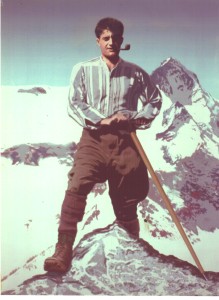
frassatiGod is training us to be sheep among wolves: to walk amongst sin and evil and yet be uncorrupted, to maintain our innocence—our steadfast faith, our enduring hope—as we journey through treacherous lands. He is preparing us for an adventure more epic than we’ve imagined.

This spirit of adventure is what motivated Blessed Pier Giorgio Frassati throughout his life. He saw his journey in the Christian life as an ascent up the mountain, and with joy he climbed ever higher—verso l’alto, to the heights. He will help us, too, to see the path before us with wonder and excitement, tackling each obstacle as we continue our ascent.

May Blessed Pier Giorgio help us to rise above our complacency, our frustrations, and every challenge before us.

Learn to be stronger in spirit than in your muscles. If you are you will be real apostles of faith in God.
—Blessed Pier Giorgio Frassati

Every day that passes, I fall more desperately in love with the mountains…I am ever more determined to climb the mountains, to scale the mighty peaks, to feel that pure joy which can only be felt in the mountains.
—Blessed Pier Giorgio Frassati

Love Is Stronger Than Rejection

Reading 1

HOS 11:1-4, 8E-9

Thus says the LORD:
When Israel was a child I loved him,
out of Egypt I called my son.
The more I called them,
the farther they went from me,
Sacrificing to the Baals
and burning incense to idols.

Yet it was I who taught Ephraim to walk,
who took them in my arms;
I drew them with human cords,
with bands of love;
I fostered them like one
who raises an infant to his cheeks;
Yet, though I stooped to feed my child,
they did not know that I was their healer.

My heart is overwhelmed,
my pity is stirred.
I will not give vent to my blazing anger,
I will not destroy Ephraim again;
For I am God and not man,
the Holy One present among you;
I will not let the flames consume you.

From today’s Gospel:

“Without cost you have received; without cost you are to give.” 

Dear fellow pilgrims,

Sometimes, Bible verses hit home. For me, today’s first reading reminded me of how I felt after a conversation (albeit mostly one-sided) I had with a close family member on a recent family vacation, a yearly family reunion on my dad’s side during the Fourth of July week. My heart was overwhelmed, I held a blazing anger in my heart… and slowly, my pity was stirred when I thought of the Cross.

I know many of you have had similar experiences with a loved one, so I share this personal anecdote especially for you, to let you know you are not alone in your suffering.

A close family member of mine has a serious mental illness and struggles with substance abuse. Other close family members have quite literally saved his life three or four times, now, and yet, he still has not made a huge effort to change his ways that continually lead him back into these grave circumstances. That is, until he decided he was going to be sober after the last close run-in with death, a decision that lasted for about six months. He started drinking again right before the family reunion, and there was hardly a time during the week where I didn’t see a drink in his hand. I tried to simply ask why he made that decision, but it turns out, it wasn’t such a simple question and he did not want to answer it. Turns out, he did not want to talk about anything with me, even just normal conversation like how he’s doing and what he’s into these days… I tried almost every angle of what I thought was non-combative conversation topics, and tried this on several different occasions, and I got nothing in return. He simply did not want to talk to me.

So, one night, I got really upset. I cried and told him that he deserved to listen to me because of how he has affected my life. I thought of the pain he caused me during the months-long stretch last summer when I didn’t know where he was or if he would even be alive at the end of the day. I thought of all the pain he has caused other close family members of mine, his parents, who have completely rearranged their lives to accommodate his illness and needs and bad decisions. But all he could think about was himself. He scoffed at me and said, “Oh, you’re upset about how my problems have affected your life?” I was filled with pain and anger and immediately fled to the nearest bathroom to cry it out. 

When I was ugly-crying and nearly getting an instant headache from the stress that tightened the muscles in my shoulders, Jesus met me. He gave me a safe space to tell Him how furious I was and frustrated that someone could be so oblivious and uncaring about my pain. The hurt I was feeling was magnified by his total ignorance and selfish response. I let it all out internally. Then, it suddenly became clear to me that this was a new part of the Cross He was allowing me brief access to in my heart. I saw people standing around the Cross, walking by, scoffing and laughing at His pain. My pain was His pain. Then, I realized, this pain I was feeling also told the story of His mission: to come and save the ones who had rejected and paid no attention to His Father. I wasn’t alone. He knew how it felt, and magnified to a greater extent than my heart could ever fathom.

And today’s first reading shows us this agony: how relationships can change as people change, and even those who were once nurtured closely in our arms can grow to forget that it was those arms who had fostered them into the life they know now. It is the tragedy of lost souls: not knowing Who they are rejecting. And, being a parent now to a growing toddler, with the efforts of caring for an infant still fresh in my mind, it is extremely difficult thinking about what it would be like if my beautiful, kind son grows up to reject and forget about me. How there would be this anger and immense sadness at the same time, and yet, a tether in my heart to always care for him no matter how much he rejects me. 

The subtitles of these sections in Hosea say it all: “The disappointment of a parent,” and “But love is stronger and restores.” Love is stronger. Love is always stronger than hate, rejection, ignorance, bitterness, betrayal. That is a truth children of good parents know in their bones, but a truth that is learned and given in a whole new way after becoming a parent. And being a parent is to know the double-edged nature of love as we grow along with our children, who’s capacity to embrace or reject you is always increasing. This giant well of love suddenly unearthed in your heart might be tested by a child who wants no part of it, the part of what makes you you, the part of you that is “mother” or “father” indefinitely. It is a harrowing possible reality for new parents to grapple with, and some parents to live through: how do you love your child who puts themselves in danger when they reject your protection?

This is why we must ask for the grace to understand our identities as “daughter” or “son.” And the best response to a deep knowledge and understanding of our identities as children of God is to give as we have been given. “Without cost you have received; without cost you are to give.” Children can never earn the exceeding amount of effort it takes to care for them, it is given out of love. So, with this in mind, we should also give this love freely and unconditionally to others, no matter how much the cost. 

Lord Jesus, I pray we all would grow to understand the deep familial bonds that draw us together on Your Cross: 

We are Your lost children, we are Your redeemed prize. 

May we grow in felt appreciation for how we are connected by Your Blood and Body. 

And I pray especially for all of the prodigal children who are still away from their Home, that they would remember the eyes of their Father, Who longs to embrace them again. 

Pax Christi,
Alyssa