Earthen Vessels

We hold this treasure in earthen vessels,
that the surpassing power may be of God and not from us.
We are afflicted in every way, but not constrained;
perplexed, but not driven to despair;
persecuted, but not abandoned;
struck down, but not destroyed;
always carrying about in the body the dying of Jesus,
so that the life of Jesus may also be manifested in our body.
For we who live are constantly being given up to death
for the sake of Jesus,
so that the life of Jesus may be manifested in our mortal flesh.

– 2 Corinthians 4:7-11

Look around you. Look at your spouse, your roommate, your good friend, your kids, your coworkers.

Do it. Right now. Look at them.

God the Father, through Jesus Christ, makes these people saints.

Tonight I attended a “Gospel Around the Grill” event put on by my local parish where we talked about the canonization process by which the Church proclaims Saints (with a capital “S”). The information was admittedly somewhat confusing and definitely fascinating, but ever since, my thought keep wandering back to the concept of humanity. Saints and their canonization are such an institution in the Church that sometimes it is easy to forget that they are not a separate category of being. They are not angels. They are not “other”. God did not hijack their humanity and release them as a holy automaton. The saints, every last one of them, were human.

Like your spouse, your roommate, your good friend, your kids, your coworkers.

Today we celebrate the feast of St. James the Apostle, and the readings selected for today certainly do not promote this narrative of saints as mythical creatures (if anything, they would almost seem a little harsh to anyone without the humility of a saint. Today’s first reading, much of which is presented above, talks about how Godly treasure resides in our “earthen vessels”. We’re dull clay pots holding golden, molten lava-fire-bright Grace, and if we play our cards right, it’s the Grace that does the walking, talking, and purifying. We can claim no accomplishment as our own: accomplishments, recognition, and glory are given by the Father alone, as today’s Gospel makes abundantly clear.

To paraphrase: “James, you will suffer with me, but it doesn’t necessarily mean you will celebrate in the eternal joy of Heaven with me. That’s for the Father to decide. He is the just Judge, He will search your soul and spirit to see if you spent your time shining up your earthen vessel to impress, or filling it with Grace to overflow.”

Today, please pray for the Grace to see the potential of God in every single person that surrounds you. Pray for the confidence that God can do that work in yourself.

And most of all: Pray and believe that the Father, through Jesus, will make you a saint.

To Be Like Little Children

Gospel: MT 11:25-27

At that time Jesus exclaimed:
“I give praise to you, Father, Lord of heaven and earth,
for although you have hidden these things
from the wise and the learned
you have revealed them to the childlike.
Yes, Father, such has been your gracious will.
All things have been handed over to me by my Father.
No one knows the Son except the Father,
and no one knows the Father except the Son
and anyone to whom the Son wishes to reveal him.”

Dear Frassati brothers and sisters,

Today’s Gospel reminds us that God wants us to be like children, that there is something about children that is an ideal in the Christian life that people lose as they age. I’ve heard this passage explained in homilies and sermons many times, but the way I always come back to interpreting it is that God wants us to remain like “little sponges,” picking up on every word He says, and staying close to Him all throughout our lives. (Even as we grow older and more and more think we know what we’re talking about…)

Children develop at a rapid pace – there is so much to learn about this life, so much joy to be had in the simplest things, so many questions to ask their caregivers, including the never-ending stream of “why? but why? why???”. But then, as childhood fades more and more into the rearview mirror, this curiosity and openness to new information and experiences slows down. We begin to feel “stuck” in our ways or even feel lethargic in life’s pursuits. We forget the amazing gift it is to just be alive. We forget how to grow, develop, because we lose track of that ideal, dependent relationship with God. We might be stuck thinking about how our life is difficult and not what we expected it to be. We grow inward, forgetting our caregivers and learning to depend on ourselves because the idea of independence and “muscling through problems” is put on a pedestal in our society. We forget we are still children of God; we forget we must constantly be developing into the image of our Father.  

And allowing God to work in us during these dark times is something that our generation especially has a hard time with because we expect things to be quickly dealt with. We live in a world where technology and industry are trying to constantly make our lives easier, smoother, less cumbersome. But … the conditions for sainthood have never changed; God has never changed.

To become a saint in these current times requires us to effortfully slow down our minds and invite God in. To become a saint requires us to courageously make space for silence, for God speaks in silence. To become a saint requires us to allow God into every space in our hearts, to actively ready this space for change, and to give God the authority and trust as our eternal Caregiver in order to create this continual shift in perspective, inner life. God wants to carve a unique piece of Heaven into each of our hearts for the world to see, but we so often choose to be formed by the things of this world.

I invite you all to take some time tomorrow night to watch this message – given by my favorite preacher, Christine Caine – and really ask God to convict you in your heart about how you have been resisting the ways He wants you to develop. Also, ask God to show you how you have been learning from Him in the way he desires. Give Him glory for the moments you have been an attentive son or daughter, and ask for direction and forgiveness for the times you have been stubborn or have turned away from His love and call to greater things. I promise that God will say something to your heart as you watch this message!

Sweet Jesus, may our hearts ever be open to your revelation. 

May our eyes be like those of little children, 

seeing the beauty of the world in awe and wonder. 

May we trust You with all of our lives, unreservedly. 

Teach us to learn as little children do, 

with an insatiable hunger for love and learning more and more. 

Amen. 

Pax Christi,
Alyssa

God Is On Our Side

“Eleven dollars and twenty-six cents!” my niece Lollipop announced after we had counted all of her savings from the shoebox under her bed.  It was nearly doubled thanks to the $5 I had used to bribe her to go on the Ragin’ Cagin’ roller coaster at Six Flags, and so I expected her to be delighted.

Instead she threw herself down on the bed and wailed.  “I will never earn enough money!” she cried.  “How will I ever get $30,000?”

She was hoping to adopt a baby sister and the cost was prohibitive, particularly given the earning power of an eight-year-old.

The adult in me wanted to smile, but I felt something (Someone) nudging my heart, and realized that our similarities were more than physical, and not just because we are both drama queens.

It’s tempting in spite of (or perhaps because of) years of Catholic formation to think we can earn God’s grace, or love or virtue.  Even knowing that this is theological nonsense, I often find myself in practice trying to do just that, only to find that in a lifetime I can never earn enough, make myself good enough or be worthy enough.

It’s not as if after a few millennia of working out, St. Peter could walk on water by himself.  Or that after a few million motivational talks he’d have the willpower to not deny Jesus three times, or to be crucified upside down, or to preach Pentecost morning while a number of listeners thought he was drunk.

It’s all grace.  I know this.  I can’t earn it.  I can’t make it happen.  I can’t even store it up for future use.  But what I sometimes forget, is that God is on my side.  He desires more good for me than I can ever think to aspire to or ask for.

In today’s Gospel, we see Jesus free a poor soul from the grip of demonic power, only for the Pharisees to spin the story and give credit to Beelzebub.  Why are the Pharisees so set against Jesus?  They have reduced religion to works, thinking that enough pious practice can earn them a place with God in heaven.  Jesus has come to show them that He is the way; there is no other.  He longs for them to come to Him, but their hearts are hardened to receiving and relationship.

Jesus then goes Himself out into all of the villages and towns.  His heart is moved by the needs of the people, and He goes to them and heals them.  There is no question of a trade-off; no payment is required for grace.  The Unmoved Mover is moved by the people themselves.

It is from this place of compassion that Jesus asks His disciples to pray for more workers to attend to the harvest.  He is not looking for more practitioners of piety, but for those who will share with Him the heart of the Father.

It is only in allowing ourselves to receive the free love of God that we can be freed to truly love and serve others, to be Christ to them.  Let us ask for the graces we need to live and love like Jesus.

P.S.  Lollipop’s baby sister was born a little over a year later.  Her money is still safely under the bed.  It seems no action on her part was required.  😊

Maria Goretti, Pier Giorgio Frassati, and Freedom

This week we celebrate the feasts of two great saints. July 4 was the feast of our patron, Blessed Pier Giorgio Frassati, and today, July 6, is the feast of St. Maria Goretti, the Little Saint of Great Mercy. During this week as we reflect upon the meaning of freedom, we can look to these saints as examples of what true freedom really looks like. It may seem counterintuitive, based on our culture’s idea of freedom, to say that these two young people who closely followed the precepts of the Church and died before they were ever able to “achieve” anything of significance were paradigms of freedom. And yet their actions in the most crucial moments of their lives demonstrate how free they truly were.

Maria Goretti shows us the freedom that comes from forgiveness. Brutally murdered at the tender age of eleven after resisting attempted rape, she would have had every reason to feel an intense, righteous anger toward her attacker, Alessandro Serenelli. However, as she lay dying from fourteen stab wounds, she expressed nothing but concern for Alessandro’s soul, uttering words of forgiveness. She refused to harbor the venom of unforgiveness, even for an instant; she would allow it to poison neither her own soul nor Alessandro’s. While she acknowledged the weight of his grave sin, she didn’t brood over the damage that had been done or seek revenge. Instead, she let go of that burden and put it all in God’s hands.

Would Maria have been “exerting her freedom” if she had given in to feelings of outrage and resentment? Or would the weight of her anger have kept her from being truly free? No one would have blamed Maria if she had been unable to forgive this man, whose evil actions led to her excruciating death and ultimately tore apart her family. But she not only forgave him; she desired his conversion, saying that she wanted him with her in Heaven. She appeared to him after her death, expressing her mercy toward him. And Alessandro, who had been utterly unrepentant and vicious even in his imprisonment, was converted overnight—a miracle whose impact would play out over the course of his lifetime. This was possible only because of Maria’s interior freedom, her ability to resist the influence of all that would lead her astray and follow the voice of God.

Maria held fast to virtue even at the cost of her life, knowing that the joys and sufferings of this world are fleeting, that what truly mattered was preparing her eternal soul for Heaven—as well as Alessandro’s soul. She desired Heaven not just for herself, but for everyone, even sinners, even the very man who brutally murdered her. Even when he was at his very worst, she still understood that he was a human being, a child of God, meant for a life much greater than the one he was living. Not only that, she still believed there was hope for him, because she trusted in the boundless mercy of God.

Like Maria Goretti, Pier Giorgio Frassati was not swayed by the voices that tried to separate him from God. Even as he was surrounded by the noise of the world, he was firmly rooted in his faith and confident in doing what was right. He was willing to go against the current, championing political views that aligned with his deeply felt understanding of human dignity—unpopular though they were. Amid pressure to achieve success, wealth, and prestige, Pier Giorgio was unfazed, keeping his focus on God alone. Free from the expectations of others and from the fear of what consequences may result from doing what was right, he followed God’s call to serve the poor and galvanize Catholic young adults.

Pier Giorgio Frassati was born about eight hours north of where Maria Goretti was living in Italy, just fifteen months before her death. They overlapped on this earth for a brief period of time. Both died young, Pier Giorgio at 24 and Maria at just 11. Both suffered painful deaths without complaint—though Maria’s was certainly more traumatic and earned her the crown of martyrdom. But most importantly, both acted with tremendous interior freedom, resisting those who would keep them from becoming who God created them to be: His instruments in this world.

There are two types of interior slavery: the chains and pains of sin or the will of God. One is a slavery in which your will is in danger of being circumscribed; the other is where your will is given the necessary grace to act in accord with what is good and believe what is true. Pier Giorgio’s witness testifies that while the world might smack you around, your soul is a living dynamism that, when infused with the freedom of the love of God in Christ, no one can hold back. I believe Pier Giorgio sums up the feeling of true freedom when he said, “Our life, in order to be Christian, has to be a continual renunciation, a continual sacrifice. But this is not difficult, if one thinks what these few years passed in suffering are, compared with eternal happiness where joy will have no measure or end, and where we shall have unimaginable peace.”
Jared Zimmerer, “Pier Giorgio Frassati as a Model of Freedom”

Solemnity of Saints Peter and Paul

Simon Peter said in reply,
“You are the Christ, the Son of the living God.”
Jesus said to him in reply, “Blessed are you, Simon son of Jonah.
For flesh and blood has not revealed this to you, but my heavenly Father.
And so I say to you, you are Peter,
and upon this rock I will build my Church,
and the gates of the netherworld shall not prevail against it.”
—Matthew 16:16–18

Considering the fact that they often disagreed in life, it’s funny that Peter and Paul now share a feast day. However, despite their differing personalities, their stories have much in common. Both Peter and Paul were beacons of the early Church, instrumental in evangelization and leadership. Both gave their lives as martyrs, sowing the seed of the Church. And both underwent radical conversions after personal encounters with Christ.

Peter’s story in the Gospels is one of constantly trying, failing, and persevering. He is somewhat of a hapless apostle, trying to please Jesus but constantly making mistakes in the process. His sincere love for Jesus is fully apparent, alongside his flawed humanity, and through this combination he models for us how to fall upon the great mercy of God. If someone like Peter can not only be forgiven for his denial and betrayal of Jesus but also be named the first pope—well, then there’s hope for all of us, isn’t there?

Roman_School,_circa_1620_Saints_Peter_and_PaulPaul has perhaps the most famous conversion story of all time, the dramatic encounter on the road to Damascus. He too is a prime example of a flawed saint; before Jesus dramatically intervened, Paul was literally murdering Christians. Not a typical path to holiness. But Jesus took even that unlikely path and redirected it toward sainthood. Paul always recognized that it was only through God’s grace that he was able to carry out his good works; he had no illusions of his own inherent goodness.

I, Paul, am already being poured out like a libation,
and the time of my departure is at hand.
I have competed well; I have finished the race;
I have kept the faith…
The Lord stood by me and gave me strength,
so that through me the proclamation might be completed
and all the Gentiles might hear it.
—2 Timothy 4:6–7, 17

St._Paul_Visiting_St._Peter_in_PrisonPaul poured himself out until he was empty, an open vessel in which Christ could dwell. It was then that God’s grace worked in him most fully, supplying him with a transcendent strength to persevere in his mission. The words Jesus once spoke to Peter apply to Paul, too: “For flesh and blood has not revealed this to you, but my heavenly Father.” Peter and Paul both found their strength in weakness, by being receptive to divine revelation, allowing God to take control. Peter was particularly changed after receiving the Holy Spirit at Pentecost—before that moment, he was cowering in the upper room, but upon receiving those graces, he immediately stepped out in courage.
There is a lesser known story in which Jesus meets Peter out on the road and redirects his path. Instead of the road to Damascus, it is the road from Rome:

A legend has Peter walking along a road outside of Rome, fleeing arrest and certain death, when he comes to a crossroads: where the Appian Way meets the Via Ardeatina.

There he meets our risen Lord.

“Quo vadis?” Peter asks, to which Jesus replies:

“Romam vado iterum crucifigi.” I am going to Rome to be crucified again….

The end of the story, of course, is the end of Peter. He turns around and heads back towards Vatican Hill. This is the last time he would need to be redirected by Jesus.

Brad Miner

1601-2

Imagine Peter at that crossroads. It would not be the first time he’d found himself in that position—his abiding love for Jesus pinned against his all-encompassing terror of suffering and death. Here was a second chance to choose faith over fear. Perhaps this time, Peter would recall the words he once spoke to Jesus: “Master, to whom shall we go? You alone have the words of everlasting life.”

Just as Peter and Paul persevered despite their flaws and sins and mistakes, may we too find the courage to get up when we fall and keep moving forward. May we recognize that it is far better to stumble along the right road than to speed down the wrong one—for even if the wrong one is smoother and easier, it won’t take us where we need to go, and there is only one Way that leads to everlasting life.


1. Anonymous (Roman school), Saints Peter and Paul / PD-US
2. Filippino Lippi, St. Paul Visits St. Peter in Prison / PD-US
3. Annibale Caracci, Domine, quo vadis? / PD-US

When giving is being filled

And your Father who sees what is hidden will repay you.
– Matthew 6:18

Today’s Gospel is likely a familiar one. It’s a strong teaching about how praying, fasting, or giving alms, while good acts, are hollow when you’re looking for attention. Pride is the root of all sin, so it’s not surprising that it can finds its way into even the most virtuous acts. Remember when Jesus said a demon was so strong that it could only come out through prayer and fasting?

To paraphrase my wife paraphrasing a recent sermon she had heard (I wish I knew which source to cite): Sometimes if the Devil can’t make you sin, he is content to make you ineffective.

I’ve recently been in a season of life that has required a lot of giving. I’m working longer hours than I have, and my duties at home grow in parallel with my toddling son. I wish I could say that my added efforts were perfectly and graciously offered to Jesus, that I was being a regular St. Joseph and that I am the image of St. Paul’s “cheerful giver” (2 Cor 9:7).

But they weren’t, I haven’t, and I’m not.

The change has been hard. And I am human (why, Lord?!). And I have gotten resentful more than I have liked.

When I go unnaturally out of my way and egg my wife on to tell me how great I am and how hard I’m working, I have received my award. When I am resentful and require a ‘reward’ (acknowledgment, affirmation, candy, etc.), that very well may be all I get for it.

God is merciful and mysterious, and he knows my heart better than I do, so I trust in him to take my small offerings and multiply them, even when my heart could further be purified. He’ll take care of His part, and today’s Gospel reminded me to take care of mine. Lord, purify my heart.

Leaves Without Fruit

Jesus entered Jerusalem and went into the temple area.
He looked around at everything and, since it was already late,
went out to Bethany with the Twelve.

The next day as they were leaving Bethany he was hungry.
Seeing from a distance a fig tree in leaf,
he went over to see if he could find anything on it.
When he reached it he found nothing but leaves;
it was not the time for figs.
And he said to it in reply, “May no one ever eat of your fruit again!”
And his disciples heard it.

They came to Jerusalem,
and on entering the temple area
he began to drive out those selling and buying there.
He overturned the tables of the money changers
and the seats of those who were selling doves.
He did not permit anyone to carry anything through the temple area.
Then he taught them saying, “Is it not written:
‘My house shall be called a house of prayer for all peoples’?
But you have made it a den of thieves.”

The chief priests and the scribes came to hear of it
and were seeking a way to put him to death,
yet they feared him
because the whole crowd was astonished at his teaching.
When evening came, they went out of the city.

Early in the morning, as they were walking along,
they saw the fig tree withered to its roots.
Peter remembered and said to him, “Rabbi, look!
The fig tree that you cursed has withered.”
Jesus said to them in reply, “Have faith in God.
Amen, I say to you, whoever says to this mountain,
‘Be lifted up and thrown into the sea,’
and does not doubt in his heart
but believes that what he says will happen,
it shall be done for him.
Therefore I tell you, all that you ask for in prayer,
believe that you will receive it and it shall be yours.
When you stand to pray,
forgive anyone against whom you have a grievance,
so that your heavenly Father may in turn
forgive you your transgressions.”

—Mark 11:11–26

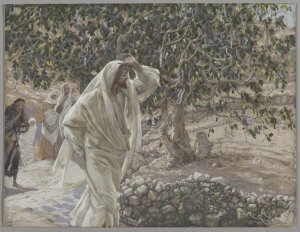
Brooklyn_Museum_-_The_Accursed_Fig_Tree_(Le_figuier_maudit)_-_James_TissotThis passage from Mark is a tricky one to understand. At first glance, it seems as though Jesus cursed the fig tree out of spite when it didn’t provide Him with food. Why not bless the tree with abundant fruit, just as He multiplied the loaves and fishes, instead of condemning it to wither and die? Mark even notes that figs were out of season at the time. Why would Jesus curse the tree, then, for not providing figs? It seems a rather extreme reaction.

But for the early Church, who were better acquainted with the fig trees of Israel, this story took on different meaning. When fig leaves would appear around the end of March, they were joined by small, edible buds, called taqsh, which fell off before the real fig was formed. Peasants would often eat the taqsh to assuage their hunger. But if no taqsh appeared, then there would be no figs on the tree that year at all.

So when Mark notes that “it was not the time for figs,” he is referring to this period when taqsh would typically grow. When Jesus looked to the fig tree to find sustenance, He saw a tree with leaves but no taqsh—meaning there would be no fruit to come, either. From a distance, it was flourishing with leaves, but up close, there was nothing of substance. Jesus recognized that, just like the fig tree, many people put on a good show of piety but had no signs or intentions of good fruits to follow. They were all outward appearance.

In the middle of this story we hear Mark’s account of Jesus rebuking the money changers in the temple. There is a parallel drawn between the fruitless fig tree and those who desecrated the house of the Lord: these men spent their days at the temple, but they had no interest in actually worshiping God. They, too, were all show with no signs of fruit.

KKSgb2948-67The fig tree is a symbol used throughout Scripture to signify peace and prosperity for Israel. It requires patience and attention in order to grow and thrive, but it delivers rich rewards, bringing both a shady resting place and delicious fruit. The money changers sought shade without fruit, capitalizing on the community surrounding the temple while paying no regard to its sacred purpose. But for Jesus, their leaves could not conceal the barrenness of their hearts.

Jesus curses the fig tree as a reminder to us all that we do not know when our time for judgment will come. We may or may not have developed fruit when that time arrives, but He expects to see in us a desire for true growth and fruitful service. We cannot assume that we can wait until next year to pay attention to what God is asking of us. He doesn’t expect perfection but presence. Jesus does not judge us based on our achievements or accomplishments but on our openness to channel His life-giving grace in all its fullness, however He wishes to manifest His fruit in us.


1. James Tissot, The Accursed Fig Tree / PD-US
2. Hans Simon Holtzbecker, Ficus carica / PD-US

Choosing Our Fire

Dear fellow pilgrims,

We had quite the…uh…blunt readings for today, huh? God was not mincing words for these readings. The first reading paints a brutal picture of how the rich people of the world will be “devoured” by their corroding gold and silver pieces, how they have “fattened their hearts for the day of the slaughter,” feeding on the luxuries of the world instead of service and living a life of humility. The second reading, straight from Jesus’ mouth, reminds us of the primacy of living for the promise of eternal life, even if it means sacrificing things that seem so crucial to our lives if they lead us to sin (e.g. “cutting off” hands and feet, which I am guessing our Lord is using as figurative examples).

What struck me from these readings is that both the righteous and the unrighteousness go through the flames, but this process means two completely different things for each of them: there is the purifying fire of the Holy Spirit, being “salted with fire,” but there is also the punishing fire of Gehenna in eternity. We pick our own fire, is the prevailing—and soul-searching, eye-opening—theme of these verses.

Part of this purifying fire of sanctification on earth that we must go through is explained by the gruesome example of cutting off limbs, sacrificing them, if they “cause you to sin.” I think once we get past the gruesomeness of the example, we can see that this is alluding to how we sometimes have to make extreme decisions about our habits or aspects of daily life that seem so given and owed and normal to us, like the use of a hand (or a smartphone or tablet…), if they are clearly causing us to turn away from God over and over again. Because it is better for us to be without these things during the life in which we think we need them than be without eternal life because of the sins we harbored due to our own preference for convenience or pleasure or pick your poison reason.

I think the fire we all need to experience on earth is the fire that burns away all that is of this world, the way in which we evaluate ourselves and others, and begins to see an eternal perspective from God’s point of view. Because while we are here, our default setting is of the world, we need to let God purify us with the fire of His Love, we need to let us “salt us with fire” if we want to remain in Him when we pass away from this life. The short-sightedness of the rich man in the first reading is on full display when we think about the tombs of Egyptian kings and queens…who literally thought they were taking it all with them after they died! I think it’s a helpful exercise to think about our lives in this way…what are we accumulating in our tombs to truly bring with us on our way back home to the Father’s embrace? What does He want us to bring to Him?

When I ask God this question, I hear “bring me the parts you can’t fix.” Well…yeah, God, that’s pretty much all of them…but I do hold so much of what I need to change about myself in my own tight clutches that it never truly gets healed. What do you hear from God when you ask Him about what He wants us to give Him on our journey back home? What is the hand or foot you might need to sever to avoid future sin? What is the loss you are trying to avoid by not giving that over to God, what experience of “being maimed,” or without, in this life are you afraid of and valuing over eternal life? Go into the silent room in your heart and have a conversation with your Father about these things.

Pax Christi,
Alyssa

Finding the Way

“Where I am going you know the way.”
Thomas said to him,
“Master, we do not know where you are going;
how can we know the way?”
Jesus said to him, “I am the way and the truth and the life.
No one comes to the Father except through me.”
—John 14:4–6

If we follow Jesus wholeheartedly, seeking first and foremost to know Him and grow ever closer to Him, then we will be on the right path. We might be led in very different directions than we imagined, we might be confused about the details as we go, but if we stay close to Him, we can trust that we’re on our way to the Father.

Like Thomas, we ask: How do we know the way?

Open your eyes, Jesus says. I am the way.

You are beholding God before you at this very moment. The Father’s house still awaits, but the Kingdom of God is already at hand.

How will you get there? Be with me. Focus on nothing else; do not worry yourself about directions. Stay with me, keep me company, let me delight in you. Relish this time we share together, even when you are disoriented, even when the path is steep. The journey itself is sacred.

The way to Heaven is not by intently navigating our path with maps and compasses and plans of our own making. The only way we’ll make it is with a guide—Jesus Himself. We cannot reach Heaven without embracing the way of Jesus: the way of the Cross, the way of mercy, the way of humility and love and truth.

Wherever God leads you today, seek the company of Jesus right where you are. Please pray for those of us who will be attending the Frassati retreat this weekend, to make the most of this opportunity to grow closer to God. And pray, too, for all those who are unable to attend—that they also will embrace the gift of this weekend and find the company of Jesus right where they are.

Nothing Will Be Wasted

When I saw today’s Gospel reading, I thought, I’m pretty sure I’ve already written a reflection about this story before. Turns out—yepTwice. So I tried to think about what new aspect I could bring to light from this story of the multiplication of the loaves and fishes. What stood out most to me from John’s version are these words from Jesus:

When they had had their fill, he said to his disciples,
“Gather the fragments left over,
so that nothing will be wasted.”
—John 6:12

Giovanni_Lanfranco_-_Miracle_of_the_Bread_and_Fish_-_WGA12454Jesus has just taken five loaves and two fishes and managed to feed five thousand people. Not only that, but there are leftovers—twelve baskets full of scraps! There is more food left over than there ever was at the beginning. Which leads me to the question: If Jesus can multiply the loaves with such abundance, why does He ask His disciples to go to all the trouble of picking up the crumbs? Why would He need to be economical about saving all the scraps when everyone in the crowd can be satiated by His grace?

This initiative to harvest every single gift that is given us—even the crumbs—is an expression of gratitude, of not taking anything for granted. At the outset, when the disciples were desperate for food, twelve baskets of bread would have seemed a gift. Why wouldn’t it be now? This too is God’s providence, and it should be gratefully received rather than overlooked.

Мадонна с младенцем под яблоней  Холст (перев с дерева), масло 87х59 см  Между 1520-1526Let us not forget that Jesus started with a few loaves in order to feed the five thousand—He began with a meager offering. He saw, then, in those leftover scraps afterward, the precious raw material for a miracle. We need Jesus to multiply our gifts, but we must begin by doing our own part, offering all that we can, however small it may seem. He will handle the rest.

Only five loaves for five thousand people? A worthy offering. Bread crumbs, broken and scattered around a field? Not to be wasted. Jesus doesn’t overlook the crumbs we give Him; He sees the potential in our offerings. Neither should we overlook the crumbs we receive: the little joys amid a mundane day, the incomplete responses to our prayers, the half-successes as we continue to learn and grow and make mistakes. Our sufferings, too, have value; not one moment of our experience will be wasted. All of it is a gift, to be gathered and given to God.


1. Giovanni Lanfranco, Miracle of the Bread and Fish / PD-US
2. Lucas Cranach the Elder, Virgin and Child under an Apple Tree (detail) / PD-US