Divine Friendship

Jesus said to his disciples:
“This is my commandment: love one another as I love you.
No one has greater love than this,
to lay down one’s life for one’s friends.
You are my friends if you do what I command you.
I no longer call you slaves,
because a slave does not know what his master is doing.
I have called you friends,
because I have told you everything I have heard from my Father.
It was not you who chose me, but I who chose you
and appointed you to go and bear fruit that will remain,
so that whatever you ask the Father in my name he may give you.
This I command you: love one another.”
—John 15:12–17

Two lines from today’s Gospel passage may seem contradictory at first glance:

You are my friends if you do what I command you.
I no longer call you slaves,
because a slave does not know what his master is doing.

Andrea_del_Sarto_-_The_Last_Supper_(detail)_-_WGA00391First of all, Jesus tells us we are friends, not slaves—if we do what He commands us. Wait. Do friends normally take orders from one another? Then He says we are not slaves because we know what our Master is doing. But…do we really? At the time He spoke these words, his apostles had no idea that He was about to suffer and die (though, to be fair, it’s not like He didn’t warn them). The disciples seemed pretty clueless most of the time about what Jesus was really up to. Can we truly say that we know what our Master is doing? I think more often we feel we are flying blind, having to trust Him without really understanding what His plan is. After all, so much of our Catholic worldview is grounded in the concepts of mystery and faith.

What do we mean when we speak of the mysteries of God? Encountering mystery does not mean that we’ll never know the answers and should simply give up trying to understand. Rather, it means that no matter how deeply we study this complex truth, there will always be more layers of understanding to peel back, always something new to learn. Our human understanding is limited, but with God we can go deeper and deeper, until we are united fully with God in Heaven and can participate in His perfect understanding.
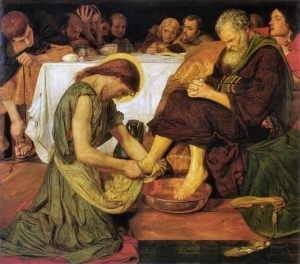
Jesus_washing_Peter's_feet

The more we plumb the depths of these mysteries, the more we grow in both understanding and wonder. But in order to get anywhere we must first have faith. We cannot grasp at this understanding for ourselves; we must draw closer to God so that He can help us see. We must trust Him. Our hearts must be open to soak in His wisdom, rather than trying to sharpen our own, which is a losing battle. Understanding the mysteries of God requires more than just intelligence; it requires divine relationship. It requires friendship with Jesus.

And Jesus offers us that friendship as a great, unmerited gift. We can begin to understand what He is doing—though it be far beyond our depth—through our love for Him. He says, “You are my friends if you trust me. And if you trust me, you will follow my commandments.” Our obedience springs from love and gratitude rather than fear and servitude. We can rest in the knowledge that we are loved and chosen, and we can return that love by recognizing Jesus in others and loving one another.

We are not mere servants; we are friends. And we are made to delight in a Love that is greater than we can comprehend. When we remain in Him, we can begin to bear the fruits of understanding, cultivated through love alone.


1. Andrea del Sarto, The Last Supper / PD-US
2. Ford Madox Brown, Jesus Washing Peter’s Feet / PD-US

The Faith to Be Healed

Paul…looked intently at him, saw that he had the faith to be healed, and called out in a loud voice, “Stand up straight on your feet.” He jumped up and began to walk about.

– Acts 14

Whoever loves me will keep my word,
and my Father will love him, 
and we will come to him and make our dwelling with him.

– John 14

The power of Jesus, working through His disciples (Paul, Barnabas – and us!) can heal others in a profound way – if they have the faith to be healed. The Evangelists tell us several times in the Gospels that Jesus either was – or was not – able to heal people based on their faith.

Do we have faith that Jesus, working through His Bride, the Church, can heal us? Do we have the faith that Jesus actually wants to heal us? That whatever current pain or suffering we experience, from without or within, is not meant to last? And faith that the time of pain can actually bring us closer to Jesus, even when the path is steep and you feel disoriented?

On the flip side, do we have faith that the Lord can make us instruments of His healing in the lives of others, knowing full well our poverty and weakness? Paul was Saul at one point – still somewhat of a piece of work even after his conversion – and yet the Lord used him in ways he could not have foreseen as he was led by the hand to Damascus. When your heart feels crushed or broken, it’s hard to see beyond the pain. But, it is precisely in our crushed and broken hearts that the Father, Son, and Holy Spirit want to dwell, revealing their love for us.

Let us pray that the Holy Spirit will remind us of all Jesus has told us in the Scriptures and through His Church, that He wants to reveal His Father’s love through us and within us. May we keep His word and know His love for us this day!

Pax et bonum,
Andy

Finding the Way

“Where I am going you know the way.”
Thomas said to him,
“Master, we do not know where you are going;
how can we know the way?”
Jesus said to him, “I am the way and the truth and the life.
No one comes to the Father except through me.”
—John 14:4–6

If we follow Jesus wholeheartedly, seeking first and foremost to know Him and grow ever closer to Him, then we will be on the right path. We might be led in very different directions than we imagined, we might be confused about the details as we go, but if we stay close to Him, we can trust that we’re on our way to the Father.

Like Thomas, we ask: How do we know the way?

Open your eyes, Jesus says. I am the way.

You are beholding God before you at this very moment. The Father’s house still awaits, but the Kingdom of God is already at hand.

How will you get there? Be with me. Focus on nothing else; do not worry yourself about directions. Stay with me, keep me company, let me delight in you. Relish this time we share together, even when you are disoriented, even when the path is steep. The journey itself is sacred.

The way to Heaven is not by intently navigating our path with maps and compasses and plans of our own making. The only way we’ll make it is with a guide—Jesus Himself. We cannot reach Heaven without embracing the way of Jesus: the way of the Cross, the way of mercy, the way of humility and love and truth.

Wherever God leads you today, seek the company of Jesus right where you are. Please pray for those of us who will be attending the Frassati retreat this weekend, to make the most of this opportunity to grow closer to God. And pray, too, for all those who are unable to attend—that they also will embrace the gift of this weekend and find the company of Jesus right where they are.

Nicodemus

Have you ever noticed that there are not many Christians named Nicodemus?  While names like “Peter” and “Mary” and “John” have remained popular through the centuries, I have yet to meet a single Nicodemus.

I wonder if it is because Nicodemus at first glance does not present as a particularly likable Gospel figure.  First, he is a Pharisee—clearly designated as one in the “bad guy” camp of those who are constantly criticizing, and being criticized by, Jesus.  Second, he comes “at night” indicating a lack of courage to follow Jesus openly.  Third, while he begins by praising Jesus, he quickly moves into an argument:

Nicodemus:  We know that you are a teacher come from God; for no one can do these signs that you do, unless God is with Him.

Jesus: Truly, truly I say to you, unless one is born a new, he cannot see the kingdom of God.

Nicodemus: How can a man be born when he is old?  Can he enter a second time into his mother’s womb and be born?

Jesus: Truly, truly I say to you, unless one is born of water and the Spirit, he cannot enter the kingdom of God.  That which is born of flesh is flesh, and that which is born of the Spirit is spirit.  Do not marvel that I say to you, ‘You must be born anew.’ The wind blows where it wills, and you hear the sound of it, but you do not know whence it comes or whither it goes; so it is with every one who is born of the Spirit.

Nicodemus: How can this be?

Jesus: Are you a teacher of Israel, and yet you do not understand this?  Truly, truly I say to you, we speak of what we know, and bear witness to what we have seen; but you do you not receive our testimony.  If I have told you earthly things and you do not believe, how can you believe if I tell you heavenly things?  No one has ascended into heaven but he who descended from heaven, the Son of Man.  And as Moses lifted up the serpent in the wilderness, so must the Son of man be lifted up, that whoever believes in him might have eternal life.

John does not tell of Nicodemus’ reaction, but instead moves onto the most quoted line of all of Scripture, “For God so loved the world that He gave His only begotten Son…”  John 3:16

It is clear that the darkness of night refers not just to the time of day, but the inability of Nicodemus to see and to understand Jesus at this time.

Indeed, much of what Christ says is mysterious or puzzling—not only to those living at the time but to us today.  Can I really fault Nicodemus for arguing with God, when I so often do the same? When there is so much I do not understand, even for years? The truth is that the Christian life is not something we receive or accomplish on a one-time basis, but it is something organic, a relationship in which we grown in knowledge and understanding as well as in love.

When we are born “naturally” we receive the gift of life, but that life will change and mature as we continue through it.  So too when we are born of “water and Spirit” in baptism.  The gifts of baptism mature in us as we cooperate with the Holy Spirit, growing in knowledge and wisdom and love.

Nicodemus does not see or understand everything at that time.  But the Unseen Spirit must have been working in Him, for when the time came for Jesus to be “lifted up” Nicodemus was there.  It was he who, along with Joseph of Arimathea, helped in the burial of Jesus.

John reports:

“Nicodemus also, who had first come to him by night, came bringing a mixture of myrrh and aloes, about a hundred pounds weight.  They took the body of Jesus and bound it in linen cloths with the spices as is the burial custom of the Jews.”  John 19:39-40

Lest we merely come around to thinking of Nicodemus as a nice guy, we must realize the significance of the amount of spice he brings—“about a hundred pounds weight.”  Pope Benedict XVI noted that this was not a small amount, but one befitting “a royal burial.”

Let us ask Nicodemus to intercede for us, that we might receive the grace to continue to dialog with Jesus, to follow even when we don’t understand, and to recognize Him as our King.

Empty Nets

So they went out and got into the boat,
but that night they caught nothing.
When it was already dawn, Jesus was standing on the shore;
but the disciples did not realize that it was Jesus.
Jesus said to them, “Children, have you caught anything to eat?”
They answered him, “No.”
So he said to them, “Cast the net over the right side of the boat
and you will find something.”
So they cast it, and were not able to pull it in
because of the number of fish.
So the disciple whom Jesus loved said to Peter, “It is the Lord.”
When Simon Peter heard that it was the Lord,
he tucked in his garment, for he was lightly clad,
and jumped into the sea.
—John 21:3–7

Duccio_di_Buoninsegna_-_Appearance_on_Lake_Tiberias_-_adjustedThe disciples do not recognize Jesus until after they bring in a full net of fish and they realize He has performed a miracle before their eyes. Often we do not recognize Jesus working in our own lives until we see the fruits of His presence. When we accomplish things we know we could never have done on our own, when we grow through a difficult experience and become stronger because of it, when we become aware of our own unique gifts, we sense Jesus’s presence more clearly.

Without Jesus, we will just keep on pulling up empty nets. Only through Him can we find nourishment—no matter how hard we labor to find fulfillment, our efforts will be fruitless. And just because we don’t see Jesus in our lives doesn’t mean He isn’t there—sometimes we just don’t notice Him until we feel the weight of a heavy net and realize Who is behind it. While we wait in hunger for that moment, we can call out for help and keep on trying until He steps in. When He does, how will we respond? When we can pinpoint where Jesus is on the shore, watching and providing for us, will we follow Peter’s example? Will we immediately jump into the sea? Will we trust Him to lead us through the unknown? Will we seek closeness with Him above all else, taking the leap instead of staying warm and dry in the boat?

The Easter season is a time to experience the abundance that the Lord wants to provide for us, to accept His gifts with open hands and to step out and follow Him—beyond our comfort zones, beyond our own limited imaginations, beyond the material attachments that hold us back. He’s asking us to take the leap and let Him take control.

The Lord asks us to set out for him. He asks us to become fishers for him. He asks us to trust him and act according to the guidance of his Word….But then something remarkable happens. When the disciples return Jesus does not need their fish. He has already prepared breakfast, and now invites the disciples to eat it; he is the host who provides them with food. The gift is mysterious but nevertheless not hard to decipher. The bread is he himself: I am the bread of life. He is the grain of wheat that dies and now bears fruit a hundredfold and is abundant for everyone until the end of time….Only love can bring about the true multiplication of bread. Material gifts, what is quantitative, always diminish through being divided. Love however increases the more it gives itself. Jesus is the bread, and he is also the fish that for our sake has gone down into the water of death to look for us there and to find us. This is the lesson on the breakfast to which Jesus invites his own on the borderline of time and eternity, the Eucharist. Come and eat, he says to us and thus enables us already to cross the boundary of time and death.
—Cardinal Joseph Ratzinger (Pope Benedict XVI)


Image: Duccio di Buoninsegna, Appearance on Lake Tiberius / PD-US

P.S. Unrelated side note: It’s been a good week for full nets at two of my favorite Catholic universities 😏

GeneralWideHagfish-size_restricted.gif

arike.jpeg

smaller_dunk.gif

ee59e4ed41893a55ed7983b25f3e1e2c324ff082c4db7da74f14ecf5961d7e9f.gif

goal.jpg

notre-dame-michigan-frozen-four-832x447.png

😎

By the Hand

I, the LORD, have called you for the victory of justice,
I have grasped you by the hand;
I formed you, and set you
as a covenant of the people,
a light for the nations,
To open the eyes of the blind,
to bring out prisoners from confinement,
and from the dungeon, those who live in darkness.

– The Servant Songs of Isaiah

Praying with today’s readings, the comforting words I have grasped you by the hand reminded me of my favorite scene from The Fellowship of the Ring. Frodo has decided to journey to Mordor alone, paddling his boat across a broad river. Faithful Samwise realizes what Frodo is up to, and plunges in after the boat. But Sam cannot swim and soon begins to sink, hand stretched towards the surface. Right as Sam’s hand becomes still, Frodo’s hand plunges down into the water. He grasps Sam’s hand and hauls the waterlogged hobbit up into the boat.

This Lent, perhaps more than any before, I have experienced the Lord grasping me by the hand and leading me into a deeper life in Him. It is not that He’s provided consolations, or that I have been particularly good at adhering to disciplines of prayer, fasting, or almsgiving. Perhaps it has something to do with receiving kindness, joy, and forgiveness from my wife and daughters in response to my weaknesses and poverty. Maybe it is the daily opportunities to serve all these ladies in my life, reminding me time and again that my life is not my own and I am called to empty myself. Or it could be finding community and brotherhood in an unfamiliar place, taking hesitant steps with hesitant trust only to be reminded again that God is faithful, He had always been faithful.

Frodo saves Sam from drowning – he saves Sam’s life. And yet because Frodo grasped his hand, Sam will go on to experience terrible suffering (no more spoilers here – read the books!). Sometimes when I feel the Lord reaching out His hand I would rather not take it – His hands bear nail marks, and I know what that means. This week more than any other reminds us of the cost of accompanying Jesus and entering into His life. And yet the wounds that signify the Cross are the same wounds that reveal the Resurrection, that are signs and witnesses to the power of God.

His hands, those wounds, this week…He’s calling us – the blind, the imprisoned – to know His Light and Freedom, and to bring His Light and Freedom to others who are blind and imprisoned. This Holy Week, grab hold of His hand that you may encounter Him in the suffering and and encounter Him in the joy.

Pax et bonum,
Andy

History Lesson

Gospel: JN 8:31-42

Jesus said to those Jews who believed in him,
“If you remain in my word, you will truly be my disciples,
and you will know the truth, and the truth will set you free.”
They answered him, “We are descendants of Abraham
and have never been enslaved to anyone.
How can you say, ‘You will become free’?”
Jesus answered them, “Amen, amen, I say to you,
everyone who commits sin is a slave of sin.
A slave does not remain in a household forever,
but a son always remains.
So if the Son frees you, then you will truly be free.
I know that you are descendants of Abraham.
But you are trying to kill me,
because my word has no room among you.
I tell you what I have seen in the Father’s presence;
then do what you have heard from the Father.”

They answered and said to him, “Our father is Abraham.”
Jesus said to them, “If you were Abraham’s children,
you would be doing the works of Abraham.
But now you are trying to kill me,
a man who has told you the truth that I heard from God;
Abraham did not do this.
You are doing the works of your father!”
So they said to him, “We were not born of fornication.
We have one Father, God.”
Jesus said to them, “If God were your Father, you would love me,
for I came from God and am here;
I did not come on my own, but he sent me.”

In today’s Gospel, Jesus’ audience is a bit… confused. We have one of the most quotable teachings in all of the Gospels (paraphrased by yours truly; I’m sure Jesus would have been more loving…):

Jesus:                “You will know the Truth, and the Truth with set you free.”

The crowd:         “Uh…we’ve never been slaves…” (Psst… Pharaoh? Egypt? Ring any bells?)

Jesus, giving them the benefit of the doubt:

                           “You are slaves to sin. You are trying to kill me. Abraham would not have done that.”

The crowd:          “Our father is Abraham.”

Jesus:                  “Yes, I heard you the first time. Abraham would not be trying to kill me. We serve the same God.”

The crowd:           “We have one Father, God.”

Jesus:                  “Do you even hear yourself?! If you were truly from God you were love me, because I AM TOO!”

Today’s Gospel, in a surprisingly humorous and sometimes sarcastic way (See footnotes HERE), illustrates the need for formation and openness to messengers from God. Last week, I wrote about how our perspective and disposition toward Jesus can dramatically impact how we receive His message, and today is no different.

In this example, I can imagine the Jews thinking that they’ve got this whole “faith in God” thing figured out, only to have Jesus throw them a curveball by saying that he came from God. No, no, God is far away, the Holy of Holies, untouchable in their minds. Jesus’ message is scandalous, but they can’t really refute it. So… they parrot some teachings that they think are good things to say and probably have been praised for asserting at the temple, but clearly don’t know what exactly they mean.

“Our father is Abraham.” Great sentiment and it’s true to a point, but when Jesus challenges their message, they haven’t truly understood what it means to be a son or daughter of Abraham. In God’s upside-down hierarchy, servants and lovers are first, and I’d like to think that claimers of a righteous lineage who do not “walk the walk”, like the Jews in today’s Gospel, are somewhere near the bottom.

But re-read that first sentence in the Gospel. These are the Jews that believed in Jesus. He is not simply putting them in their place, he is also instructing them. It’s some tough-love teaching, but it’s still love and it’s still teaching.

Formation can be hard. Formation, whether through Scripture, prayer, insight, mentorship, community, spiritual direction, etc., can and should challenge our assumptions about God, especially if a complacent faith has led toward exclusion or violence (literal or figurative) toward others as we see from the crowd in today’s Gospel. Our disposition toward the Lord needs to be open to hearing His Word from nearly any medium, not just from those people or sources that we expect.

Jesus was so far outside of the realm of the expectations of his contemporary Israelites that he showed their true colors: the proud lashed out and denounced him as a blasphemer, while the meek and humble hopefully and ecstatically proclaimed Christ’s love and healing message. Our faith in God must have a similar flexibility. We must be willing to examine and even relinquish our expectations of how God will work in our lives.

God always has something better than we could imagine. Do we really have the faith to believe that?

Mid-Lenten Lethargy

Brooklyn_Museum_-_Prayer_for_Death_in_the_Desert_-_Elihu_Vedder_-_overall

We are now over halfway through Lent, right in the midseason slump—past the novelty of our Lenten resolutions but still a ways away from Easter. It feels sometimes like we have to push ourselves to get through these last few weeks. But in reality, we are called not to simply “muscle through” our discomfort in this moment; rather, we are called to use this as an opportunity for a deeper relationship with God. We are asked to dwell in our discomfort, to allow ourselves to actually feel it, and to be attentive to what it shows us about God and about ourselves.

The purpose of fasting is not to prove our endurance; it is to awaken our desire for God, to develop an awareness of our hunger for Him. The disciples did not fast when Jesus was with them because they were already in the presence of the One who fulfilled the deepest longings in their hearts.

We are feeling the strain, now, of going without our chosen distractions. The things we normally use to numb ourselves from pain are no longer there, and so we are forced to entrust ourselves entirely to God’s care. We take a leap of faith that He will show up to fill the void, and in doing so we open our senses to perceive Him.

If you feel like you’re failing at Lent, maybe that’s the point. In recognizing our weakness, we learn how to depend on God. In these last few weeks of Lent, He wants to meet us in the desert. Rather than trying to push ourselves through the rest of the journey, let us call out for God and ask Him to carry us the rest of the way.

The LORD is close to the brokenhearted;
and those who are crushed in spirit he saves.
Many are the troubles of the just man,
but out of them all the LORD delivers him.

He watches over all his bones;
not one of them shall be broken.
The LORD redeems the lives of his servants;
no one incurs guilt who takes refuge in him.

—Psalm 34:19–21, 23


Image: Elihu Vedder, Prayer for Death in the Desert / PD-US

Faith

From Today’s Gospel (John 4):

Now there was a royal official whose son was ill in Capernaum. When he heard that Jesus had arrived in Galilee from Judea, he went to him and asked him to come down and heal his son, who was near death.
Jesus said to him, “Unless you people see signs and wonders, you will not believe.”
The royal official said to him, “Sir, come down before my child dies.”
Jesus said to him, “You may go; your son will live.”
The man believed what Jesus said to him and left. While the man was on his way back, his slaves met him and told him that his boy would live. He asked them when he began to recover.
They told him, “The fever left him yesterday, about one in the afternoon.”
The father realized that just at that time Jesus had said to him, “Your son will live,” and he and his whole household came to believe.

Three thoughts on today’s Gospel:

1) Jesus’ response can sound like an admonition (Unless you people…), a scolding for the people’s lack of faith. But what if it’s not? What if Jesus is rather acknowledging the reality that the people’s faith is based on an encounter with Him that reveals Him as Healer, Prophet, Savior? In other words, “You people will begin to believe in me, once I reveal myself to you.” He knows us, and continually acts to reveal Himself to us in a manner that will draw us to Him.

2) God often intervenes in our lives in ways we would not expect. The official first wants Jesus to come to his son and heal him there in close physical proximity – perhaps thinking of the recent sign that Jesus performed at the wedding feast in Cana. And yet Jesus chooses to act in a different way, sending the man on a 1-2 day journey home, with “only” a promise of healing. Jesus shows the official, the town, his disciples – and us – that even His words have power, even His voice can heal and bring life.

3) Our faith is progressive – that is, we should progress in faith through every encounter with our Lord. St. John notes that the official first believes in Jesus’ word “Your son will live,” and then again after he receives confirmation that his son was healed at the time when Jesus spoke the promise. Every day, God reveals Himself to us in love as Father, Son, and Holy, Spirit. Every day, He invites to believe in Him again, to draw close Him, to be transformed.

Blessed Pier Giorgio, pray for us today – that like you, we may receive God’s actions and words in our lives, and respond in such a way to increase our faith and lay down our lives for others.

Pax et bonum,
Andy