To Be Like Little Children

Gospel: MT 11:25-27

At that time Jesus exclaimed:
“I give praise to you, Father, Lord of heaven and earth,
for although you have hidden these things
from the wise and the learned
you have revealed them to the childlike.
Yes, Father, such has been your gracious will.
All things have been handed over to me by my Father.
No one knows the Son except the Father,
and no one knows the Father except the Son
and anyone to whom the Son wishes to reveal him.”

Dear Frassati brothers and sisters,

Today’s Gospel reminds us that God wants us to be like children, that there is something about children that is an ideal in the Christian life that people lose as they age. I’ve heard this passage explained in homilies and sermons many times, but the way I always come back to interpreting it is that God wants us to remain like “little sponges,” picking up on every word He says, and staying close to Him all throughout our lives. (Even as we grow older and more and more think we know what we’re talking about…)

Children develop at a rapid pace – there is so much to learn about this life, so much joy to be had in the simplest things, so many questions to ask their caregivers, including the never-ending stream of “why? but why? why???”. But then, as childhood fades more and more into the rearview mirror, this curiosity and openness to new information and experiences slows down. We begin to feel “stuck” in our ways or even feel lethargic in life’s pursuits. We forget the amazing gift it is to just be alive. We forget how to grow, develop, because we lose track of that ideal, dependent relationship with God. We might be stuck thinking about how our life is difficult and not what we expected it to be. We grow inward, forgetting our caregivers and learning to depend on ourselves because the idea of independence and “muscling through problems” is put on a pedestal in our society. We forget we are still children of God; we forget we must constantly be developing into the image of our Father.  

And allowing God to work in us during these dark times is something that our generation especially has a hard time with because we expect things to be quickly dealt with. We live in a world where technology and industry are trying to constantly make our lives easier, smoother, less cumbersome. But … the conditions for sainthood have never changed; God has never changed.

To become a saint in these current times requires us to effortfully slow down our minds and invite God in. To become a saint requires us to courageously make space for silence, for God speaks in silence. To become a saint requires us to allow God into every space in our hearts, to actively ready this space for change, and to give God the authority and trust as our eternal Caregiver in order to create this continual shift in perspective, inner life. God wants to carve a unique piece of Heaven into each of our hearts for the world to see, but we so often choose to be formed by the things of this world.

I invite you all to take some time tomorrow night to watch this message – given by my favorite preacher, Christine Caine – and really ask God to convict you in your heart about how you have been resisting the ways He wants you to develop. Also, ask God to show you how you have been learning from Him in the way he desires. Give Him glory for the moments you have been an attentive son or daughter, and ask for direction and forgiveness for the times you have been stubborn or have turned away from His love and call to greater things. I promise that God will say something to your heart as you watch this message!

Sweet Jesus, may our hearts ever be open to your revelation. 

May our eyes be like those of little children, 

seeing the beauty of the world in awe and wonder. 

May we trust You with all of our lives, unreservedly. 

Teach us to learn as little children do, 

with an insatiable hunger for love and learning more and more. 

Amen. 

Pax Christi,
Alyssa
To the Heights

You will be hated by all because of my name,
but whoever endures to the end will be saved.
—Matthew 10:22

I have humbled him, but I will prosper him.
—Hosea 14:9

As we grow into a deeper relationship with God, we may reach a point where it feels as though He has started ignoring us. Whereas we were at first captivated by the words of Scripture or felt a great peace in prayer, we now feel dryness and discontent. We aren’t “getting anything” out of prayer anymore, and we feel disconnected.

God uses these periods of discontent to push us toward a deeper, more lasting faith. He allows us to experience moments of frustration, helplessness, and humility so that we can learn to depend on Him more fully. While we might be content to float happily through life with a surface-level faith, God wants more for us. He wants us to be strong, walk boldly, perform great deeds, and endure persecutions. As Grace told us during retreat: God loves us right where we are, and He loves us too much to let us stay there.

frassatiGod is training us to be sheep among wolves: to walk amongst sin and evil and yet be uncorrupted, to maintain our innocence—our steadfast faith, our enduring hope—as we journey through treacherous lands. He is preparing us for an adventure more epic than we’ve imagined.

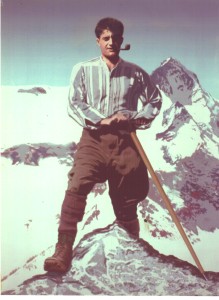
This spirit of adventure is what motivated Blessed Pier Giorgio Frassati throughout his life. He saw his journey in the Christian life as an ascent up the mountain, and with joy he climbed ever higher—verso l’alto, to the heights. He will help us, too, to see the path before us with wonder and excitement, tackling each obstacle as we continue our ascent.

May Blessed Pier Giorgio help us to rise above our complacency, our frustrations, and every challenge before us.

Learn to be stronger in spirit than in your muscles. If you are you will be real apostles of faith in God.
—Blessed Pier Giorgio Frassati

Every day that passes, I fall more desperately in love with the mountains…I am ever more determined to climb the mountains, to scale the mighty peaks, to feel that pure joy which can only be felt in the mountains.
—Blessed Pier Giorgio Frassati

God Is On Our Side

“Eleven dollars and twenty-six cents!” my niece Lollipop announced after we had counted all of her savings from the shoebox under her bed.  It was nearly doubled thanks to the $5 I had used to bribe her to go on the Ragin’ Cagin’ roller coaster at Six Flags, and so I expected her to be delighted.

Instead she threw herself down on the bed and wailed.  “I will never earn enough money!” she cried.  “How will I ever get $30,000?”

She was hoping to adopt a baby sister and the cost was prohibitive, particularly given the earning power of an eight-year-old.

The adult in me wanted to smile, but I felt something (Someone) nudging my heart, and realized that our similarities were more than physical, and not just because we are both drama queens.

It’s tempting in spite of (or perhaps because of) years of Catholic formation to think we can earn God’s grace, or love or virtue.  Even knowing that this is theological nonsense, I often find myself in practice trying to do just that, only to find that in a lifetime I can never earn enough, make myself good enough or be worthy enough.

It’s not as if after a few millennia of working out, St. Peter could walk on water by himself.  Or that after a few million motivational talks he’d have the willpower to not deny Jesus three times, or to be crucified upside down, or to preach Pentecost morning while a number of listeners thought he was drunk.

It’s all grace.  I know this.  I can’t earn it.  I can’t make it happen.  I can’t even store it up for future use.  But what I sometimes forget, is that God is on my side.  He desires more good for me than I can ever think to aspire to or ask for.

In today’s Gospel, we see Jesus free a poor soul from the grip of demonic power, only for the Pharisees to spin the story and give credit to Beelzebub.  Why are the Pharisees so set against Jesus?  They have reduced religion to works, thinking that enough pious practice can earn them a place with God in heaven.  Jesus has come to show them that He is the way; there is no other.  He longs for them to come to Him, but their hearts are hardened to receiving and relationship.

Jesus then goes Himself out into all of the villages and towns.  His heart is moved by the needs of the people, and He goes to them and heals them.  There is no question of a trade-off; no payment is required for grace.  The Unmoved Mover is moved by the people themselves.

It is from this place of compassion that Jesus asks His disciples to pray for more workers to attend to the harvest.  He is not looking for more practitioners of piety, but for those who will share with Him the heart of the Father.

It is only in allowing ourselves to receive the free love of God that we can be freed to truly love and serve others, to be Christ to them.  Let us ask for the graces we need to live and love like Jesus.

P.S.  Lollipop’s baby sister was born a little over a year later.  Her money is still safely under the bed.  It seems no action on her part was required.  😊

Do Not Be Unbelieving

“Do not be unbelieving but believe”—John 20:27

I remember standing on the deck, enraptured by beauty, as we sailed through the sparkling blue of the Mediterranean to the Amalfi coast.  The temperature was perfect, the views spectacular, and my heart soared with delight.  I don’t know what the mystical experience of ecstasy is like, but this was as close I had ever come on a merely human level, and it may be that that moment was also infused with something of the divine.  “I don’t know how anyone could ever doubt the existence of God!” I remember whispering in awe.

This memory burned within me, when, months later, I was plunged into a terrifying spiritual darkness.  I had always paid lip service to the idea that faith is a gift, but I had not really known what that meant until it disappeared.

I had always believed in God, even when other parts of my spiritual life were in disarray.  Faith itself had always come easily to me, and while studying had bolstered my faith, it was not the foundation for it.  Now, suddenly, the entirety of the faith presented itself as an epic joke.  I was tempted to doubt not merely an individual doctrine or practice, but even the idea that there could be a God, the idea that there could be meaning behind all that I saw.  All of the cruelty of the universe—in human experience, in the violence of nature, and in particular in the weaknesses and scandals among Christians—screamed in mockery at me as I tried to hold on.  The more I tried to reason my way back to belief, back to peace, the more preposterous it all seemed.  My will was the only very fragile thread that kept me believing anything at all.

The darkness was terrifying and profoundly lonely.  More than once I cried in Confession—an act as mortifying to the poor priest as it was to me.  He tried to assure me that God still loved me, while I tried to explain that if there was no God, not only was I unloved but my whole life had been built on an illusion.

The memory of this is still so awful that I mentioned recently to my spiritual director how afraid I am that I could go back there. “Yeah, good thing you got yourself out of that!”  he replied, with no little sarcasm.

Because of course I did not, could not, get myself out of that.

I tried, in particular reaching out for answers to the questions that I could not answer—reading, researching and attending Bible Study with the ever-patient Brother John Mary.  There was one class in particular that I hoped would put an end to a particularly challenging question, and I looked forward to it with all the hope I could muster.  But instead an unavoidable calendar conflict caused me to miss it and so I never got my answers.

Then one day I went to Confession at Catholic Underground.  I had zero expectations but confessed my doubts with an almost hopeless resignation.  “What do you want from me?” the priest asked.  “Just absolution?  Or something else?”  I was surprised by the question, and said simply, “I don’t know.  Yes, absolution.  And if you have anything to say from God, I’d love that of course, but I am not expecting anything.”

He then told me then a story about St. Angela Foligno, a mystic whose periodic experiences of “abandonment” by God would leave her screaming like a crazy person, to the great embarrassment of her brother who was a priest.  Then she would regain her faith, and conclude that while God’s love was faithful, her own was “nothing but games.”  I don’t remember all of the details of the story—it doesn’t actually matter, because it wasn’t the story that was convincing.  Somehow, during the telling, it was as though a match was struck, and I was aware once again of the Light.  I could not see anything new—my faith would return more completely over time, but I was assured only of the reality of this Light.  I was not alone in the dark after all.

I don’t know all of the reasons God allowed this particular season in my life, although I can see some fruits.  Certainly I have more compassion for those who struggle with doubt.  I understand better now that faith is a gift I did not, cannot, earn, and that I should never take for granted.

But I also learned that faith is about more than answers.  It is about the One Who Answers.  In a mysterious way, I am in the hands of God, who is infinitely beyond understanding.

This is the One who appeared to Thomas, aware of his doubts and of the obstacles in him to belief.  He invited Thomas not only to touch the wounds in His hands, but to put himself into them.  “Do not be unbelieving, but believe.”  Saint Thomas, pray for us that we might receive ever more the gift of faith.

*            *            *

“It is not the task of Christianity to provide easy answers to every question, but to make us progressively aware of a mystery.  God is not so much the object of our knowledge as the cause of our wonder.” —Kallistos Ware (Orthodox church author)

A Tiny Whispering Sound

Abraham_Bloemaert_-_Landscape_with_the_Prophet_Elijah_in_the_Desert_-_WGA2277

At the mountain of God, Horeb,
Elijah came to a cave, where he took shelter.
But the word of the LORD came to him,
“Go outside and stand on the mountain before the LORD;
the LORD will be passing by.”
A strong and heavy wind was rending the mountains
and crushing rocks before the LORD—
but the LORD was not in the wind.
After the wind there was an earthquake—
but the LORD was not in the earthquake.
After the earthquake there was fire—
but the LORD was not in the fire.
After the fire there was a tiny whispering sound.
When he heard this,
Elijah hid his face in his cloak
and went and stood at the entrance of the cave.
—1 Kings 19:9–13

A tiny whispering sound. How gentle God is toward us. He is all-powerful; He created mountains and earthquakes and fire and wind. He could drop anvils and send down lightning to try and get our attention. And yet He speaks to us softly and tenderly.

He is the still, small voice within our hearts. He does not seek to control us; instead, He delights in watching us find our own way. He is always whispering words of guidance and love—and if we aren’t distracted by our own noise, we will hear His voice. But He does not force Himself upon us; rather, He pursues us with gentleness and care.

We are called to imitate this example of gentleness: to be both strong and kind, brave and humble, confident and caring. To be sensitive toward our neighbors without compromising our own strength. To respond to others without feeling as though we have to intimidate them or prove what we’re capable of. To be secure in the knowledge that withholding force is not a sign of weakness in us, but of composure and mercy.

Pier-Giorgio-PortraitLook to Blessed Pier Giorgio Frassati as an example: a strong, active young man who approached the poor and downtrodden with the utmost care. This was a guy who was popular and athletic, who regularly climbed mountains for fun. And yet he didn’t go around flexing his muscles to try and impress people; rather, his true strength showed through in his tenderness toward those who were weak.
When we feel frustrated and wish God would send us a big, loud, obvious sign from above, let us remember that maybe we wouldn’t actually be able to handle such a bold response. God speaks to us softly so as not to intimidate us, but also to draw us closer to Him. In order to hear His gentle whisper, we must draw ever nearer.


1. Abraham Bloemaert, Landscape with the Prophet Elijah in the Desert / PD-US
2. Portrait of Blessed Pier Giorgio Frassati / Brandon Vogt

The Hammer of the Heretics

Elijah appealed to all the people and said,
“How long will you straddle the issue?
If the LORD is God, follow him; if Baal, follow him.”
– 1 Kings 18:21

Therefore, whoever breaks one of the least of these commandments
and teaches others to do so
will be called least in the Kingdom of heaven.
But whoever obeys and teaches these commandments
will be called greatest in the Kingdom of heaven.
– Matthew 5:19

How long will I straddle the issue?

I love it when Scripture speaks so plainly. Reading this, the second verse from today’s readings, stopped me in my tracks. How long have I straddled issues in my life? What doubts, chronic sins, or bad habits have I allowed to take root in me?

So many times I get caught up in the lie of trying to get the best of both worlds (or more accurately in this case, ‘the best of both Heaven and Earth”). I want to be holy, but I want to be admired. I want to be deep, contemplative, and thoughtful, but I want to be recognized for it. I want to preach the Gospel, but I don’t want to come off as “preachy”.

How long will I straddle the issue?

Fitting, then, that today’s strong verbiage is accompanied by a strong saint’s feast day: St. Anthony of Padua, who is apparently also known as the “Hammer of the Heretics” (though the citations for this are dubious… but it’s a great name so let’s stick with it). St. Anthony’s witness was his life of prayer and preaching; he was (quite literally) tossed and turn on the waves of life and ended up following a much different path than expected: instead of risking martyrdom to preach to the Moors in Morocco, Anthony found himself in decidedly Catholic Italy. What could easily have felt like defeat, or at the very least a blow to his ability to live for God’s glory, instead led to the exact path he needed for sainthood.

St. Anthony shares much in common with our patron Pier Giorgio, chiefly a zeal for service and the Gospel of Jesus Christ. Wealth, glory, and fame were certainly within both of their respective reaches in life, and yet illnesses sidetracked their earthly plans to bring about even greater glory for God.

These men are an inspiration to me, giving me courage and faith that I could be a champion for God’s kingdom, even here and now in my current, humble state in life. What is needed is zeal and decisive faith. Elijah is calling to me: “If the LORD is God, follow him.”

Leaves Without Fruit

Jesus entered Jerusalem and went into the temple area.
He looked around at everything and, since it was already late,
went out to Bethany with the Twelve.

The next day as they were leaving Bethany he was hungry.
Seeing from a distance a fig tree in leaf,
he went over to see if he could find anything on it.
When he reached it he found nothing but leaves;
it was not the time for figs.
And he said to it in reply, “May no one ever eat of your fruit again!”
And his disciples heard it.

They came to Jerusalem,
and on entering the temple area
he began to drive out those selling and buying there.
He overturned the tables of the money changers
and the seats of those who were selling doves.
He did not permit anyone to carry anything through the temple area.
Then he taught them saying, “Is it not written:
‘My house shall be called a house of prayer for all peoples’?
But you have made it a den of thieves.”

The chief priests and the scribes came to hear of it
and were seeking a way to put him to death,
yet they feared him
because the whole crowd was astonished at his teaching.
When evening came, they went out of the city.

Early in the morning, as they were walking along,
they saw the fig tree withered to its roots.
Peter remembered and said to him, “Rabbi, look!
The fig tree that you cursed has withered.”
Jesus said to them in reply, “Have faith in God.
Amen, I say to you, whoever says to this mountain,
‘Be lifted up and thrown into the sea,’
and does not doubt in his heart
but believes that what he says will happen,
it shall be done for him.
Therefore I tell you, all that you ask for in prayer,
believe that you will receive it and it shall be yours.
When you stand to pray,
forgive anyone against whom you have a grievance,
so that your heavenly Father may in turn
forgive you your transgressions.”

—Mark 11:11–26

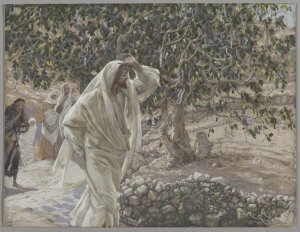
Brooklyn_Museum_-_The_Accursed_Fig_Tree_(Le_figuier_maudit)_-_James_TissotThis passage from Mark is a tricky one to understand. At first glance, it seems as though Jesus cursed the fig tree out of spite when it didn’t provide Him with food. Why not bless the tree with abundant fruit, just as He multiplied the loaves and fishes, instead of condemning it to wither and die? Mark even notes that figs were out of season at the time. Why would Jesus curse the tree, then, for not providing figs? It seems a rather extreme reaction.

But for the early Church, who were better acquainted with the fig trees of Israel, this story took on different meaning. When fig leaves would appear around the end of March, they were joined by small, edible buds, called taqsh, which fell off before the real fig was formed. Peasants would often eat the taqsh to assuage their hunger. But if no taqsh appeared, then there would be no figs on the tree that year at all.

So when Mark notes that “it was not the time for figs,” he is referring to this period when taqsh would typically grow. When Jesus looked to the fig tree to find sustenance, He saw a tree with leaves but no taqsh—meaning there would be no fruit to come, either. From a distance, it was flourishing with leaves, but up close, there was nothing of substance. Jesus recognized that, just like the fig tree, many people put on a good show of piety but had no signs or intentions of good fruits to follow. They were all outward appearance.

In the middle of this story we hear Mark’s account of Jesus rebuking the money changers in the temple. There is a parallel drawn between the fruitless fig tree and those who desecrated the house of the Lord: these men spent their days at the temple, but they had no interest in actually worshiping God. They, too, were all show with no signs of fruit.

KKSgb2948-67The fig tree is a symbol used throughout Scripture to signify peace and prosperity for Israel. It requires patience and attention in order to grow and thrive, but it delivers rich rewards, bringing both a shady resting place and delicious fruit. The money changers sought shade without fruit, capitalizing on the community surrounding the temple while paying no regard to its sacred purpose. But for Jesus, their leaves could not conceal the barrenness of their hearts.

Jesus curses the fig tree as a reminder to us all that we do not know when our time for judgment will come. We may or may not have developed fruit when that time arrives, but He expects to see in us a desire for true growth and fruitful service. We cannot assume that we can wait until next year to pay attention to what God is asking of us. He doesn’t expect perfection but presence. Jesus does not judge us based on our achievements or accomplishments but on our openness to channel His life-giving grace in all its fullness, however He wishes to manifest His fruit in us.


1. James Tissot, The Accursed Fig Tree / PD-US
2. Hans Simon Holtzbecker, Ficus carica / PD-US

The Precious Blood of Christ, the Price for Which We Were Bought

Beloved:
Realize that you were ransomed from your futile conduct,
handed on by your ancestors,
not with perishable things like silver or gold
but with the precious Blood of Christ
as of a spotless unblemished Lamb.
He was known before the foundation of the world
but revealed in the final time for you,
who through him believe in God
who raised him from the dead and gave him glory,
so that your faith and hope are in God.
– 1 Peter 1:18-21

We’ve heard the message before: “You were bought at a price!”

But what does this mean to us? How does this affect our lives? It is an incredible faith exercise to reflect upon what exactly that price was. One of the main reasons gold and silver have been valued through the ages is their constancy/durability. How many things in life change our perspective so deeply that we would see them as perishable? Bananas are perishable, not gold or silver.

Such is the Blood of Christ.

In Chesterton’s Orthodoxy (happy birthday yesterday, GK!), he touches on this theme in a way that has stuck with me for years: we ought to reflect on the constant things in life, because they speak to God’s imperishable love. Atheists, he notes, take the rigid laws of nature, the rising and setting of the sun, as proof that these realities are, in fact, dull and unquestionable. The universe does not behave any other way because it could not behave in any other way, so the laws of thermodynamics and gravity, for example, are not proof of some greater design, but simply normal.

However, I would bet that even among non-believers, most people would be more likely to acknowledge the staggering improbability of it all. Life, the universe, all of it. Instead of a fatalist boredom, to these the vastness of creation inspires an admittedly uninspiring thought: we were just really, really lucky. With trillions of stars, planets, and combinations of the periodic table throughout all existence, there was bound to be a fortunate set of conditions such as ours. We were the 00 on the enormous roulette wheel of the universe, so we might as well cash in.

As believers, our job is to actively believe otherwise. We all have our experiences of the living God in our lives that refute any kind of inevitability or impersonal cosmic fluke of creation as the source of Goodness. Haven’t you? Where does the goodness in your life come from? Do you attribute it to the Living Water? We must protect and proclaim these experiences of Christ’s Blood covering us, keeping them lit as we do the candle above the tabernacle.

There is something more inside.

Take time contemplate the vastness of the universe in the upcoming weeks. Read The Divine Comedy or The Tempest. Listen to Beethoven’s 9th symphony. Watch Planet Earth or Cosmos (and pray for Neil Degrasse Tyson’s ultimate conversion, I know it’s gonna happen!). Go for a walk and the count the homes you pass. God knows them all inside and out. He knows every soul fully. In a city of 8.5 million, that ought to have an effect on you. Bask in the hugeness of creation, and know that Christ was known before any of it was known. He was “known before the foundation” and revealed to us. The Creator burst into our reality, took on our form for Love’s sake, and imprinted Himself on every one of our hearts.

Such is the Blood of Christ.

“O, wonder!

How many goodly creatures are there here!

How beauteous mankind is! O brave new world,

That has such people in’t!” 

― William Shakespeare, The Tempest

Not From Me But For Me

Peter began to say to Jesus,
“We have given up everything and followed you.”
Jesus said, “Amen, I say to you,
there is no one who has given up house or brothers or sisters
or mother or father or children or lands
for my sake and for the sake of the Gospel
who will not receive a hundred times more now in this present age:
houses and brothers and sisters
and mothers and children and lands,
with persecutions, and eternal life in the age to come.
But many that are first will be last, and the last will be first.”—Mark 10:28-31

*            *            *

It is the sound that every mother of a toddler learns to fear: an eerie silence, followed by piercing squeals of unfettered delight.

My friend Heidi and I ran down the stairs from where we had been packing for a day at the pool, to find her not-quite-two-year-old Nicholas splashing about with great enthusiasm in the toilet.

Even the future Saint Grace was quite appalled, and we immediately moved to extract him. He quickly became as stiff as a board and twice his usual weight as he began to wail piteously and thrash about.  He remained inconsolable, as we cruelly re-dressed him, buckled him in his car seat and drove him further away from his sole source of joy.  That we were driving to a pool, a much bigger and more glorious version of his tiny heart’s desire, was an irony not lost on me.

This fear of trusting, this doubt that good things can follow a No to what we think we want or are currently enjoying, is not only a quality of toddlers.

A friend of mine who was preparing to enter the seminary tried to explain the vows of poverty, chastity and obedience to his secular friends.  “Dude, you’ve got to be kidding me!  Those are the three things I am most trying to avoid!”  one responded in shock.

It’s easy for me to laugh at that guy, but my own conversion was significantly delayed because I feared that if I took my faith seriously God would “make me a nun.”  (That this was for me the worst possible fate is itself quite telling).

In today’s Gospel, Jesus promises that those who give up “house or brothers or sisters or mother or father or children or lands” for His sake will receive “a hundred times morein this present age”—as well as persecution, and eternal life.  We get the persecution and the eternal life part; but do we believe the hundredfold in this life?

This renunciation, this death to self, this emptiness, is a characteristic of all Christian life, not just those with what we call a “religious vocation.”   And all, whether lay or ordained, married, single or professed, are called to live not as corpses but as “witnesses to the resurrection.”

In my first ever attempt at Lectio Divina, we were invited to imagine ourselves as a person or object in the story of the Wedding in Cana.  I found myself imagining myself as one of the six stone jars in the story, and imagined myself being emptied and filled, day after day after day (before of course the Big Day in the story).  As I felt the weariness of being emptied yet again, I felt a question rise to the surface of my mind, “Grace, why are you focusing on being emptied rather than being filled?”

Later, when my life unraveled and I felt as though everything was being taken away from me yet again, I was on my knees asking God, “What is it that you want from me?”  And unmistakably the voice came back, “It is not what I want from you, it is what I want for you.”

One of the marks required for considering sainthood is a life characterized by joy.  Although the saints invariably lived lives of renunciation and at times profound suffering, they were filled with something, and this emanated in a life of joy.

God is never outdone in generosity, and indeed I have experienced on many occasions this “hundredfold” and gifts of joy I never imagined possible.  Whenever I have surrendered something to Him, He has replaced it with something better.

Yet, this is an ongoing story—I can look back on this as a promise fulfilled, but I must also look to it with the eyes of faith as a promise still to come.  Some days I am gloriously happy in my current life even without a lot of things I thought I wanted/needed.   But some days “dying to self” is like blowing out trick candles on a birthday cake, and Christianity can feel like a cruel joke.

Anyone who has attempted the Christian life for any significant stretch of time is familiar with these ups and downs, these seasons of plenty and famine.  St. Ignatius called these spiritual seasons “consolation” for the good, and “desolation” for the down times.  It is helpful to remember that just like the seasons of earth, they will come and go.  In times of good, it is helpful to build memories and gratitude to recall and strengthen us for the times that are harder.  And in the tough times, we can hold on to our memories of good and the promises of Christ.

Let us pray today for the grace to trust in the goodness and generosity of God at all times.

Because We Need Faith

Dear fellow pilgrims,

Today in Mass, I continued to ponder the answer to the Lord’s assertion that “it is better for you that I go” amidst a day of celebrating my completed PhD at NYU in Developmental Psychology (AMDG—all glory to God, y’all). I had never thought of the answer within a view of my own discipline…thinking about us as children, and having the disciples, the Church, needing to learn what it’s like to not always have Jesus, their ultimate caregiver, around. After all, in the development of a child’s life, they eventually have to be able to function without the constant help of a caregiver as they get older and more responsibilities are given to them.

In other words, it’s easier to have faith in Jesus when He is in front of you doing miracles and you are physically encountering Him than it is when you are believing without seeing. (But, just for the record, even believing when He was on earth was still a challenge!) And what is Jesus constantly about in our lives? Seeing that we grow further and further into deeper trust and faith in Him. While Jesus was on earth, He subjected himself to being in one place at one time, and in a way, gave up the ability to be present to everyone everywhere in the same way that He can be now, post-Ascension and post-Pentecost.

He left us because you can’t have a deep faith without embracing a space of unknowing. Thomas rejected that space, demanded concrete evidence, and even though our Lord was gracious to meet him where he was, He also acknowledged the superiority of “believing without seeing” over believing because you saw.

Thinking about this dynamic more, I realized that the way I typically have thought of the Ascension (i.e. Jesus itching to ascend and FINALLY get back home, just waving bye-bye to the disciples as they all stare as He ascends slooooowly up towards the clouds) might not have been so one-sided on the angst part. Being a parent and learning to let go is HARD (and my kid is only 15 months old!), so it occurred to me today that Jesus was probably not so unaffected by the disciples pleading. The tone of “it is better for you that I go,” is one straight from a loving Father’s mouth, trying to show that He is doing something that upsets his children only because it is ultimately for their good they could not find from following another way. Saying goodbye to His disciples was probably very challenging, even though He was also intensely joyful to return to Heaven!

The priest today at Mass recalled the words of some saints who have mentioned similar pleas to their loved ones on their deathbeds: It is better for me to intercede for you in Heaven than it is for me to be with you here. Getting to Heaven means joining with the Source of all life and love and holiness, and the Holy Spirit is like the electrical current that flows from that source (going with Grace’s power analogy from Tuesday). It’s like Jesus had to draw the circuit board of salvation history in order to reconnect humans to God, only He could pave the way or connections between Heaven and earth, and He could only truly connect Heaven to earth in the way originally intended in His mission if He returned to Heaven.

But…there is still the waiting after the Ascension. There is still this gap, an empty channel soon to be filled, but the disciples did not know exactly when the Holy Spirit would come! It has never occurred to me that the days after the Ascension were probably filled with similar angst among the disciples as were the days post-crucifixion. “Ok…so He told us to wait in Jerusalem…but not for how long…and what exactly did He say would come to us, again?”. The Lord has left them “for good,” or so it seems like, and they have directions to follow but are uncertain as to the specifics of expectations.

I invite us all to put ourselves in the disciples’ shoes after the Ascension—what would you do if you were in their place? How would you feel after you lost sight of Jesus arising farther and farther into the sky…when He turned from a speck in the air to unable to be seen…maybe it was a foggy day and they lost sight quickly…insert yourself into the scene, and reread passages from different Gospels, praying through instincts that arise when you dig deep into what it would be like to be there. Take note of your responses and what it says about how you could pray for deepening your faith.

Pax Christi,
Alyssa