When giving is being filled

And your Father who sees what is hidden will repay you.
– Matthew 6:18

Today’s Gospel is likely a familiar one. It’s a strong teaching about how praying, fasting, or giving alms, while good acts, are hollow when you’re looking for attention. Pride is the root of all sin, so it’s not surprising that it can finds its way into even the most virtuous acts. Remember when Jesus said a demon was so strong that it could only come out through prayer and fasting?

To paraphrase my wife paraphrasing a recent sermon she had heard (I wish I knew which source to cite): Sometimes if the Devil can’t make you sin, he is content to make you ineffective.

I’ve recently been in a season of life that has required a lot of giving. I’m working longer hours than I have, and my duties at home grow in parallel with my toddling son. I wish I could say that my added efforts were perfectly and graciously offered to Jesus, that I was being a regular St. Joseph and that I am the image of St. Paul’s “cheerful giver” (2 Cor 9:7).

But they weren’t, I haven’t, and I’m not.

The change has been hard. And I am human (why, Lord?!). And I have gotten resentful more than I have liked.

When I go unnaturally out of my way and egg my wife on to tell me how great I am and how hard I’m working, I have received my award. When I am resentful and require a ‘reward’ (acknowledgment, affirmation, candy, etc.), that very well may be all I get for it.

God is merciful and mysterious, and he knows my heart better than I do, so I trust in him to take my small offerings and multiply them, even when my heart could further be purified. He’ll take care of His part, and today’s Gospel reminded me to take care of mine. Lord, purify my heart.

A Tiny Whispering Sound

Abraham_Bloemaert_-_Landscape_with_the_Prophet_Elijah_in_the_Desert_-_WGA2277

At the mountain of God, Horeb,
Elijah came to a cave, where he took shelter.
But the word of the LORD came to him,
“Go outside and stand on the mountain before the LORD;
the LORD will be passing by.”
A strong and heavy wind was rending the mountains
and crushing rocks before the LORD—
but the LORD was not in the wind.
After the wind there was an earthquake—
but the LORD was not in the earthquake.
After the earthquake there was fire—
but the LORD was not in the fire.
After the fire there was a tiny whispering sound.
When he heard this,
Elijah hid his face in his cloak
and went and stood at the entrance of the cave.
—1 Kings 19:9–13

A tiny whispering sound. How gentle God is toward us. He is all-powerful; He created mountains and earthquakes and fire and wind. He could drop anvils and send down lightning to try and get our attention. And yet He speaks to us softly and tenderly.

He is the still, small voice within our hearts. He does not seek to control us; instead, He delights in watching us find our own way. He is always whispering words of guidance and love—and if we aren’t distracted by our own noise, we will hear His voice. But He does not force Himself upon us; rather, He pursues us with gentleness and care.

We are called to imitate this example of gentleness: to be both strong and kind, brave and humble, confident and caring. To be sensitive toward our neighbors without compromising our own strength. To respond to others without feeling as though we have to intimidate them or prove what we’re capable of. To be secure in the knowledge that withholding force is not a sign of weakness in us, but of composure and mercy.

Pier-Giorgio-PortraitLook to Blessed Pier Giorgio Frassati as an example: a strong, active young man who approached the poor and downtrodden with the utmost care. This was a guy who was popular and athletic, who regularly climbed mountains for fun. And yet he didn’t go around flexing his muscles to try and impress people; rather, his true strength showed through in his tenderness toward those who were weak.

When we feel frustrated and wish God would send us a big, loud, obvious sign from above, let us remember that maybe we wouldn’t actually be able to handle such a bold response. God speaks to us softly so as not to intimidate us, but also to draw us closer to Him. In order to hear His gentle whisper, we must draw ever nearer.


1. Abraham Bloemaert, Landscape with the Prophet Elijah in the Desert / PD-US
2. Portrait of Blessed Pier Giorgio Frassati / Brandon Vogt

Who Is My Brother?

“You have heard that it was said to your ancestors, ‘You shall not kill; and whoever kills will be liable to judgment.’ But I say to you, whoever is angry with his brother will be liable to judgment, and whoever says to his brother, ‘Raqa,’ will be answerable to the Sanhedrin, and whoever says, ‘You fool,’ will be liable to fiery Gehenna. Therefore, if you bring your gift to the altar, and there recall that your brother has anything against you, leave your gift there at the altar, go first and be reconciled with your brother, and then come and offer your gift.”

Dear fellow pilgrims,

The Gospel passage for today reminds me of the sign of peace during Mass, and especially certain Masses where sharing that peace was really difficult with specific people around me at the time, but healing and (what is emphasized in this passage) necessary for approaching the Lord’s table. This passage is especially vivid in application for a Catholic because of the prayers of Mass, bringing our life offerings to His table as a community is important, but being united in doing so is even more important and takes precedence over giving the actual gifts.

And our Catholic Church is strikingly divided on many issues that have caused anger between people who hold opposing views on important issues. Here are just a couple: There are some who believe Pope Francis is the fantastic, merciful pope of the people, but there are others who believe he should retake his theology classes and clarify some issues where he muddied the waters (e.g. suggesting there may be a way for divorced Catholics to receive communion). Fr. James Martin is heralded by some as building the necessary bridge between the LGBTQ community and the Church, while others view some of his statements as dangerous and vague in their theological implications. Heck, after writing all those sides out, they don’t seem entirely mutually exclusive, but it wouldn’t make headlines if we Catholics had reasonable and balanced discussions about important topics. Our world draws out polarized views because we love drama, clickbait, and the warm fuzzy feeling of having a “tribe” that can complain about other tribes. Oh, and the evil one is the Divider, and he knows how to distract us from living in harmony and peace with each other (which he does not want! Bad for business).

Unfortunately, the Church has not avoided the political tensions that are engulfing this nation. And I’m no better! My heart has succumbed to anger against others. I need to learn to pray for our president not by obligation and muttering discontents under my breath, but out of Christian love and trust the God is truly greater than any form of government and can work to change hearts and minds.

But please, do not read this as a political statement. I bring this up because, in searching my own heart for objects of anger, that’s where I landed. I bring this up because even when we are on good terms with people we know and converse with, we may be harboring a reservoir of anger towards certain groups or individuals who we have never met, but are angry at them because of the views that divide “them” from “us.” We might not be able to reconcile with them personally, but it is necessary to reconcile our individual anger with the Lord if we are to truly give our gifts to Him and receive His gifts fully within us. We must not fall into a habit of feeling like we are owed the sacraments, or that they are given without any conditions…we must pave the way in our hearts actively to receive Him.

Of course, there is righteous anger. But we must remind ourselves that because Jesus’ sacrifice covers every person’s sins, people are not our enemies, the evil one is. Still, I would argue, that all too often it is easiest to believe that we are in the moral high ground and give ourselves permission to harbor anger towards others on the basis of believing we are simply expressing a “righteous anger” when we are really expressing a lack of compassion and empathy, and sometimes, an abundance of immaturity in just dealing with other people who are different from you. This is a complex topic that merits further discussion elsewhere, but I want to leave you with the simple and yet painfully difficult charge our Lord gives us to “love our neighbor.” Because truly, when we love our neighbor as they should be loved, we love Jesus as He should be.

Pax Christi,
Alyssa

The Hammer of the Heretics

Elijah appealed to all the people and said,
“How long will you straddle the issue?
If the LORD is God, follow him; if Baal, follow him.”
– 1 Kings 18:21

Therefore, whoever breaks one of the least of these commandments
and teaches others to do so
will be called least in the Kingdom of heaven.
But whoever obeys and teaches these commandments
will be called greatest in the Kingdom of heaven.
– Matthew 5:19

How long will I straddle the issue?

I love it when Scripture speaks so plainly. Reading this, the second verse from today’s readings, stopped me in my tracks. How long have I straddled issues in my life? What doubts, chronic sins, or bad habits have I allowed to take root in me?

So many times I get caught up in the lie of trying to get the best of both worlds (or more accurately in this case, ‘the best of both Heaven and Earth”). I want to be holy, but I want to be admired. I want to be deep, contemplative, and thoughtful, but I want to be recognized for it. I want to preach the Gospel, but I don’t want to come off as “preachy”.

How long will I straddle the issue?

Fitting, then, that today’s strong verbiage is accompanied by a strong saint’s feast day: St. Anthony of Padua, who is apparently also known as the “Hammer of the Heretics” (though the citations for this are dubious… but it’s a great name so let’s stick with it). St. Anthony’s witness was his life of prayer and preaching; he was (quite literally) tossed and turn on the waves of life and ended up following a much different path than expected: instead of risking martyrdom to preach to the Moors in Morocco, Anthony found himself in decidedly Catholic Italy. What could easily have felt like defeat, or at the very least a blow to his ability to live for God’s glory, instead led to the exact path he needed for sainthood.

St. Anthony shares much in common with our patron Pier Giorgio, chiefly a zeal for service and the Gospel of Jesus Christ. Wealth, glory, and fame were certainly within both of their respective reaches in life, and yet illnesses sidetracked their earthly plans to bring about even greater glory for God.

These men are an inspiration to me, giving me courage and faith that I could be a champion for God’s kingdom, even here and now in my current, humble state in life. What is needed is zeal and decisive faith. Elijah is calling to me: “If the LORD is God, follow him.”

Salt and Light

Jesus said to his disciples:

“You are the salt of the earth.
But if salt loses its taste, with what can it be seasoned?
It is no longer good for anything
but to be thrown out and trampled underfoot. –Matt 5:1

*     *     *

My late father was an introvert.  At his funeral the joke was that he would have preferred a smaller event, so that he wouldn’t have to talk to so many people.  He was intelligent and well-educated, having studied eight languages while working on a PhD in English—but he chose all dead ones, thus avoiding the risk of having to converse in them.  These ranged from familiar ones like Latin and Hebrew and Ancient Greek, to Hittite and Sanskrit and Tocharian (which in my uneducated mind was spelled Tolkarian, and which I assumed was something that hobbits spoke—until I had to google it).  He tended to stay on the periphery of conversations, only occasionally injecting bits of wisdom, humor or an odd pun.

So it was something of a shock when the phone rang, one day years ago, and it was for him.  It was a collect call from a Massachusetts prison, from a young man named Scott, looking for my father.  Even more of a shock was that my father stayed on the phone with him for close to an hour, using more than a few month’s quota of words on someone we didn’t even know he knew.  This was repeated many times, as Scott had found in my quiet father something of a mentor.

Indeed, my father attracted quite a fan club among surprising populations.  This is probably not the best place to mention “Boomer”, another prison inmate, who saw in my father’s Sicilian features an underlying presence, and took him for a Godfather figure.  He refused to believe that my father was who claimed to be (ironically at the time, a sales rep for a large stuffed animal company) and thought he must in fact be a Boss.  “Let me work for you!” Boomer insisted.  “I could be your hit man!” (true story)

At his funeral many commented how my father spoke rarely, but when he did, people listened.  I know in my own life, I have held on to these bits of wisdom, which while infrequent had more impact than many longer conversations or even entire courses in theology.  And I have come to recognize that this unassuming wisdom was the fruit of a life of prayer.

“One of the greatest evils in the Church today,” my father told me when I was seventeen and on the way to college in Steubenville, “is the number of people in positions of authority who have long since ceased to be holy themselves.”  I heard these words long before the Church was rocked by public scandal and had the veneer of public piety removed from some of the most horrifying of private sins.  But my father’s warning was not directed at others, but as a caution to me.  “It is very easy when you are learning about God, doing things for God, talking about God, to forget to talk to God.”  For my father this was the worst possible fate.

“You cannot give what you don’t have.”  I don’t think that expression was original to Dad, but it points to the necessity of prayer, and is the heart of today’s Gospel.  “If salt loses its flavor, what good is it?” Jesus asks, after telling his disciples to be salt and light for the world.   Similarly, one cannot give light by studying it, talking about it—only by being filled with it.  And the place we are filled is prayer.

There was one cause which propelled my Dad from the comfort and confines of a hidden life, and that was the prolife movement.  In his retirement he went weekly to an abortion clinic, more than sixty miles from our home, to stand alone peacefully offering literature about the help and alternatives available to women as they entered the clinic.  But then later in the morning he would stand across the street with a sign, across from the parking lot where they would see him as they left, with a sign that said: “Jesus forgives and heals.”

Many people thought it was “too soon.”  That the women were not ready for repentance and thus not ready for Christ’s mercy.  But my father believed that being prolife was more than just saving babies, that it was about saving souls.  And he knew from the experience of many who shared their personal stories of abortion with him, that memories of the day would come back years later.  He hoped that with them would come the memory of that message of mercy.*

I think of this too when I think of salt and light, and how the one thing that they cannot be is hidden. Like my Dad, I prefer quiet and solitude, and more than he, invisibility when it comes to controversy.  I don’t like to be the one to speak out, to stand out.  I prefer to be one of the crowd.  But we all know what the “crowd” does to Jesus.

It is in prayer that I draw both the strength and motivation to step out of myself. Just as improbable as my father’s prison ministry is my own public speaking.  I have learned how true it is that “the one who does not speak to God has nothing to say to the world.”  That it is only by practicing faithfulness to daily prayer that I have anything at all to say, and more importantly, the courage to step out of myself and my fears to say it.

Let us ask God today that we may be truly salt and light for the world, witnessing by what we are and have received.

Like my father I have only love for those who have had abortions.  I know the sometimes unbearable pressures of circumstances, boyfriends, family and friends that weigh into such decisions.  I also know that for many, often years later, there is great anguish and pain following that decision.  If you know of someone who is seeking healing from an abortion, there are many organizations who can help including the Sisters of Life linked here.

Solemnity of the Most Sacred Heart of Jesus

My heart is overwhelmed,
my pity is stirred.
I will not give vent to my blazing anger,
I will not destroy Ephraim again;
For I am God and not a man,
the Holy One present among you;
I will not let the flames consume you.
—Hosea 11:8–9

Jungholz_-_panoramio_(5)The Heart of Jesus, pure and tender, feels all human emotions more intensely and yet is not ruled by them. His Sacred Heart is not hardened or cold like our own, and so the feelings He experiences are powerful and raw: love, anger, joy, pity, solace, grief.

When Jesus faced His crucifixion and brutal death, He knew that this was the Father’s will for the salvation of the world, but that doesn’t mean that He didn’t feel distressed or afraid or angry about what was to come—in fact, He felt all those things even more acutely than you or I would. His perfect Heart felt everything more distinctly, and yet He was able to feel those emotions without allowing them to dictate His actions. Jesus stayed the course and persevered for our sake, even as His Heart was filled with dread.

Sometimes, when our emotions distract us from carrying out our plans, we try to numb our hearts and stop feeling anything at all. But our hearts are a gift, to be nurtured and cherished, and if we lose touch with them we will find ourselves without meaning or purpose. So how can we persevere in God’s will as Jesus did without making ourselves numb to those inner cries of joy and anguish?

Mehrerau_Collegiumskapelle_Fenster_R06c_Herz_JesuOnly when we are connected to the Sacred Heart of Jesus will we perceive the immense graces that come from being in tune with our emotions and aware of how God formed our hearts. They are a compass for us as we discern His plans and seek to understand who He created us to be. We will see the beauty of our human emotions, even when they make it harder for us to do what is right. We will find the mysterious grace of sharing in Jesus’s sorrow, knowing that He walks alongside us in our pain. We will remember His Passion amidst our greatest joys and His Resurrection amid our deepest sorrows, and everything will be offered up to Him. Jesus will grant us the heavenly perspective that will allow us to press onward through all the ups and downs of this life, knowing that this is not the end.

Jesus invites each of us into His Sacred Heart. He has sacrificed for our redemption and cleansed us through Baptism, that we might enter into His Love and not be destroyed by the flames. May we offer Him our whole heart, holding nothing back, so that He might transform it like unto His own.

I will give you a new heart, and a new spirit I will put within you. I will remove the heart of stone from your flesh and give you a heart of flesh.
—Ezekiel 36:26


1. Photo by Richard Mayer / Mosaic in Jungholz, Austria / CC BY 3.0
2. Photo by Andreas Praefcke / Stained glass window, Collegium Chapel, Vienna / PD-US

The Word of God Is Not Chained

2 TM 2:8-15

“Beloved:
Remember Jesus Christ, raised from the dead, a descendant of David:
such is my Gospel, for which I am suffering,
even to the point of chains, like a criminal.

But the word of God is not chained.
Therefore, I bear with everything for the sake of those who are chosen,
so that they too may obtain the salvation that is in Christ Jesus,
together with eternal glory.”

Dear fellow pilgrims,

As I read this first reading from St. Paul, the imagery and meaning of “chains” stood out to me. Prison cells just shortly after Jesus’ time could not have been very conducive to writing a major religious work, but these were the conditions under which the Holy Spirit was thriving in prophesying and teaching through St. Paul. Here was a man who had made a living killing Christians who was about to be martyred for that same faith. He saw his conditions, his chains, but he also saw the deeper truth of the unchained Spirit working in and through him. For he had seen the chains of his own heart destroyed by the wind and fire of the Holy Spirit in the extreme conversion of heart he experienced; he knew the power of God keenly.

And this is why he distinguishes the power of the Spirit working inwardly from his current outward state: we should never doubt that God works wonders even when it seems all external constraints have taken hold on our lives. “The word of God is not chained!” That is a cry to yell into the evil one’s face when he is making you feel like you’re “nowhere near where you thought you would be in life by this point,” or if you really can’t figure out why God would allow this much suffering in your life…we are all “in chains” that constrain us or even hurt and confine what we want our life should be. We might be “in chains,” but the source of all strength and courage and purifying grace and mercy is never limited to our condition, rather, He liberates us from our conditions to a higher consciousness of prayer and awareness.

Where in life do you feel stuck? Do you feel like God is working there, or do you feel like He has left you?

Speak into these parts of our lives. Claim your chains so you can claim the Spirit’s freedom to work within you given the circumstances. These chains are the environment where God is trying to reach you, and there may be reasons that will ultimately benefit you why you are remaining in such a state.

Pray for clarity, wisdom, and humility, to know our limits of our state of life and vocation, and for a greater outpouring of His Spirit upon our lives.

Pax Christi,
Alyssa

Stirred into flame

For this reason, I remind you to stir into flame
the gift of God that you have through the imposition of my hands.
For God did not give us a spirit of cowardice
but rather of power and love and self-control.
So do not be ashamed of your testimony to our Lord,
nor of me, a prisoner for his sake;
but bear your share of hardship for the Gospel
with the strength that comes from God.
– 2 Timothy 1:6-8

Today’s first reading is the basis for an incredibly formative moment in my faith journey, a college retreat called Fan Into Flame. Saint Paul’s Outreach (SPO), my campus Catholic community, would host this retreat for relatively new members of their ministry. It was intense, charismatic, and went deep quickly. It would be easy to think that the whole retreat might be a bit “heavy” for the college students who were still feeling out their identity and path in life, so why does SPO start with this retreat? The Scripture above gives the “why”: the laying on of hands is a direct reflection and prayer for an imposition of the Holy Spirit upon the students’ lives.

Through the sacraments and intercessory prayer, we have received the Spirit. Through Christ, we are temples of the Spirit. The Spirit is the mobilizing force of God, His Presence and Advocate in our soul. When we pray for a renewed outpouring, perhaps a “baptism in the Spirit“, we give the Holy Spirit permission to move in new ways. We cry out for manifestations of the Gifts of the Holy Spirit, not for drama’s sake, but for the good of the Church, to strengthen ministry. We ask the Lord for power, love, and self-control.

When was the last time you prayed to the Holy Spirit? I encourage you to pray today for an unlocking of the Spirit you have received, that you would be stirred into flame. Even better, pray with someone else, as St. Paul would have done (he knew a thing or two about the Spirit).

Then go forth in confidence, power, love, self-control, and with the strength that comes from God.

Stinkbugs and Fleas

In every age, O Lord, you have been our refuge. (Psalm 90:2)

Living in a city shoebox apartment may have its down side, but living in a big house in the country has its outside.  And when winter departs and the tundra thaws, the outside springs to life—and then the outside starts to make its way inside.

The worst of these unwanted interlopers is the stink bug, which I defy even Saint Francis to love.  The other morning, I was awoken by my 88-year-old aunt shouting with great alarm, “There is something…prehistoric…crawling on the wall!”  One of the world’s ugliest but otherwise harmless (apart from smell) insects was indeed making its way up toward the ceiling. Being the generous, virtuous soul that I am, I said “No! I am not killing anything until I have had my coffee!” and stomped downstairs.  And I guzzled a few days-worth before grimly making my way back upstairs to begin the day’s extermination, which did not end with just one.

And so it is that when Corrie ten Boom wrote in The Hiding Place about fleas, I was entirely on her side.  Corrie and her sister hid Jews during the Holocaust, and the first part of her book is filled with remarkable stories of God’s providence, and how they were given the grace not only to witness to Christ heroically but to save countless lives.  But then they were betrayed to the Gestapo, and sent to Ravensbrück concentration camp.  The suffering and abuse they would experience was horrific, but what nearly put Corrie over the edge was the infestation of fleas they encountered when they first moved to new barracks.  “How can we live in such a place?” she wailed.

Her sister Betsie believed that the answer to “how” was to be found in Saint Paul’s exhortation to “give thanks to God in all circumstances,” and she led Corrie reluctantly through a litany of thanksgiving for everything—including all of the awful aspects—culminating with the fleas.  Corrie writes:

The fleas!  This was too much. “Betsie, there’s no way even God can make me grateful for a flea.”

“Give thanks in all circumstances,” [Betsie] quoted.  It doesn’t say, ‘in pleasant circumstances.’ Fleas are a part of this place where God has put us.”

And so we stood between tiers of bunks and gave thanks for fleas.  But this time I was sure Betsie was wrong.

But Betsie would have the last laugh.  For it turns out that the flea-infested room was their one place with sufficient freedom for prayer and bible study, which was for the prisoners the sole source of peace and calm in the years of torment.  It was the one place the wardens never entered, never caught them worshipping.  One day they discovered that their freedom was directly due to the infestation—the guards refused to enter the room precisely because of the fleas!

Corrie writes: “My mind rushed back to our first hour in this place.  I remembered Betsie’s bowed head, remembered her thanks to God for creatures I could see no use for.”

When we think of God as our “refuge and help” throughout the centuries, we are often tempted to think of the highlight reel of good times and blessings.  But we are invited to look deeper, to discover a God who is Emmanuel, with us in all things—including times of evil and suffering.

“The mystery of suffering is the biggest challenge we face in living out our faith…Faith doesn’t take away the mystery or the suffering, but it offers us another mystery: that God does not run from those who suffer, but instead draws close to them,” writes Sr. Marie Paul Curley, FSP in See Yourself Through God’s Eyes.

“The Lord is close the brokenhearted,” the Psalms tell us.  The Incarnation shows God taking on our suffering Himself in the person of Christ, but He also continues to love each of us in our own particular suffering.  And just as His own Cross brought about both Redemption and Resurrection, God can bring good out of everything in our lives too.  Some we see in this life; some will be seen only in the next.

The gratitude Betsie preached was important not only as spiritual etiquette, as giving God His due, but also in placing the situation, and all of its ugliness, in the palm of Providence.  When we thank God for His gifts, we build our own trust in Him as Giver, and our confidence that He will continue to keep us in His care.  When we recognize the good even in the midst of suffering, we strengthen our hope that future evils will also be accompanied by, and used for, good.

In a recent homily Pope Francis spoke about joy “not as living from laugh to laugh” but as a gift of the Holy Spirit that can be lived even in suffering.  The key to this joy, he said, is gratitude and memory.  It is the memory of God’s faithfulness that both sparks joy and gives hope for the future.

Let us pray for the grace of grateful hearts, to receive all as good from the Giver of All Good Things.

*            *            *

*Betsie would eventually give her life in the concentration camp, and when they found her body it was radiant and joyful.  Corrie survived the holocaust and went on to be a great Christian speaker and writer, whose works include The Hiding Place in which this story is found.

You can find See Yourself Through God’s Eyes by Sister Marie Paul Curley FSP in the Pauline bookstore or in the embedded link, or on Amazon here.  The above quote is from page 119.

“The Lord is close the brokenhearted” is from Psalm 34:18.

Leaves Without Fruit

Jesus entered Jerusalem and went into the temple area.
He looked around at everything and, since it was already late,
went out to Bethany with the Twelve.

The next day as they were leaving Bethany he was hungry.
Seeing from a distance a fig tree in leaf,
he went over to see if he could find anything on it.
When he reached it he found nothing but leaves;
it was not the time for figs.
And he said to it in reply, “May no one ever eat of your fruit again!”
And his disciples heard it.

They came to Jerusalem,
and on entering the temple area
he began to drive out those selling and buying there.
He overturned the tables of the money changers
and the seats of those who were selling doves.
He did not permit anyone to carry anything through the temple area.
Then he taught them saying, “Is it not written:
‘My house shall be called a house of prayer for all peoples’?
But you have made it a den of thieves.”

The chief priests and the scribes came to hear of it
and were seeking a way to put him to death,
yet they feared him
because the whole crowd was astonished at his teaching.
When evening came, they went out of the city.

Early in the morning, as they were walking along,
they saw the fig tree withered to its roots.
Peter remembered and said to him, “Rabbi, look!
The fig tree that you cursed has withered.”
Jesus said to them in reply, “Have faith in God.
Amen, I say to you, whoever says to this mountain,
‘Be lifted up and thrown into the sea,’
and does not doubt in his heart
but believes that what he says will happen,
it shall be done for him.
Therefore I tell you, all that you ask for in prayer,
believe that you will receive it and it shall be yours.
When you stand to pray,
forgive anyone against whom you have a grievance,
so that your heavenly Father may in turn
forgive you your transgressions.”

—Mark 11:11–26

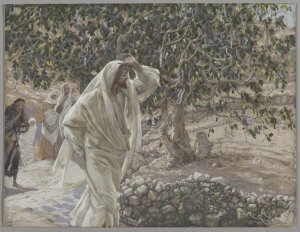
Brooklyn_Museum_-_The_Accursed_Fig_Tree_(Le_figuier_maudit)_-_James_TissotThis passage from Mark is a tricky one to understand. At first glance, it seems as though Jesus cursed the fig tree out of spite when it didn’t provide Him with food. Why not bless the tree with abundant fruit, just as He multiplied the loaves and fishes, instead of condemning it to wither and die? Mark even notes that figs were out of season at the time. Why would Jesus curse the tree, then, for not providing figs? It seems a rather extreme reaction.

But for the early Church, who were better acquainted with the fig trees of Israel, this story took on different meaning. When fig leaves would appear around the end of March, they were joined by small, edible buds, called taqsh, which fell off before the real fig was formed. Peasants would often eat the taqsh to assuage their hunger. But if no taqsh appeared, then there would be no figs on the tree that year at all.

So when Mark notes that “it was not the time for figs,” he is referring to this period when taqsh would typically grow. When Jesus looked to the fig tree to find sustenance, He saw a tree with leaves but no taqsh—meaning there would be no fruit to come, either. From a distance, it was flourishing with leaves, but up close, there was nothing of substance. Jesus recognized that, just like the fig tree, many people put on a good show of piety but had no signs or intentions of good fruits to follow. They were all outward appearance.

In the middle of this story we hear Mark’s account of Jesus rebuking the money changers in the temple. There is a parallel drawn between the fruitless fig tree and those who desecrated the house of the Lord: these men spent their days at the temple, but they had no interest in actually worshiping God. They, too, were all show with no signs of fruit.

KKSgb2948-67The fig tree is a symbol used throughout Scripture to signify peace and prosperity for Israel. It requires patience and attention in order to grow and thrive, but it delivers rich rewards, bringing both a shady resting place and delicious fruit. The money changers sought shade without fruit, capitalizing on the community surrounding the temple while paying no regard to its sacred purpose. But for Jesus, their leaves could not conceal the barrenness of their hearts.

Jesus curses the fig tree as a reminder to us all that we do not know when our time for judgment will come. We may or may not have developed fruit when that time arrives, but He expects to see in us a desire for true growth and fruitful service. We cannot assume that we can wait until next year to pay attention to what God is asking of us. He doesn’t expect perfection but presence. Jesus does not judge us based on our achievements or accomplishments but on our openness to channel His life-giving grace in all its fullness, however He wishes to manifest His fruit in us.


1. James Tissot, The Accursed Fig Tree / PD-US
2. Hans Simon Holtzbecker, Ficus carica / PD-US