Better Off

But I tell you the truth, it is better for you that I go.
For if I do not go, the Advocate will not come to you.
But if I go, I will send him to you.  (John 16:7)

We all have those particular passages of Scripture that test our faith and strain our credulity:  When Balaam’s ass thinks his master is being one, and so strikes up a conversation about it.  When Jonah is swallowed by the whale and then spit out again so that he can go to Nineveh after all.  When the Apostle Paul is preaching so long that Eutyches falls asleep, falls out the window and dies.  Yes, Paul raises him from the dead, but then he goes back upstairs and goes on preaching.

And then there’s today’s Gospel.  Why in the world does Jesus say: “It is better for you that I go”?

How can this be?  Jesus is claiming that we are better off with the Holy Spirit, than if Jesus Himself were sitting right here bodily among us.

Do I really believe this?  What do I do about it?

In the beginning of the Acts of the Apostles, as Jesus is about to ascend into heaven, He tells His apostles: “You will receive power when the Holy Spirit comes upon you.”

The word “power”—dynamis in Greek—is closely related to “dynamite.”  The gift that Jesus is promising is no wimpy substitute for Himself.

I thought about this in March when three successive snowstorms dumped almost thirty inches of snow on us in less than ten days.  The heavy wet snow in combination with storm winds caused trees to topple, severing multiple power lines and leaving many without power for days.

At first, it seems almost romantic, eating and reading by candle light as in times gone by.  But then one notices that the internet does not work without power.  Foods that don’t require cooking are used up, and there is nothing to prepare for dinner without the power of the stove.  Water from wells likewise cannot be pumped through faucets without power.  The furnace cannot heat the house without power and so things quickly become cold.  And then very, very cold.  The dark is no longer fun; we wait impatiently for the power and light to return.

So it is with the power of the Holy Spirit.  It was by His power that The Light entered the world when He overshadowed Mary and Jesus was conceived; it is by His power that we receive the light of faith and understanding.  It is by the power of the Holy Spirit that the bread becomes the Body of Christ at Mass, our ultimate Food.  It is the power of the Holy Spirit that awakens for us the thirst for God, for goodness, for truth—and He that ensures that we are drawn to the Living Water.  It is by the Holy Spirit that we are given the Word Made Flesh, and the words to communicate this love to one another.  It is by His Power that we are made clean in the Sacrament of Reconciliation.  It is in this power that we can live the abundant life and joy that Jesus desires for us.

Just as on a large scale the power of the Holy Spirit makes the Christian life possible and real, we need the power of the Holy Spirit on a practical and personal level even to pray.  Scripture tells us that not only does the Holy Spirit inspire us to pray, He prays with us and in our place:

Likewise the Spirit helps us in our weakness; for we do not know how to pray as we ought, but the Spirit himself intercedes for us with sighs too deep for words. (Rom 8:26)

Not only has the Holy Spirit inspired me with all of my deepest desires, He expresses them to God when I cannot.  And if He does this for me in prayer, how much more will He do if I open my entire life to His Power?  For God “gives the Spirit without measure.” (John 3:34)

As Pentecost approaches, let us ask for the grace to be ever more open to the work of the Holy Spirit in our lives and in our world.

Knowing the Holy Spirit

Jesus said to his disciples: “When the Advocate comes whom I will send you from the Father, the Spirit of truth who proceeds from the Father, he will testify to me. And you also testify, because you have been with me from the beginning.

– John 15

On Friday, Erin reflected on the mystery of friendship that Jesus offers us. Jesus mentions a very important fruit of this friendship in today’s Gospel: He sends us the Holy Spirit. At first (and not just at first, honestly) the Holy Spirit seems rather mysterious: Who is He? What is He? How does He do His thing today, in 2018, in my life? How can we come to know Him?

The Catechism of the Catholic Church paragraph 688 is a helpful guide:  

“The Church, a communion living in the faith of the apostles which she transmits, is the place where we know the Holy Spirit:

– in the Scriptures he inspired;
– in the Tradition, to which the Church Fathers are always timely witnesses;
– in the Church’s Magisterium, which he assists;
– in the sacramental liturgy, through its words and symbols, in which the Holy Spirit
puts us into communion with Christ;
– in prayer, wherein he intercedes for us;
– in the charisms and ministries by which the Church is built up;
– in the signs of apostolic and missionary life;
– in the witness of saints through whom he manifests his holiness and continues the work of salvation.”

So in other words, we find the Holy Spirit and come to know Him wherever we find the Church.  Read a biography of Bl. Pier Giorgio Frassati, and you’ll find he was working the entire list pretty hard – because he sought to live fully within the Church! What Erin said about mystery in general is very applicable here: “no matter how deeply we study this complex truth, there will always be more layers of understanding to peel back, always something new to learn.” The list above is not exhaustive by any means – there are many, many ways to know the Holy Spirit and to welcome Him into your life in a deeper way!

My challenge for you today: spend some time in prayer with the list above. Pray the simple prayer “Come, Holy Spirit!” throughout your day. Ask the Holy Spirit in what ways He wants you to come to know Him. And then be open! Have confidence that through your life, the Holy Spirit will testify the love of the Father to the world as shown through the life, death, resurrection, and ascension of Jesus.

Come Holy Spirit!

Pax et bonum,
Andy

Divine Friendship

Jesus said to his disciples:
“This is my commandment: love one another as I love you.
No one has greater love than this,
to lay down one’s life for one’s friends.
You are my friends if you do what I command you.
I no longer call you slaves,
because a slave does not know what his master is doing.
I have called you friends,
because I have told you everything I have heard from my Father.
It was not you who chose me, but I who chose you
and appointed you to go and bear fruit that will remain,
so that whatever you ask the Father in my name he may give you.
This I command you: love one another.”
—John 15:12–17

Two lines from today’s Gospel passage may seem contradictory at first glance:

You are my friends if you do what I command you.
I no longer call you slaves,
because a slave does not know what his master is doing.

Andrea_del_Sarto_-_The_Last_Supper_(detail)_-_WGA00391First of all, Jesus tells us we are friends, not slaves—if we do what He commands us. Wait. Do friends normally take orders from one another? Then He says we are not slaves because we know what our Master is doing. But…do we really? At the time He spoke these words, his apostles had no idea that He was about to suffer and die (though, to be fair, it’s not like He didn’t warn them). The disciples seemed pretty clueless most of the time about what Jesus was really up to. Can we truly say that we know what our Master is doing? I think more often we feel we are flying blind, having to trust Him without really understanding what His plan is. After all, so much of our Catholic worldview is grounded in the concepts of mystery and faith.
What do we mean when we speak of the mysteries of God? Encountering mystery does not mean that we’ll never know the answers and should simply give up trying to understand. Rather, it means that no matter how deeply we study this complex truth, there will always be more layers of understanding to peel back, always something new to learn. Our human understanding is limited, but with God we can go deeper and deeper, until we are united fully with God in Heaven and can participate in His perfect understanding.

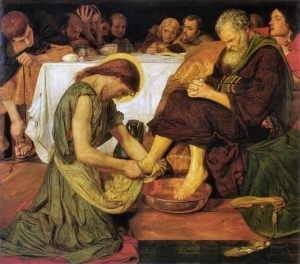
Jesus_washing_Peter's_feet

The more we plumb the depths of these mysteries, the more we grow in both understanding and wonder. But in order to get anywhere we must first have faith. We cannot grasp at this understanding for ourselves; we must draw closer to God so that He can help us see. We must trust Him. Our hearts must be open to soak in His wisdom, rather than trying to sharpen our own, which is a losing battle. Understanding the mysteries of God requires more than just intelligence; it requires divine relationship. It requires friendship with Jesus.

And Jesus offers us that friendship as a great, unmerited gift. We can begin to understand what He is doing—though it be far beyond our depth—through our love for Him. He says, “You are my friends if you trust me. And if you trust me, you will follow my commandments.” Our obedience springs from love and gratitude rather than fear and servitude. We can rest in the knowledge that we are loved and chosen, and we can return that love by recognizing Jesus in others and loving one another.

We are not mere servants; we are friends. And we are made to delight in a Love that is greater than we can comprehend. When we remain in Him, we can begin to bear the fruits of understanding, cultivated through love alone.


1. Andrea del Sarto, The Last Supper / PD-US
2. Ford Madox Brown, Jesus Washing Peter’s Feet / PD-US

Due Process

*Note: A disclaimer about today’s writings – I spend some time reflecting on the ways and ceremonies by which some denominations practice their faith. I am very poorly-versed in this arena. I don’t know which jargon is fair game and which is horribly offensive. My musings are my own, as are any possible (probable) heresies. I will answer for them, I’m sure. I just hope what I’m saying even makes sense at this time of day and I’m sending this out in faith that the Holy Spirit found His way in there somewhere. -ab

Some who had come down from Judea were instructing the brothers,
“Unless you are circumcised according to the Mosaic practice,
you cannot be saved.”
Because there arose no little dissension and debate
by Paul and Barnabas with them,
it was decided that Paul, Barnabas, and some of the others
should go up to Jerusalem to the Apostles and presbyters
about this question.
They were sent on their journey by the Church,
and passed through Phoenicia and Samaria
telling of the conversion of the Gentiles,
and brought great joy to all the brethren.
When they arrived in Jerusalem,
they were welcomed by the Church,
as well as by the Apostles and the presbyters,
and they reported what God had done with them.
But some from the party of the Pharisees who had become believers
stood up and said, “It is necessary to circumcise them
and direct them to observe the Mosaic law.”
The Apostles and the presbyters met together to see about this matter.
—Acts 15:1-6

The book of Acts is a gold mine.

The Bible is full of unspeakable depths of beauty and wisdom, and God is His goodness not only teaches us about himself through Scripture, but He also gives us invaluable examples of what it means to be living as a Church in the A.D. world.

Today’s reading makes me proud to be a Catholic. I know our Mother Church doesn’t have the only claim to a “due process” of sorts in theological matters, but in no other church is today’s first reading so faithfully and literally lived out.

I recently had the opportunity to attend one of the largest churches in my hometown of Brainerd. It is a non-denominational church with multiple services on multiple campuses every weekend. The music was wonderful, the sermon was scriptural and sound, and then they began communion. I was confused. Why does a church like this celebrate communion? Every part of the service was so carefully crafted to be accessible, attractive, and modern, and this ritual performance seemed jarringly out of place. Now, I’m Catholic (surprise!), so I have no question about why somebody would want to celebrate the Eucharist! The closeness with Christ and your fellow partakers is unmistakable. But why would a church that was working so hard to establish an identity based on “spiritual, not religious” (one of the songs even had a lyric about God breaking down their ‘religion’) maintain this practice that is historically rooted in Catholicism? A cynical explanation: they want something that feels familiar to all of the ex-Lutherans, ex-Presbyterians, and ex-Catholic in attendance. A more hopeful explanation: even with all of its lack, this celebration with bread and grape juice speaks to the congregation in a deep, yearning that invites them to be truly one with Christ one day in the sacrament of the Eucharist.

Now the whole point of this anecdote is not necessarily to examine the theology behind their monthly practice of celebrating communion (which really is fascinating!), but to examine the process by which they crafted their weekly services. When you’re planting your own church and eschewing “stale tradition”, you’re writing your own ‘liturgy’. Who makes the calls? A group of elders behind closed doors? A public vote once a year? The one pastor who founded it all? Who decided to keep this part of tradition when “tradition” and “ritual” are so anathema to your target audience?

No matter how much you might try to avoid having any stances on any issues (a huge part of the “spiritual, not religious” moment), any church that claims a shared identity will eventually have to take some. There will be disagreement, and there needs to be a way to arrive at a consensus. That’s how science, effective democracy, and a healthy church work. Now how do we get there?

See the above reading.

One last, unrelated note that struck me:

“They were sent by the Church…” and “they were welcomed by the Church…”

Paul and Barnabas are fundamental examples of heroic pastoral ministry. Today’s readings, along with many others in Acts and the epistles, show that these saints were servants in every sense of the word. They were cloven to Christ, the true vine, and servants and pruners of His Church, the branches. They were practical, logical, and yet wildly, radically faithful. They were attentive to their flock, saw their needs, and moved quickly to respond to them. They sought the one Truth, hence their need to come to a consensus.

Let us pray to receive Jesus’s Truth in our hearts and trust in the process He and his disciples established.

They Thought They Knew Him

Coming to his hometown, He began teaching the people in their synagogue, and they were amazed.  “Where did this man get this wisdom and these miraculous powers?” they asked.  Isn’t this the carpenter’s son?…Where then did this man get all these things? And they took offense at him.  But Jesus said to them, “A prophet is not without honor except in his own town and in his own home.” And he did not do many miracles there because of their lack of faith.

Matt 13:54-58—Gospel from Feast of St. Joseph the Worker, May 1st

*            *            *

It’s easy to feel smug about the crowds in today’s Gospel, who don’t recognize God in their midst in the form of the local carpenter’s son.  They are outraged because he’s a local boy; they’ve watch him grown up, they know his parents, they know all about him and what to expect from such a one.  When He claims to be More than what they know, they are scandalized and offended.

We of course know better.  We know to expect more of Him than from an ordinary man.  We know not to be shocked when He claims the power to change things, to work miracles, to be something other than what one might expect.  We know He’s God and He’s bigger than anything our tiny human minds are able to conceive.

Or do we?

Years ago when I was going through a spiritual crisis a priest suggested I spend some time each day reading the New Testament.  I nodded politely but inwardly sighed.  I “already knew” all of those stories.  I had a Master’s Degree in theology, I had read them repeatedly and had taught many of those passages so often that I could recite them almost verbatim.  How could God possibly speak through the same old stories I knew so well?

I look back sometimes, stunned at my ignorance and my arrogance, humbled by the fact that years later when I did put that advice into practice, God did show up in new ways and did work some “mighty works” that astonish me even to this day.  Simple words that I had heard thousands of times became at divinely appointed moments portals into paradise.   When I finally opened my heart, God showed up in so many unexpected ways and places that I could only stand in awe.  Even now, He continues to surprise me on a regular basis.

I would like to claim that I learned my lesson and no longer limit God to my low expectations.  But even now I am tempted to put God in a box, expecting Him to answer only in the ways I am familiar with and accustomed to.  And sometimes not even that.

Awhile ago my spiritual director suggested that I answer the question that Jesus asks of the blind man (Luke 18:35-43) and in turn to each of us, “What is it that you wish me to do for you?”  On one particular morning, I decided to get very specific and spent a long time journaling about various (pretty big) problems in my life and how I hoped He would fix them.  I felt better at the end, and thanked God for letting me get it all off my chest.

It was months later, on New Year’s Eve, when I was reviewing my journal that I came upon that list and realized how God had concretely and specifically answered the biggest of my requests!  I had been surprised and thrilled and suitably grateful when the gifts had come, but had frankly forgotten that I had been inspired to specifically request them in prayer.  How could I have so easily forgotten?  If I am honest, I never really expected God to answer me.

That same day, I also enjoyed one of my favorite little traditions, Jennifer Fulwiler’s “Saints Name Generator” and her new “Word of the Year Generator.”  Each randomly generates a word or saint for you for the year.  I did the Word one first and was given the word “see.”  I admit, I was hoping for something a little more personally meaningful—that word did not resonate at all with my past experiences or my hopes for the future.  Then I did the Saint generator and was given Saint Cosmos—invoked as patron of the blind and against blindness!  Could it be that God has something new to teach me?

There is no divine title “Lord of the Everlasting Same-Old Same-Old.”  Rather He promises “Behold I make all things new.”

Let us resolve not to limit God by our experiences or expectations!

*            *            *

*I chose today the (optional) readings for the Feast of St. Joseph the Worker.  On the feast day we pray especially for those who are unemployed or underemployed, that they might find meaningful work, and that all workers throughout the world receive a just wage, just working conditions, and be treated with dignity and respect.  St. Joseph the Worker, pray for us!

**For those beginning the 30 Day (15 minutes a day) Prayer Challenge, the linked reading to the story of the Blind Man can be a good place to start.  Using your bible, read the passage a few times, asking the Holy Spirit to help you, and imagine yourself in the scene, perhaps as the Blind Man (but let the Holy Spirit guide you).  Imagine Jesus asking you that same question, “What do you want me to do for you?” and answer Him, speaking as you would to a friend.  Let the conversation go wherever it goes (without fear or judgement), asking for help as you need to (Lord, help me to know what it even is that I want…or, Lord, help me to know the deepest desires of my heart…or Lord, help to trust that are even there, that you care enough to hear me speak these desires to you…)  When your 15 minutes are up, thank Jesus for your prayer time but do not pass a judgement on “how it went”—trust that all prayer is fruitful, whether or not we experience or feel anything. 

If you have questions you are welcome to email me, but please be aware it may take me some time to answer and/or I may try to work answers into future writing as I pray about them (generally, if one person has a question, many others are wondering the same thing).